
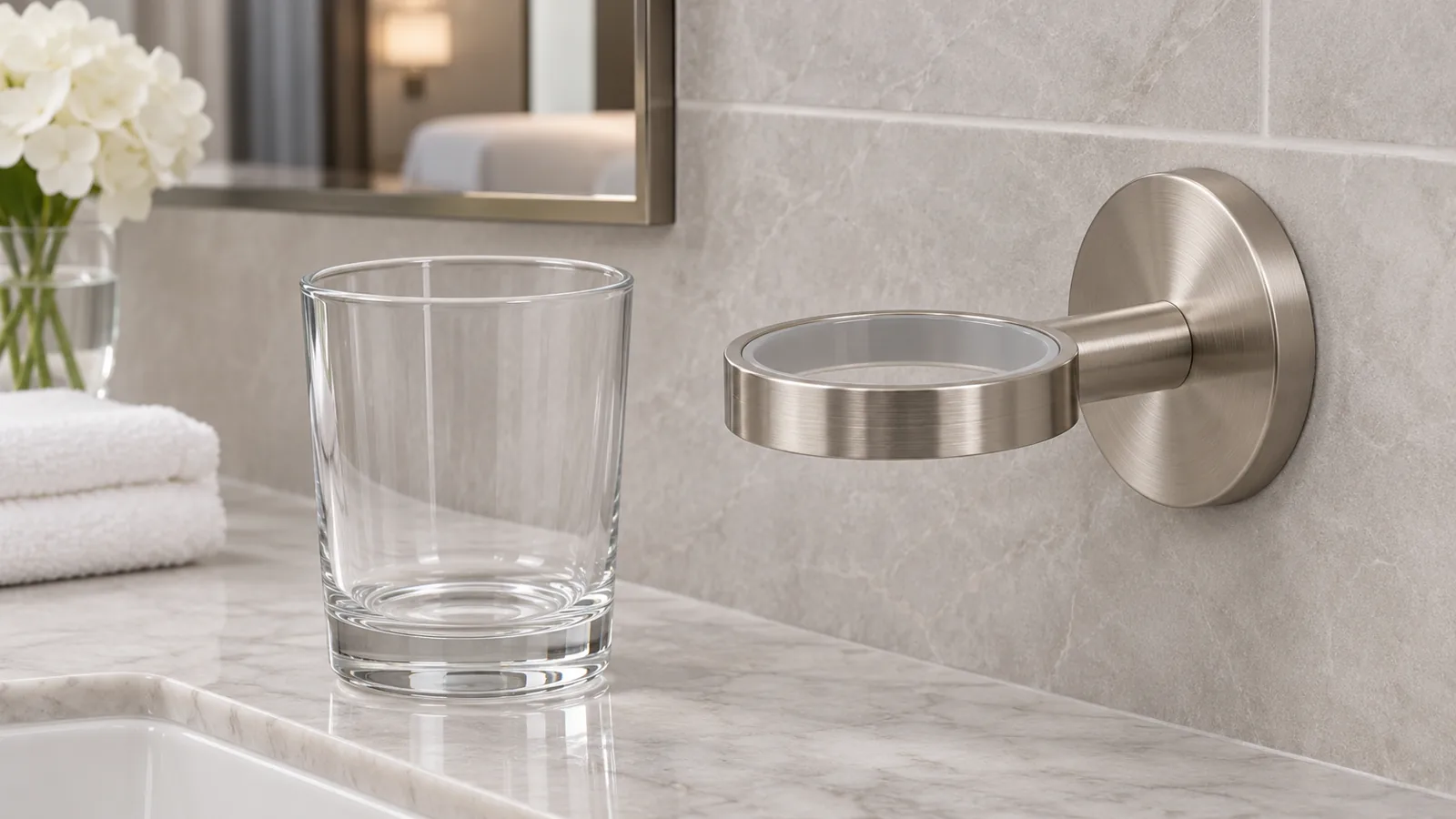
Buyer Decision and Project Scope The buyer should document bathroom tumbler holder replacement glass as a named requirement. The buyer should record the exact "bathroom tumbler holder replacement glass" requirement in the sourcing file.
Buyer Decision and Project Scope
Direct answer: match the replacement glass to the exact holder series
A replacement glass for a wall-mounted bathroom tumbler holder should be approved against the installed holder’s maker, series, model, and revision. Buyers should obtain the original glass part code or controlled reference, then compare the proposed glass on the actual metal holder. Approximate outside diameter, color, or visual similarity alone does not establish that it seats, clears the retainer, or can be removed as intended.
Manufacturers sell replacement tumblers tied to specific accessory series. tesa identifies a replacement glass for its V-shape bathroom accessory line. HEWI documents a stainless ring holder paired with a glass tumbler, and GESSI technical documentation lists the tumbler and wall-fixing set as distinct components. These examples support a part-number and interface review; they do not prove that products from different brands interchange or that Koitor supplies glass. See tesa’s replacement glass, HEWI’s wall tumbler holder, e GESSI’s component drawing.
Why a replacement glass is a separate sourcing decision
A wall-mounted tumbler assembly typically combines a metal holder, wall-side fixing, a glass vessel, and sometimes a retaining ring, pad, insert, or other interface component. The buyer should verify how the specific design supports the glass and what part is expected to be replaced. A replacement glass may let a buyer retain an installed holder, but the actual series compatibility and replacement scope must be documented by the product owner.
For importers and distributors, the challenge is often part identity. A customer may ask for “the glass cup for the bathroom holder” without knowing the maker, model, original part number, or whether the holder changed over time. The distributor should identify the installed hardware before quoting a spare. A near-match could be too wide, narrow, tall, or otherwise incompatible with the actual seating geometry.
The initial product-design question differs from the replacement decision. When designing a new holder, an engineer may choose rim support, inverted support, or another architecture. For a replacement program, the buyer must preserve the interface of an already-installed holder and keep the corresponding series and part records aligned.
Identify the installed holder before ordering
Start with the product label, original purchase record, maintenance inventory, or manufacturer documentation. Record the maker, collection or series name, model code, finish, and revision where available. A hotel may have several generations of bathroom hardware that look similar, so do not assume that the property used one series throughout.
Photograph the holder from front, side, and top. Include the wall plate and contact area, but do not remove installed hardware unless an authorized person owns that work. A photograph can help identify the shape and condition; it does not provide controlled dimensions or confirm hidden details.
If the original glass is available, retain its part number and identify whether it is the actual original component or a previous substitute. Note any markings, packaging codes, and supplier information. If the glass has broken and no reference remains, ask the holder maker or original distributor to identify the correct replacement based on the installed series and available product records.
For a multi-property program, create a configuration list by property or room type. Record distinct series and revisions separately. Do not merge items simply because they have a similar ring shape or finish. The record should distinguish confirmed codes from unknowns.
Understand the actual seating interface
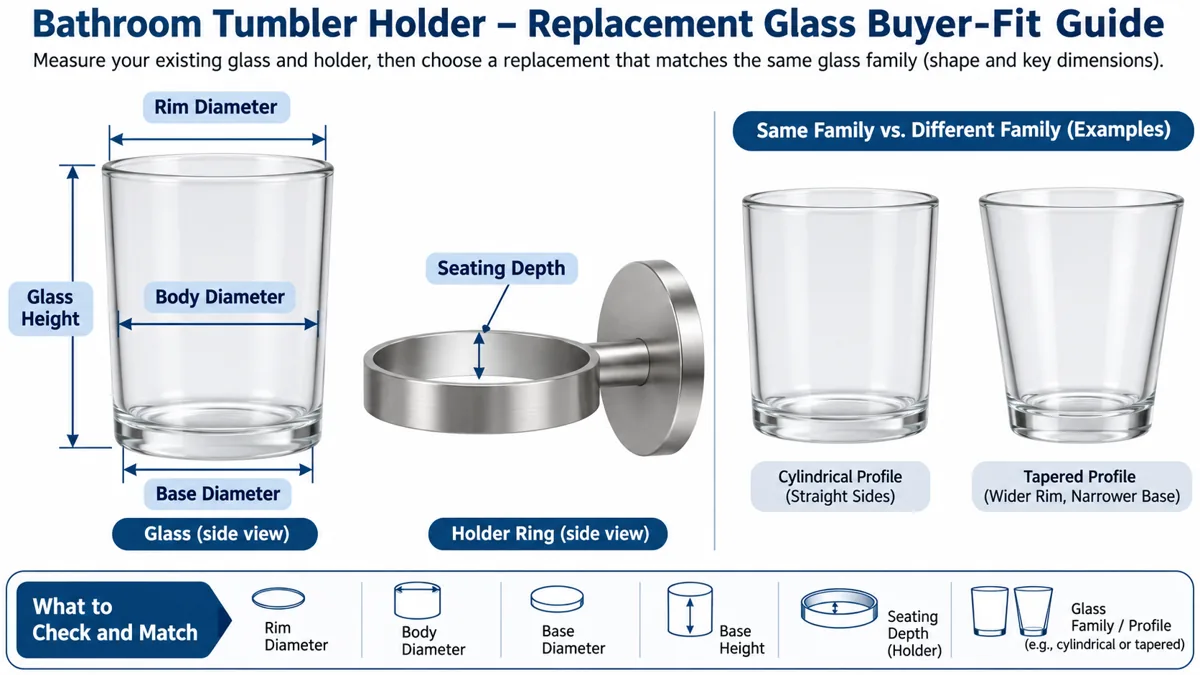
The replacement decision depends on how the glass contacts the holder. Depending on the design, support may occur at a rim, a ring, a ledge, a pad, a collar, or another shaped interface. Identify the points that locate and support the specific tumbler. Do not assume a generic cup diameter describes the entire interface.
Record the proposed glass’s external dimensions from a supplier-controlled drawing or sample. Relevant details may include rim shape, rim diameter, body taper, height, base profile, and local features that engage the holder. Which dimensions matter depends on the actual product. Buyers should not invent a tolerance or grind, bend, or force a component to make it fit.
Check whether the glass is intended to sit upright, inverted, or in another orientation. A tumbler that appears to rest in the ring may not be supported in the approved way. Observe how it is inserted and removed and whether the retainer, pad, or holder affects that motion. This is a fit observation only; it does not establish breakage resistance or a safety rating.
If the design includes a separate pad or insert, identify the part number and supplier. It may be part of the original holder assembly rather than part of the glass. A replacement glass quotation that omits this component may not represent the configuration the buyer expects.
Use a holder-to-glass compatibility matrix
For each proposed replacement, create a record that links the installed product to the new spare. A useful matrix can include:
| Campo | Buyer record |
|---|---|
| Installed holder | Maker, series, model, revision, finish |
| Original glass | Part code, supplier, reference sample, condition |
| Proposed glass | Maker, model/part code, drawing or sample source |
| Interface | Rim, body, base, retainer, pad or other support features |
| Orientation | Upright, inverted, or other approved position |
| Replacement kit | Included parts, insert/pad, packaging and labels |
| Review evidence | Sample ID, dimensions source, reviewer, date |
| Fit status | Unreviewed, sample observed, approved named combination |
| Scope limit | Exact holder codes covered and excluded variants |
| Change owner | Person/team notified of supplier or geometry revisions |
Use the exact holder codes in the status. “Fits V-shape series, model X, revision Y” is more useful than “fits glass holders.” If the supplier lists several compatible models, retain the dated document and confirm that it covers the buyer’s installed revision.
This matrix is a procurement control, not a universal engineering test form. The buyer can add fields required by its quality system. Unknown details should remain marked as unknown. Do not silently assume a product-family name covers every finish, region, or revision.
Review a physical sample safely and narrowly
When feasible, obtain the proposed replacement glass and compare it with the actual installed holder or a controlled reference assembly. The review should be performed by an authorized person using the project’s handling procedure. Glass can break; this article does not prescribe glass-handling or installation instructions.
Record whether the glass rests in the intended position, whether the contact surfaces align, whether any retainer or pad is present, and whether insertion and removal follow the product’s intended method. Note visible gaps, interference, rocking, or uncertain contact without converting them into a performance judgment. The buyer must define acceptance criteria with the relevant product owner.
Photograph the assembled configuration, identify the glass and holder codes, and record the sample date, drawing revision, and reviewer. If the holder is installed at a site, document only what the authorized project team permits. Do not disturb wall fixings or make modifications to the glass or holder during a compatibility check.
A sample fit does not establish glass strength, impact resistance, thermal performance, safety compliance, or breakage rate. Those claims need product-specific evidence from the responsible glass maker or product owner. The sample review should state that it addressed the observed part interface only.
Plan spare-part labeling and replacement kits
A distributor should label the replacement glass with its part code and the exact holder series or models it is documented to fit. If the package includes a pad, insert, or other accessory, list it. If the buyer receives glass only, avoid wording that suggests the full holder assembly or wall fixing is included.
Keep similar replacement parts in separate inventory bins or records if their series differ. A tumbler that fits one ring holder may not fit another. The buyer’s ERP or spare-parts file should associate the glass SKU with its approved holder codes, supplier, and document revision.
For a hotel or commercial project, identify the property and room type only as needed by internal inventory procedures. Avoid putting confidential customer or site details on public product labels. The goal is clear configuration control without disclosing sensitive information.
When the original glass is discontinued, ask the holder maker whether an approved substitute exists. If the supplier proposes a newly sourced tumbler, treat it as a new interface review. Do not describe it as “equivalent” until the evidence and scope are clear.
Control product and supplier changes
Changes can originate with the holder maker, glass supplier, distributor, or buyer. A new glass source may alter rim shape, body taper, dimensions, or packaging. A holder revision may change the contact area or retainer. A finish revision may affect visible clearance in some designs. These are potential review triggers; their actual effect depends on the product.
The buyer should define who must provide change notice and who can approve a replacement configuration. Request supplier identification of part and drawing revisions, and ask whether a compatibility list was updated. If the supplier cannot confirm that the physical interface remained the same, the buyer should decide whether a fresh sample review is needed.
Do not transfer approval across brands, series, or years without documented basis. The same collection name can include multiple products, and product listings can be updated. Save the exact document or webpage date used for procurement and identify any uncertainty.
A practical change log can record old code, new code, supplier explanation, affected holder models, supporting evidence, decision owner, and approval date. If the change is only packaging or labeling, the buyer may close the review differently than for changed glass geometry; record the rationale rather than applying an unexplained blanket rule.
| Buyer input | Record before approval |
|---|---|
| Named product or component | Exact model, code, and revision |
| Interface or project condition | Reference sample, drawing, or site input |
| Evidence and owner | Source, reviewer, and unresolved questions |
| Release status | Approved scope and excluded claims |
Product Fit and Specification
Define the RFQ and purchase order scope
An RFQ should identify the installed holder family, model/revision, original glass code if known, proposed replacement glass, quantity, packaging, and required evidence. State whether the buyer can provide the installed holder, an old glass, a drawing, or only photographs. Ask the supplier to identify assumptions and confirm the specific compatible models.
If the quote includes a pad, retainer, or other piece, list it separately. Clarify whether the glass supplier or holder supplier owns the interface information. A supplier’s product listing may be useful evidence but should not be treated as a buyer approval unless it covers the exact installed series.
The purchase order should reference the approved part code, compatibility matrix, packaging, and any change-notification requirement. If there are multiple variants, use separate line items or a controlled model list. A broad description such as “replacement bathroom cup” may be insufficient for distribution and reorder control.
Compare quotes on a like-for-like basis. A glass-only part, a replacement set with an insert, and a complete holder assembly are different commercial scopes. Do not infer cost savings from replacing only the glass without considering actual supplier pricing, availability, packaging, and service requirements.
Buyer checks for bathroom tumbler holder replacement glass
Packaging and inbound handling questions
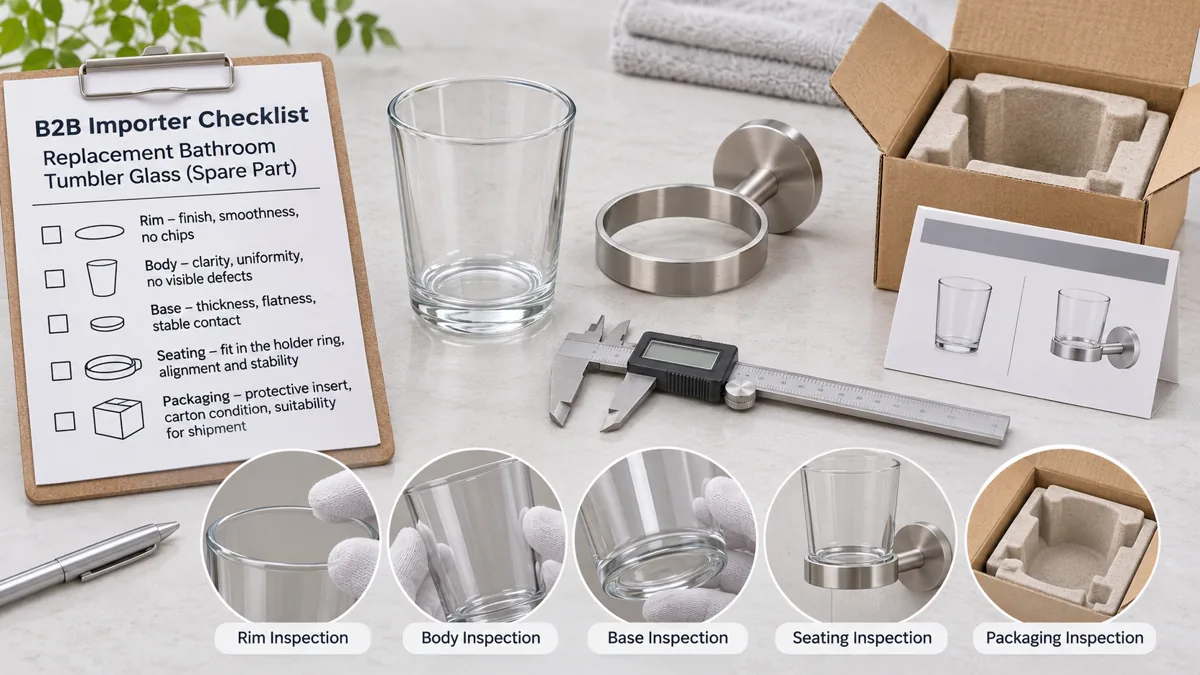
Glass packaging should be specified with the buyer and supplier based on the product and distribution route. State whether each tumbler is individually protected, how the replacement part is identified, and what outer-pack information is needed. This article does not prescribe a drop test or claim any packaging method guarantees against breakage.
If the buyer reports a damaged glass shipment, preserve the package and lot or carton references and follow the agreed supplier claim procedure. Record the observed damage and quantity. Do not infer the cause or assign responsibility from a photograph alone; the buyer and supplier should review the evidence under their commercial terms.
For spare parts, packaging should keep the glass identity linked to the holder model. If a carton contains more than one glass variant, separate and label them in a way that prevents accidental substitution. A clear part label does not establish compatibility by itself; it supports traceable handling of an already-approved combination.
Common mistakes for importers
- Ordering based only on approximate rim or cup diameter.
- Treating a similar appearance as evidence of series compatibility.
- Confusing a replacement tumbler with a complete holder assembly.
- Forgetting a separate pad, retainer, collar, or insert included in the original system.
- Applying one series’ approval to another model or revision.
- Assuming the supplier’s current product page covers an older installed version.
- Modifying or forcing glass to fit a metal holder.
- Treating a fit check as evidence of glass safety or impact performance.
- Omitting holder codes from spare-part labels and inventory records.
- Leaving replacement packaging and damage claims undefined.
Questions to ask before releasing a spare
- What is the installed holder maker, series, model, and revision?
- What was the original glass part code and source?
- Does the proposed glass match the actual support and contact geometry?
- Are any pads, retainers, inserts, or adapters part of the approved set?
- Which physical sample or controlled document supports compatibility?
- What exact holder models are covered by the supplier’s compatibility list?
- How should packaging identify the glass and protect it during distribution?
- What changes trigger a new review?
- Who owns the approval and replacement SKU record?
- Which claims require separate glass or product evidence?
Perguntas frequentes
Can I use any glass tumbler with a wall-mounted ring?
No. The ring and tumbler form a product-specific interface. Confirm the installed holder series and assess the proposed replacement.
Is outside diameter enough to identify a replacement?
Usually it is only one input. Rim profile, body taper, height, base, orientation, and any insert or retainer may also matter for the specific design.
Can a replacement glass be approved from a photograph?
A photo can help identify a candidate, but it may not provide controlled dimensions or show the contact interface. Use maker documentation or an authorized sample review for the required evidence.
Sample Review and Change Control
Does a sample fit prove the glass will not break?
No. Fit evidence does not establish strength or impact performance. Those claims require product-specific evidence.
Should the replacement include a new pad or retainer?
Follow the original design and supplier’s parts information. Identify each component in the RFQ and decide whether it is included in the approved replacement set.
Can a distributor sell one tumbler for several brands?
Only if the compatibility scope is documented for the named models. Do not assume cross-brand interchangeability from appearance.
Distributor triage for an incomplete spare-part request
A hotel maintenance ticket may identify only a broken glass and a room number. A distributor should not guess the series based on a ring shape. Begin with the available records: prior invoices, packing labels, installation schedules, photographs, and property asset lists. Ask for the building or refurbishment phase if that helps locate the original order, but treat an inferred match as a lead rather than a confirmation.
If a customer cannot provide the holder code, request front and side photographs and a clear image of any maker mark or wall plate. Ask whether a second intact holder or tumbler from the same room type can be examined by an authorized person. Capture dimensions only with a stated method and suitable reference. Do not remove a wall-fixed assembly without site authorization.
When several candidate series remain, list them separately and show which evidence supports each candidate. The distributor can ask the manufacturer to identify the series from documented features. Until the match is confirmed, label the quote as provisional and specify what the customer must verify before order release. This prevents a tentative identification from becoming a blanket fit statement.
A useful customer response distinguishes four states: exact code confirmed; likely match awaiting supplier confirmation; sample comparison required; or insufficient information. That status is more actionable than “should fit.” Keep the quotation tied to the selected state and update it when additional evidence arrives.
Distinguish original replacement from a new substitute
An original replacement glass is listed by the holder maker for a named series or part code. A substitute glass may come from another source and require a new compatibility assessment. Buyers should preserve this distinction in product records and sales language. A substitute should not inherit the original manufacturer’s compatibility statement unless that statement actually covers it.
Ask the proposed substitute supplier for a controlled drawing, part identifier, and revision. Compare the interface against the installed holder’s documented geometry and available sample. A dimensionally similar outline is a starting point; it does not establish identical contact or removal behavior. If the holder maker lists an original replacement, record whether it remains available and whether the buyer is evaluating the substitute as a contingency.
Do not modify the glass or holder to force compatibility. If the proposed component does not seat as intended, stop the fit review and request clarification or another part. Grinding, bending, or improvised packing changes the product and can create risks outside a sourcing compatibility assessment.
For a substitute released to distribution, assign a unique SKU or clear compatibility label. Preserve the basis for approval, including holder models, drawing revision, sample identification, reviewer, and limits. A new supplier or changed process should trigger review under the buyer’s supplier-control procedure.
Set up returns and breakage reports with useful evidence
When a glass arrives damaged or a customer reports a break, record the part code, order, quantity, carton reference, package condition, and the observation in the customer’s words. Keep photographs of the received package and item where available. Do not infer whether damage occurred during packing, transport, storage, installation, or use from a single image.
The buyer and supplier should follow their commercial claim and investigation process. The replacement compatibility article does not establish packaging performance or a cause of failure. If a repeated pattern is suspected, compare records across orders and lots, and distinguish verified observations from an emerging hypothesis. Do not claim a breakage rate without adequate data.
A replacement shipment should carry the same traceable part identification as the original order. If the supplier changes the glass source while resolving a claim, the buyer should decide whether the change affects the approved interface and whether a new sample is required. The replacement process should not silently switch to a visually similar but undocumented glass.
Order and inventory controls for multiple properties
A distribution network may serve hotels that use different accessory series. Keep the stock location, product code, approved holder list, and supplier source connected in the inventory record. If a warehouse uses a generic description, add the model compatibility note so staff do not pick the nearest looking tumbler.
For customer-managed inventories, define whether replacement glass is sold as a single piece, a pair, or a set with a holder insert. The commercial unit should match the actual package and reorder code. If a supplier changes inner-pack quantity, update the purchasing record and customer-facing description without changing the compatibility scope by implication.
Use separate stock identifiers where holder series or revisions are not confirmed interchangeable. Consolidation is a buyer decision supported by evidence, not a convenience assumption. If the buyer later validates a common fit, document the model list and approval date before merging inventory records.
Extra buyer questions for replacement programs
How should a buyer identify an older holder series?
Start with original purchase records, manufacturer marks, archived product documentation, and an authorized sample comparison. Record uncertainty and ask the original maker or distributor to confirm the candidate series.
Purchasing Questions and Practical Decisions
Can the replacement be ordered by glass height alone?
No. Height is only one possible dimension. The actual seating interface, rim, body, base, holder support, orientation, and any insert can matter for the specific design.
Should a spare glass be sold together with the metal holder?
That depends on the buyer’s replacement scope. Quote glass-only and full-assembly options as separate configurations with distinct part codes and included components.
What if the original tumbler is no longer sold?
Ask the holder maker for a documented alternative. If the buyer considers a substitute, assess it against the installed holder and keep the approval limited to the exact tested or reviewed combination.
Can a distributor use the same photo for several compatible models?
Only if the compatibility list covers each model and the image accurately represents the offered part. A generic image cannot establish interchangeability.
Should the buyer set a universal dimensional tolerance?
No universal tolerance should be invented. The buyer and supplier should define critical dimensions, methods, and acceptance criteria for the actual holder-glass interface.
Does replacement availability mean the holder is repairable indefinitely?
No. A current spare listing does not guarantee future supply or lifetime support. Buyers should confirm availability terms and maintain their own approved alternatives.
Close the replacement decision
A replacement glass program succeeds when buyers can trace a spare to an installed holder without relying on visual guesswork. Confirm the series, original part code, and support arrangement; assess a named substitute on the real interface; and connect packaging, inventory, and change records to that exact configuration. Keep glass safety, packaging performance, and installation decisions with their respective owners.
Buyer takeaway
A replacement tumbler is a controlled spare-part decision. Identify the installed holder series, trace the original glass code, inspect the actual support interface, and approve the proposed replacement on a named assembly. Record exact model scope, included accessories, packaging, and change triggers. Keep fit evidence separate from glass safety, strength, and installation claims.
For a metal bathroom hardware discussion, share the holder drawing or model code, original glass reference, proposed replacement, and packaging requirements. Koitor can discuss confirmed metal hardware scope; it does not claim glass manufacturing, universal glass compatibility, or product safety performance. See the custom bathroom hardware manufacturer page or contacte a Koitor. For an initial holder-design question rather than a replacement part, see the distinct guide to inverted tumbler holder rim support and clearance.
Review a Tumbler Replacement Interface
Share the installed holder model, original tumbler reference, proposed replacement, and packaging scope. Koitor can discuss confirmed metal hardware capabilities; glass supply and performance remain with the responsible supplier.
OEM / MARCA PRÓPRIA
Transforme este guia de fornecimento num resumo do produto
Indique o produto pretendido, as dimensões, o acabamento, a quantidade a encomendar e os requisitos de embalagem. A sua equipa receberá uma análise prática da viabilidade de fabrico antes da apresentação do orçamento.

 English
 Español
 Português
 Français
 Deutsch
 العربية