

Citric acid passivation stainless steel proposals need more definition than the name of a chemistry. A buyer should identify the stainless grade and incoming surface condition, the governing treatment specification, the processor’s agreed scope, post-treatment rinsing and handling, verification method, and records tied to the production lot. The word “citric” alone does not establish that a part is clean, that a particular acceptance test has passed, or that the finished product will resist corrosion in every service environment.
This guide is for OEM buyers who coordinate a qualified finishing processor. It helps define the questions for a quote, drawing, purchase specification, and lot record. It does not provide a bath recipe or replace the responsible processor’s procedure. The ASTM public scope for A967/A967M-25 identifies nitric, citric, and electrochemical treatments and discusses alternative verification approaches. The full paid standard was not reviewed here, so use the current controlled standard and processor procedure for project requirements. ASTM’s public page is A967/A967M-25.
What Does Citric Acid Passivation Mean for a Buyer?
Passivation is a treatment applied to stainless steel to support the condition of its passive surface after fabrication and cleaning. A buyer should treat it as one controlled operation within a product’s manufacturing and finishing route. The treatment name does not identify the alloy, the prior fabrication condition, the cleaning steps, the process limits, the rinse quality, the inspection plan, or the product’s later exposure. These inputs and outputs belong in the processor’s controlled scope and the buyer’s product specification.
Citric-acid-based treatments are one route used for stainless passivation. The process may be performed by a specialist finishing supplier, and the exact method belongs to that processor’s qualified procedure. The supplier’s choice of chemistry must be evaluated against the specified material, incoming condition, part geometry, and governing requirement. Do not turn a general description of citric chemistry into a universal ranking over nitric chemistry. The buyer’s task is to define the required outcome and verification with the responsible technical parties.
Passivation should also be distinguished from operations with different purposes. Descaling removes oxide scale; cleaning removes contaminants; electropolishing is an electrochemical surface-removal process. A project may require one or more of these operations in sequence, but one process label does not prove that another was performed. A buyer considering treatment selection should review the separate passivation-versus-electropolishing comparison in the project knowledge base, keeping that process-selection question distinct from the citric-route handoff covered here. The purchase order should still state which operations apply to the product at hand.
For a bathroom or storage component, the relevant question is not whether the word “passivated” appears on a quotation. It is whether the component’s specified material and surface condition have been treated to an agreed procedure and whether required evidence is available for the relevant lot. That framing reduces ambiguity without inventing a performance guarantee.
What Must Be Known Before Treatment?
Start with the material identity. Record the stainless grade or the material designation approved by the product engineering owner, and map it to each component. An assembly can contain stainless parts and other materials, so a general product-level description may be insufficient. If the grade is unknown, resolve the material record before the finishing processor selects a method or the buyer writes an acceptance claim.
The incoming condition matters as well. Fabrication can leave oil, shop soil, free iron contamination, heat tint, oxide scale, weld residues, embedded particles, or other conditions that require different controls. This list is a set of possibilities to discuss, not a claim that each condition exists on every part. The fabricator should identify the operations already completed, including welding, grinding, polishing, and prior cleaning. The processor should review whether the incoming state fits its procedure and identify any extra preparation or hold point required.
Geometry and handling should be described. Blind holes, narrow gaps, overlapping joints, hollow sections, threaded features, and areas where liquid can remain may affect cleaning, drainage, rinsing, drying, or inspection. The buyer should supply drawings and note critical surfaces, cosmetic faces, assembly interfaces, and any areas that cannot retain process liquid. The processor can then confirm whether the part design is compatible with its equipment and handling method. Do not assume an attractive external surface means the interior or joint has the same condition.
The handoff should answer four questions before a production lot moves forward: what is the component and material; what condition is it in when received; what prior cleaning or oxide-removal step is included; and who owns approval when the condition falls outside the agreed scope? Document exceptions and rework decisions. A processor should not be expected to infer undocumented design or product-use requirements from a finish name.
How Should the Buyer Define the Specification and Processor Scope?
Identify the governing specification and revision on the drawing, purchase order, or approved process document. Confirm the material and part category fall within its stated scope, then have the responsible processor identify the procedure it will use. Avoid writing “passivate per industry standard” without naming the applicable document, revision, acceptance requirements, and responsibility for records. Where the customer specification and processor procedure differ, resolve the conflict before production.
The buyer should distinguish a required process from the evidence needed to accept it. Some specifications allow more than one treatment route or verification option; the exact choice depends on the applicable requirements and agreement. Do not select a verification method based solely on convenience or a product marketing page. Agree which tests or records apply, who performs them, how results are reported, and what happens when a result is inconclusive or outside limits. A water-break observation, for example, may help assess cleanliness in a defined context, but it should not be described as standalone proof of passivation.
| Scope field | O comprador deve definir | Processor should confirm | Record to retain |
|---|---|---|---|
| Part identity | Part number, revision, quantity, and critical surfaces | Receiving and traceability method | Lot and traveler reference |
| Material | Grade or approved material declaration by component | Suitability of the proposed process for stated material | Material-to-lot mapping |
| Incoming state | Fabrication, weld, polish, cleaning, and oxide-removal history | Accepted condition and any exclusions | Receiving condition or exception record |
| Treatment | Governing specification and revision | Controlled procedure and process responsibility | Procedure identifier and revision |
| Post-treatment | Required rinse, drying, protection, and handling | Included steps and handling limits | Batch or lot completion record |
| Verification | Agreed tests, sampling, and acceptance rules | Method, frequency, and reporting format | Results linked to lot and part |
| Controlo de alterações | Who approves material or process changes | Notification and hold-point practice | Approved change record |
A process label is not a substitute for these fields. If a quotation excludes cleaning, descaling, testing, or reporting, the buyer should decide whether those operations are handled elsewhere and document that boundary. The buyer should also identify who has authority to release the lot when the responsible technical documents require a review.
What Happens During Processing and After the Treatment?
The detailed operating procedure belongs to the qualified processor. The buyer generally needs enough information to define interfaces and confirm that controls exist, not an unqualified recipe. Request confirmation that the processor has a controlled procedure applicable to the material and part geometry, that process parameters are managed within the processor’s system, and that deviations are recorded. Do not copy parameters from a general online article into a purchase specification; they may not suit the alloy, finish, geometry, or processor equipment.
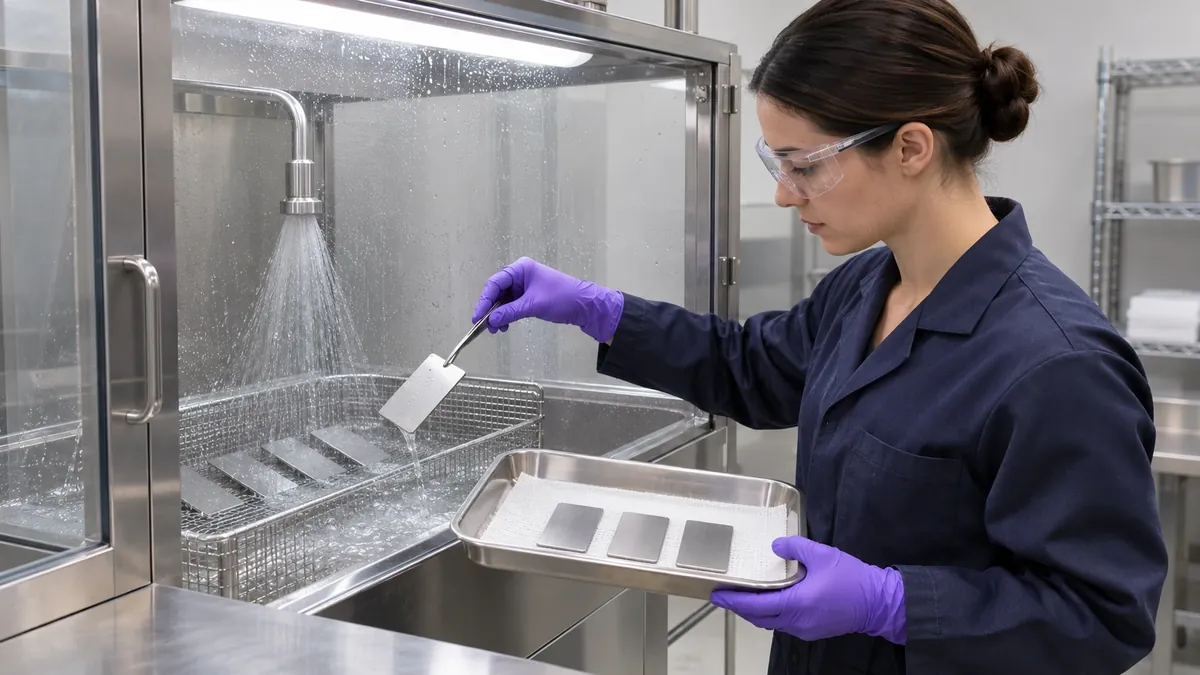
Post-treatment handling deserves explicit attention. Rinsing, drainage, drying, storage, and separation from carbon-steel contamination can affect the condition in which parts reach assembly or packaging. The correct controls depend on the processor’s validated procedure and the product. The buyer can state how parts are identified, protected, and transported, then ask the processor to describe its agreed handoff. If the product passes through several suppliers, define who is responsible at each transfer and what evidence travels with the lot.
The finished surface should be inspected against the agreed criteria. A clean appearance may be relevant, but visual review alone cannot identify every contamination or process condition. Likewise, the presence of a certificate or a batch record is evidence of an administrative or process record; it is not automatically proof of every finished-part performance claim. Tie each record to the actual part, lot, procedure, and acceptance plan.
A useful receiving review checks that the delivery matches the part and lot identity, records are present, exceptions are resolved, and packaging has kept parts separated and protected. If a lot has a discrepancy, quarantine it under the buyer’s normal quality process and ask the processor for its documented investigation. Do not treat a repeat rinse or re-treatment as an automatic remedy without technical review, since a corrective step must be suitable for the material and product.
How Should Citric and Nitric Routes Be Compared?
A buyer should not select between citric and nitric routes by treating either chemistry as universally superior. The specification, material, incoming condition, part geometry, processor capability, environmental controls, verification requirements, and customer acceptance criteria define the decision. The responsible engineer and finishing processor should assess whether a proposed route meets the stated requirement for the actual product.
For buyers comparing citric acid passivation stainless steel proposals, the important distinction is whether each offer meets the same contracted scope. The public ASTM A967/A967M-25 scope lists both nitric and citric treatments among the covered approaches. That supports the limited point that both appear within the standard’s scope; it does not reveal the full detailed methods or establish that every option is interchangeable for every part. Astro Pak describes its own passivation process and citric approach, including company-specific claims; those details should not be transferred to an unrelated processor or Koitor product. The buyer can review Astro Pak’s process overview as a supplier’s explanation, while relying on the governing specification and contracted processor for actual requirements.
For a quote comparison, ask each processor to state the proposed route, applicable procedure, preconditions, included preparation, verification, traceability, exclusions, and corrective-action path. Compare equivalent scopes. If one quote includes surface preparation and lot reporting while another excludes them, a chemistry label does not make the prices comparable. Record the approved route against the product revision and require approval before substitution.
If the processor proposes an alternate treatment after order placement, place the lot on hold until the responsible buyer or engineer reviews the change. Confirm whether the applicable customer specification permits it, whether the verification method remains appropriate, and whether sample or production validation is required. This is a change-control decision, not merely a purchasing preference.
What Does the Process Name Fail to Prove?
The process name alone does not prove that the incoming material was correctly identified, that scale or weld discoloration was removed, that cleaning was adequate, that the exact treatment procedure matched the purchase requirement, or that the final lot passed an agreed verification. It also does not establish that the product will never corrode, that a particular service life is achieved, or that the finish is suitable for every cleaner, humidity, chloride exposure, or installation environment.
A treatment certificate should be interpreted within its scope. Check which parts and lot it covers, the procedure or specification cited, its revision, the reported results, and any exceptions. If a report summarizes work without listing every process detail, ask the processor which controlled records support the statement and whether those records are available under the commercial arrangement. Do not request confidential proprietary chemistry when a procedure identifier and agreed conformance evidence are sufficient for the buyer’s quality system.
Product performance also depends on design, fabrication, material, surface condition, handling, use, cleaning, and maintenance. A passivation step cannot compensate automatically for unsuitable material selection, embedded contamination, poor drainage, crevices, damaged surfaces, or an environment beyond the product specification. This is why the product requirement and process evidence should stay connected. The finishing operation is one part of a quality plan, not a replacement for design review or service-specific evaluation.
For customer-facing claims, use only evidence that supports the exact product and conditions. If the business needs a corrosion or durability statement, identify the test method, sample configuration, exposure, acceptance rule, and limitations with the responsible technical owner. Do not convert the word “passivated” into a broad promise. A buyer can still make a sound sourcing decision without overstating what the process record establishes.
What Should a Buyer Put in the Purchase Record?
A useful record is concise and specific. It names the part, material, revision, incoming condition assumptions, treatment specification, processor, verification, lot traceability, packaging handoff, and approval contact. Attach or reference the drawing and approved sample. Include what happens when incoming parts are outside the expected condition and require a stop-and-review rather than an undocumented workaround.
| Record item | Example of the question it answers |
|---|---|
| Material declaration | Which approved grade applies to this component and revision? |
| Surface condition | Which fabrication and pre-cleaning steps occur before the processor receives it? |
| Treatment scope | Which controlled procedure and specification revision govern the lot? |
| Acceptance evidence | Which agreed verification records accompany each shipment or lot? |
| Traceability | How can receiving connect the report to cartons and component batches? |
| Exceptions | Who approves rework, retesting, or a process substitution? |
| Handling | How are treated surfaces protected through assembly and shipment? |
The record should distinguish required evidence from optional information. It should also state the retention period or applicable quality-system rule where the buyer has one. If a supplier changes a subcontractor or route, the change should be reviewed according to the buyer’s approved change-control process. These points are particularly useful when the component is bought in, treated externally, and then assembled into a larger bathroom or home-storage product.
A buyer may need one process document for several related parts, but the part-to-material mapping must remain clear. Shared finish wording does not mean that all components have identical geometry, exposure, or inspection needs. Keep records easy for quality, sourcing, and customer-service teams to retrieve when a field question or reorder arises.

How Can an OEM Buyer Coordinate the Work?
An OEM buyer can send the drawing, material declaration, target finish, use environment, incoming fabrication description, quantity, and customer specification to the manufacturer and finishing processor. Ask the manufacturer to identify which operations it performs, which operations a specialist supplier performs, and how part identity and approval information are transferred. Koitor Hardware is a family-owned custom metal hardware factory; its approved company information supports custom bathroom and home-storage metal hardware made from buyer drawings or physical samples. It does not establish an in-house citric passivation service or a certified testing laboratory.
When an external processor owns the treatment, the buyer should coordinate one written scope across the parties. The manufacturer can clarify part geometry, welds, assembly interfaces, and packaging requirements. The processor should confirm the treatment procedure, incoming acceptance, process records, verification, and any handling limitations. The buyer’s quality or engineering owner should approve the governing requirement and decide whether the offered evidence meets it. That division of responsibility makes a quote clearer without suggesting that one supplier controls an operation performed by another.
Before production, review a representative part and confirm that the process and records can be tied to the correct revision. If a pilot lot is required, define its purpose and acceptance before the work starts. A pilot can reveal transfer or documentation gaps, but it does not prove all future lots will be identical. Maintain normal production change control and lot review.
For custom hardware scope, see Koitor’s custom bathroom hardware manufacturing page e OEM home-storage hardware page. Send a drawing, sample, material and finish specification, and the exact process question through the Página de contacto do Koitor. The appropriate finishing processor remains responsible for confirming its passivation process and supporting data.
Before releasing the first order, make sure the records are practical for the people who will use them. Purchasing needs a quote with scope and exclusions; engineering needs the material and drawing revision; quality needs the acceptance plan and lot evidence; receiving needs a way to match cartons and reports. If the processor uses a batch traveler or certificate number, agree where that identifier appears on the delivery documents. A technically adequate report can still be difficult to use if nobody can connect it to the delivered parts.
When documenting citric acid passivation stainless steel requirements, the buyer should also decide how long to retain the approved procedure references, sample records, and test reports under the organization’s normal controls. This is a documentation decision, not a claim about a universal retention period. Reorders should point back to the approved specification revision and identify any change to the material, fabrication sequence, processor, or verification plan. That creates a traceable basis for reviewing a later lot without assuming that a previous record automatically applies to a changed product.
Perguntas frequentes
Does citric acid passivation mean a part cannot rust?
No. The process name does not guarantee corrosion-free service. Material grade, design, fabrication, surface condition, exposure, handling, and maintenance remain relevant. Use product-specific evidence for a defined claim.
Does passivation remove weld scale or heat tint?
Do not assume it does. Oxide removal and passivation are distinct process questions. State the incoming surface condition and ask the responsible processor whether a separate preparation step is included and suitable.
Is citric passivation always better than nitric passivation?
No universal choice follows from the chemistry label alone. Use the applicable specification and a processor’s assessment of the material, geometry, required verification, and project conditions.
Is a water-break observation enough to verify passivation?
Not as a standalone proof. It may relate to cleanliness in a defined procedure, but the buyer should use the verification methods and acceptance criteria specified for the actual job.
What should a passivation certificate include?
At minimum, confirm that the record identifies the covered parts or lot, applicable procedure or specification, revision, results where required, and exceptions. Contract requirements determine the exact record content.
Can Koitor confirm citric passivation performance?
Koitor’s approved company facts do not establish an in-house passivation process or laboratory. The buyer should obtain process and verification confirmation from the responsible finishing processor.
What is the difference between passivation and electropolishing?
They are different process routes and should not be used as synonyms. They can have different purposes and effects. Review the product-specific scope and the linked comparison guide before selecting a process.
Should the buyer specify process parameters?
The buyer should identify the governing specification and required outcome, then agree the processor’s controlled procedure and evidence. Avoid copying an unverified recipe into the order.
Coordinate the Process Scope Before Ordering
Share the drawing revision, stainless grade, incoming surface condition, governing specification, required verification, and lot-record expectations with the responsible suppliers. Koitor can help clarify custom hardware and sourcing interfaces; the finishing processor must confirm the treatment route and its evidence.
Define the Process Before the Purchase Order
Send the drawing, material declaration, incoming condition, and treatment requirement for a scope review.
OEM / MARCA PRÓPRIA
Transforme este guia de fornecimento num resumo do produto
Indique o produto pretendido, as dimensões, o acabamento, a quantidade a encomendar e os requisitos de embalagem. A sua equipa receberá uma análise prática da viabilidade de fabrico antes da apresentação do orçamento.


 English
 Español
 Português
 Français
 Deutsch
 العربية