

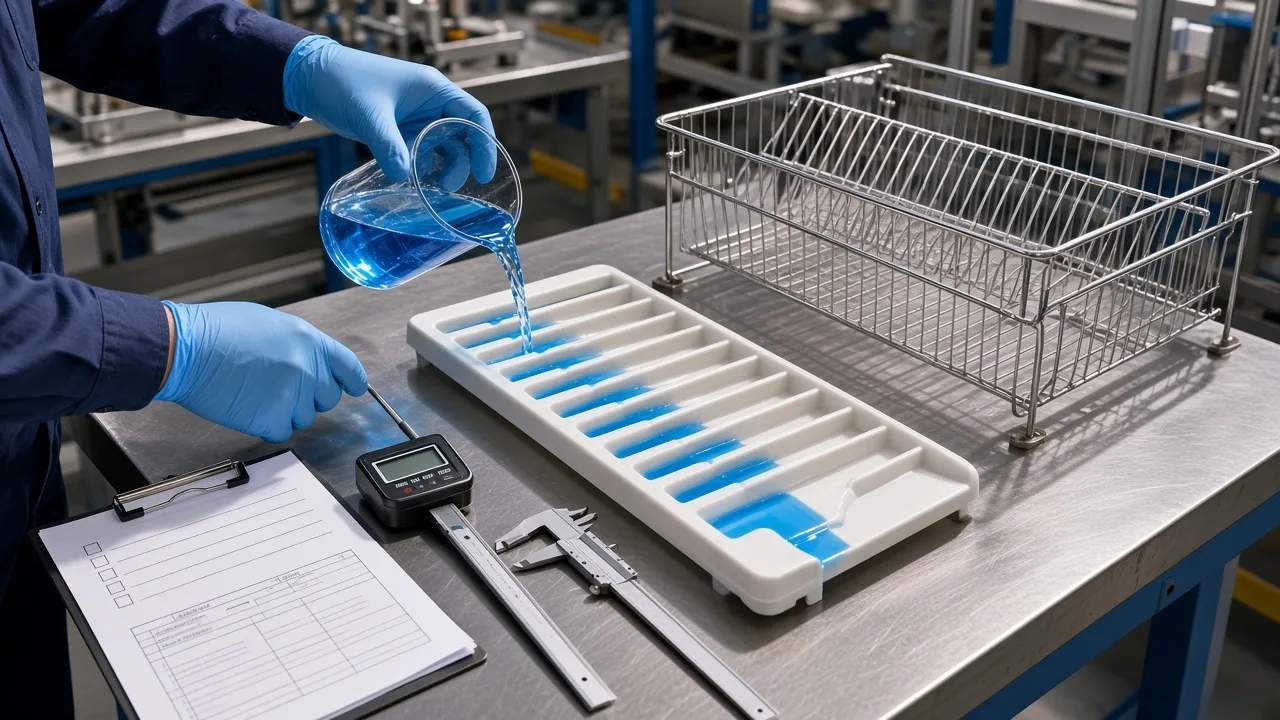
A dish drying rack drain board can look fine in a catalog photo and still puddle on the counter because slope, lip height, and mating to the rack were never frozen in IQC. This guide is the incoming/process checklist for the dish drying rack drain board itself. It complements—without rewriting—the kitchen sink dish rack drainage design pillar that explains the full water path from dish to sink.
Post #1226 (kitchen sink dish rack drainage design) remains the design-path neighbor. Here we freeze measurable board CTQs, dyed-water IQC, and disposition language importers can paste into RFQs.
In this guide
- Why Drain Board IQC Complements Drainage Path Design
- How to Freeze Dish Drying Rack Drain Board CTQs
- 10 Drain Board IQC Checks Buyers Must Spec
- Accept, Rework, or Reject for Drain Boards
- RFQ Checklist Language for Slope, Lip, and Leak Paths
- FAQ: Dish Drying Rack Drain Board Specs
- Send Your Dish Drying Rack Drain Board Spec for Review
Why Drain Board IQC Complements Drainage Path Design
Design essays explain channel intent and sink overhang philosophy. IQC decides whether this lot’s boards actually drain. Buyers need both.
Keep the design neighbor open: kitchen sink dish rack drainage design. Related rack geometry posts such as kitchen dish rack plate slot spacing design and chrome finish IQC in collapsible dish rack hinge stability OEM guide stay adjacent. This page stays on the drain board accept gate.
How to Freeze Dish Drying Rack Drain Board CTQs
Freeze overall size, sink overhang, channel slope, lip height, feet friction, rack nesting/registration, material/finish, and dyed-water pass criteria. Name the check dish drying rack drain board on the sheet.
Slope and lip before cosmetics
A glossy board that ponds water fails. Measure slope with an angle gauge or rise/run across defined datums. Lip height must keep sheets from spilling off the counter edge.
Rack registration
If the rack sits on the board, freeze pads, bosses, or wire rests so the rack cannot walk and block channels.
Angle and length metrology can follow shop practices supported by NIST calibration ideas. Plastics and coatings sometimes reference ISO material methods, while water-exposure or coating evaluations may cite ASTM catalogs when formally adopted.
10 Drain Board IQC Checks Buyers Must Spec
DB-01 — Overall dimensions
L/W/H within tolerance; warp limit __ mm. Record under dish drying rack drain board.
DB-02 — Slope / rise-run
Angle or mm drop across datum meets min. Record under dish drying rack drain board.
DB-03 — Channel continuity
No flash blocking channels; dyed water reaches lip. Record under dish drying rack drain board.
DB-04 — Lip height
Min lip __ mm; no flash gates on pour edge. Record under dish drying rack drain board.
DB-05 — Counter spill test
Agreed water volume leaves ≤ __ ml on counter. Record under dish drying rack drain board.
DB-06 — Feet friction / stability
Board does not skate under wet rack load. Record under dish drying rack drain board.
DB-07 — Rack registration
Rack locates without blocking channels. Record under dish drying rack drain board.
DB-08 — Finish / stain
No untreated flash; coating adhesion if painted/plated parts present. Record under dish drying rack drain board.
DB-09 — Food-contact claims
If claimed, documentation lot-tied; otherwise do not imply. Record under dish drying rack drain board.
DB-10 — Pack protection
Boards not crushed; channels not warped in carton. Record under dish drying rack drain board.
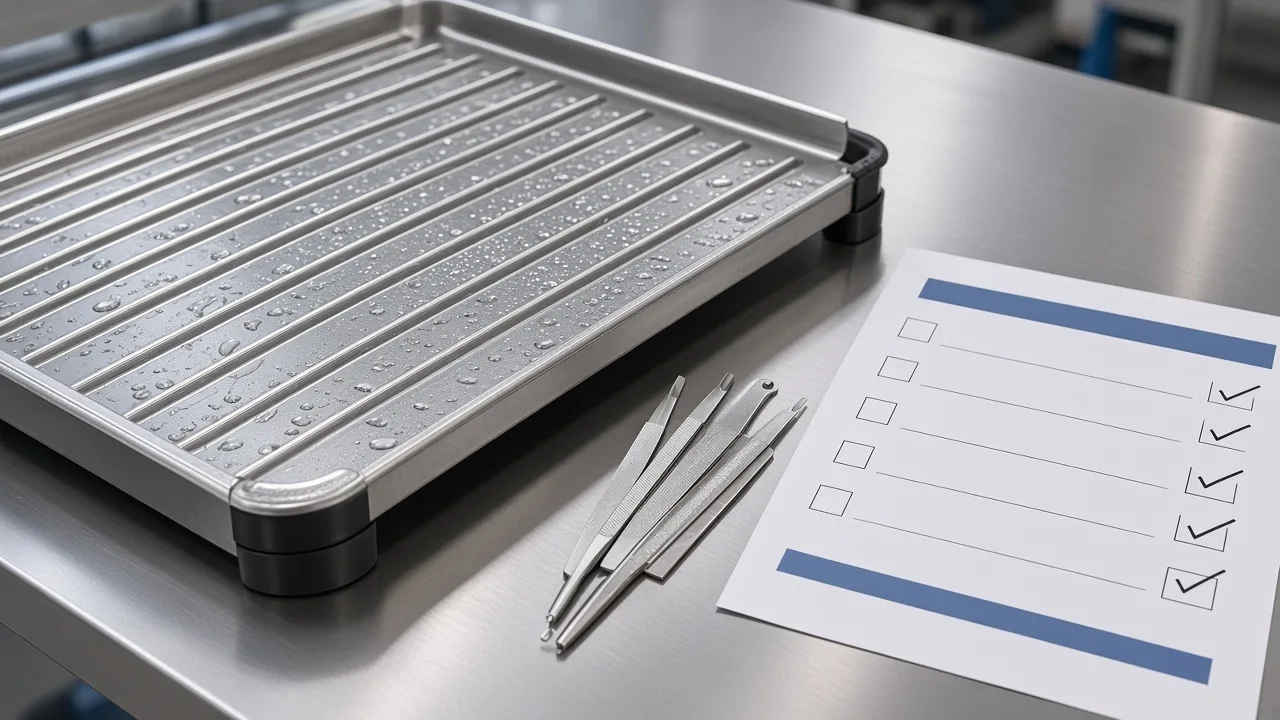
FAQ: Dish Drying Rack Drain Board Specs
Is this a rewrite of drainage design #1226?
No. #1226 is path/design. This is board IQC and RFQ accept language.
Plastic vs stainless boards?
Freeze material-specific warp and stain checks; slope math stays.
How much dyed water?
Agree a volume that stresses channels without creating a circus—document it.
Send Your Dish Drying Rack Drain Board Spec for Review
If you are building an RFQ or PPS checklist around dish drying rack drain board, send the drawing revision, target retail channel, and sample matrix to Koitor Hardware contact or email simon@koitorhardware.com. We will map CTQs, suggest accept language, and note where a complementary pillar post already covers an adjacent angle.
Factory reference: Jiangmen, Guangdong OEM wire and bathroom/kitchen storage hardware. Photos in this draft are generic laboratory and product scenes, not a claim that every SKU ships from one line.
Dye concentration should be visible on camera without staining permanently if boards are returned to stock after pass.
Measure boards after 24h unboxed; some plastics relax out of the carton.
If the board nests under the rack for freight, validate nest crush separately.
Silicone feet lots vary—pull retention on skip lots.
Forbid silent resin grade swaps that change warp.
Photograph overhang on a real sink, not only a flat bench.
Retail claims about “no counter puddles” must match the spill limit number.
Train IQC to fail blocked channels even when overall slope passes.
Keep golden boards sealed away from sun warp.
Align SKU codes for left/right spout orientations if applicable.
Metal boards need edge sharpness checks for cut risk.
Coatings on metal boards need adhesion checks after wet cycles.
Do not approve artwork that shows impossible overhangs.
Carton ECT must protect long boards from mid-span bend.
If sold as a set with the rack, IQC the set registration, not only the board alone.
Record ambient temperature during slope checks for plastics.
Flash at the pour lip is a Major when it deflects water sideways.
Use a shallow tray under the bench to measure spill volume cleanly.
Bilingual sheets should keep the English CTQ phrase stable.
CAPA should name mold cavity IDs when one cavity warps.
Tie every fail to a fixture ID, tool ID, and revision letter so CAPA is not a blame meeting. Lock carton marks and insert revision with the hardware BOM to protect retail intake identity.
Photograph the scale or caliper display in the same frame as the sample tag whenever metrology decides the lot. Prefer a short process note on the controlling dimension over a marketing capacity claim.
Separate Critical, Major, and Minor before the audit walk so rework cannot be redefined after goods leave the dock. Require the supplier to name the consumer-condition fixture used in the lab.
Ask for bilingual callouts when EU and AU share tooling but not copy decks. Skip-lot cadence should be written, not implied by “we tested the first lot.”
Confirm cure and cool-down after finishing before functional cycles begin. Keep quarantine cages for failed units so they cannot re-enter finished goods without a retest.
Map left-hand and right-hand variants explicitly; silent mirroring errors become field returns. Export edge protection on golden samples prevents false field narratives.
Store golden samples with desiccant when finish rub is part of accept criteria. Train inspectors to reject undocumented tool substitutions during the audit.
Lock carton marks and insert revision with the hardware BOM to protect retail intake identity. When retailers demand in-store demos, label non-rated demo masses clearly.
Prefer a short process note on the controlling dimension over a marketing capacity claim. Humidity loggers near wet-room fixtures prevent dry-lab theater.
Require the supplier to name the consumer-condition fixture used in the lab. Change wire diameter or slide brand only with a protocol re-run, not a verbal OK.
Skip-lot cadence should be written, not implied by “we tested the first lot.” Retail channel differences (hotel yank vs residential bottle mass) belong in the RFQ notes.
Keep quarantine cages for failed units so they cannot re-enter finished goods without a retest. Third-party labs must receive your mount kit and coupons, not “equivalents.”
Export edge protection on golden samples prevents false field narratives. Digital records should keep the English CTQ phrase stable across translations.
Train inspectors to reject undocumented tool substitutions during the audit. Tie every fail to a fixture ID, tool ID, and revision letter so CAPA is not a blame meeting.
When retailers demand in-store demos, label non-rated demo masses clearly. Photograph the scale or caliper display in the same frame as the sample tag whenever metrology decides the lot.
Humidity loggers near wet-room fixtures prevent dry-lab theater. Separate Critical, Major, and Minor before the audit walk so rework cannot be redefined after goods leave the dock.
Change wire diameter or slide brand only with a protocol re-run, not a verbal OK. Ask for bilingual callouts when EU and AU share tooling but not copy decks.
Retail channel differences (hotel yank vs residential bottle mass) belong in the RFQ notes. Confirm cure and cool-down after finishing before functional cycles begin.
Third-party labs must receive your mount kit and coupons, not “equivalents.” Map left-hand and right-hand variants explicitly; silent mirroring errors become field returns.
Digital records should keep the English CTQ phrase stable across translations. Store golden samples with desiccant when finish rub is part of accept criteria.
Tie every fail to a fixture ID, tool ID, and revision letter so CAPA is not a blame meeting. Lock carton marks and insert revision with the hardware BOM to protect retail intake identity.
Photograph the scale or caliper display in the same frame as the sample tag whenever metrology decides the lot. Prefer a short process note on the controlling dimension over a marketing capacity claim.
Separate Critical, Major, and Minor before the audit walk so rework cannot be redefined after goods leave the dock. Require the supplier to name the consumer-condition fixture used in the lab.
OEM / MARCA PRÓPRIA
Transforme este guia de fornecimento num resumo do produto
Indique o produto pretendido, as dimensões, o acabamento, a quantidade a encomendar e os requisitos de embalagem. A sua equipa receberá uma análise prática da viabilidade de fabrico antes da apresentação do orçamento.
 English
 Español
 Português
 Français
 Deutsch
 العربية