

Drawer slide nominal length cabinet depth are related specification terms, but they are not automatically the same measurement. A buyer should distinguish the runner's stated nominal length from the cabinet's usable interior depth, rear fixing space and clearance required by the exact model. The selected manufacturer's planning table is the source for model-specific values. Confirm the complete cabinet, drawer and runner configuration before quoting an organizer system; a single length number cannot prove that the assembly fits.
This short video shows the product or manufacturing context discussed in this guide.
Why do nominal runner length and cabinet depth differ?
A nominal length identifies a runner size or product option according to its supplier's catalog convention. Cabinet interior depth describes the available space inside a particular cabinet, measured from a defined front reference to a rear obstruction. Minimum cabinet depth may include the room the runner needs beyond its nominal length for fixing, movement or construction details. Since vendors can define their product dimensions differently, the buyer should not assume the two values are interchangeable.

The Hettich runner catalog cited in the research pack presents nominal runner length and minimum carcase interior depth as separate planning fields for its system. That is useful evidence that a buyer should ask for both. Any numeric relationship in that catalog belongs to the named model and revision. It must not be copied into another maker's runner specification or used as a universal allowance for a custom cabinet organizer.
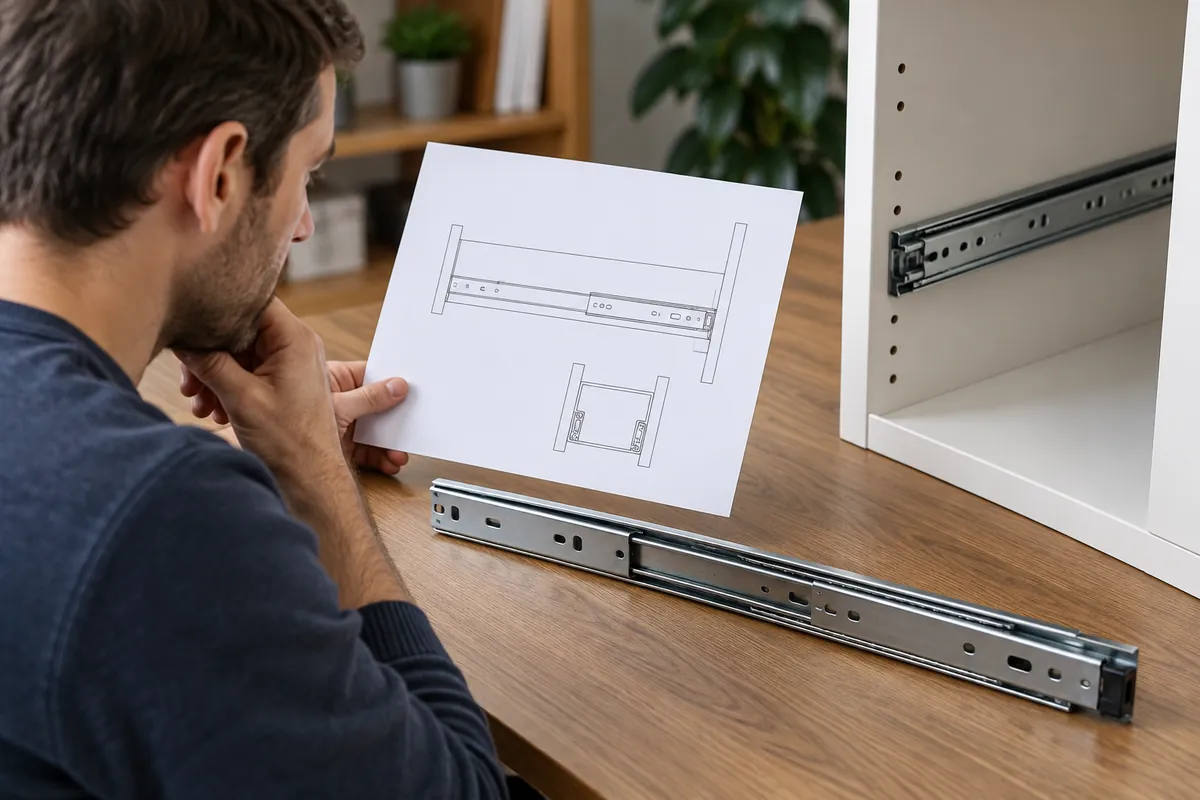
The cabinet itself can add constraints that a nominal runner dimension does not capture. A back panel, cable, pipe, rear bracket or uneven wall may reduce usable depth. A front frame or door can change the mounting datum. A drawer or basket may also need room for a front fitting, rear hook or stop. A product photo shows a general arrangement but rarely provides enough information to determine the actual clearance envelope.
For importers, this distinction matters during assortment planning. A catalog may list a runner size that sounds compatible with the cabinet, while the assembled storage product still projects too far or cannot reach its intended closed position. Treat fit as a stack of named dimensions and supplier conditions. Ask which point the catalog measures and what other space must remain available around the moving parts.
What dimensions and cabinet conditions belong in the RFQ?
Record the cabinet's clear interior depth from the chosen front datum to the nearest rear obstruction. State whether doors, face frames, hinges or front lips are included in that measurement. Identify the rear panel and whether the runner can be fixed to it or requires a bracket. If the cabinet will be built by a separate supplier, coordinate one drawing showing the cabinet interior, runner position and drawer or organizer travel.
Ask the runner supplier for the selected model's nominal length, minimum required cabinet depth, installation depth and any rear clearance or bracket needs. Request the current installation sheet and clarify whether the values describe the closed runner, moving member or installed assembly. The buyer should not derive an allowance from an unrelated model. When a catalog uses a special measurement convention, retain its definition with the quotation so another reviewer does not treat the number as a standard cabinet dimension.
Include the organizer dimensions and motion envelope. A pull-out basket may have a front frame, handle, retaining rail or accessory that changes how far it needs to move. Note whether the product must close flush, clear a hinged door, reach a stop or expose a specific amount of storage. For a cabinet with more than one moving element, identify neighboring drawers or shelves that could intersect the path. The fitter's operating requirements belong in the sample setup.
Specify the conditions that can change the fit: cabinet side material, fixing method, panel thickness, rear support, left-right runner placement and any spacers. Ask the supplier to distinguish required values from assumptions. If a proposed design requires machining, notching or an adapter, show it on the controlled drawing and name who will make it. The RFQ should make the supplier's expected envelope visible before samples are ordered.
How should buyers compare runner and depth proposals?
Compare complete model-specific data rather than sorting offers by nominal length alone. One supplier may define its catalog length differently from another, and two runners with the same nominal label may have different required installation spaces. Put each proposal into a common comparison sheet: stated runner length, minimum cabinet depth, rear fixing requirement, front datum, extension, mounting orientation and any bracket or spacer. Mark unavailable fields as open instead of filling them with inferred values.
Review the purchased assembly's intended use and clearances. The longest runner is not automatically the best match if it collides with a rear wall or leaves no room for a fitting. A shorter runner may reduce access, depending on the buyer's requirement. These trade-offs should be demonstrated on a dimensioned cabinet layout and confirmed by the component supplier. Do not claim that one extension style is superior without comparing the exact cabinet and product.
Include parts and installation scope in the commercial comparison. A model that requires a separate rear bracket, specialized fastener or cabinet preparation may carry additional sourcing and assembly work. Confirm whether the supplier's stated minimum depth assumes a specific bracket or panel. Compare packaging and identification too if a private-label kit contains the runner and organizer as separate components; the approved model should remain traceable when a retailer reorders.
A useful comparison distinguishes the source and confirmation level of each value: catalog figure, supplier-confirmed project figure, buyer-measured cabinet value, sample-observed clearance or unresolved assumption. This is more reliable than a single green or red fit indicator. If dimensions conflict, ask the supplier to resolve the datum before approval. Keep the alternative model under review until the updated drawing and cabinet setup agree.
What should a representative sample prove?
Use a cabinet mock-up or production-intent cabinet that matches the planned interior depth, rear construction and front opening. Verify the runner model and revision before fitting. Measure the cavity from the agreed datum, note obstructions and photograph the setup. A loose runner on a tabletop cannot establish cabinet fit. If the sample uses a temporary panel, record its thickness and mounting position so its result is not mistaken for a final cabinet approval.
Install the runner according to the supplier's current instructions and record any required spacer, rear bracket, notch or special fixing. Place the basket or drawer in the assembly and observe whether it reaches the intended closed position, clears the back panel and moves without unplanned contact. Check the full travel and return path, including neighboring doors or drawers. This is an observational fit review under the tested conditions, not an endurance or load test.
When the sample does not fit, record the location and amount of interference only if measured using an agreed method. Note whether the obstruction comes from the cabinet, runner, front fitting, organizer frame or an undocumented adjustment. Avoid simply shortening the organizer or moving the runner in the sample; a change can affect another interface. Have the responsible supplier update the drawing and confirm any revised minimum depth or mounting condition.
Close approval with a configuration sheet that lists cabinet dimensions, datum, runner identification, organizer revision, brackets, installation instructions, observed clearances and deviations. Attach photos from the side and rear. If the buyer later changes the back panel, face frame, runner series or drawer front, decide which fit observations need repeating. The record should allow a second buyer or production team to recreate the setup without relying on the memory of the first reviewer.
How do buyers prevent depth confusion on repeat orders?
Put both the runner model and cabinet depth definition on the approved bill of materials or technical data sheet. Do not list only a generic dimension such as slide length. Reference the supplier's catalog revision and preserve the page or installation document used to select the model. For any custom organizer, retain the mating cabinet drawing so an alternate fitting supplier can see the installed envelope and mounting datum.
Use a change process for model substitutions. A new runner series may have a different nominal length convention, bracket position or minimum cabinet depth even when its overall appearance is similar. Ask for supplier confirmation and review the effect on the actual cabinet. Decide whether a drawing review is enough or whether an assembled sample is required; make that decision from the affected interfaces and the buyer's approval plan.
Commercial teams should align the exact part selection before communicating the cabinet fit to customers. Avoid promising compatibility based on an unverified size match. If a product listing or package uses a cabinet-depth range, that range must come from the actual fitting supplier and approved assembly. A retailer's return policy or the ability to force a drawer into a cabinet does not substitute for an accurate specification.
Koitor's verified work with custom metal storage products supports discussion of organizer drawings, samples and interface coordination. This article does not imply Koitor manufactures cabinet runner systems. Buyers can share the organizer drawing and cabinet envelope with Koitor while asking the fitting supplier to confirm its own runner requirements. Keeping those responsibilities clear helps the metal product and purchased fitting reach one approved configuration.
How should the buyer resolve conflicting depth figures?
When two documents show different cabinet depth figures, first determine whether they use the same front datum and define the same part of the assembly. One number may refer to the runner body, another to the minimum interior depth with a bracket, and a third to the buyer's usable cavity. Ask the runner supplier to identify the controlling figure for the selected model and show the reference surfaces on a drawing.
Do not average conflicting values or add an informal allowance. Record both source documents, revision dates and the question sent to the supplier. If the supplier replaces a catalog sheet, preserve the newer document and note which value governs the project. If a cabinet drawing uses an outer measurement while the runner data expects clear inner space, have the cabinet maker reconcile the dimensions before a sample is built.
A tolerance stack may involve the cabinet back, side panels, front rail, runner brackets and drawer rear feature. The buyer can ask suppliers to identify the dimensions they control and those they receive from another vendor. This helps identify which interface needs a tolerance or adjustment provision. A range should come from engineering review, not from adding several unverified catalogue allowances together.
The phrase drawer slide nominal length cabinet depth is most useful when the product file keeps nominal length and minimum installed depth in separate fields. That simple distinction reduces quotation errors and makes model substitutions easier to review. Keep the exact supplier wording beside each field if the catalog uses a special term, and explain the buyer's cabinet measurement separately.
What if the cabinet changes after the runner is selected?
A cabinet revision can reduce interior depth even if its outside dimensions stay the same. A thicker rear panel, new face frame, hinge, trim or cable route can occupy the runner's required space. Ask the cabinet supplier to issue the revised clear dimension from the agreed datum and compare it with the runner manufacturer's current installation requirement. Do not rely on a prior sample built before that cabinet change.
If the cabinet becomes shallower, the team may need a different runner model, a different organizer envelope or a documented design adjustment. Each choice can affect travel, access and storage capacity. The runner vendor should confirm its product selection, while the organizer supplier checks its geometry. Avoid cutting or bending a purchased fitting to regain clearance unless the supplier expressly allows that preparation.
Record which drawing revision was used when the runner was approved and which revision introduced the cabinet change. This chronology helps the buyer see whether a fit issue existed in the original design or entered later. If the change occurs after samples are distributed, identify affected SKUs and orders so that production does not mix cabinet depths within one approved package.
For distributors, a model cross-reference can support future sourcing only when it is tied to the exact cabinet and runner series. Similar nominal lengths across brands do not make the assemblies interchangeable. Retain supplier confirmation, updated drawings and a revised sample record whenever a new system is chosen. This is a practical way to protect repeat orders from silent dimensional drift.
How should depth requirements be communicated across vendors?
Put drawer slide nominal length cabinet depth in separate fields on the RFQ and drawing review form. Identify the runner model's nominal length, the supplier's stated minimum installed depth, the cabinet's clear interior depth and the measurement datum for each. Ask the cabinet maker and runner supplier to confirm the same released revision. This avoids a quote or substitution relying on an outside cabinet dimension that does not represent usable space.
Buyer comparison table
| Comparison field | What it means | Who confirms it |
|---|---|---|
| Nominal runner length | Supplier's model label or defined runner measurement | Runner manufacturer |
| Minimum cabinet depth | Required installed cabinet envelope for the model | Runner manufacturer |
| Usable interior depth | Buyer-measured cabinet space from named datum | Cabinet supplier or buyer |
| Organizer envelope | Basket, front, rear and moving clearance | Organizer supplier and buyer |
| Rear fixing space | Room for bracket, panel and fasteners | Runner supplier and cabinet designer |
Lista de verificação do comprador
- Name the cabinet depth datum
- Record model-specific nominal runner length and minimum depth separately
- Show rear panel, bracket and fastener space
- Include the organizer motion path and front clearance
- Build a representative cabinet mock-up
- Record observed fit and all temporary adjustments
For a project-specific detail, consult the manufacturer or technical reference. Its information applies to the stated system and conditions.
See related OEM sourcing information or contacte a Koitor for a metal-product drawing discussion.
Perguntas frequentes
Is nominal runner length the same as required cabinet depth?
Not necessarily. Confirm both fields and their definitions in the selected manufacturer's current catalog and installation instructions.
Can I use another brand's depth allowance?
No. Values and measurement conventions are model-specific. Obtain the data for the exact series being quoted.
Does a runner fitting on the cabinet side prove the organizer will fit?
No. Check the drawer or basket envelope, rear fixing space, front opening and complete movement path.
Should a substituted runner trigger a new review?
Yes, review the changed system data and affected interfaces; the supplier can identify whether a new assembled sample is needed.
Discuss a project-specific sourcing question
Koitor Hardware is a family-owned custom metal hardware factory focused on bathroom and home storage products. Share the product drawing or physical sample, the purchased fitting identity, the intended application and the buyer decision that still needs evidence. Specialist drawer runners, closet shelf fittings and coating systems must be confirmed by their responsible suppliers.
OEM / MARCA PRÓPRIA
Transforme este guia de fornecimento num resumo do produto
Indique o produto pretendido, as dimensões, o acabamento, a quantidade a encomendar e os requisitos de embalagem. A sua equipa receberá uma análise prática da viabilidade de fabrico antes da apresentação do orçamento.

 English
 Español
 Português
 Français
 Deutsch
 العربية