

The exporter vs importer distinction depends on the direction of a goods movement relative to a country or territory. In an exporter vs importer review, always state which jurisdiction the label refers to before matching it to a company name or document field. A business moving goods out of one jurisdiction may be described as exporting in that context, while a business receiving goods from abroad may be described as importing in the destination context. One shipment can therefore be an export from its origin and an import into its destination. These trade-direction roles are not automatically the same as seller, buyer, shipper, consignee, customs declarant, importer of record, or carrier.
For an overseas buyer sourcing bathroom or home-storage hardware, the useful first step is to name the countries and direction, then list the commercial, shipment, and customs roles separately. This prevents a factory name, invoice field, or delivery address from being treated as proof of a formal customs assignment.
What Is an Exporter and What Is an Importer?
In broad trade language, an exporter sends or moves goods from a country to another place; an importer brings goods into a country from abroad. The terms are relative to the geography and direction of the transaction. If metal shelves move from a factory in China to a buyer in the United States, the movement is an export from China and an import into the United States in the broad directional sense.
That statement does not determine which legal entity is formally listed as exporter or importer on a declaration. It also does not assign customs liability, tax obligations, ownership, payment responsibility, or licensing status. Those questions can depend on the destination and origin rules, transaction structure, sales contract, authorizations, and the exact documents used.
HM Revenue & Customs (HMRC) provides an official example of geography-specific definitions in its statistics methodology. For that publication, it describes businesses moving goods into Great Britain from the EU or into the UK from non-EU countries as importers, and businesses moving goods from Great Britain to the EU or from the UK to non-EU countries as exporters. The methodology is bounded to the stated UK/GB movements and the statistical publication; it is not a worldwide legal definition.
The United States International Trade Commission (USITC) describes trade measures that count physical merchandise arriving in or exported from the United States, and distinguishes domestic exports from re-exports in its statistical context. This illustrates another important point: statistics can define categories for measurement that are narrower or more specific than the terms used in ordinary buyer conversation.
| Comparison point | Export direction | Import direction | Buyer clarification |
|---|---|---|---|
| Geographic movement | Goods move out from the stated origin country or territory | Goods arrive from outside into the stated destination country or territory | Name both origin and destination |
| Direction label | Export relative to the exporting jurisdiction | Import relative to the importing jurisdiction | The same movement may carry both descriptions |
| Business activity | A business may be involved in outward trade | A business may be involved in inward trade | One business can participate in both over different transactions |
| Document role | May be separate from seller, shipper, or declarant | May be separate from buyer, consignee, or recipient | Do not infer formal status from a casual role label |
| Evidence to check | Applicable export records and transaction documents | Applicable import records and destination instructions | Confirm with the responsible customs professional or authority |
Why Does One Shipment Have Both an Exporter and an Importer?
An international movement crosses at least one border between a place of departure and a place of arrival. Each side can describe the movement from its own direction. The exporter question asks what business or party is involved in sending goods outward under the relevant context; the importer question asks what business or party is involved in bringing goods inward under the destination context.
The names of the parties involved may not line up one-to-one with these labels. A manufacturer may sell the product to a trading company; the trading company may sell it to a distributor; a logistics provider may arrange movement; a broker may submit or support a declaration; and a separate consignee may receive the cargo. Some businesses can perform multiple roles. The actual party relationships should be confirmed rather than assumed from the supply-chain chart.
For example, suppose a Chinese OEM factory produces a custom metal bathroom organizer. A brand owner in one country purchases it through an importing company in another country, while a freight forwarder arranges transport. The factory can be the manufacturer and possibly the party that tenders goods for dispatch. The buyer or another named company may appear in a sales document. The importer/exporter designation for customs purposes must be confirmed under the applicable rules and transaction facts; the scenario alone cannot determine it.
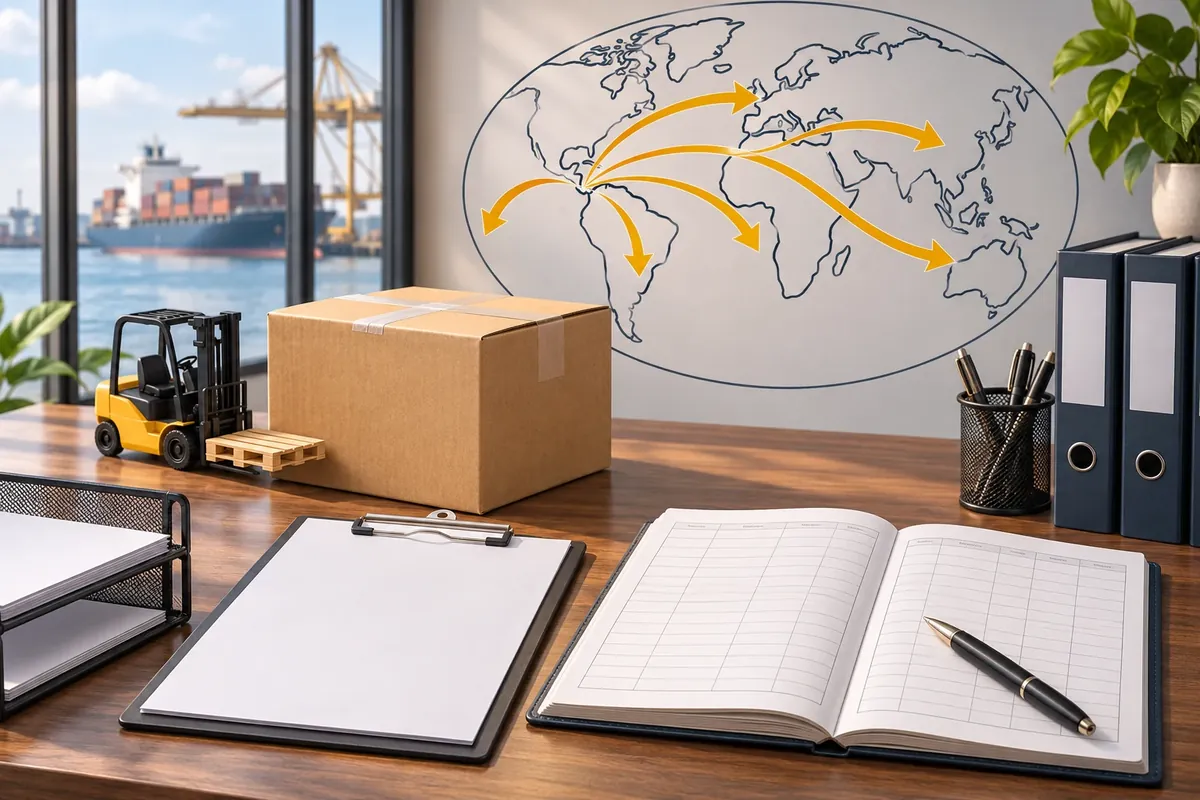
The distinction is easiest to understand by drawing the route and labeling each border:
- Identify the physical origin of the goods and the country or territory from which they leave.
- Identify the destination where the goods enter and the country or territory relevant to that entry.
- Note any intermediate countries, transshipment locations, or customs territories that matter to the actual route.
- For each movement, identify the commercial buyer and seller separately from the logistics and document parties.
- Ask the authorized customs contact who will be named for the applicable export or import procedure.
This is a planning framework, not a customs filing method. A route map helps the team ask better questions, but it does not establish a declarant, importer of record, exporter of record, tariff treatment, tax obligation, or correct code.
How Are Exporter and Importer Different from Buyer, Seller, Shipper, and Consignee?
The exporter and importer terms describe cross-border direction or a formal role defined by a jurisdiction or document. Buyer and seller describe commercial relationships under a sale. Shipper and carrier describe transport roles in a movement. Consignee, notify party, and other fields may have specific meanings on particular documents. A single organization may occupy more than one role, but the labels should not be treated as synonyms.
A purchase contract can name a seller and buyer while a logistics instruction identifies a pickup party, a forwarding provider, and a receiving warehouse. A shipping document may show a shipper and consignee according to its own field definitions. A customs declaration may identify the entity assigned a particular role under local rules. These are related records but they do not all answer the same question.
A role matrix can help an importer avoid mixing these concepts:
| Role to identify | Pergunta principal | Example evidence to review | Avoid assuming |
|---|---|---|---|
| Seller | Who sells the goods under the commercial arrangement? | Sales contract, purchase confirmation, commercial invoice | That the seller is automatically the exporter of record |
| Buyer | Who purchases under the sale? | Purchase order and contract | That the buyer is automatically the importer of record |
| Shipper | Who sends, tenders, or prepares goods for a movement in the relevant context? | Pickup instruction, booking details, shipment document field definition | That the shipper necessarily owns the cargo |
| Carrier | Who undertakes transport for a specified leg? | Transport service agreement and leg-specific records | That one named carrier performs every leg |
| Consignee | Which party is named as recipient or consignee on a specific record? | The document and its instructions | That a consignee is automatically the buyer or customs importer |
| Formal customs role | Which entity is assigned to a required role under the applicable jurisdiction and procedure? | Current official guidance, declaration, authorization, customs broker confirmation | That a general trade label establishes legal status |
The matrix is an operational prompt; the meaning of a field must be checked on the document itself. A bill of lading, customs declaration, commercial invoice, and delivery order can name different parties for different purposes. If a difference matters, ask the issuing party or qualified customs professional to explain which record controls and what correction procedure applies.
How Should an Importer Map a Hardware Shipment?
A hardware importer can make a simple country-and-party map before booking. The map should show where goods are made, which country they leave, any intermediate locations, the destination market, the commercial buyer and seller, the expected transport providers, and which party is responsible for clarifying customs roles. If one shipment combines several suppliers, record the origin and package references for each supplier rather than treating all cartons as one undifferentiated lot.
For example, a distributor may combine a towel rack, a wire basket, and mounting components into a single shipment. Each line may have a different production supplier, packaging state, or place of collection. The importer can record each product reference and carton count, then link it to the transport booking and relevant customs instructions. The consolidation plan can identify who hands each package to the collection provider and where totals are reconciled. A current multi-supplier consolidation readiness checklist provides related packing and coordination questions.
A route can also include a third country or customs territory. A product may be manufactured in one place, stored or consolidated elsewhere, and later sent to a final destination. The physical route, the commercial sale, and the customs treatment are related but not identical questions. A transshipment or warehousing location should be included in the map when it affects the actual journey or the documents, but its presence does not by itself tell the buyer who has a formal exporter or importer role. A re-export may have a specific meaning under a country’s trade or statistical rules. For example, USITC’s statistical explanation defines re-exports in a U.S. measurement context and distinguishes them from domestic exports. The buyer should not take that statistical category as a complete determination of a shipment’s customs treatment elsewhere. The responsible declarant or broker must assess the actual product origin, route, prior entry, procedure, and applicable rules.
An exporter vs importer check should also distinguish geography from the identity of the company. One company may sell the goods, another may arrange the export movement, and another may make the import declaration. The country pair can remain the same even when the commercial parties change, while a new route may change which local entities need to be involved. Keeping the route and party matrix separate lets the purchasing team ask precise questions: which country is this company acting in, which movement is being discussed, and what document or rule supports the assigned role?
The map should separate known facts from assumptions. “Factory in China” may be a known manufacturing location. “Exporter of record” should remain unconfirmed unless the responsible party and applicable documents establish it. “Delivered to our warehouse” identifies an intended destination but does not identify the entity formally responsible for customs procedures.
Buyers can maintain these fields:
- Country or territory of goods origin and shipment departure.
- Country or territory of final import and delivery.
- Intermediate transport or customs locations that are relevant to the actual route.
- Seller, buyer, and purchasing entity.
- Party releasing cargo and party arranging transport.
- Consignee or receiving party as shown on the relevant document.
- Customs broker or authorized declarant, if used.
- Exact open questions and the person responsible for obtaining confirmation.
- Document names, reference numbers, versions, and dates.
If an organization changes the route, seller, or importing entity, update the map and recheck which documents or instructions are affected. Do not copy party names from a prior order without confirming that the same legal entities and shipment conditions apply.
What Documents Can Help Confirm the Parties?
Different documents record different facts. A purchase order can show the buyer’s order reference; an invoice can show the seller and transaction details; a packing list can show package information; a transport record can identify transport parties for a particular leg; and customs documents can record parties under the applicable procedure. No one document should be assumed to prove every role or obligation.
Read the document instructions and confirm its purpose. A commercial invoice does not by itself establish the party formally named in a customs declaration. A warehouse receipt may record cargo received at one location without establishing who is the importer. A transport document can identify parties in a mode-specific field that should not be reinterpreted from ordinary English alone.
A safe review sequence is:
- Identify the document type and issuer.
- Read the meaning of each relevant field from its own instructions or official rules.
- Match the party name, address, and identifier to the transaction record.
- Confirm the country, direction, and shipment leg to which the document relates.
- Ask the responsible broker, forwarder, seller, or importer to resolve discrepancies before filing or release.
- Preserve the original and any corrected version with a clear date and reason.
A company may appear with a slightly different branch name, legal suffix, or address across records. Treat that as a discrepancy to verify, not automatic proof of a separate business or data-entry error. The responsible customs or logistics professional can clarify which details are needed for the applicable filing and whether a document requires correction.
This guide cannot determine a company’s customs role. For a particular trade route, the importer should consult current official guidance for the origin and destination jurisdictions and confirm the arrangement with the party filing or authorizing declarations. This is especially important when the transaction involves a trading company, an agent, a nonresident entity, a bonded facility, or re-exported goods.
What Questions Should Buyers Ask Before a Cross-Border Order?

Before order confirmation or shipment booking, an importer can ask:
- What are the origin and destination countries or territories for this movement?
- Which party is the contractual seller, and which entity is the buyer?
- Who will release the goods at origin, and what cargo records will accompany them?
- Which company arranges the transport and which provider performs each leg?
- Who is the intended recipient on each transport record?
- Which entity is authorized or responsible for the relevant customs declaration in each jurisdiction?
- What identifiers and documents does the broker need, and who provides them?
- Does the route include consolidation, transshipment, bonded storage, or re-export?
- Which named party should clarify an inconsistency in an invoice, packing list, or transport document?
- If the named buyer differs from the receiving party, has the responsible professional confirmed the arrangement?
These are questions to route to the appropriate parties, not a checklist that guarantees compliance. Do not request a supplier to provide a legal conclusion outside its role. Instead, ask the supplier for the accurate commercial and packing facts it can confirm, then let the authorized customs professional evaluate the applicable declaration requirements.
If the project uses Incoterms, identify the exact rule and named place in the contract and refer to the official ICC text. Incoterms allocate specified obligations, costs, and risks between sellers and buyers under the sale; they do not automatically identify every customs party or resolve all country-specific procedures. See the separate FCA versus FOB guide for containerized cargo for a focused comparison. This article does not replace that page or provide legal advice.
How Can the Manufacturer Clarify Its Part of the Shipment?
A manufacturer can confirm project facts within its actual scope: product identity, packaging configuration, cargo readiness, the pickup location, the contact authorized to release goods, and records that it has prepared. The buyer should state the product and order reference, requested handoff, required document fields, and any discrepancy to resolve. The manufacturer should distinguish information it can confirm from customs or transport decisions controlled by another party.
Koitor is a family-owned custom metal bathroom and home-storage hardware factory. Its OEM home-storage hardware information describes the relevant product and manufacturing scope. Buyers can contacte a Koitor with a project-specific question about a hardware order or package handoff. This does not imply that Koitor serves as exporter of record, customs declarant, carrier, customs broker, or legal adviser in a particular shipment.
Perguntas frequentes
Can one company be both an exporter and an importer?
Yes, a company may be involved in outward movements from one country and inward movements into another, or import and export goods in different transactions. The formal role for each shipment still depends on the applicable jurisdiction and record.
Is the buyer always the importer?
No. A buyer and the entity named for a formal import role may differ. Confirm the arrangement under the actual sales contract, customs requirements, and filing instructions.
Does a consignee mean importer of record?
Not automatically. A consignee is a party named in a particular document field. The field’s function and any customs role must be checked separately.
Can a factory be the exporter?
A factory may take part in exporting activity or appear in a document, but its manufacturing location alone does not establish which entity has a formal customs role. Confirm the transaction and filing arrangements.
Does this article explain how to file an export or import declaration?
No. The exporter vs importer guide here explains broad directional language and party distinctions. Declaration rules, registration, tariff classification, duties, taxes, permits, and eligibility must be verified for the relevant jurisdiction and transaction.
What should an importer do if documents show different party names?
Identify which document and field differ, then ask the issuing party and authorized customs professional to confirm the correct entry. Do not alter official documents based on an assumption.
Sources and Scope
- HM Revenue & Customs, Customs importer and exporter population 2025: methodology notes — used for the publication’s specific GB/UK statistical definitions and the fact that a business can engage in both directions. These boundaries are stated in the source and are not generalized into worldwide customs law.
- United States International Trade Commission, Trade Measure Definitions — used for U.S. statistical distinctions among physical arrivals, imports for consumption, domestic exports, and re-exports. It does not determine a party’s legal status in a particular transaction.
- This article is general buyer education, not customs, tax, tariff, licensing, Incoterms, or legal advice. Confirm current rules with official authorities and qualified professionals for the relevant countries and shipment.
Clarifying Roles for a Hardware Import?
Share the hardware order reference, package information, origin and destination, and the specific handoff question. Koitor can confirm product and packaging details within its actual manufacturing scope.
OEM / MARCA PRÓPRIA
Transforme este guia de fornecimento num resumo do produto
Indique o produto pretendido, as dimensões, o acabamento, a quantidade a encomendar e os requisitos de embalagem. A sua equipa receberá uma análise prática da viabilidade de fabrico antes da apresentação do orçamento.



 English
 Español
 Português
 Français
 Deutsch
 العربية