
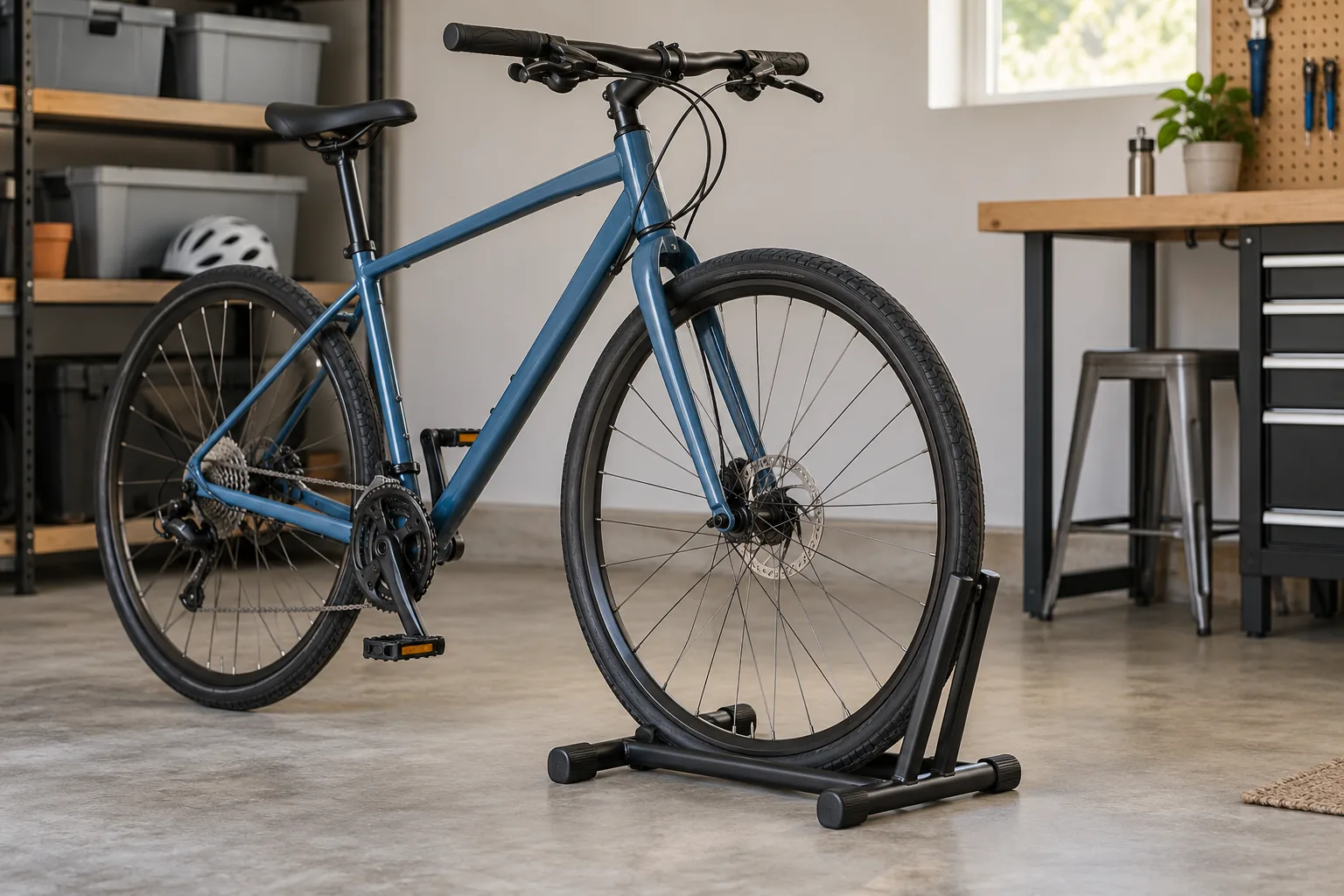
A floor bicycle storage stand should be approved with the actual bicycles and tires the importer intends to support. Record bicycle mass and model, tire width and diameter, tread and sidewall shape, fenders or nearby components, then test the wheel’s entry, cradle contact and removal on a physical sample. A tire-range label alone cannot establish compatibility with every bicycle. This is a floor-parking decision: wall-hanging brackets, repair stands and lift systems use different interfaces and are outside this guide.
Which Bicycle Models Should Be Included?
List the reference bicycles by intended category: city, road, mountain, cargo, child or electric models if they are part of the assortment. Do not assume that one bicycle represents all others. Tire sizes, tread, fender placement, disc rotor, derailleur and frame geometry can change how a bike approaches a stand. The buyer should identify whether the stand supports a front wheel, rear wheel or either wheel and whether the bicycle is loaded in a particular orientation.
Measure the inflated tire width and outer diameter, not just a nominal size label. Note tread knobs, sidewall thickness, fenders, mudguards and any accessories close to the cradle. If an e-bike is included, record the specific model and mass from the product documentation, but do not infer that a stand supports it without a separate assessment.
| Bike-fit field | Buyer record | Por que é importante |
|---|---|---|
| Bicycle model and type | Brand, model and intended category | Defines compatibility scope |
| Bicycle mass | Manufacturer data or measured value | Context for project-specific evaluation |
| Tire diameter | Exact stated format and measured envelope | Relates to cradle geometry |
| Inflated tire width | Maximum measured width | Checks slot clearance |
| Tread and sidewall | Smooth, knobby or other profile | Affects contact and seating |
| Fender/mudguard | Position and projection | May collide with support arms |
| Rotor/derailleur | Position near supported wheel | May interfere with insertion |
| Wheel selection | Front, rear or either | Changes nearby obstructions |
| Stand cradle | Opening, depth and contact surfaces | Defines the wheel interface |
| Floor condition | Surface and slope if relevant | Part of the installation context |
| Sample revision | Bike and stand identifiers | Makes approval traceable |
How Should Tire-Cradle Fit Be Checked?
Measure the cradle’s clear opening, support depth, arm spacing and any adjustable position. Compare these dimensions with the actual tire at the intended engagement location. Check whether the tire reaches the intended support surfaces without being wedged or resting on a rotor, fender or other component. A cradle that fits a smooth narrow tire may interact differently with a wide knobby tire.
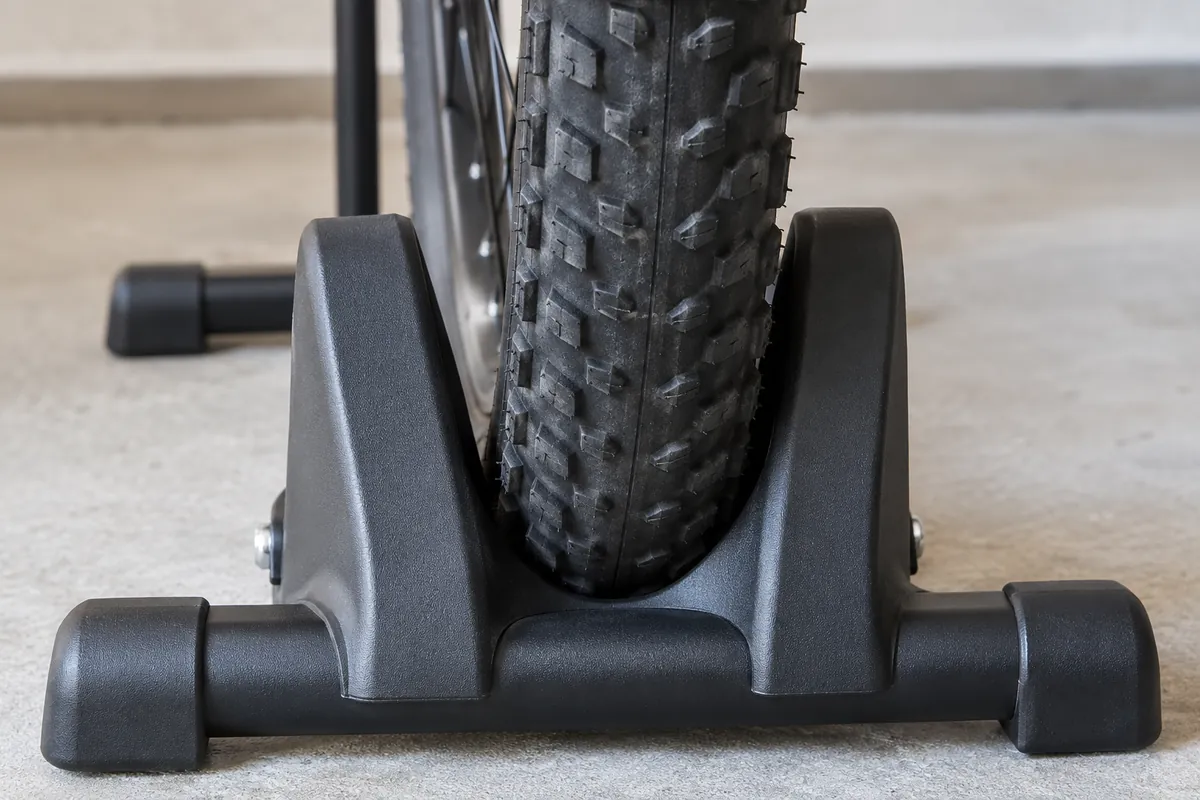
Park and remove the bicycle using the expected user motion. Observe whether the wheel enters the stand naturally, whether the bike must be lifted or steered at an awkward angle, and whether the tire can be withdrawn without dragging the stand. Repeat with the largest and smallest intended tires. Record the exact samples and method.
This sample check does not establish a universal retention force or stability rating. If the product claim depends on a defined slope, movement or load condition, the buyer and qualified product team should specify the protocol and acceptance criteria. No numeric force or slope limit is invented here. The actual floor surface and use conditions must be part of that assessment.
What Obstructions Should Be Considered?
Review components close to the supported wheel: disc rotor, derailleur, fender, rack, kickstand, brake cable or accessory. These features may be found on one wheel and not another. If the stand is advertised for either wheel, verify both positions on the target bicycle models.
Check that the cradle contacts the intended tire surfaces and does not press on a delicate component. Do not infer carbon-frame compatibility from a wheel cradle; the product may avoid frame contact, but the whole bicycle still requires review. Avoid claims about not damaging bicycles unless suitable evidence supports the exact model and contact method.
If the stand uses adjustable arms, confirm how adjustment is made, which positions are available and whether the mechanism remains in position under the defined use. If it uses a fixed cradle, state the supported range based on actual fit evaluation rather than assuming a broad fit from the opening size alone.
How Do Floor Footprint and Parking Motion Affect the Choice?
A stand’s footprint determines where the parked bicycle can sit. Measure the product’s overall base, including protruding feet or arms. Then consider the bicycle’s length, handlebar width and turning path as the user brings it into position. A tire may engage the cradle while handlebars still block a doorway or neighboring equipment.
Test the stand on the intended surface. A tile floor, rough concrete and mat may interact differently with the base. The buyer should note the observed contact and movement and decide what evidence is needed for the product claim. A photo on a flat studio surface does not represent every garage, apartment or retail environment.
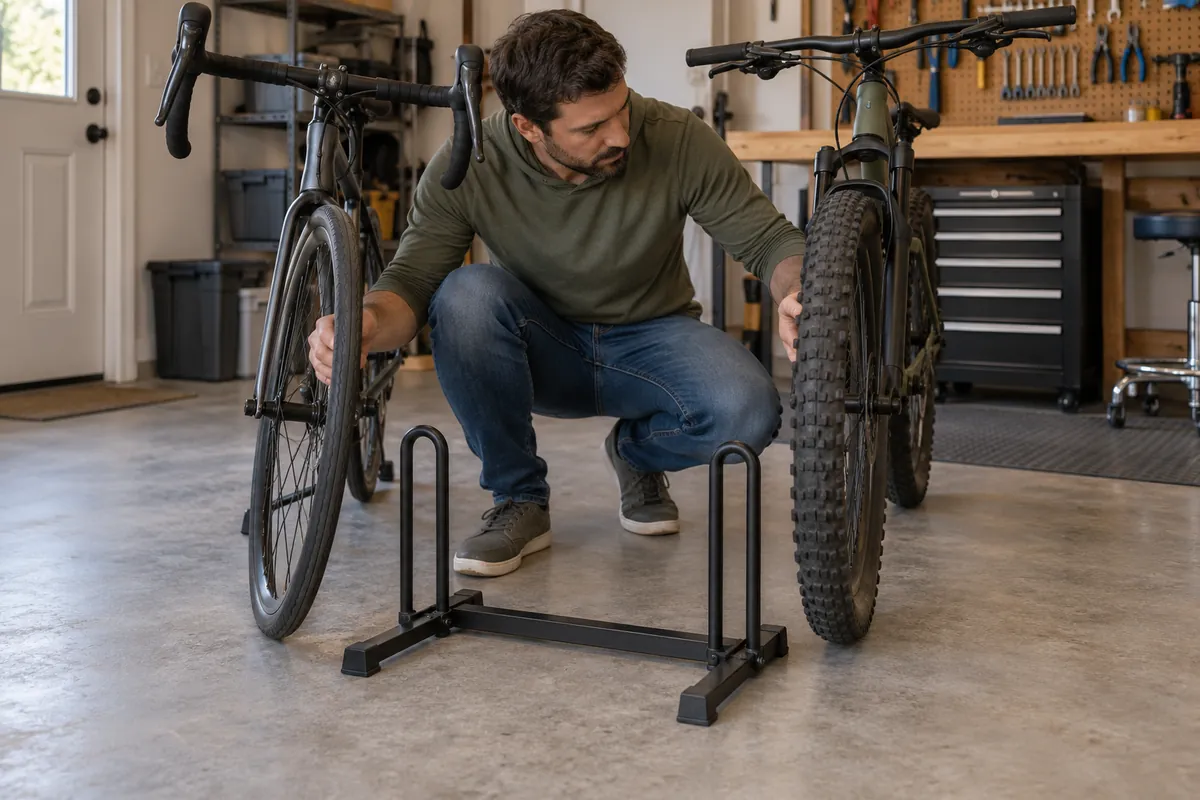
For a multi-bike arrangement, test spacing and retrieval. Removing one bicycle should not require unsafe handling of the neighboring bicycle or moving the entire row unless that is the intended operation. A single-stand approval does not prove a multi-unit layout works.
How Should Buyers Compare Floor Stands with Wall Mounts?
Keep floor stands separate from wall-mounted storage. A floor stand supports the wheel at ground level and requires a footprint and parking path. A wall mount suspends a tire, rim or frame and brings different wall substrate, fastener, access and load questions. A repair stand may clamp a bicycle during maintenance and has another function entirely.
Koitor’s existing bicycle wall-mount topic covers suspended wheel or hook interfaces. K1337 is limited to freestanding floor parking, tire-cradle engagement, insertion/removal and footprint. This distinction matters when buyers compare products or create an assortment: shared words like “bike holder” do not mean that the use, installation or evidence is interchangeable.
What Should the RFQ and Product Claim Include?
The RFQ should include reference bicycles, tire range, wheel position, nearby component envelope, intended floor surface, storage environment, target quantity and packaging requirements. Ask the supplier to provide a drawing showing cradle opening, arm geometry, adjustment and overall footprint. Confirm which accessories or anchors, if any, are included.
Compatibility copy should state the verified tire or bicycle range and any exclusions. If the sample checks one specific tire width and wheel design, do not claim the stand supports every model with a similar nominal size. A listing should not imply e-bike compatibility unless that exact scope is supported. “Stable,” “secure” and “tip-proof” claims also require evidence and careful definition.
An importer should preserve the sample record, drawing revision, packaging and inspection result. If the cradle, adjustment mechanism, base or finish changes, determine whether another sample review is necessary. Reorders should be compared with the approved configuration rather than a generic product photograph.
Buyer Sample-Approval Checklist
- List the bicycle models and intended wheel positions.
- Measure inflated tire width, diameter and tread profile.
- Record bicycle mass from a reliable product source where relevant.
- Note fenders, rotor, derailleur and other nearby obstructions.
- Measure cradle opening, support depth and stand footprint.
- Test parking and removal with actual bikes.
- Observe the tire’s contact location and any component interference.
- Review the base on the intended floor type.
- Separate floor parking from wall mounting and repair use.
- Keep compatibility statements limited to tested models or ranges.
- Require defined evidence for load, slope, stability or non-damage claims.
- Tie approval to the bike samples, stand revision and instructions.
How Should a Buyer Maintain a Reference-Bicycle Matrix?
An importer may support several bicycle families across a single assortment. Keep each reference bike identified by model, year or component configuration when those details are available. Record measured tire dimensions and nearby parts along with the approved parking direction. This prevents a buyer from using a test on one bicycle to justify a much broader statement about all bikes in a size category.
If a bicycle model is updated, compare the new tire, fender, rotor and derailleur geometry with the prior reference. A similar frame name does not guarantee that the wheel assembly stayed unchanged. A different tire tread or fender position can change contact with the cradle. Where no physical bicycle is available, label the dimensions as manufacturer-published and unverified by fit test; do not present them as sample-approved.
Record how the stand is intended to be used: where it is placed, which wheel engages, whether the user rolls or lifts the bike into position and how removal occurs. If an adjustable cradle is offered, identify the approved adjustment setting for each test model. This detail helps another reviewer recreate the same setup and detect a mismatch after a design or instruction revision.
Finally, include packaging and assembly version in the change record. A revised stand may ship with different bolts, arms or feet even if its assembled appearance is similar. The buyer should compare the unboxed product with the approved configuration and determine whether the interface review remains valid. This does not replace a separate structural or installation assessment.
Document the Parking and Removal Sequence
The product instructions should show how the user approaches the stand, positions the selected wheel and removes the bicycle. If the design needs a specific cradle adjustment or wheel direction, identify it clearly. A short setup diagram can reduce assembly errors, but it cannot replace assessment of the actual bike and floor. The importer should approve the diagram against the same reference bicycle used for the fit review.
For several stands placed together, mark the intended spacing and consider handlebar sweep, pedal position and access to neighboring bikes. A row that works with one bicycle may become crowded when all parking positions are filled. Ask the target operator to demonstrate the sequence of parking and retrieving a bike from the center of the row. Record any required movement of adjacent bikes as part of the layout decision.
If the product is offered with adjustable arms or removable cradles, include the settings used during sample approval. The package should identify adjustment parts and indicate which configuration was reviewed. If users can change the setup, describe the supported configurations only when they have been evaluated. An adjustment feature does not imply universal fit.
When the target market includes different floor surfaces, identify the surfaces used in the review and keep claims appropriately narrow. A mat, tile and uneven concrete can interact differently with the stand base. If the buyer needs a particular performance statement, define a test protocol with the responsible technical reviewer. Do not replace that evidence with a marketing phrase such as “secure on any floor.”
Record the approved floor bicycle storage stand scope with the sample identity and current drawing revision so later product changes trigger the right review.
Perguntas frequentes
Does a tire-width range prove every bike will fit?
No. Tread, diameter, fenders, rotors and insertion angle can affect fit. Use the actual target bicycles.
Can one floor stand hold any wheel, front or rear?
Not without checking. Nearby rotors, derailleurs, fenders and frame parts vary by wheel and model.
Is a floor parking stand the same as a wall hanger?
No. The wheel contact, installation, clearances and evidence requirements differ.
Does a tire-cradle stand support every e-bike?
No compatibility should be assumed. Identify the exact bicycle and obtain evidence for the intended use and configuration.
Can the stand be called tip-proof after one sample review?
No. That claim requires a defined method, actual conditions and appropriate evidence. A basic fit check does not prove it.
Koitor Scope and Buyer Next Step
Koitor’s documented capabilities include custom metal hardware discussions, sample development, forming, finishing, assembly and packaging. Current manufacture of a floor bicycle stand, an approved bicycle fit range, e-bike capacity, anti-tip performance or certified parking performance is unconfirmed. Buyers can review the home-storage OEM context e metal storage rack information, then share the bicycle models, tire measurements, cradle concept, floor context and quantity through the contact page. All fit and performance claims need validation for the exact stand and bicycle combination.
When comparing supplier proposals for floor bicycle storage stand, use the same reference samples and acceptance notes to keep the purchasing decision traceable.
Developing a Floor Bicycle Parking Stand?
Share the reference bicycles, tire range, wheel obstructions, floor conditions, stand drawing and target quantity for a bounded fit review.
OEM / MARCA PRÓPRIA
Transforme este guia de fornecimento num resumo do produto
Indique o produto pretendido, as dimensões, o acabamento, a quantidade a encomendar e os requisitos de embalagem. A sua equipa receberá uma análise prática da viabilidade de fabrico antes da apresentação do orçamento.


 English
 Español
 Português
 Français
 Deutsch
 العربية