

How to use curtain hooks in a product assortment starts with identifying the curtain’s actual header, not with choosing a hook from a familiar product-family name. For a buyer, deciding how to use curtain hooks starts with matching the attachment to that header and the maker’s instructions. For a buyer, deciding how to use curtain hooks starts with matching the attachment to that header and the maker’s instructions. A gathering-tape hook, a clip that grips fabric, and a suspension component that meets a rod, wire, ring, or track are separate decisions. For an importer, the practical first step is to record the curtain model or sample, the required curtain-side attachment, the exact part code, and the independently confirmed upper connection. A name or photograph alone does not prove that two parts fit together.
That distinction matters when a buyer coordinates a curtain from one supplier with hooks or suspension hardware from another. A product can look similar to a sample and still belong to a different interface family. The purchasing record should make the intended pairing visible before a quotation, sample approval, or replacement order is released.
What does “curtain hook” identify in a buying brief?
The phrase “curtain hook” can refer to a part that attaches to a prepared curtain header, a clip that grips fabric, or a component that connects the curtain-side part to a rail or ring. These functions are related, but they are not interchangeable labels. A buyer who writes only “curtain hooks, silver” has not necessarily stated which fabric preparation is present, which part is supplied, or how the upper end is supported.
For assortment work, divide the assembly into three named interfaces:
| Interface | Buyer identifies | Supplier confirms |
|---|---|---|
| Curtain header | The actual curtain model, revision, and header family or controlled sample | Whether the proposed curtain-side part is intended for that header |
| Curtain-side attachment | Pleating hook, clip, another documented attachment, or no supplied part | Exact product code, material description, included pieces, and model-specific instructions |
| Suspension-side connection | Rod, wire, ring, runner, track, or other receiving component | Whether the selected hook’s upper end matches the named receiving part |
This is a documentation framework, not a universal list of hook designs. A supplier may use different terminology, and two products called “hooks” can have different functions. The buyer should preserve the maker’s exact name and code alongside a plain-language explanation of the interface.
The distinction is especially useful in a private-label assortment with more than one curtain header. The same rail system may serve curtains with different top constructions, while one header family may require a different curtain-side attachment from another. If the assortment record collapses every component into “hook,” a product-data writer, purchasing manager, and supplier can each make a different assumption without realizing that the order is incomplete.
Start with the curtain, then identify the accessory. Do not begin with a preferred hook and infer that the curtain must accept it. The product team can provide the curtain’s model number, current drawing, sewn header description, physical sample, or supplier document. If none is available, mark the field unresolved instead of assigning a hook based on a room photograph.
Why does the curtain header come before the hook name?
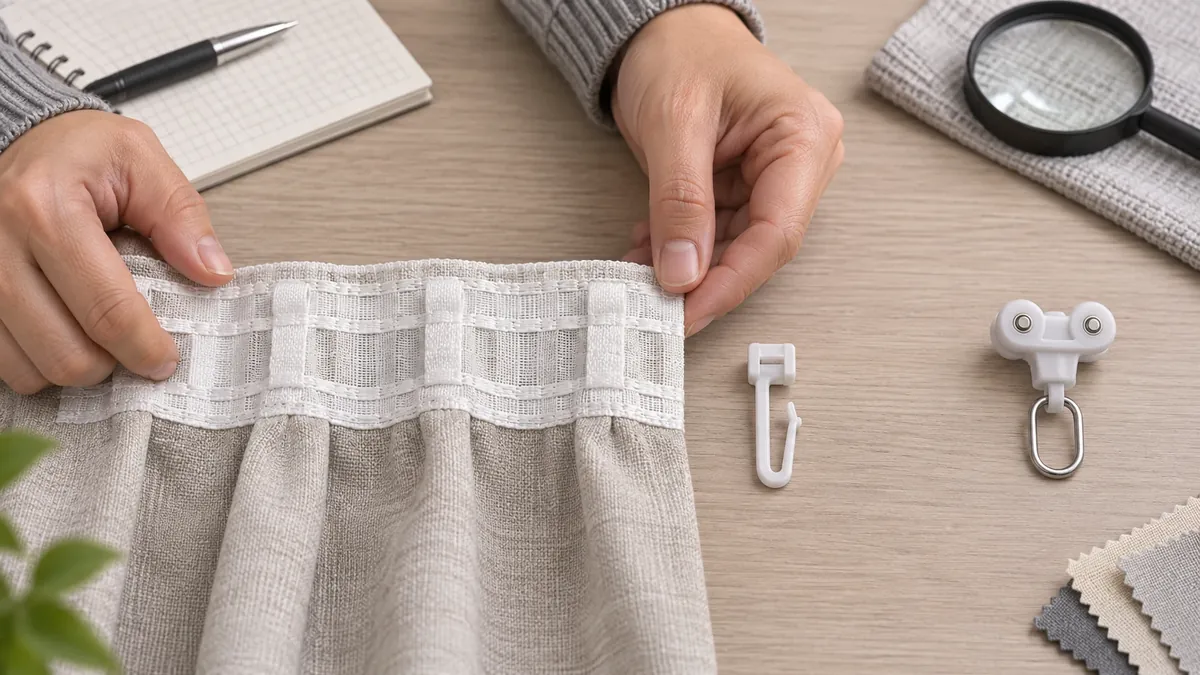
The header is the part of the curtain that determines what kind of attachment can be considered. Retail and maker guides describe several header families, including eyelet, pencil pleat, slot-top, hidden-tab, and multiway styles. They are useful category names for browsing, but they do not replace a model-specific attachment statement. A private-label buyer should confirm which family the selected curtain actually uses and whether the supplier’s part reference applies to it.
A maker’s own item pages show why the part code matters. IKEA identifies RIKTIG item 402.122.03 as a steel pleating hook intended for curtains with gathering tape. A different item, RIKTIG 602.122.02, is a curtain hook with a clip and is described as clamping curtains. Those descriptions support a narrow comparison between two named products. They do not establish that every gathering-tape curtain uses the first item, that every fabric clip fits every textile, or that the two references can substitute for each other.
The published IKEA guidance for attaching curtains to Japanese rails also separates curtains labeled with heading tape from curtains without that tape. The page directs the first group to a buyer-supplied adjuster hook and describes another route for the second group. That is a maker-specific answer for the products and system in its guidance. It is not a global installation instruction.
For the same reason, a curtain family name is not enough to approve a receiving rail or ring. The curtain-side component may attach correctly while its upper end remains incompatible with the proposed suspension component. Ask the relevant supplier to confirm the full path from curtain header through attachment to receiving part. If the curtain and track suppliers are different, make each supplier responsible for the part they supply and for the interface they can verify.
A buyer does not need to collect every technical detail at the first screening step. The goal is to prevent a catalog phrase from standing in for the actual assembly. Keep three questions visible:
- What does the top edge of the specific curtain provide?
- What exact part attaches to that top edge?
- What exact rod, wire, ring, runner, or track receives the other end?
If one answer is missing, the order is not fully defined. The missing field may be resolved by a drawing, a written maker statement, an identified sample, or a supplier-to-supplier confirmation. Record which source supports the answer so a future replacement buyer can distinguish a verified match from an old assumption.
How should buyers compare pleating hooks, clips, and other routes?
Use a comparison that describes the header-side task rather than ranking products in general. This table serves as an editorial decision aid; it does not replace the source maker’s instructions or establish a fit guarantee.
| Buyer’s observed curtain condition | Candidate route to verify | Provas a solicitar | What remains unproven |
|---|---|---|---|
| Curtain specification identifies gathering tape | A pleating hook named for that exact curtain or header | Curtain model, supplier statement, and hook code | Pocket spacing, hook count, final drop, and fit with an unrelated rail |
| Curtain has no documented tape pockets but is intended to be clipped | A fabric clip and hook assembly named for that curtain | Actual sample or drawing, clip code, fabric reference, and suspension reference | Holding force, textile damage, weight capacity, or long-term performance |
| Curtain uses eyelets, tabs, a direct pole opening, or another header | The documented system for that header family | Curtain supplier’s connection detail and receiving-component model | That a pleating hook or clip is suitable merely because another curtain uses it |
| Curtain header is unknown or the sample is incomplete | Hold the item decision pending identification | Controlled sample, current product sheet, or written confirmation | Any compatibility assumption based on a room image or generic catalog label |
A buyer may be shown a curtain and a hook in a single marketing photograph. That image can help identify the product family, but it may not expose the part code, receiving interface, or whether the pictured combination is supplied as one set. Ask for the source document that establishes the pairing. If the answer is “this is the standard hook,” ask which curtain model and header revision that statement covers.
The product references in the maker examples should also stay distinct. IKEA’s 402.122.03 and 602.122.02 pages describe different parts and different attachment approaches. Their shared RIKTIG family name does not make them the same product. A buyer should not transfer the material, quantity, dimensions, or compatibility of one code to the other without documentation. These statements describe those references only; they are not endorsements or recommendations for another manufacturer’s assortment.
Avoid forcing every selection into a binary “tape hook or clip” choice. Some curtains may have a different documented connection, may arrive without a curtain-side accessory, or may be designed for direct suspension. The correct decision can be “not applicable,” “supplier to identify,” or “hold for sample.” A controlled unknown is more useful than a confident but unsupported part selection.
What should the RFQ and sample record contain?
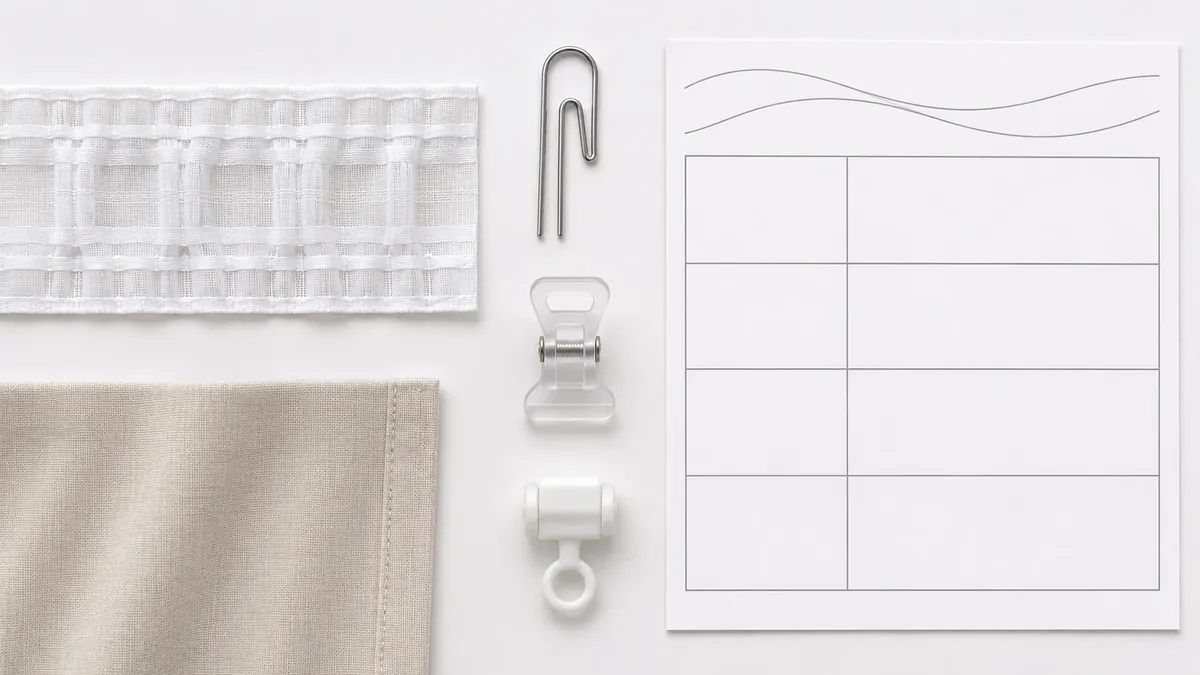
A purchasing team can keep the decision short if it names the components and unresolved fields. The following schedule is suitable for an RFQ, sample review, or product-data approval. It is a proposed buyer tool, not a claim that Koitor or another supplier already uses this exact form.
| Record field | Example of useful wording | Approval status |
|---|---|---|
| Curtain identity | Supplier, style or model code, revision, and sample reference | Confirmed / unresolved |
| Header family | Maker’s stated family plus a photograph or drawing reference | Confirmed / unresolved |
| Curtain-side attachment | Exact pleating hook, clip assembly, other documented part, or none | Confirmed / unresolved |
| Part identity | Manufacturer and exact item code, not only “curtain hook” | Confirmed / unresolved |
| Suspension component | Named wire, rod, ring, runner, or track model and supplier | Confirmed / unresolved |
| Pairing evidence | Current maker document, drawing, sample sign-off, or written confirmation | Attached / missing |
| Supply scope | Which pieces are included, excluded, or ordered separately | Confirmed / unresolved |
| Quantity basis | Unit of sale and included-piece count as quoted by the supplier | Confirmed / unresolved |
| Change trigger | Curtain, header, accessory code, receiving part, or revision change | Review required / not applicable |
| Decision owner | Product, sourcing, or technical person accountable for approval | Named / unresolved |
The RFQ should ask each supplier a question it can answer. A curtain maker can confirm the curtain’s header and the part it recommends for that model. A hook supplier can confirm its own part code and the interface it documents. A rail or suspension supplier can confirm the receiving part. If no supplier owns the full assembly, the buyer should document the gap and arrange a joint confirmation rather than treating a seller’s general statement as system-wide approval.
The sample set should carry the same identity as the RFQ. Label each curtain, hook, and receiving component separately. Keep the maker’s packing labels, product codes, and sample revision together. If pieces are removed from their original package for a review, record which reference each piece came from. An unlabeled tray of similar metal parts can make a later approval difficult to reproduce.
Do not treat a successful fit during a sample review as proof of every performance claim. A sample can answer a defined question such as whether the documented parts connect in the approved arrangement. It cannot, by itself, establish a load rating, a cycle life, textile compatibility across all fabrics, corrosion resistance, or an installation outcome that has not been tested under a defined method. Keep functional approval and performance evidence as separate records.
If a product-data team plans to make a broad compatibility statement, ask what evidence supports the exact wording. A statement about one curtain and one named accessory should not be expanded to all curtains in a family. A buyer may use a model-specific sentence and retain the maker’s reference, or omit the compatibility claim until the responsible supplier supplies evidence. A conservative product page can still be clear: name the documented curtain or attachment family, list the included components, and state what the buyer must verify.
How can buyers prevent a replacement order from drifting?
A replacement order often starts from a partial reference: a product photograph, an old carton, a discontinued code, or a line in a spreadsheet that says only “curtain hooks.” That is a prompt to recover the full identity, not a reason to assume the closest-looking part is correct.
Compare the replacement item against the approved record in this order:
- Confirm that the curtain model and header have not changed.
- Confirm that the curtain-side attachment code is the same or that a supplier has documented the replacement.
- Confirm the receiving rod, ring, wire, runner, or track.
- Confirm whether the same parts are included and whether the order unit changed.
- Record the source and date for any supplier statement.
- Flag a changed curtain supplier, header revision, or receiving component for re-approval.
Do not interpret a similar finish or shape as proof of the same interface. Two silver-colored hooks may be intended for different header constructions. A clip and a tape hook may both be described as curtain hooks while attaching to different parts of the curtain. A product-family name can persist while the model code or included pieces change. The replacement decision should follow controlled identity, not visual resemblance alone.
A supplier change also deserves a precise question. Ask whether the new part is intended for the identified curtain header, whether the upper interface is the same, and what source supports the answer. If the supplier cannot confirm one of those points, mark the substitution as unverified. Do not silently preserve a previous product claim after a part code changes.
This scope differs from the next question in the assembly path: whether a moving ring passes a bracket or telescopic joint. Koitor’s guide to bypass curtain rings and bracket clearance addresses that distinct travel decision. The related shower-curtain roller-ring joint check also belongs to the receiving path. Neither article should be used as evidence that an unrelated pleating hook or fabric clip fits a particular curtain.
Where do packaging and product information fit?
The part-selection record should carry through to the carton, product listing, instruction sheet, and replacement-parts process. The objective is not to prescribe a universal packaging design. It is to make the supplied set clear enough that a buyer can identify what was approved and what is expected in each unit.
The quotation should identify whether the order includes the curtain-side attachment, a suspension-side component, both, or neither. If the product is sold in a pack, state the supplier’s pack basis and the number of included pieces as confirmed. Do not infer quantity from a retail product page in another market or copy another maker’s pack size. A product data team should match photography and diagrams to the actual offered code. If an image shows a hook clipped to fabric but the package contains only a hook, the listing should not imply that the fabric clip is included.
An instruction insert or assembly diagram should name the model and the interface it covers. Keep the approved revision with the sample sign-off and purchase order. If a supplier supplies an alternative accessory, record its code and any buyer-reviewed substitution. A generic illustration may explain the difference between header families, but it should not show parts assembled in a way that suggests a fit that has not been confirmed.
Packaging and logistics add another reason to control part identity. Loose small components can become separated from their labels; mixed codes can be hard to reconcile during receiving. The buyer can define a clear part label and pack list with the supplier, but the chosen method depends on order configuration and packaging scope. The article does not prescribe a bag type, carton layout, inspection frequency, or transit test. Those decisions need product-specific information and approval by the responsible team.
In the product record, keep “included,” “sold separately,” and “not applicable” visibly different. If a hook is supplied with the curtain but the rail-side connection is not, say so. If buyers must provide their own adjuster hook or ring, the product description should identify the requirement based on the exact maker documentation. If supply scope is unknown, do not publish a universal compatibility or completeness claim.
What does a careful supplier handoff look like?
A useful handoff is specific enough that the next person can see the decision without replaying an informal conversation. It contains the curtain reference, header family, selected attachment, receiving component, source evidence, supply scope, and any open question. It identifies the responsible supplier for each connection and records who approved the combination.
For example, a buyer could send a curtain supplier’s model code and a controlled header photograph, request the supplier’s exact hook or clip code, then pass that code with the proposed receiving component to the rail supplier for confirmation. This sequence does not presume that either supplier has validated the other supplier’s part. If the supply chain has one vendor responsible for the complete set, the buyer can request written confirmation for that full model combination and retain the response with the approved data.
Use questions that separate evidence from assumption:
- Which exact curtain model and header family does this accessory reference cover?
- What is the accessory code, and what parts are supplied in the quoted unit?
- Which named rod, wire, ring, runner, or track receives the upper end?
- Is the pairing supported by a current drawing, model statement, or approved sample?
- What changes would require the combination to be reviewed again?
The response can be concise. A long email thread is not more reliable if no one can tell which answer applies to which revision. Put the approved combination into the product specification or controlled order record, link the source, and label unresolved details. When the curtain supplier, part code, or receiving system changes, reopen only the affected pairing rather than assuming that earlier approval carries over.
A buyers’ schedule is particularly useful when different stakeholders use different terms. The product team may say “heading tape,” the supplier may say “pleating hook,” and the catalog may call the assembly a “curtain hook.” A purchasing record can preserve each party’s wording while mapping it to an exact model. That reduces ambiguity without pretending there is a universal vocabulary shared across brands.
What can Koitor credibly review?
Koitor Hardware’s approved scope is metal bathroom and home-storage hardware, including drawing or sample-based product discussions and relevant forming, joining, finishing, assembly, and packaging considerations. That experience can support a conversation about an identified metal component within a broader home-storage or hardware project. It does not establish that Koitor manufactures curtains, sewing headers, curtain tracks, fabric clips, pleating hooks, or the IKEA references discussed above.
For buyers whose project includes metal storage hardware, a drawing or physical sample can help define the part, interface, finish, and packaging question before quotation. The project’s product scope and manufacturing feasibility still need to be confirmed. The general OEM home-storage hardware overview describes Koitor’s relevant broader metal-product context. It should not be read as a curtain-accessory catalog or a promise that every adjacent component is available.
The boundary is important for technical and commercial accuracy. Koitor cannot substitute its general metal-hardware experience for a curtain maker’s header specification, a hook supplier’s fit statement, a textile supplier’s material guidance, or a suspension-system supplier’s approval. Buyers should ask the responsible party to confirm each interface and should keep product-specific performance or safety requirements with a qualified reviewer.
Buyer checklist before approving an order
Before quotation, sample approval, or a replacement order, confirm:
- The curtain model, revision, and header family are identified.
- The curtain-side attachment is named by supplier and exact code.
- The receiving rod, wire, ring, runner, or track is identified separately.
- The full pairing is supported by model-specific source evidence or an approved controlled sample.
- The quote distinguishes included, separately ordered, and excluded parts.
- Pack quantity is stated from the actual quotation, not inferred from another product.
- Product images and instructions represent the supplied model and its documented connection.
- Any changed curtain, hook, or receiving component is routed for review.
- Performance claims are supported by separate, relevant evidence.
- Unresolved fields are marked as unresolved rather than assumed.
If one of the first five fields is missing, the buyer should hold the item selection until the relevant supplier responds. The record can be short; its value comes from naming the exact parts and preserving who confirmed each relationship.
Perguntas frequentes
Does every curtain use a pleating hook?
No. Curtain headers differ, and the selected attachment must match the actual curtain and its supplier documentation. A pleating hook is relevant only when the specified header and maker guidance support it. Do not infer the attachment from the word “curtain” or from another item in the same retail family.
Are a curtain clip and a pleating hook the same part?
Not necessarily. The cited IKEA pages identify different product codes and describe different curtain-side approaches: one is a pleating hook intended for gathering tape, and another is a clip hook described for clamping curtains. That comparison applies to those specific references. A different supplier may use different names or designs, so buyers should check the exact code and intended interface.
Does a hook that attaches to the curtain automatically fit any rail?
No. The curtain-side attachment and the receiving suspension component are separate interfaces. A buyer should identify the named rod, wire, ring, runner, or track and ask the responsible supplier to confirm the pairing. A generic product-family name does not establish compatibility.
What should an importer do when the current hook code is unavailable?
Keep the original curtain and receiving-system references, then ask the supplier to identify a replacement code and provide evidence for the exact pairing. Compare the interface, included parts, and order scope. Mark the substitution unverified until the responsible supplier or approved sample review resolves it. Do not select a visually similar part solely by finish or shape.
Is sample fit enough to claim long-term performance?
No. A sample review can resolve a defined question about an identified assembly, but it does not establish performance across other models, fabrics, environments, or service conditions. Any durability, load, fabric-damage, corrosion, or cycle claim needs evidence that matches the actual product and the claim being made.
Need Help Defining a Metal Hardware Interface?
If your assortment includes a metal bathroom or home-storage component, send Koitor the relevant drawing or physical sample, finish requirement, packaging scope, and expected quantity. The team can review the confirmed metal-product scope and discuss manufacturability before quotation. Curtain, textile, hook, and track compatibility must be confirmed by the suppliers responsible for those parts.
OEM / MARCA PRÓPRIA
Transforme este guia de fornecimento num resumo do produto
Indique o produto pretendido, as dimensões, o acabamento, a quantidade a encomendar e os requisitos de embalagem. A sua equipa receberá uma análise prática da viabilidade de fabrico antes da apresentação do orçamento.

 English
 Español
 Português
 Français
 Deutsch
 العربية