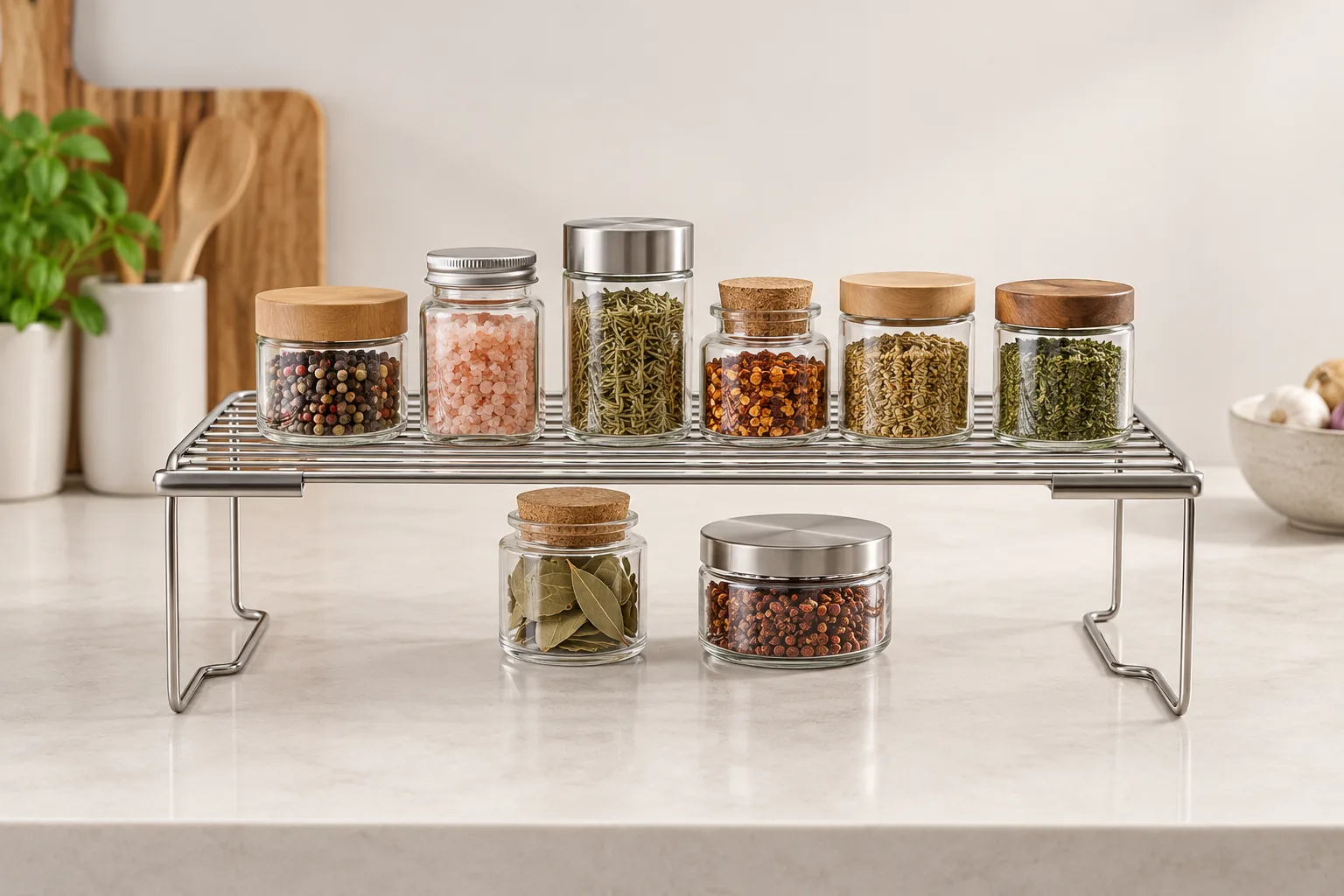
Kitchen spice rack jar clearance design should begin with the buyer's intended jar assortment and the space needed to place and remove those jars. Outside rack dimensions do not establish usable shelf width, cap clearance or retrieval access. Importers should approve a jar-envelope record, relevant installation boundaries and a representative fit trial before freezing the drawing. This makes a compatibility claim specific enough for the factory to manufacture and the retailer to explain.
Which jar assortment should the rack fit?
Define the intended jars before specifying the rack, because a rack that fits one sample may not fit the assortment sold in the target market. The approved assortment is a product-development input, not an assumption based on a styled product photo.
Start with the buyer's own planned packaging formats or a clearly identified set of reference jars. Include the body, lid, label and any outer sleeve that remains in normal use. A jar's nominal capacity does not define its maximum outside dimensions.
Separate included jars from examples. If the product is sold with a fixed jar set, the set can be controlled as part of the supplied product. If the rack is sold alone, the buyer needs a defined compatibility statement and a realistic range of reference containers. Do not imply universal jar fit.
Record whether the assortment includes round, square, tapered or irregular containers. A cap can be wider than the body, while a square jar may need more space when rotated. These are observations to measure on the selected samples rather than reasons to copy a dimension from an unrelated product.
The supplier's catalog can help reveal the distinction between overall size and intended use. Rev-A-Shelf's sliding spice and can rack page identifies a particular organizer type. Its product dimensions and installation approach describe that product, not a universal specification for Koitor racks.
A useful assortment file contains sample photographs, identifiers and dimensions with a clear measurement basis. State whether the buyer supplied actual containers, drawings or estimated packaging concepts. An estimated jar should remain an open item until its dimensions are confirmed.
Consider a hypothetical importer planning one rack for small glass spice jars and larger seasoning containers. Rather than approve the rack with a single attractive jar, the importer should identify the controlling body width, cap width and height across the assortment. That creates a clear development question for the OEM supplier.
How should buyers record jar envelopes and finished-rack dimensions?
Record the largest relevant container envelope and the finished internal rack dimensions that constrain it. The drawing should distinguish usable space from overall dimensions and explain how the measurements are taken.
For each jar, identify maximum body width or diameter, cap width, overall height and any feature that changes placement. If filled weight matters to the structure review, record the relevant filled condition separately. Weight information does not replace a project-specific strength assessment.
For the rack, mark clear shelf width, shelf depth, vertical clearance and retaining-rail location. State the reference surfaces used to measure each dimension. The outside width of a bent wire frame may be substantially different from the space available between its side wires.
Measure the final coated or finished product where finish affects the fit question. A drawing that only describes an unfinished wire form may not capture the supplied configuration. Confirm tolerances with the supplier and responsible designer rather than inventing a standard allowance for every jar.
| Item | Measurement or record | Buyer decision |
|---|---|---|
| Jar body | Maximum relevant outside envelope | Whether the container can sit in the intended position |
| Cap or lid | Width and overall height | Whether the lid interferes with adjacent jars or shelves |
| Rack shelf | Finished clear width and depth | Whether the approved assortment fits the usable space |
| Vertical opening | Clear space above a seated jar | Whether the jar can be lifted for removal |
| Retaining rail | Height and location relative to shelf | Whether retention obstructs extraction |
| Installation boundary | Nearby shelf, cabinet or countertop geometry | Whether product fit survives the intended location |
| Sample variation | Identified reference samples and limitations | Whether the compatibility statement is justified |
Do not use nominal volume as a shortcut. Two jars holding the same amount can differ in shape, lid and height. A retailer's assortment decision should use the actual packaging envelope or a controlled drawing.
Kitchen spice rack jar clearance design also needs a measurement priority. Identify the dimensions that directly govern the intended fit and which are appearance or packaging dimensions. This helps the supplier avoid spending effort controlling an outside dimension while the critical opening remains vague.
If a finish or structure changes, check whether the finished clearance remains within the approved requirement. A wider side rail, revised corner bend or additional shelf support can change usable space even when the overall rack outline appears similar.
How do shelf pitch and retaining rails affect retrieval?
Shelf pitch and rail geometry affect whether a jar can be removed conveniently, not merely whether it can be stored. Evaluate the complete removal path with the intended container and surrounding assortment.
Shelf pitch is the separation between shelves or their reference levels. It is not automatically the clear opening available above a jar. Wires, rails, supports and the next shelf's underside can occupy part of that space. Mark the actual controlling features on the drawing.
A jar may need to rise above a front rail before it can move forward. The cap can then approach the shelf above. A low retaining rail may ease retrieval but change retention behavior. The buyer should define both tasks rather than select a rail height from a generic chart.
Check whether the jar must tilt. If the intended removal path involves tilting, the wider cap or diagonal body envelope may become relevant. Confirm the path on samples and state any limitation. Do not claim that a jar fits solely because its upright height is below the opening.
Assess neighboring containers. A tightly packed row may store the jars while leaving insufficient space for fingers or a clear extraction path. Use the intended assortment arrangement rather than placing one jar at the center of an empty shelf.
Also review replacement. Users must be able to return a jar without trapping another lid or scraping an exposed edge. The assembly should be checked in its supplied condition, including finish and any removable parts. Observe contact rather than inferring it from a rendering.
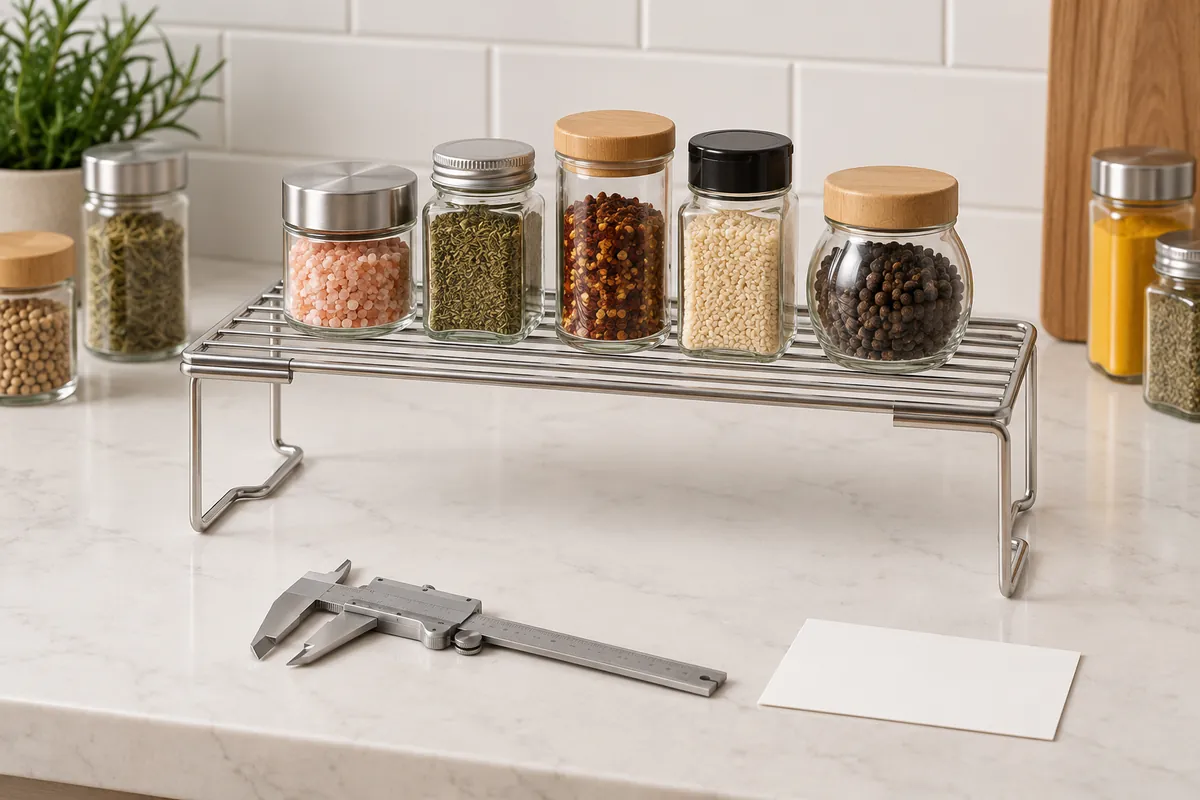
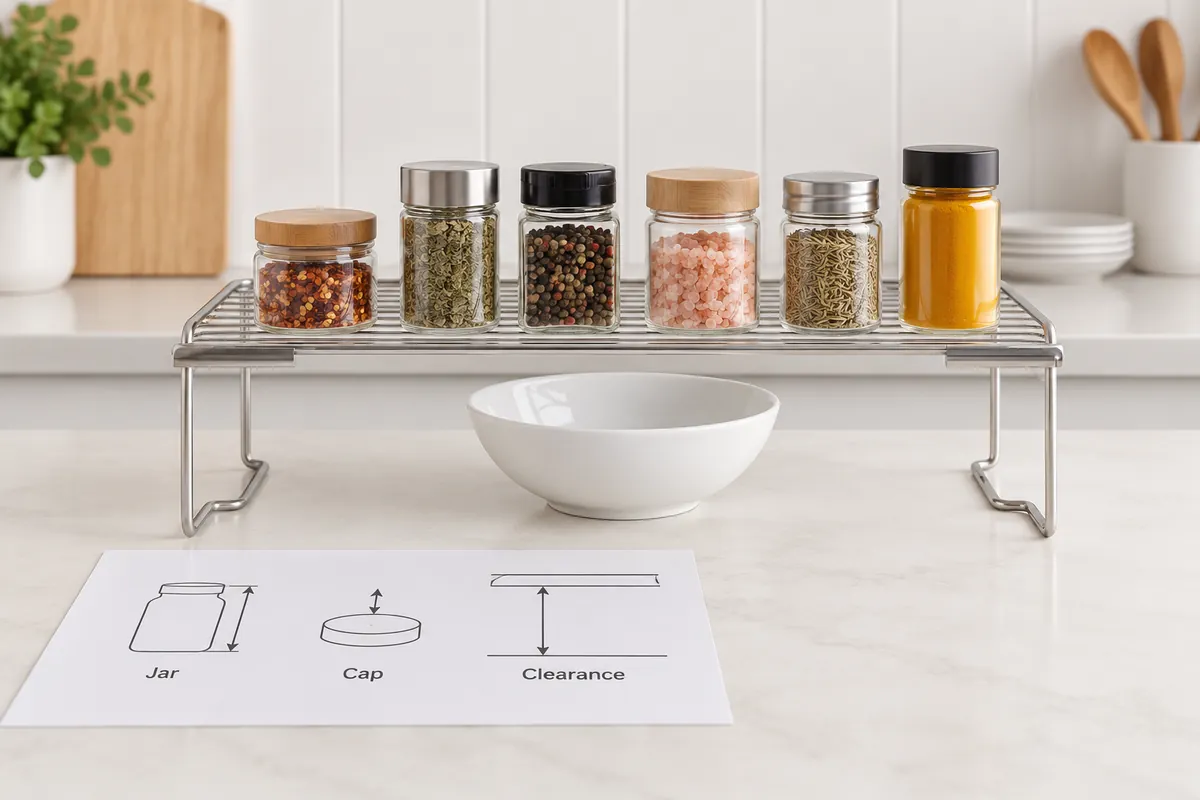
A reference shelf can illustrate how usable space differs from the outline, but the final approval must use the actual proposed spice-rack design. The images in this guide illustrate a review task; they do not establish capacity, dimensions or a completed fit result for a Koitor product.
For an OEM buyer, the useful decision is a documented combination of jar envelope, shelf arrangement, rail configuration and retrieval method. That is more specific than a product brief stating convenient storage and avoids promising fit for containers never reviewed.
Which installation boundaries belong in a separate fit record?
Record the intended placement and nearby obstructions separately from jar fit. A rack can accommodate the approved jars yet fail its cabinet, countertop or shelf location.
Identify whether the design is freestanding, wall mounted, door mounted or part of a pull-out assembly. Do not transfer clearance assumptions between mounting systems. This article addresses the jar and retrieval specification; mounting and load approval remain product-specific tasks.
For a cabinet location, record the usable opening and relevant shelf, hinge or frame obstructions. If the rack moves, identify the movement envelope and any nearby components. A nominal cabinet width does not necessarily describe the available space.
For a countertop shelf, state the supporting surface and available space above and around the rack. Check whether taller jars can be inserted under a nearby cabinet or whether the rack must be repositioned during use. Those questions should be addressed in the proposed use statement.
Separate a known installation from a broad market claim. A buyer can approve fit in an identified cabinet or defined opening range. That evidence does not establish compatibility with every kitchen. Retail dimensions should clearly distinguish the product's overall size from the opening and container requirements.
If the buyer's own installation information is incomplete, identify the uncertainty before sampling. A supplier can develop a rack from confirmed dimensions but cannot validate an unspecified kitchen environment. Keep a hold item for the missing boundary instead of quietly assuming an average cabinet.
Document which team owns each record. The jar supplier may confirm container drawings, the rack supplier may confirm finished geometry, and the buyer may approve the intended installation range. The combined record supports a useful compatibility claim without implying that one supplier controls every variable.
For kitchen spice rack jar clearance design, separating those records also makes changes easier to assess. A new jar lid changes one envelope. A new cabinet assortment changes another. Both can affect use, but they may require different sample work.
How should buyers review a representative worst-case jar set?
Review a defined sample set that covers the controlling dimensions and use tasks. A worst-case set means the identified limiting cases for the approved assortment, not a universal collection of every jar on the market.
Select samples that represent the largest relevant body, tallest cap, widest lid and any distinctive shape. Those limits may belong to different jars. Label each sample so the supplier can connect an observation to the assortment file.
Evaluate placement, storage, removal and replacement in the intended arrangement. Observe interference with shelf wires, rail openings, neighboring caps and surrounding boundaries. Record where contact occurs and whether the task matches the intended user instruction.
An importer should agree the observation method with the supplier. The aim is to make the decision repeatable, not to invent a laboratory test number. Where accessibility, safety or market-specific requirements apply, obtain the appropriate qualified review rather than substituting an informal fit trial.
Use photographs or short records showing the actual configuration. Include the finished rack revision and jar sample identities. A photo of an empty rack beside jars is useful for identification but does not establish retrieval clearance.
If a conflict appears, identify which requirement should change. The options may include narrowing the intended assortment, revising shelf pitch, changing a rail or developing another size. Assess manufacturing, packaging and commercial effects before choosing.
Koitor can review wire forming, welding, finishing and practical structure changes from drawings or physical samples. The custom kitchen storage rack manufacturing page provides the relevant OEM context. A confirmed jar-envelope file makes that discussion more precise.
After a revision, repeat the relevant fit task on the changed sample. Do not assume that a new shelf spacing solves every issue if rail placement, stability or packaging also changed. Record the final limitations so product listings do not overstate what was approved.
Which drawing and sample checklist freezes compatibility?
Freeze compatibility by connecting the assortment record, finished drawing and approved sample. The purchasing file should explain the claim and make later substitutions visible.
- – Identify the target buyer, market and planned product assortment.
- – State whether jars are included or independently sourced.
- – Record each jar's identifier, body envelope, cap and height.
- – Identify controlling samples and measurement reference surfaces.
- – Specify finished clear shelf width, depth and vertical opening.
- – Record shelf pitch, retaining rails and other obstructions.
- – Define placement, removal and replacement tasks.
- – Record intended mounting and nearby installation boundaries.
- – Save the finished sample revision and fit observations.
- – List permitted claims, excluded containers and unresolved questions.
- – Approve packaging dimensions and assembly instructions separately.
- – Define jar, rack, finish and installation changes requiring review.
For repeat orders, confirm that jar packaging has not changed. A brand can retain the same label and nominal capacity while changing the lid or container shape. The purchasing record should track the packaging version relevant to fit.
Likewise, request notice of rack changes affecting the opening. Wire dimensions, bends, shelf supports and finish can change the functional space. A manufacturing improvement should not quietly change the approved assortment claim.
Cost discussions should compare the complete specification. Increasing clearance may affect overall height, material usage or carton size. A second product size may improve assortment coverage but add inventory and tooling considerations. Ask the supplier to explain those trade-offs for the actual design.
Koitor supports flexible small-batch OEM production and sample-based or drawing-based development. Order quantity, materials, finish and packaging affect MOQ and timing. Confirm the scope before quotation rather than treating jar-fit development as a free universal guarantee.
A clear compatibility file helps retail and e-commerce teams publish dimensions responsibly. It also gives inspection teams a specific feature to check instead of relying on a broad phrase such as fits standard jars.
What do importers ask about spice-rack clearance?
Can a nominal jar capacity define rack fit?
No. Capacity does not identify maximum outside width, cap diameter or height. Use the actual container or a controlled packaging drawing for the intended assortment.
Does a jar fitting upright mean it can be removed?
No. Removal may require lifting above a rail or tilting beneath the next shelf. Review the full retrieval path with neighboring containers and intended installation boundaries.
Should the rack drawing include only overall dimensions?
No. Overall dimensions matter for installation and packaging, but the drawing also needs finished internal clearances and relevant reference surfaces. Identify which openings control the approved jar fit.
Can one trial establish universal spice-jar compatibility?
No. It establishes observations for the identified rack, samples and use conditions. Keep retail claims within the approved envelope and state relevant limitations.
What should be rechecked after a lid or shelf changes?
Review the dimensions and tasks affected by the change, including retrieval and neighboring-container contact. Update the sample and drawing record before repeating the old compatibility claim.
Discuss Your Hardware Specification With Koitor
Send Koitor your drawing, physical sample, material and finish requirements, intended use and packaging plan. Our family-owned custom metal hardware factory can review manufacturing practicality and small-batch OEM project requirements before quotation. Specific performance and any adjacent product feasibility require project confirmation.
OEM / MARCA PRÓPRIA
Transforme este guia de fornecimento num resumo do produto
Indique o produto pretendido, as dimensões, o acabamento, a quantidade a encomendar e os requisitos de embalagem. A sua equipa receberá uma análise prática da viabilidade de fabrico antes da apresentação do orçamento.
 English
  Español
  Português
  Français
  Deutsch
  العربية