

A magnetic knife holder OEM buyer specification should define the intended knife assortment, strip length, blade-contact face, mounting arrangement, supplier evidence and complete-product sample method before approval. A magnet supplier’s catalog pull figure does not by itself describe how a finished holder behaves with the buyer’s knives, cover material, orientation and wall installation. Specify the actual configuration and agree how retention, sliding, placement and removal will be reviewed. Koitor’s production or sourcing of magnetic knife holders and magnet assemblies is unconfirmed, so this article is an adjacent-category buyer guide rather than a capability claim.
Why is a component pull-force figure not enough?
A pull-force value is meaningful only with its test piece, contact condition, direction and method. A perpendicular separation test on a clean steel coupon answers a different question from whether a knife slides down a vertical strip, rotates when its handle is offset, or releases comfortably when the user removes it. For the finished product, the blade material and shape, magnet pattern, face cover, air gap, contact area and wall orientation all matter.
Specialist magnet guidance, including K&J Magnetics’ knife-holder design discussion, describes how distance between magnet and blade, knife configuration and friction can change holding and removal behavior. Those explanations are useful for understanding what to ask, but the examples and ratings from one magnet, knife, or holder design do not establish performance for another. A separate magnetic pull-test guide notes that a controlled test is bounded by its specified test piece and direction; it cannot be treated automatically as shear or sliding performance. Keep any reported number attached to its original method.
The buyer’s purpose is not to calculate an engineering rating from a product listing. It is to ask the responsible product and magnet suppliers for evidence relevant to the proposed assembly, then confirm the actual configuration with agreed sample checks. If no evidence exists for the complete holder, list that as an open approval item rather than filling the gap with a component figure.
Which knives must the product brief cover?
List the representative knife assortment by type and dimensions: for example, chef, paring, bread or utility knives where relevant to the buyer’s range. Record approximate blade length, height, spine thickness, handle shape and weight range when the supplier needs them for fit or evidence planning. Do not assume every steel alloy or blade construction responds identically to a magnetic interface; the responsible supplier should identify the intended compatibility and any exclusions.
Include the actual knives or representative samples for development when practical. A generic steel block may help the component supplier compare a controlled test setup, but it may not reproduce the buyer’s blade geometry or balance. Note whether knives have a full tang, bolster, broad blade, curved profile, coating, decorative cladding or unusually heavy handle. These features may affect contact, spacing or rotation; they are inputs for project-specific review, not a universal prediction of failure.
Define how many knives should fit across the usable zone and the minimum spacing the product team needs for fingers and handles. Show the intended orientation and whether knife handles may overlap, touch a nearby wall or interfere with cabinets. Check access to the strip ends and to any mounting screw cover or bracket. A holder that appears long enough in a catalog image may offer less usable length once end caps, gaps and the chosen assortment are considered.
What should the RFQ specify?
The magnetic knife holder OEM buyer specification should make supplier responses comparable and assign responsibility for each part of the system. Use a drawing or annotated reference image that identifies the visible face, magnet or magnetic assembly location, mounting components, fastener positions and any protected contact surface. Identify which items the holder supplier provides and which come from a separate magnet, hardware or knife supplier.
| RFQ field | What the buyer should state | Por que é importante |
|---|---|---|
| Knife assortment | Representative knife types, dimensions and handle range | Defines the products used for fit and sample review |
| Holder geometry | Overall and usable length, section, end treatment and mounting points | Prevents catalog length from being mistaken for usable capacity |
| Contact face | Cover material, finish, seams, coatings and visible edges | Clarifies the interface between blade and holder |
| Magnetic assembly | Responsible supplier, layout revision and available method data | Separates component evidence from complete-product approval |
| Intended orientation | Wall mounting, height and placement relative to users/cabinets | Establishes the configuration being evaluated |
| Mounting hardware | Fasteners, anchors, bracket, substrate assumptions and installation instructions | Keeps the wall connection within the product review |
| Aparência | Color, sheen, scratches, burrs, sharp edges and approved reference | Gives incoming and sample reviewers observable criteria |
| Pack-out | Individual protection, accessories, instructions, carton and SKU labels | Ensures the approved configuration is shipped and identifiable |
| Approval plan | Sample revision, method, observations, approvers and change triggers | Creates a repeatable record for production release |
Send the same revision and assumptions to each bidder. Ask the supplier to mark exclusions and proposed substitutions directly on the drawing or quote. If magnet sourcing is handled by a separate specialist, record who supplies the data, who integrates the component, who checks assembly and who signs off on the final sample. This avoids a gap where the frame supplier assumes the magnet supplier owns performance while the magnet supplier has only rated a standalone component.
How should the buyer review the blade-contact face and strip layout?
Inspect the face finish, joints, end caps and transitions that a knife may touch. Record visible burrs, sharp corners, protruding fasteners, gaps or coating damage as observations against the approved reference. If the face includes wood, plastic, a coating or a thin cover, record its material and thickness revision because that distance may be part of the magnetic system. Do not infer hidden magnet strength from the external appearance.
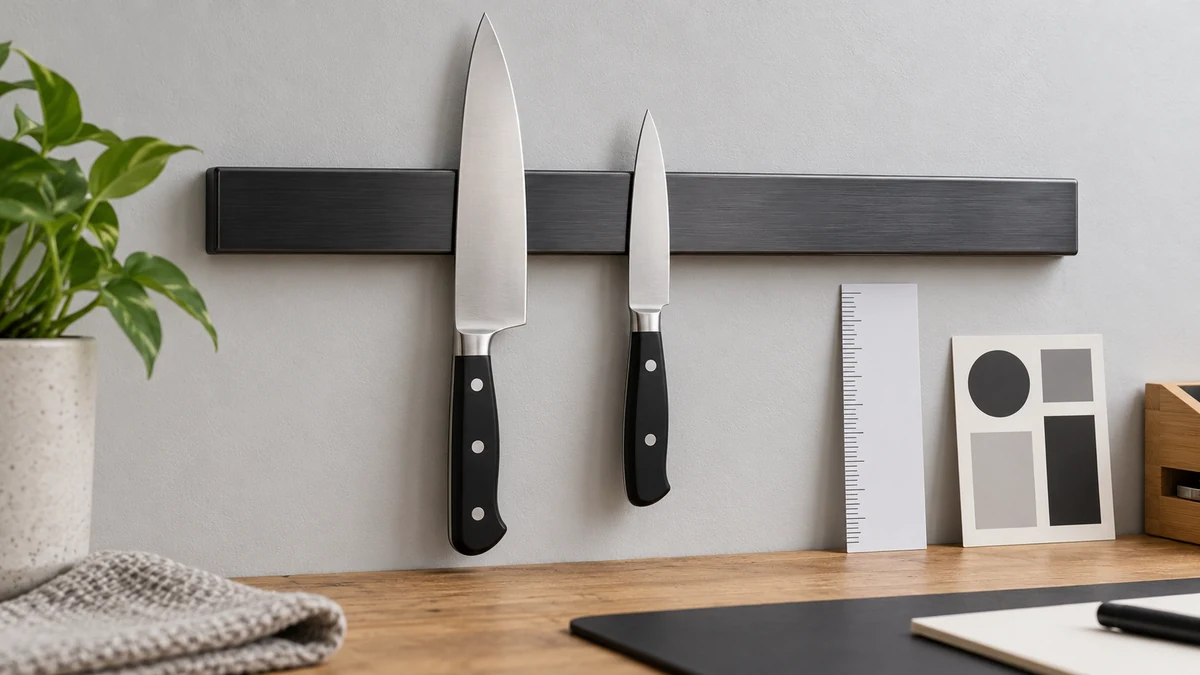
Place the representative knives in the buyer-defined positions. Observe whether the intended blade area contacts the face as designed, whether handles or bolsters prevent the blade from reaching the intended region, and whether adjacent knives interfere. Check the usable zone near both ends and between any component layout areas that the supplier identifies. A magnet arrangement may have local differences, so buyers should ask the responsible supplier where it expects the product to be used rather than assume the full bar is uniform.
Review placement and removal with the supplier’s approved instructions. The product sample should be handled in a controlled setting by a competent reviewer, keeping fingers away from sharp edges and maintaining a stable catch area. Record whether the stated motion matches the intended user instructions and whether the knife can be placed or removed without unintended contact with adjacent blades or the mounting surface. This review does not replace product-specific safety assessment or applicable market requirements.
What sample method can support approval?
Write the review method before the sample arrives. Identify the holder revision, magnet or component revision, face material, finish and mounting hardware. Specify the representative knives, their positions and orientation, the mounting surface or substrate, and the installation method. If a component supplier provides a force test, preserve its fixture, test direction, target piece, gap and measurement record separately from the complete-holder evaluation.
Agree observable checks and acceptance criteria with the responsible product team. The review might record whether each specified knife remains in its intended position during the defined observation period and buyer-selected handling sequence, whether any movement occurs, and whether placement or removal follows the supplier’s instructions. Set the sequence, duration, handling and acceptable observations before testing; do not invent a universal load or time threshold. Stop if the assembly shifts unexpectedly or a knife may fall, and have the product supplier investigate before resuming.
A perpendicular pull result and a complete-holder sample review should remain distinct evidence items. If the buyer requires a numeric performance claim, require the responsible supplier to define the method and its scope, and obtain competent technical review of the proposed threshold. Do not label a sample check as certification, an accredited test, a safe working load or proof of long-term use unless the applicable evidence supports those statements.
Keep photographs and a signed record that identify the sample and configuration. Log the knife models or sample identifiers, mounting substrate, installation details, method, observations, deviations, evidence owner and approvers. If a test condition changes, repeat or formally assess the affected check instead of comparing unlike results as though they were equivalent.
What else should be checked before production release?
Inspect wall-mount details independently from blade retention. Confirm fastener size, number, spacing, bracket fit and supplied accessories against the drawing. Ask the responsible installer or product engineer to confirm that the fastener and substrate combination is suitable for the intended installation; the buyer should not assume that one screw or anchor works in every wall. Verify that instructions identify the specified installation route and any required tools or substrate limits.
Check assembly and finish on the production-intent sample. Confirm that the holder is straight, the face and end treatment match the reference, covers are seated, visible joints are acceptable and fasteners do not interfere with knife placement. Inspect packaging for protection against abrasion and movement, and verify that fasteners, templates and instructions are included as approved. Confirm that a carton or accessory change does not create an unreviewed configuration.
Use the magnetic knife holder OEM buyer specification as the release record: freeze drawing revision, component list, magnet supplier and layout identification where shared, face and finish reference, mounting hardware, sample review method, packaging, labeling and instructions. Changes to any item that affects the magnetic gap, knife assortment, holder geometry, wall connection or contact face should prompt a documented impact review and may require a new sample.
For a specialized metal hardware factory, a drawing or physical-sample review can help clarify housing geometry, bends, joints, finish access, packaging and change control. It does not establish that the factory supplies the magnet system or validates knife retention. Koitor’s documented strengths concern custom metal bathroom and home-storage hardware and buyer-to-factory communication; its magnetic knife-holder and magnet-sourcing capability is not confirmed. Buyers should confirm exact project scope with each responsible supplier.
Buyer checklist before approving a quotation or sample
- Representative knife assortment and dimensions attached or clearly identified
- Usable strip length, placement, orientation and clearances defined
- Contact face, cover or finish revision documented
- Magnet/component supplier and evidence responsibility assigned
- Any pull-force data retained with its original test conditions
- Complete-holder sample method and acceptance observations agreed in advance
- Mounting hardware and intended substrate/installation route reviewed
- Safe handling and supplier instructions reviewed for the sample process
- Finish, edge, assembly and accessory requirements recorded
- Packaging, labels and included fasteners checked against the approved revision
- Change triggers, deviation handling and approvers listed in the release record

Perguntas frequentes
Does a magnet pull-force rating tell me how many knives a strip can hold?
No. It is tied to a particular test piece and method. It does not automatically establish sliding resistance, rotation, removal feel or performance with a different blade and cover. Ask the responsible suppliers to explain the test conditions and review the complete assembly with the buyer’s representative knives.
Should every knife in the buyer’s range be tested?
Agree a representative set with the product and technical teams. Include knives that reflect the range’s relevant sizes, shapes, handles and blade construction, and document what the review does not cover. If a later assortment adds a substantially different knife, assess whether the previous approval remains relevant.
Does a passing sample prove long-term safety?
A sample review documents only the defined configuration and method. It does not establish all-use safety, durability or compliance. Any broader claim needs appropriate product-specific evidence and the relevant market review.
Can Koitor manufacture a magnetic knife holder?
Current Koitor production or sourcing of magnetic knife holders and magnet assemblies is unconfirmed. Buyers should confirm exact capability and supplier responsibilities directly before qualification or purchase.
Clarify the knife-holder brief before sampling
Share the target assortment, drawing and sample conditions with the responsible supplier. Koitor’s adjacent-category capability should be confirmed for the exact project scope.
OEM / MARCA PRÓPRIA
Transforme este guia de fornecimento num resumo do produto
Indique o produto pretendido, as dimensões, o acabamento, a quantidade a encomendar e os requisitos de embalagem. A sua equipa receberá uma análise prática da viabilidade de fabrico antes da apresentação do orçamento.


 English
 Español
 Português
 Français
 Deutsch
 العربية