

A magnetic refrigerator storage rack OEM buyer specification should define the rack envelope, target appliance surface, intended contents, mounting configuration and acceptance checks for the complete product. Ask the responsible magnet-component supplier for evidence that matches the actual contact conditions; a component catalog figure alone does not approve a finished rack. Then review a production-intent sample on buyer-selected representative surfaces with agreed loading and handling criteria. Koitor’s magnetic-component sourcing and testing capability is unconfirmed, so this guide focuses on buyer specifications and supplier handoffs.
What decision should the product brief settle first?
A magnetic side rack combines a metal frame, storage geometry, a magnet or mounting assembly and a particular target surface. The buyer’s first task is to describe the product as a use case rather than a generic “magnetic basket.” State where it will be positioned, what it will hold, how often those contents will be removed, and whether the rack must move between surfaces. This gives the supplier context for proposing the frame and for identifying who is responsible for the magnetic component.
Separate three approvals: the metal structure and finish; the magnet assembly and its evidence; and the performance of the assembled product in the intended configuration. A supplier’s material or magnet data may help with one part, but it cannot replace a sample review of the whole rack. If the supplier only provides a generic pull-force claim, ask what test surface, contact condition, force direction and configuration it represents before using it as a project criterion.
This is an adjacent kitchen-storage sourcing guide, not confirmation that Koitor currently makes refrigerator racks or magnetic assemblies. Koitor’s verified expertise is in metal bathroom and home-storage hardware. Buyers considering a new category should confirm exact production and component responsibilities before treating a factory as the magnet-system supplier.
How should importers define the rack and target surface?
Record the outer width, height and projection from the appliance, plus usable shelf or basket dimensions. Note lip height, divider positions, hooks, removable parts, drainage or cleaning access if relevant, and clearances around handles, doors, vents and adjacent cabinets. Specify whether the rack holds lightweight packets, jars, bottles or another defined assortment. Do not rely on a product photograph to communicate usable space or the center of gravity of a loaded rack.
Name the target surface and conditions for evaluation. “Refrigerator side” can refer to different panel materials, coatings, thicknesses, curvature, seams, door geometry or nonmagnetic covers. Ask the buyer or product team to identify representative models or provide an agreed panel sample. If the product may be used on multiple appliance types, list each intended surface separately and decide whether the same configuration must pass on all of them.
Also clarify whether a protective film, spacer, coating or surface texture sits between the magnet and the target. Even a small gap can change the magnetic interaction, and a rough or curved interface can reduce effective contact. Technical magnet guidance discusses such dependencies, but its engineering ratings are not transferable to household racks. Use it as a reason to specify the real interface—not as a basis for estimating consumer-product capacity.
Which RFQ fields help suppliers quote the same product?
Use a concise brief built around the magnetic refrigerator storage rack OEM buyer specification. This makes the proposed products comparable. Attach a dimensioned sketch or drawing when available and identify which dimensions are functional, cosmetic or still open. Include the reference finish, color target, contact areas that must not scratch the appliance, and the buyer’s required packaging presentation. If dimensions or materials may change after the first sample, name the approval points and who signs them off.
| RFQ field | What to state | Why the supplier needs it |
|---|---|---|
| Product envelope | Outer dimensions, projection and usable internal area | Defines fit and usable volume |
| Intended contents | Item types, quantity range and removal pattern | Helps review arrangement and movement, without implying a universal load rating |
| Target surface | Representative appliance panel or approved surface description | Makes the sample interface reproducible |
| Mounting assembly | Component supplier, layout, contact face and any alternate mounting method | Clarifies scope and evidence responsibility |
| Metal frame | Material preference, wire/sheet/tube sections and joining appearance | Supports a realistic drawing and process review |
| Finish and protection | Color, sheen, coating reference and no-contact zones | Aligns appearance and surface protection expectations |
| Embalagem | Individual protection, carton arrangement, labels and revision | Reduces ambiguity during sample and order sign-off |
| Project context | Trial quantity, target market, logo and private-label needs | Helps scope customization and quoting inputs |
If a buyer uses a competitive RFQ, send the same drawing revision and assumptions to each bidder. Ask them to flag exceptions instead of silently substituting dimensions, mounting parts or packaging. This makes quotation differences easier to explain and reduces the chance that a low initial quote reflects a different product definition.
What can magnet-supplier data prove?
Ask the responsible component supplier to identify the tested magnet system and the conditions represented by its data. Useful questions include: What target material and thickness were used? Was there a coating, air gap or protective layer? Was the force perpendicular to the surface or parallel to it? What temperature and component orientation applied? Was the value measured on the component alone or on the assembled rack? Which revision and lot does the evidence cover?
The answers help buyers judge whether the evidence is relevant to their design. They do not produce an automatic pass/fail capacity for a kitchen rack. Actual behavior can also depend on contact flatness, surface finish, rack geometry, load position, vibration, repeated handling and user motion. Keep any supplier rating attached to its original method and conditions; do not relabel it as the rack’s safe working load unless a qualified test plan supports that conclusion.
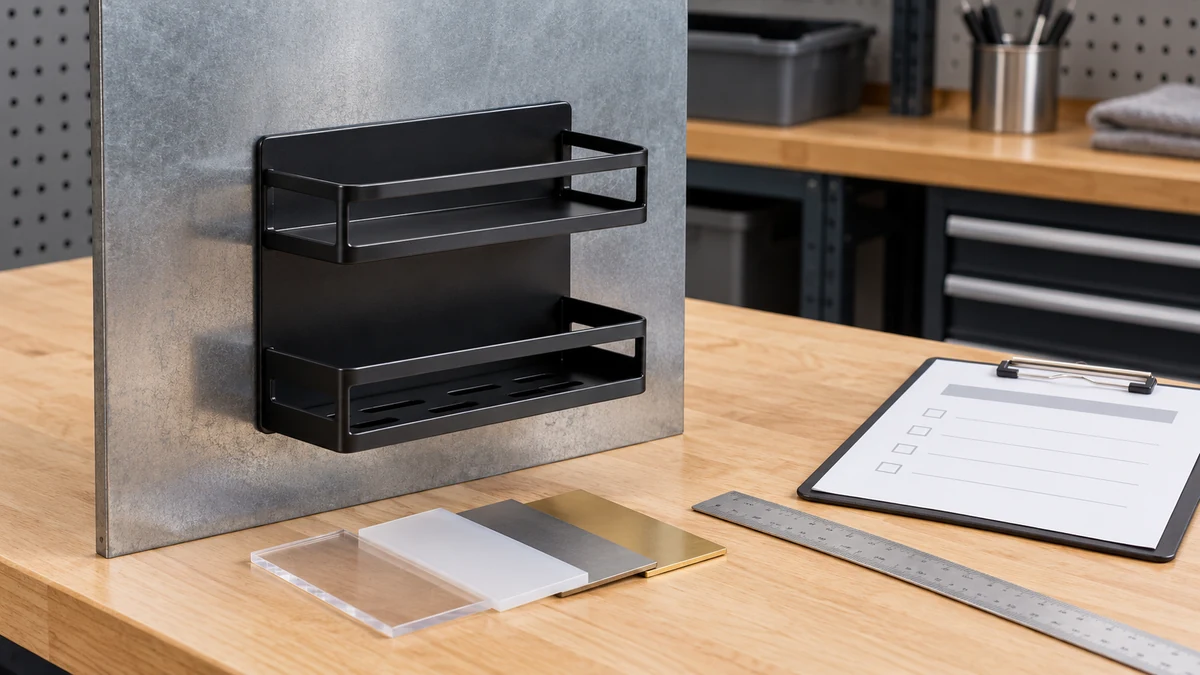
For the buyer’s approval, the magnetic refrigerator storage rack OEM buyer specification should agree a complete-product method with the supplier and any responsible component specialist. Define the representative surface, product configuration, load items, placement, dwell or movement sequence, inspection points and acceptance criteria before testing. Record deviations and stop conditions. If the buyer’s application involves children, breakables or a public space, have the responsible product-safety specialist set the appropriate risk review; this article does not establish a safe load or safety standard.
How should the production-intent sample be reviewed?
Approve a sample that matches the intended frame, finish, magnet layout, protective contact layers and packaging revision. A visually similar prototype may use different components or assembly details, so mark each sample with its drawing and bill-of-material revision. Photograph the tested configuration and note the surface sample identifier; otherwise a later reviewer may not be able to reproduce the same setup.
During fit review, check that the rack clears adjacent doors and handles and that its shelves or hooks are accessible with the intended contents present. Inspect edges, joints and contact areas for burrs, sharp transitions, loose parts or finish damage. Look for a protective layer that is missing, displaced or too thick to match the agreed interface. These are observations for the specific sample, not proof of service life.
For functional review, use the buyer-defined contents and placement. Check whether the rack shifts during the agreed access and handling actions, whether items collide or escape, and whether the mounting interface shows movement or damage. Do not create improvised maximum-load tests that may damage a sample or appliance. Agree a controlled procedure and stop conditions with the supplier first.
After the check, retain a signed sample or a clear reference record. Include the approved drawing, component identification, finish target, packaging details, sample date and any open deviations. Any change to the panel, magnet, adhesive or protective layer, rack geometry, finish thickness or load layout should trigger a review of whether the previous sample evidence remains applicable.
What mistakes lead to a misleading approval?
A frequent process mistake is treating a magnet’s advertised force as the performance of the finished rack. The figure may have been measured under ideal contact on a specified test piece, while the actual appliance surface and rack configuration differ. Ask for method details and review the complete product under conditions that reflect the buyer’s use.
Another mistake is using one appliance panel to represent every refrigerator. Surface construction and finish can differ, so choose representative surfaces from the intended market or narrow the product claim to the surfaces actually approved. Avoid universal compatibility language unless a defined program of product-specific evidence supports it.
Buyers can also approve a sample before locking the product contents and layout. A change in bottle size, hook location or shelf depth can shift weight and create different access forces. Freeze the intended assortment and movement pattern before approving the sample. If the assortment changes later, revisit the test plan rather than assume the approval still applies.
Finally, magnet performance review does not replace metal-frame quality, finish inspection or packaging approval. Record these workstreams separately so a passing result in one area does not hide an open issue in another. If the category is outside the factory’s proven capability, identify the specialist supplier responsible for the magnet system and keep that responsibility visible in the RFQ and purchase documentation.
How can a metal hardware factory support the review?
A specialized metal hardware manufacturer can help clarify frame geometry, material options, bends, joints, finish access, assembly points and packaging requirements from a drawing or physical sample. A family-owned factory with small-batch OEM experience may also discuss how to organize a trial sample and what details need to be frozen before repeat production. These capabilities concern the metal frame and project communication; they do not establish magnet sourcing or validation capability.
For this adjacent product, ask each supplier to state its scope in writing: who selects the magnet or mounting assembly, who provides component data, who integrates and inspects it, who runs the agreed full-product sample method, and who owns any packaging protection. If Koitor is considered for a frame-related discussion, confirm current scope and capability for the exact design before issuing an order. Do not assume that a factory’s metalwork expertise makes it the specialist for every magnetic or appliance-interface question.
Use a sample approval meeting to close open questions before a small trial order. The meeting record can capture the agreed model, target surfaces, configuration, evidence owner, inspection observations, packaging revision and signatories. Clear boundaries help the buyer compare suppliers and prevent a component claim from being mistaken for a finished-product acceptance.
Buyer checklist before requesting a quotation:
Prepare the buyer brief and attach the available drawing, reference photos or physical sample. Mark assumptions that need supplier confirmation rather than presenting them as final requirements.
- Rack envelope, usable dimensions, shelf or hook arrangement, and door/handle clearances
- Intended contents and agreed placement for the sample check
- Target appliance surfaces or representative panel samples
- Magnet/component supplier and responsibility for technical evidence
- Contact protection, finish, color and cosmetic acceptance references
- Complete-product sample method, criteria and stop conditions
- Drawing, component, finish and packaging revision control
- Trial quantity, target market, private-label and carton requirements
- Named approvers for the metal frame, mounting assembly and finished product

Perguntas frequentes
Does a magnet supplier’s pull-force figure tell me how much a rack can hold?
No. It describes a component under a stated method and contact condition. The finished rack’s behavior depends on the complete assembly, target surface, load placement and use conditions. Request application-specific evidence and agree a product-level sample method.
Will a magnetic rack work on every refrigerator?
Do not assume so. Appliance panels differ in material, thickness, coating, shape and accessible contact area. Identify representative target surfaces and approve the product only for the configurations actually reviewed.
What should a supplier include with a production sample?
Request the drawing and component revisions, finish reference, target-surface assumptions, packaging configuration and any relevant magnet-supplier evidence. Record the sample test setup and all deviations so the approved product can be reproduced.
Can Koitor supply a magnetic refrigerator rack?
Koitor’s current magnetic-component sourcing and magnetic-rack production capability is not confirmed by the information available for this article. Buyers should confirm project-specific scope directly with the factory and the responsible component supplier before qualification.
Clarify the rack brief before sample approval
Share the drawing or reference sample, target surface and intended use so the product scope and metal-frame questions can be reviewed.
OEM / MARCA PRÓPRIA
Transforme este guia de fornecimento num resumo do produto
Indique o produto pretendido, as dimensões, o acabamento, a quantidade a encomendar e os requisitos de embalagem. A sua equipa receberá uma análise prática da viabilidade de fabrico antes da apresentação do orçamento.


 English
 Español
 Português
 Français
 Deutsch
 العربية