

When contacting metal trellis manufacturers, an importer should define the trellis architecture, the plant-support envelope, the mounting or joining interface, the finish, the package and the sample approval record. A generic request for “a metal trellis for climbing plants” leaves too many choices open: a wall panel, freestanding frame, modular pair and decorative stake may all be described with the same product phrase. The quotation and approved sample should identify one configuration and one controlled revision.
This guide is for buyers sourcing a metal plant-support panel or frame as a garden or home-improvement SKU. It helps translate the target retail use into supplier-checkable requirements. It does not provide horticultural advice, an installation design, a structural rating or a promise that one opening pattern suits every plant. It also does not claim that Koitor currently manufactures trellises, plant supports, anchors or garden products. Koitor’s broader metal-storage experience may be relevant when discussing adjacent fabrication questions, but capability for any specific garden product must be confirmed directly.
Published product data shows why the brief needs to identify a model rather than rely on a category name. LumaBase lists a particular metal trellis at 36 inches high by 12 inches wide, while Agriframes describes a different wall-mounted lattice supplied with stand-offs and fixings. Those examples demonstrate distinct product configurations; they are not universal dimensions or installation recommendations. See LumaBase’s metal trellis product information e Agriframes’ wall-mounted lattice trellis.
Decide which trellis architecture is being quoted
Start with a product statement that distinguishes the intended structure. Is the SKU a wall-mounted panel, freestanding frame, modular extension, arched support, narrow obelisk or plant stake? Does the buyer expect one panel, a pair joined together, or a kit with connector pieces? A supplier cannot quote accurately if the buyer and factory imagine different forms while using the same term.
Show the intended installed or assembled configuration, not only a front-view product image. A clear drawing lets metal trellis manufacturers confirm which construction and interfaces the buyer actually needs. A side view can identify stand-off distance, projection and any feet or base. An exploded view can distinguish the main panel from connectors, caps, stakes, mounting plates or hardware supplied by another vendor. Mark optional accessories separately so they do not become accidental assumptions in the quotation.
Also state what is out of scope. If the SKU is only a metal panel, say whether fasteners, anchors, ties, planter boxes and instructions are excluded. If it is a kit, list each included part and its quantity. Garden retailers sometimes sell a compatible fastening set or separate panel extension; a buyer should not assume the metal trellis supplier owns those items unless the RFQ says so.
Translate the plant and retail use into a fit envelope
The buyer does not need to tell the supplier how to grow a plant. The buyer does need to describe the product space that the panel should serve. Identify the intended retail segment, whether the panel is decorative or part of a defined support concept, the approximate plant or container envelope, and the adjacent surfaces or products that constrain the dimensions. If the product is sold for a named plant category, the buyer should validate that statement with its own horticultural or product specialist.
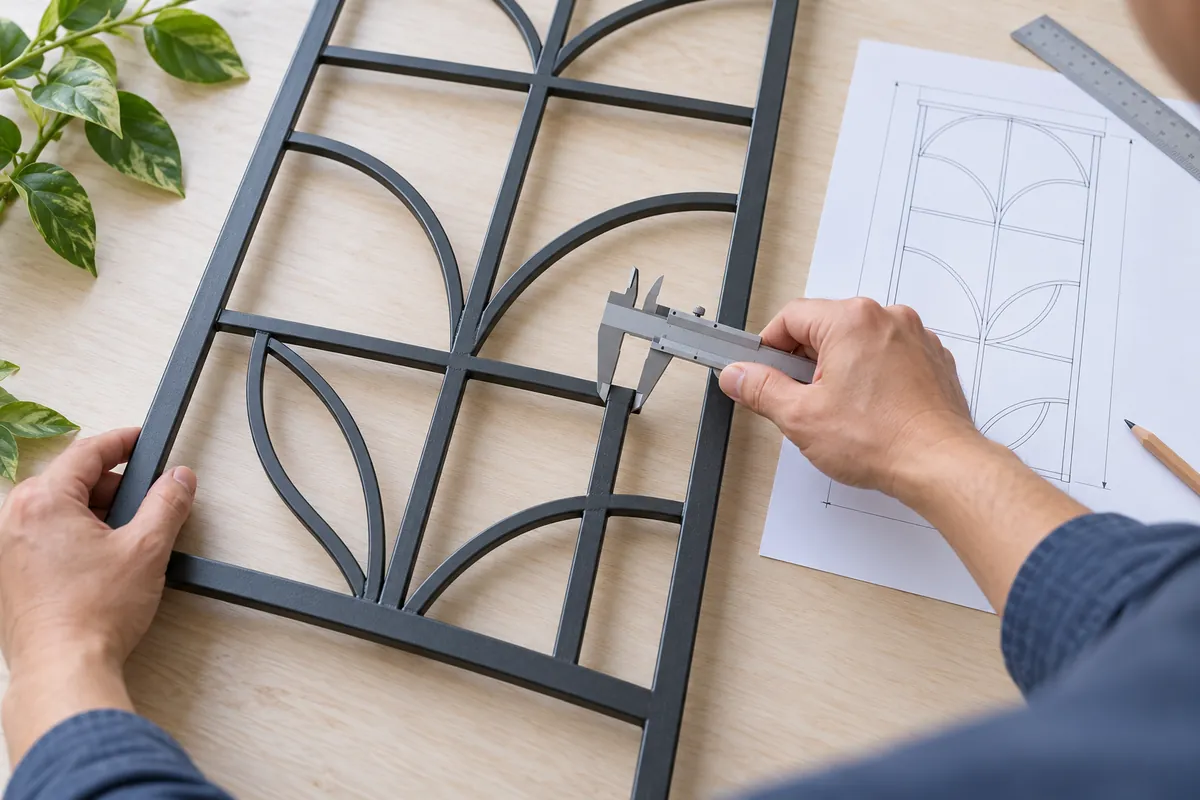
For the metal product, define overall height and width, usable panel area, frame or perimeter size, projection, edge clearance and any joining or extension dimension. If a plant tie, clip or accessory must pass through an opening, show the intended interface and its minimum clear opening. A grid dimension quoted from wire center to wire center differs from the clear opening between the wires; make clear which one matters.
Choose a small set of critical dimensions and give each a datum and measurement method. For example, the overall envelope may be checked edge to edge, while opening size may be measured between inner wire surfaces. The buyer should identify the openings, connector locations or attachment points that affect the intended SKU. Applying an overly tight tolerance to every decorative bend can increase quote complexity without improving the fit decision. Conversely, leaving the mating joint undefined can make two visually similar modules difficult to connect.
Do not assume a more open or more tightly spaced grid is always better. The design has to balance access, visibility, plant tie placement, panel stiffness, visual style, material usage and pack size for the selected product. These effects depend on the actual geometry and materials. Ask the supplier to identify manufacturability concerns and proposed changes on a marked-up drawing before approving a sample.
Put the mounting or joining interface on the drawing
The mounting decision starts with the architecture. A wall-mounted trellis needs a defined hole or bracket pattern, stand-off or spacer arrangement, and orientation. A freestanding frame needs its own base, feet or ground-interface description. A modular design needs connector geometry and the intended number and orientation of connected sections. These are different interfaces and should not be collapsed into a single generic “mounting hardware” line.
For a wall panel, specify the plate or attachment point dimensions, hole centers, slot direction, driver access and clearance between the frame and wall. State whether hardware is included, and identify the exact type and quantity if the buyer controls it. Any installation guidance must be written for the specific product and intended substrate by the responsible product team; a generic importer guide cannot establish which anchor or fixing is suitable for every wall.
For a freestanding configuration, document the assembled footprint and which components contact the ground or planter. Avoid an unsupported statement that the product will remain stable in every soil, wind or plant condition. The buyer can specify the use assumptions and request product-specific validation, but should not substitute an unloaded showroom sample for a defined performance evaluation.
For a modular product, check the first and last panel connections as well as an interior connection if the system uses repeated sections. Record whether connectors are welded, bolted, clipped or supplied loose. Identify which parts must align when modules are connected and how the consumer can distinguish the top, bottom or left/right component in the pack. If a feature can be assembled in more than one orientation, show the intended versions in the drawing and instructions.
Specify material, finish and appearance evidence carefully
State the buyer’s required construction and appearance without pretending that a broad phrase settles the material choice. Identify whether the proposed frame is wire, tube, strip, sheet or a combination; list any known material or finish requirement and ask the supplier to declare the exact proposal. If the supplier suggests a different construction, record the change and ask what dimensions, mass, appearance, process sequence or packing assumptions it affects.
Describe the target exposure in plain terms: covered or exposed, expected wetting, proximity to a coast if relevant, and known cleaning or handling conditions. Name the finish system only when the buyer has a defined specification and the supplier can confirm it. “Outdoor finish” or “rustproof” alone is not enough to establish a particular service life. Material grade and coating label by themselves do not prove product performance under every exposure.
For sample approval, compare the finish on the visible face, edge, bend, joint and attachment area. Identify which faces are cosmetic, whether a seam or weld may remain visible, the approved color reference and any texture or gloss expectation. A visually smooth sample does not establish adhesion, corrosion performance or long-term weather resistance. If the buyer needs a coating or exposure test, define the method, specimen preparation, acceptance criteria and reporting responsibility separately.
Compare RFQs and review the first sample against one configuration
Use a quote table that links each requirement to what the supplier must confirm and how the buyer will verify it. This keeps price comparisons focused on the same product rather than on different included kits, panel sizes or finish assumptions.
| RFQ decision | Supplier response | Sample or document evidence |
|---|---|---|
| Product architecture | Wall, freestanding, modular or stake; included sections and accessories | Approved assembled view and part list |
| Panel envelope | Overall size, clear openings, edge and connector dimensions | Measurements recorded from named datums |
| Mount or join | Hole pattern, stand-off, base or connector details; hardware scope | Interface fit and pack contents match the drawing |
| Material and finish | Declared construction, finish system and exposure assumptions | Visual comparison to the approved sample and written spec |
| Retail pack | SKU, labels, instruction version, carton and protection | Artwork revision, counts and packed sample checked |
Before sample approval, verify that the sample part number and drawing revision match the quotation. Measure the agreed overall dimensions, critical grid openings, attachment points and mating features. Assemble the actual modular sections if applicable, and compare the assembled silhouette and package contents with the approved view. A photo of the front face alone may hide an incorrect stand-off, connector or hardware kit.
Record the finish observation by surface and location. If one joint is allowed to show, mark it; if a surface is designated cosmetic, include it in the sample record. Count all loose parts and compare them with the list. If a supplier proposes a substitute wire diameter, panel pitch or finish, do not treat the sample as approved until the buyer accepts the revised specification and determines whether the dimensions or intended interface need a new check.
Treat sample approval as evidence for the specific reviewed item and acceptance checklist. It does not prove that every mass-produced unit is identical, that the product suits every plant or substrate, or that the frame meets an unspecified load or outdoor life. If the purchase requires a test, define the sample, setup, conditioning, method and pass criteria so the result can be interpreted against the exact buyer decision.
Make retail packaging part of the product definition
The pack-out can change how well a trellis reaches the buyer. A tall panel may be shipped as a complete assembly, nested, folded or separated into sections. Each choice affects carton dimensions, surface contact, assembly work and the number of loose components that need identification. Ask the supplier to show the intended packed arrangement and identify which surfaces could rub during transit.
Specify whether components need sleeves, separators or other protection at contact points, and how connectors or fixings will be bagged and labeled. Avoid assuming that more packaging always prevents damage; the pack must be checked with the actual panel geometry, finish and shipment configuration. If the buyer needs a drop or compression test, define the packed sample and the applicable method separately instead of claiming that a generic test guarantees damage-free delivery.
For a private-label program, tie the carton, barcode, product label and instruction artwork to the exact SKU and revision. State whether the trellis is sold individually or in a pair, whether hardware is included, and how the consumer can identify each module. For multiple heights, finishes or connection options, use a variant matrix so that picking, packaging and reorder documents identify the same configuration.

Control production changes and repeat orders
Keep the approved drawing, sample photos, finish reference, package specification and open-action list together. A change to grid spacing can alter the clear opening; a different joint or frame may affect how panels connect; a revised finish may change appearance or packaging contact. When a supplier proposes a change, ask for the affected drawing revision and an explicit statement of what has changed.
The purchase order should identify the approved part number and revision, accepted material/finish description, quantities, packaging configuration, and any agreed inspection record. If the buyer plans to expand the product range, treat each new size or module as a defined variant and establish which interfaces remain common. Do not assume that a visually similar panel is interchangeable with the approved configuration.
For reorders, compare the delivered label and pack contents with the original variant record before the goods are released into inventory. If the product is sold across multiple channels, keep the carton and instruction version in the same change-control record as the panel. That helps purchasing and quality teams trace a discrepancy to the exact part and revision instead of relying on a broad product name.
A concise importer brief to send suppliers
Before sending the RFQ, assemble these project inputs:
- Architecture: wall-mounted panel, freestanding frame, modular system, stake or another defined form.
- Intended product envelope: overall size, plant/container context, clear openings and adjacent clearance.
- Construction: wire, tube, strip, sheet or mixed structure; critical joints and cosmetic faces.
- Interfaces: wall plate, stand-off, base, connector and the dimensions that must mate.
- Hardware: exact included/excluded parts, quantities and identification requirements.
- Finish: target appearance, exposure assumptions, supplier-declared proposal and any agreed test plan.
- Retail pack: SKU variants, protective arrangement, inserts, labels, instructions and carton artwork revision.
- Sample plan: drawing revision, dimensions to check, assembly configuration, finish review and sign-off owner.
- Quote assumptions: quantity, substitutions, exclusions, lead-time assumptions and unresolved capability questions.
The goal is not to make the brief longer for its own sake. It is to ensure that the supplier quote, product drawing, approved sample and retail pack all describe the same item. A metal trellis manufacturers inquiry is more useful when it identifies measurable interfaces and documented assumptions instead of relying on a product category or an unqualified performance phrase.
Koitor’s metal storage rack manufacturing overview gives adjacent context on its broader metal storage work; it is not a confirmation of garden-trellis capability. For a specific sourcing question, buyers can contacte a Koitor with the drawing, target dimensions, quantity and required pack details so the project scope can be reviewed.
Reviewing a Metal Storage Product Brief?
Share the drawing, reference sample and target quantity. Koitor can discuss confirmed metal storage product scope; garden-trellis capability and project requirements should be confirmed for each inquiry.
OEM / MARCA PRÓPRIA
Transforme este guia de fornecimento num resumo do produto
Indique o produto pretendido, as dimensões, o acabamento, a quantidade a encomendar e os requisitos de embalagem. A sua equipa receberá uma análise prática da viabilidade de fabrico antes da apresentação do orçamento.



 English
 Español
 Português
 Français
 Deutsch
 العربية