

Metal ski rack binding clearance should be approved with named ski and binding references, a stated support method, and every intended occupied position. A rack’s advertised pair count or an overall hanger spacing does not show whether a particular binding projects into a neighboring bay, whether the ski is supported at the intended contact points, or whether it can be inserted and removed without interference. Buyers should document the actual arrangement and keep fit approval separate from load, wall fixing, and equipment-protection claims.
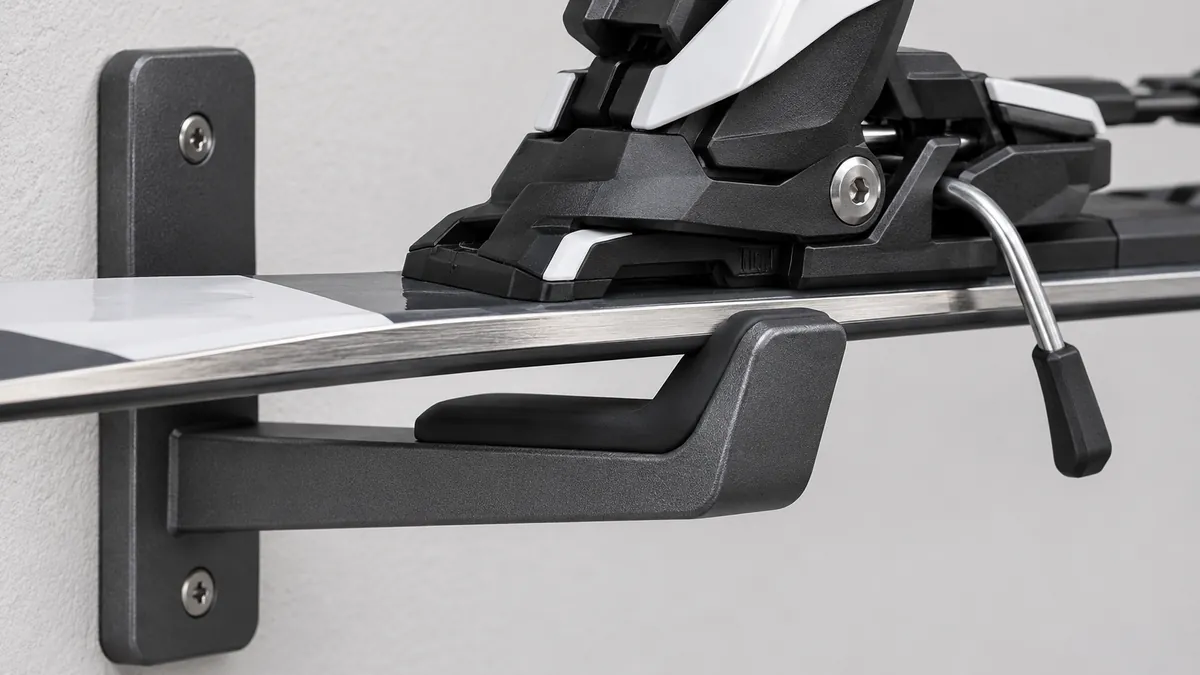
Why should importers review ski rack binding clearance?
Skis are not simply flat boards with identical edges. A pair may be stored together or separately, and bindings project from the ski surface. Their shape and position vary among equipment models. A rack that supports one reference in a simple catalog photograph may present a different clearance question when the buyer selects another binding, places several pairs beside one another, or chooses an adjustable support position.
Commercial metal rack listings show that suppliers may use different support architectures, including adjustable attachments and specified spacing around the binding area. Those product details are evidence about the named products only. They do not establish that every metal ski rack should contact a binding, that the same distance works for all skis, or that a third-party design or mechanism is available from Koitor. The buyer should ask the equipment manufacturer which contact regions are acceptable for its own reference model and then communicate those requirements to the rack supplier.
The decision is especially important when a distributor intends to publish pair count, compatibility, or storage-position claims. A count is meaningful only when the arrangement is defined. Does it mean a number of individual skis, matched pairs, or a tested number of occupied attachment locations? Does the stated setup include room for projecting bindings, or is the figure based on a different orientation? These questions belong in the sample plan and claim record, not in an assumption derived from a product category label. A useful ski rack binding clearance record names the equipment and rack revisions together so later buyers can see exactly what was reviewed.
Which ski and binding references belong in the approval set?
Choose specific equipment references that represent the intended assortment. Record the ski model or buyer reference, revision if available, and whether it is stored as a pair or as separated skis. Include the relevant tip, waist, and tail outline where those regions determine the rack’s contact. For the binding, record the physical envelope that projects toward adjacent positions and its location on the ski. If the buyer plans to support more than one family, list each family rather than calling the assortment “universal.”
The buyer should distinguish equipment data from rack data. A ski manufacturer or equipment owner is the appropriate source for handling and acceptable storage-contact advice. The rack supplier should identify the offered support feature, adjustment range documented for that product, and the exact position used in the sample. A web listing may provide useful reference dimensions, but do not silently convert them into universal product limits or copy one competitor’s geometry into another supplier’s drawing.
Make the sample set practical but representative. It may include the largest projected binding, another common outline, and the intended paired or separated configuration. That selection is a buyer’s coverage choice; it does not statistically prove compatibility with every ski on the market. If the assortment is broad, use a compatibility matrix that shows included, reviewed, and excluded references. An unknown cell should remain unknown until the equipment and rack evidence are reconciled.
| Approval field | Buyer or supplier record | Decision supported |
|---|---|---|
| Equipment identity | Named ski and binding reference | Defines what was actually reviewed |
| Stored state | Paired or separated, orientation, and number of occupied bays | Makes the advertised configuration reproducible |
| Support method | Actual bearing feature and responsible source for contact guidance | Avoids assuming that any visible contact is acceptable |
| Binding envelope | Projection and position from the named reference | Identifies likely neighboring-bay interference |
| Hanger setting | Supplier-documented location and adjustment revision | Ties fit to the offered sample configuration |
| Evidence boundary | Fit observations, exclusions, and separate load or mounting evidence | Prevents a fit check becoming a broader performance claim |
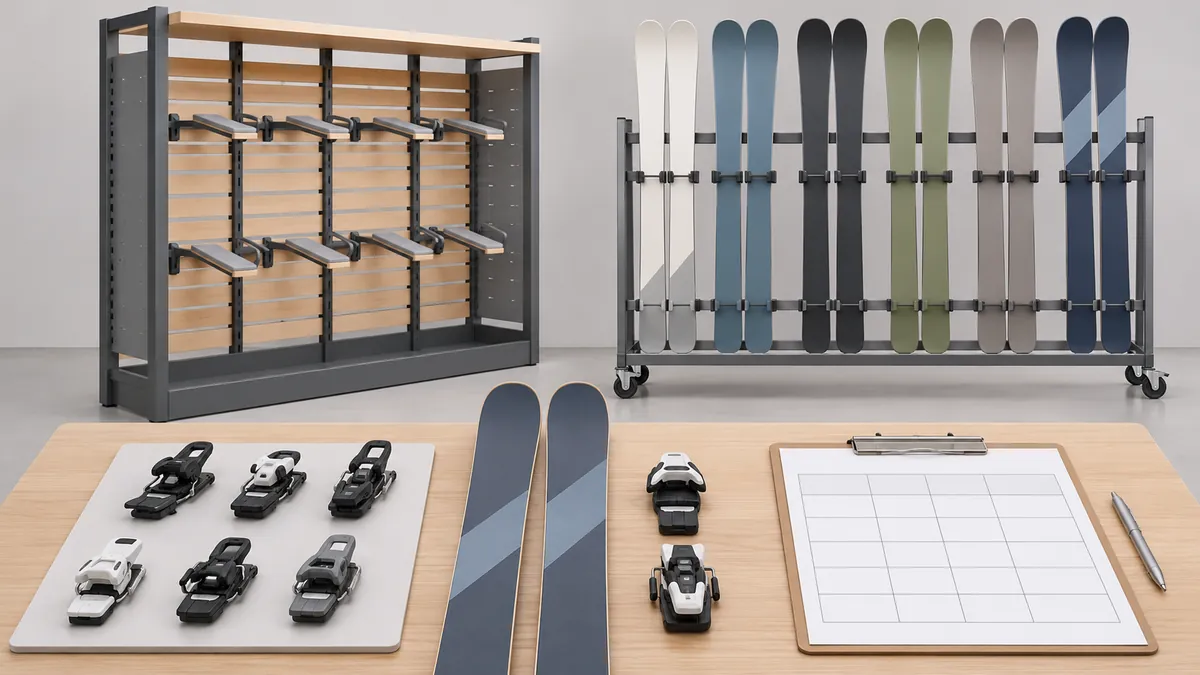
How should binding clearance be checked in a sample?
Assemble the intended rack configuration using the supplier’s current instructions. Identify the attachment and adjustment state before placing the reference skis. Do not begin with an assumed position copied from a different model. If the rack uses a purchased support, clip, pad, or spring component, confirm its identity and revision because it can affect the interface.
Place the nominated ski or pair in the stated arrangement. Observe where the rack supports it and whether the binding contacts the frame, another support, or neighboring equipment. The rack should not be pushed into a forced position merely to make the sample pass. Record whether the support feature was chosen by the equipment maker, rack supplier, or buyer; a visual observation is not a substitute for authoritative contact guidance.
Next, fill adjacent positions according to the intended commercial configuration. Binding projection may matter more when the rack is fully occupied than when a single ski is displayed alone. Check the path for inserting and removing one item while neighboring bays remain occupied. Note any interference, collision, awkward orientation, or contact that requires a claim or design review. The approval record should include photographs from a repeatable viewpoint and the drawing revision, sample ID, and reference equipment.
This exercise establishes observed fit and access under defined sample conditions. It does not demonstrate structural capacity, wall-anchor adequacy, long-term protection, vibration resistance, or a preservation benefit. Those require separate, appropriately scoped evidence and responsible product/site review. A matched sample is useful for narrowing compatibility; it is not a certification or an all-equipment guarantee.
What does the support architecture change?
A support point can be a ledge, hook, cradle, adjustable attachment, or another feature. Different architectures distribute contact and clearance differently. The buyer should identify the actual feature from the supplier’s drawing rather than rely on a generic term such as “ski holder.” If the rack’s adjustable positions move, ask what adjustment is documented and how the chosen setting is retained in the offered configuration. Do not assume that an adjustment mechanism is locked or that a branded spring system exists on an unbranded sample.
The stored state also affects interpretation. Supporting skis together as a pair can create a different side-to-side envelope from placing individual skis in adjacent locations. A binding’s projection may face inward or outward depending on orientation. The approval matrix should show that orientation explicitly. Where a supplier offers several arrangement options, choose the one that matches the buyer’s intended use and approve each distinct variant that will carry a separate compatibility claim.
Clearance is not just a single gap value. It includes the ski and binding outline, hanger position, neighboring occupied bay, and the movement needed to retrieve the equipment. A static photograph can capture one arrangement but not every access path. If the buyer cannot provide a representative ski sample, dimensions and photographs may support an initial discussion, but final claims should wait for appropriate project evidence.
| Risk area | Sample observation | O que permanece separado |
|---|---|---|
| Binding projection | Contact or overlap with adjacent support | Permission for the equipment to bear on that region |
| Occupied bays | Interference in the selected full arrangement | Capacity or structural rating |
| Retrieval path | Insertion and removal under stated setup | Long-term ease of use or durability |
| Wall position | Rack projection and reference envelope | Anchor design and substrate qualification |
| Advertised count | Number and state demonstrated in sample | Universal compatibility across other models |
Which claims should remain limited?
Avoid the word “universal” unless the manufacturer has a defined and supported compatibility scope. A rack sample that fits three chosen models demonstrates those three combinations under the recorded conditions. It does not automatically represent every ski length, binding family, ski pair, or future equipment revision. Publish a named compatibility list or a clearly qualified description instead of implying unrestricted fit.
Do not turn fit into a protective-performance claim. The fact that a sample does not visibly touch a binding does not prove that a rack preserves camber, prevents damage, or has no long-term effect. Similarly, a rack’s listed holding count or static load belongs to its own configuration and evidence. It does not establish another supplier’s load rating or prove that a particular wall is suitable.
Keep wall installation responsibilities distinct. The rack supplier can provide its product-specific mounting information, but project teams must review the actual wall, substrate, anchors, and local requirements with the responsible qualified party. A buyer’s compatibility article should not invent anchor sizes, drilling instructions, or safe-load limits from an unrelated catalog listing.
If the supplier changes support geometry, purchased components, finish thickness, or position adjustment after sample approval, check whether the reviewed clearance remains applicable. A drawing revision, component substitution, or packaging configuration may affect the demonstrated arrangement. The buyer should decide which changes require renewed review and retain the sample record alongside the released product specification.
How can an OEM inquiry be framed responsibly?
Koitor Hardware is a family-owned custom metal hardware manufacturer with documented bathroom and home storage hardware experience. Current ski rack manufacture, ski-specific support mechanisms, equipment-protection tests, structural ratings, and winter-sport certifications are not confirmed. A buyer may share a lawful drawing and equipment reference for a project-specific metal feasibility discussion, but the inquiry must not presume that an existing ski product or specialty mechanism is available.
For a useful discussion, provide the rack concept, intended support method, named ski and binding references, desired stored state, finish direction, packaging needs, and any purchased components. Identify who supplies the support parts and who owns contact guidance and performance claims. Ask the prospective supplier to confirm the proposed metal process and scope before converting a concept into a commercial commitment.
A supplier review can clarify whether the frame geometry and documented interfaces appear feasible within the confirmed project scope. It cannot replace the ski manufacturer’s use guidance, a qualified structural assessment, or the buyer’s own claim substantiation. Keep those roles visible in the RFQ so that each party can answer the question it is qualified to answer.
The manufacturer’s adjustable metal ski rack listing and its separate rack configuration show why attachment positions and binding spacing are product-specific details. They should be treated as examples, not as a standard or a design to copy. For general metal storage project scope, buyers can review Koitor’s OEM home storage hardware information and discuss only a confirmed feasibility path.
What should buyers send before sample approval?
- The rack drawing, model and revision, plus selected support components.
- Named ski and binding references, photographs, and available supplier guidance.
- Paired or separated storage state and the exact intended orientation.
- Number of occupied positions and the arrangement to be represented in claims.
- The bearing or contact feature and the authority that approves it.
- Hanger locations and adjustment setting for each reviewed configuration.
- Observed insertion, removal, and adjacent-bay clearance notes from a physical sample.
- Separate evidence requirements for load, wall mounting, and any protection claim.
- Exclusions, unresolved references, component responsibilities, and sign-off owner.
- Packaging, labeling, and revision-change controls for the commercial SKU.
Perguntas frequentes
Does a ski rack’s pair count prove binding compatibility?
No. It describes a particular product arrangement only when the supplier defines how pairs and positions are counted. Buyers should check their named binding references and occupied-bay configuration.
Should a rack support a ski by its binding?
There is no universal answer in this guide. Use the equipment maker’s guidance for the named ski and binding, and confirm the rack supplier’s intended support feature. Do not infer an approved bearing point from a catalog image.
Is one sample enough to claim universal ski fit?
No. One sample supports only the observed pairing and conditions. Broader claims require a defined compatibility range and evidence for the included references.
Does a fit check confirm wall load or anchorage?
No. Fit, structural rating, and wall installation are distinct questions. Obtain product-specific evidence and qualified site review for the latter.
Is this an existing Koitor ski rack product?
No current Koitor ski-rack SKU or ski-specific mechanism is confirmed. Project feasibility and scope would need to be discussed from a lawful drawing and actual reference set.
Discuss a Storage Hardware Brief
Share a lawful frame drawing, actual equipment references, intended arrangement, and component responsibilities for a project-specific feasibility discussion.
OEM / MARCA PRÓPRIA
Transforme este guia de fornecimento num resumo do produto
Indique o produto pretendido, as dimensões, o acabamento, a quantidade a encomendar e os requisitos de embalagem. A sua equipa receberá uma análise prática da viabilidade de fabrico antes da apresentação do orçamento.



 English
 Español
 Português
 Français
 Deutsch
 العربية