

Polyurethane vs rubber is not a simple comparison between one material and one uniform alternative. Polyurethane includes different material forms, while “rubber” can refer to many natural or synthetic elastomer compounds. Buyers should first identify the component—such as a wheel tread, bumper, foot, pad or seal—then define its contact, exposure, movement, geometry and acceptance criteria. Compare the exact grade and finished part, because a family name or black flexible sample does not prove compatibility, wear life, noise, load performance or cost.
What purchasing decision does polyurethane vs rubber support?
The polyurethane vs rubber comparison helps an importer or product developer decide whether a purchased elastomer component should use a proposed polyurethane product or a rubber compound. That question often appears when a supplier suggests a change in a wheel, protective bumper, seal, foot or contact pad. The buyer needs to know which requirements the proposal addresses and which evidence would show that the finished component is suitable.
Start with what the part does. A wheel tread experiences rolling contact, a bumper may receive repeated impact, a foot may remain compressed against a floor, and a gasket may need to seal a particular interface. These parts do not share one performance requirement. The best material for one function cannot be transferred to another just because both products are flexible or have similar colors.
The comparison should separate three questions: which polymer or elastomer family is proposed, what specific grade or compound is supplied, and how the part is designed and manufactured. Geometry, hardness, construction, adhesive or insert, contact surface and process all affect the outcome. A family-level tendency may help frame a supplier conversation, but it does not replace a grade-specific data sheet or a representative part evaluation.
This article is a sourcing framework for purchased elastomer components used alongside metal hardware. It is not an automotive suspension guide, load rating, food-contact approval, medical-use recommendation, chemical compatibility chart or service-life guarantee. Those claims require evidence tied to the exact product and intended application.
What do “polyurethane” and “rubber” mean in component sourcing?
Polyurethane is a broad polymer family. It can be supplied in different forms and manufacturing routes, including thermoplastic polyurethane (TPU) and thermoset cast polyurethane. Those forms are not interchangeable simply because both contain “polyurethane” in a description. Formulation, chemistry, hardness, color, process, reinforcement and design affect the product a buyer receives.
“Rubber” is also broad. It can refer to natural rubber or to many synthetic elastomers and compounds. Each may be formulated for different use conditions. A quote that says only “rubber” does not reveal the exact base polymer, compound, hardness, construction or supplier product. Ask the component supplier to identify its material designation and the information it can provide for the intended duty.
The BASF Elastollan documentation, for example, distinguishes TPU grades and chemistry families within one named product portfolio. That illustrates why “polyurethane” does not specify a single property set. Likewise, a cast-polyurethane maker’s comparison with rubber can inform buyer questions about industrial components, but its examples and branded claims apply to its own product context. Do not transfer a manufacturer’s numerical comparisons to another supplier or part.
For an RFQ, record the exact proposed grade or compound where available. If the supplier treats a formula as proprietary, request sufficient controlled identification, a data sheet or declaration, and change-notification terms to manage the purchase. The buyer does not need confidential formulation details to know which approved component is being delivered.
How should buyers compare polyurethane and rubber by duty?
Compare the exact component’s function, operating environment and evidence. The following matrix is a structured set of questions, not a ranking of material families.
| Component duty | Buyer questions | Evidence to compare |
|---|---|---|
| Rolling contact | What wheel geometry, surface and movement are involved? | Exact grade, tread design, maker’s test or load documentation for the intended product |
| Repeated impact | How often and where does the bumper contact another part? | Representative component, attachment, deformation or recovery requirement |
| Sustained compression | Does a foot or pad remain loaded over time? | Compound-specific compression data and finished-part dimensions where relevant |
| Sealing | What mating surfaces, compression and exposure apply? | Exact compound, section geometry and application-specific seal evidence |
| Abrasion or sliding | What is the counterface, motion, debris and duty cycle? | Comparable test method, grade data and actual contact conditions |
| Chemical or environmental exposure | Which substance, concentration, temperature and duration matter? | Supplier compatibility for the exact grade and conditions |
| Appearance and marking | Will the part touch a visible floor, metal face or retail surface? | Approved color, finish, contact sample and care guidance |
Some polyurethane products are selected for wear or load characteristics in particular industrial applications. Some rubber compounds may be preferred for compliance, sealing or other requirements. Those are prompts for grade-level review rather than universal statements that polyurethane always lasts longer or rubber is always softer. Supplier pages may use a specific compound, geometry, test and operating condition; those results do not automatically transfer to a different component.
For chemical contact, identify the exact media and exposure: name the cleaner or fluid, concentration, temperature, contact time, frequency, and whether the part is under load. A general compatibility table may not represent the compound or finished geometry in the buyer’s quote. If the exposure is not yet known, note it as an open item and do not approve an unsupported claim.
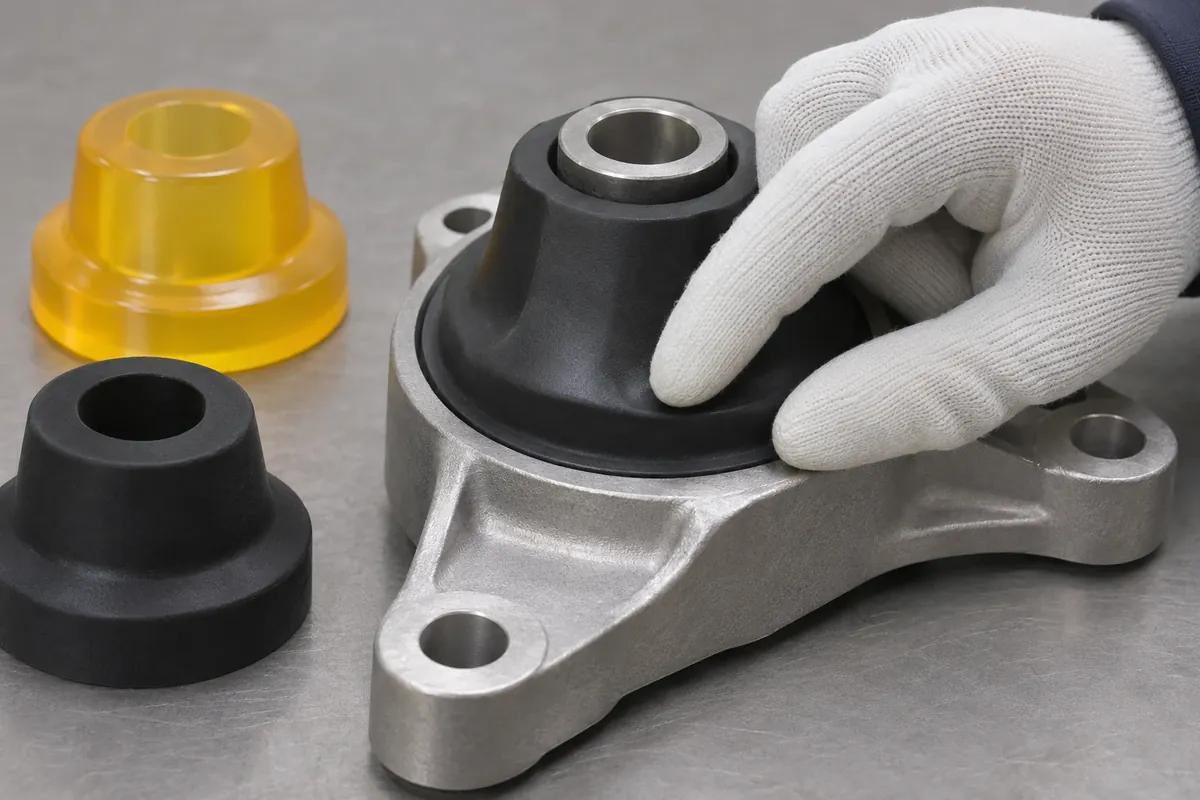
The phrase polyurethane vs rubber therefore has to be translated into a specific purchase decision. A buyer may compare a cast polyurethane wheel with a natural-rubber wheel, a TPU pad with a synthetic rubber bumper, or two supplier compounds designed for different duties. These are not all the same comparison. Record the exact product form on both sides and avoid treating every polyurethane result as representative of every urethane product.
When supplier evidence is presented, ask what material and component were tested. Was it a branded grade, a prototype coupon, a molded wheel, a molded bumper or a finished assembly? What were the test surface, temperature, speed, load, cycle and acceptance rule? If those details are missing, treat the statement as a general lead rather than proof. You can ask the supplier to provide a comparable test or a sample for the actual design. Do not calculate a universal material winner from test figures collected from unrelated sources.
Does one material always win on hardness, wear or cost?
No. Material families contain many grades and compounds, and the finished component’s shape and process matter. A hardness number needs its scale, test method, specimen condition and acceptance range. Hardness alone does not establish abrasion resistance, rebound, compression set, noise, chemical compatibility, grip or service life. Do not make a cross-material ranking from unmatched data sheets.
Wear comparisons need a comparable test and duty. A flat coupon rubbed against one counterface may not represent a wheel rolling across a floor or a pad rubbing against a metal edge. The specimen shape, load, speed, temperature, debris and test duration can all influence a result. Ask the supplier whether the data comes from a generic material specimen or the product being quoted, and what the result can and cannot show.
Cost also depends on more than resin price. Part volume, tool or mold requirements, setup, tolerance, finishing, adhesive, inserts, inspection, packaging, minimum order quantity and supplier availability may change a quote. If a material substitution reduces one cost but requires a new tool or different assembly, total landed cost may move differently. Compare supplier proposals using identical geometry, quantity, finish and packaging.
Avoid universal statements such as a fixed abrasion multiplier or guaranteed longer life. If a maker publishes a comparison, check whether it describes its own grade and test. The buyer can use that source to identify a question, then request evidence for the proposed component and its actual use.
How do design, attachment and assembly change the choice?
The interface can decide whether an elastomer part works as intended. A bumper can be shaped to distribute contact, a foot can have a specific footprint, and a gasket can require a defined section and compression. Changing material without reviewing geometry may alter fit, deflection, retention or appearance. The sample should include the actual metal part, adhesive, insert or fastener when these affect the interface.
Specify attachment and assembly responsibilities. Is the component press-fit, mechanically retained, bonded, overmolded or loose? Who supplies the adhesive or insert? Does the assembly surface require cleaning or priming? If there is a bond, ask which supplier controls the system and what cure or handling instructions apply. The polymer family alone cannot approve a bond to an unknown coating or surface.
For floor-contact parts, identify the surface and the buyer’s concern: marking, sliding, leveling, noise or load distribution. A polyurethane wheel maker’s load rating, for example, is tied to its product and stated conditions; it should not be applied to a different foot or rack. A sample should be reviewed on the intended surface and under the relevant assembly conditions, without inventing a test or declaring the whole material family safe for every floor.
For repeat orders, document the material designation, drawing revision, supplier, color, dimensions and any approved variation. If the component changes from rubber to polyurethane, reassess fit, installation method, maintenance copy, packaging and supplier documentation. A similar appearance does not demonstrate equivalent function.
A material substitution can also affect instructions and downstream handling. A change in color or surface texture may alter the appearance; a change in compliance may affect assembly force or retention; a change in contact behavior may matter to the user. Buyers should confirm whether the packaging, storage, cleaning or installation instructions need revision. If the part is bonded, confirm that the adhesive and substrate preparation remain approved. If the part is mechanically captured, check that it cannot shift or be pinched during installation. These issues should be reviewed on the assembled sample where the interface drives function.
Cost evaluation should separate component price from engineering and conversion costs. A new material may require tooling, a different mold, process setup, revised drawings or additional inspection. A quote may also change because the requested quantity is small or the supplier uses a different production batch. Ask each vendor to make the assumptions visible and compare total scope. Do not tell the buyer one family is always cheaper, because the actual grade, part form, quantity and supply route determine the offer.
Before a material comparison becomes an order decision, prepare a sample plan. Select the actual metal assembly, the proposed elastomer part and the counterface that represents use. Define what the buyer will observe: fit, retention, contact marks, movement, appearance or another named feature. If the concern is chemical exposure, abrasion or compression over time, a short visual fit check is not enough; a suitable technical test must be scoped by the responsible supplier or qualified engineer. Do not label a sample “approved for life” after one basic inspection.
Keep an untouched approved part as a reference where practical. Record its material designation, supplier, color, dimensions and sample date. If several compounds look alike, label each container and sample so procurement and quality teams cannot mix them. A photo should show the part and identification, but it should not replace the material record. When the buyer approves one option, note whether that approval covers only appearance and fit or also includes the evidence listed in the purchase specification.
If the supplier proposes a second option after sample review, capture what changed. A new grade may affect dimensions after molding, shrinkage allowances, parting lines, adhesive compatibility or assembly force. The correct comparison is between finished components made to the same revision, not separate catalog photographs. Confirm whether the vendor can maintain the selected grade across repeat orders and what notice is given before any formulation or source change.
What should buyers request in an elastomer-component RFQ?
A useful RFQ identifies the component duty and gives suppliers enough context to propose an exact product. Include:
- Part name, drawing number, revision and installed location.
- Function: wheel, pad, bumper, foot, gasket, seal, spacer or other component.
- Proposed polymer family or permission to recommend a documented alternative.
- Exact grade or compound designation, construction and form where known.
- Dimensions, tolerance, color, hardness scale and range if functionally required.
- Counterface, mating surface, movement, load case or compression requirement that matters.
- Chemical exposure, temperature, moisture, sunlight and cleaning conditions as applicable.
- Adhesive, insert, fastener, retention method and assembly responsibility.
- Sample quantity, inspection method, acceptance criteria and required product documents.
- Packaging, labeling, lot identity and advance notice for material or source changes.
If the buyer is uncertain about material choice, request a clear proposal for each option. The supplier should name the grade, explain why it fits the stated duty, identify assumptions and state which properties are not confirmed. Buyers can then compare like-for-like quotes and decide whether a sample or test is warranted. An “equivalent” label should be supported by a defined comparison, not inferred from color or flexibility.

Material changes may also affect spare-part planning. If the importer sells replacement pads or bumpers, the approved product identity and revision should be available to customer support and reorder buyers. Keep the component code linked to the finished-product model, and clarify whether a replacement is backward-compatible or requires a matching bracket, adhesive or fastener. Do not assume a replacement from the same polymer family will fit every earlier design. Verify the latest approved drawing before ordering spares.
How can a China OEM manufacturer support an assembly using purchased elastomers?
Koitor Hardware is a family-owned factory and specialized OEM manufacturer of bathroom and home-storage metal hardware. When a product includes a purchased polyurethane or rubber part, the metal hardware team can discuss the surrounding drawing, mounting point, metal interface, fit, packaging and assembly within its confirmed scope. This does not imply that Koitor manufactures every elastomer, casts polyurethane, supplies a specific compound or provides material testing unless verified for that project.
Buyers can share the metal assembly drawing or physical sample and identify which part comes from another supplier. Mark contact surfaces, visible faces, fastener locations and any movement or clearance. State the target quantity, whether the project is a trial or repeat order, and what decision the component must support. The OEM manufacturer can then review the metal-side interface while the elastomer supplier confirms compound and material evidence.
The OEM home-storage hardware page outlines the broader manufacturing context. For rack assemblies, review the custom metal storage-rack overview and identify any bought-in pad, wheel or bumper in the project brief.
Small-batch development can help buyers review fit and packaging before committing to a larger order, but a sample does not automatically prove long-term material life. Define what the sample is intended to show, record the exact part and grade, and obtain separate supplier evidence for properties that cannot be confirmed through visual inspection alone.
For a new private-label product, create a concise component record that links the approved drawing, supplier grade, sample photograph, acceptance points and reorder code. If a part is supplied in multiple hardnesses or colors, use separate identifying references rather than a generic “PU insert” or “rubber pad.” This reduces mix-ups during purchasing and replacement. Ensure the final carton or kit label makes the right component traceable without exposing proprietary formula details that the supplier does not disclose.
At receiving, confirm that the delivered part matches the approved description and is packed to avoid contamination or deformation. Check model and lot references, bag or carton labels, obvious damage, color differences and quantity per kit. Resolve mismatches before assembly begins. If parts have storage or shelf-life conditions, use the exact supplier instructions rather than estimating from the polymer family. Store components away from incompatible materials or exposure only as the maker specifies. Photograph a discrepancy before mixing new stock with previously approved inventory.
Keep discontinued components and replacements traceable to the buyer-approved record; do not swap grades based on shorthand names alone. Confirm spare-part fit before fulfillment. Retain the approved drawing for future reference.
Buyer checklist and frequently asked questions
Before approving polyurethane or rubber for an assembly, confirm:
- The exact component duty and installed geometry.
- Whether “polyurethane” means TPU, cast PU or another specified form.
- Which rubber compound is proposed if the quote says “rubber.”
- The mating surface, motion, compression, exposure and cleaning conditions.
- Required appearance, color, hardness scale, dimensions and retention method.
- The supplier evidence and sample review needed for the actual use.
- Who controls adhesive, insert, assembly and material change notification.
- Whether packaging protects the component and prevents mix-ups between grades.
Is polyurethane a type of rubber?
Polyurethane can be an elastomeric material, but the term covers different chemistries and product forms, including thermoplastic and thermoset products. “Rubber” is also a broad term. Buyers should ask for the exact material form and grade rather than relying on everyday category labels.
Is polyurethane always harder than rubber?
No. Both categories include products with different hardness and formulation. Compare the test scale, grade and part function. Hardness alone does not prove wear, compliance, sealing or life.
Can a rubber part be replaced with polyurethane without changing the design?
Not automatically. Review geometry, fit, attachment, mating surface, exposure and functional requirements. Approve the exact material and representative component before production if the change can affect fit or use.
Is polyurethane always more wear-resistant?
No universal ranking applies to all grades and conditions. Wear depends on the exact product, counterface, load, motion, temperature, debris and test method. Request comparable evidence for the actual application.
Trabalhe com a Koitor Hardware
Review the Elastomer Interface in Your Metal Hardware Project
Share the assembly drawing or sample, purchased-component details, target quantity, contact surfaces and packaging requirements. Koitor can discuss confirmed metal hardware OEM scope while the elastomer supplier confirms the proposed grade and material evidence.
OEM / MARCA PRÓPRIA
Transforme este guia de fornecimento num resumo do produto
Indique o produto pretendido, as dimensões, o acabamento, a quantidade a encomendar e os requisitos de embalagem. A sua equipa receberá uma análise prática da viabilidade de fabrico antes da apresentação do orçamento.


 English
 Español
 Português
 Français
 Deutsch
 العربية