

A soap dispenser replacement pump should be selected by the dispenser maker, model and revision, then confirmed against the orderable pump assembly and its included components. The word “pump” can refer to a complete mechanism, a pump head, a tube or straw, or a service kit that includes seals and mounting parts. A similar finish or appearance does not establish that a pump fits, dispenses the intended product or works with the existing bottle. For distributors, the reliable approach is to map the installed dispenser to the manufacturer’s current part reference, define the kit scope, and retain written confirmation and a sample or drawing where needed.
Why does a replacement pump need a model-specific match?
A wall-mounted or deck-mounted dispenser is an assembly, not a pump in isolation. Depending on the product, it can include a decorative head or actuator, pump mechanism, spout, pickup tube, bottle or reservoir, mounting shank, locknut, washers, gaskets, seals, and a housing or cover. A service listing may offer one of these items separately or combine several into a kit. The buyer should establish which component has failed and what the maker actually supplies before placing an order.
A “pump head” may be the visible piece a user presses, while a pump assembly can extend into the reservoir and include an internal mechanism. A pickup tube or straw can be sold as a separate part. A replacement bottle may use its own neck or connection. Some product families instead identify a complete soap dispenser unit or a pump-and-tube set. These labels vary by manufacturer, so buyers should use the parts diagram and order code rather than treating the terms as universal.
Official parts information provides concrete examples. Moen’s support material says its soap-dispenser repair kits are not interchangeable and instructs users to identify the dispenser model before ordering the correct kit. Its parts drawings separately identify components such as pump, straw, base, gasket, mounting nut and bottle for named products. Newport Brass’s replacement-parts drawing similarly distinguishes an O-ring, mounting kit, pump assembly, pump-head assembly and bottle, each with a separate reference. EMCO lists a replacement pump unit against a named dispenser article number. These are manufacturer-specific examples; they do not create cross-brand fit rules.
The model boundary matters even inside one brand. A product line can include multiple shapes, finishes, actuation types, reservoir layouts and revisions. A shared brand or a similar-looking chrome head is not enough. A new pump may fit one model but differ in tube length, bottle interface, mounting geometry, finish or dispensing mechanism on another. If the maker lists a superseding part, confirm which original models it covers.
For a distributor, keep four commercial states distinct: original part identified by the dispenser maker; maker-approved supersession; specialist-supplier replacement with documented model coverage; and unverified candidate based on appearance or partial measurements. The listing language should follow the evidence. Do not advertise universal compatibility merely because a seller shows a familiar thread, head shape or bottle connection.
Pump identification is also separate from soap or refill compatibility. A pump can be the correct spare for a dispenser model and still require the product pairing that the dispenser maker has approved. This article focuses on identifying and sourcing the replacement component. Koitor’s existing pump-and-soap compatibility guide addresses the separate question of evaluating the pump together with the actual refill product; buyers should not infer fluid compatibility from a pump part number.
What should buyers record before requesting a quote?
Start with the dispenser itself. Record manufacturer, model name or number, product family, finish, revision if available, installation date or purchase reference, and any label on the bottle, packaging, housing or instruction sheet. A hotel or facility buyer can include an internal asset ID in its controlled supplier inquiry if needed, but should not publish room numbers or customer details in a public listing.
Photograph the whole dispenser and the components visible from the front and underside. Include the head, mounting area, bottle, pump stem and pickup tube where they are visible without disassembly. An image of the installed product helps identify its style, but often cannot reveal the internal pump or connector. If the unit has a removable reservoir or pump, follow the manufacturer’s directions and keep the pieces labeled. Do not force parts apart or apply an improvised tool.
If an old component is available, preserve it as a sample and identify exactly where it came from. Mark whether it is the head, pump, tube, bottle, gasket or complete assembly. Note if it is broken, stretched, missing, clogged or altered. A damaged pump may not retain its original length or shape, so describe the condition rather than using it as the sole dimensional authority.
| Buyer record | O que fotografar | Por que é importante |
|---|---|---|
| Dispenser identity | Maker, model, family, revision and purchase reference | Establishes the product family and parts lookup |
| Installed component | Head, pump assembly, tube, bottle, seal or mounting kit | Avoids ordering the wrong service scope |
| Part code | Number from current manual, drawing, packaging or maker support | Supports the exact cross-reference |
| Actuation | Manual, sensor-operated, foam or other maker-defined type | Helps distinguish different mechanisms |
| Interface | Maker-documented connection or bottle arrangement | A visual match does not prove engagement |
| Concluir | Original finish code or approved sample | Separates appearance from mechanical fit |
| Kit contents | Pump, head, tube, gasket, bottle, mounting hardware or other items | Prevents missing-component orders |
| Refill pairing | Existing approved soap/refill reference, handled separately | Preserves prior compatibility control |
| Evidence | Parts drawing, supplier reply, sample identity and check date | Creates an auditable service record |
| Unknowns | Clearly label missing model or uncertain dimensions | Stops guesses becoming purchase requirements |
Only measure features that the manufacturer or qualified component supplier identifies as relevant. Depending on the design, this may include a tube length, neck interface, thread, mounting shank, bottle opening or overall pump assembly dimensions. Record where the measurement begins and ends and whether the part is new, used or damaged. Do not treat an estimated thread pitch or nominal bottle opening as proof of interchangeability.
Do not invent a standard for soap-pump necks, dose volume, tube length, material, viscosity or thread size. The referenced manufacturer documents use product-specific part numbers and assemblies; this is a reason to consult the exact model data. If a specification is not published, ask the responsible maker to confirm it. Never transfer a dimension from one brand’s diagram to another product.
For a wall-mounted dispenser, document how the housing is mounted and how the service pump is accessed. That information may help distinguish a front-service head from a reservoir behind the wall or a removable bottle. It does not authorize drilling into a wall, opening a sealed housing or changing a mounting arrangement. The manufacturer or qualified service provider should confirm any maintenance procedure.
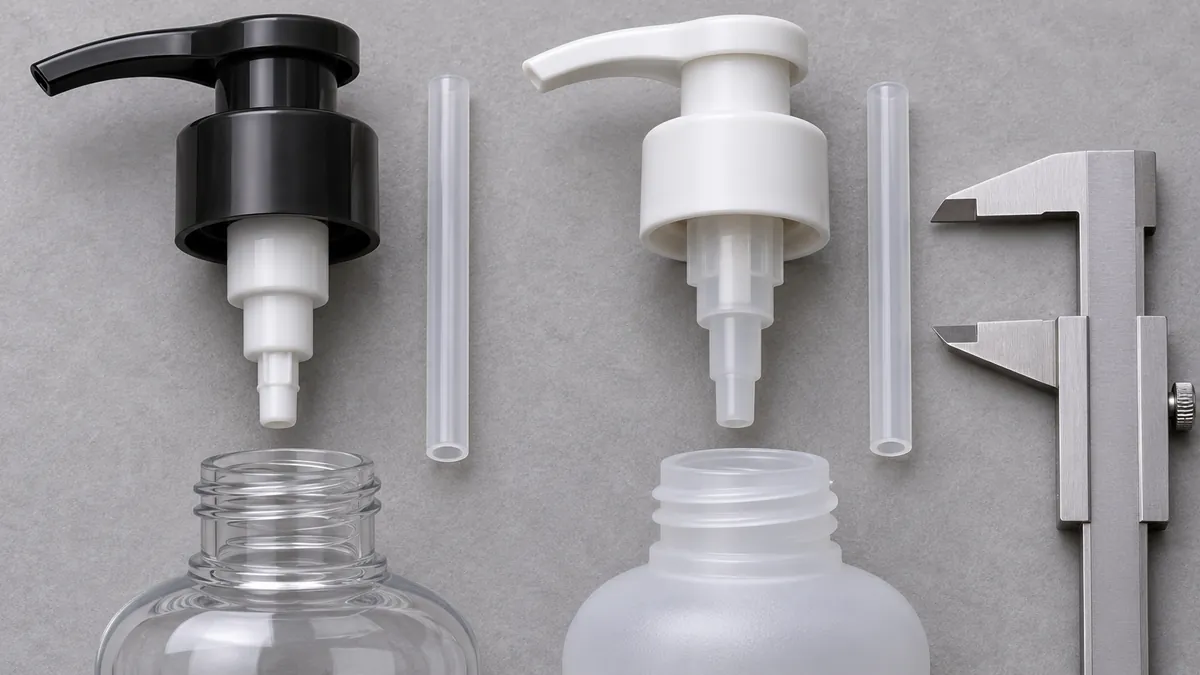
How do buyers distinguish pump, head and full service kit?
Begin with the manufacturer’s exploded view or spare-parts table. Match the visible callout to its part number and note whether the number represents a single piece or a set. Some manufacturers list the pump assembly and pump head separately. Others use one part code for a pump-and-tube unit or a whole dispenser assembly. The description should be copied only with its stated model and scope.
Check the parts included with the quote. A “pump unit” may or may not include a decorative head, pickup tube, bottle, O-ring, gasket, mounting nut or lockable cover. Don’t infer contents from the photo. Request a written packing list or a parts diagram marked with the quoted item. If a replacement requires a seal or adapter, ask whether it is included or ordered separately.
Determine whether the dispenser uses a manual pump, an electronically controlled mechanism, or a system intended for a specific product type such as foam. This is an identification field, not a performance claim. A manually operated liquid-pump component is not presumed to replace an electronic or foam system. Use the original manufacturer code and product documentation.
| Scope name in a quote | Questions to resolve |
|---|---|
| Pump head | Does it include only the press head or the internal mechanism too? |
| Pump assembly | Are tube, seals, stem and connection parts included? |
| Tube/straw | Which named pump and reservoir is it intended to serve? |
| Bottle/reservoir | Is the neck or connection specific to one model family? |
| Seal or O-ring | Which exact pump and material callout does it match? |
| Mounting kit | Does it contain the shank, nut, washers and gasket or only selected pieces? |
| Complete dispenser | Which finish, head, pump, bottle and mounting parts are included? |
| Service kit | What is the manufacturer’s kit number and complete bill of materials? |
Ask whether the proposed item is an original part, approved replacement or a third-party compatible candidate. If the supplier offers an alternative, request the original and replacement references, the models covered, known exclusions and evidence used. A compatible-part claim should identify the actual dispenser models; “fits Moen” or “fits standard dispenser” is too broad unless the supplier documents that scope.
If the maker has discontinued a pump, request its current supersession path or service guidance. A replacement may require a matched bottle, head or seal. Do not assume an old pump code remains available or that a newer part fits every earlier revision. Preserve the maker’s response in the SKU record and update the public listing only after its model scope is clear.
How should a buyer preserve pump and refill compatibility?
A replacement part should retain the approved dispenser configuration. Keep the pump model linked to the dispenser model and separately record the soap or refill that has been evaluated for that system. If the buyer changes the pump, soap, bottle, tubing or container, ask the responsible dispenser maker whether the previous product approval remains applicable.
Do not infer soap viscosity limits, chemical resistance, dose, priming behavior or hygiene performance from a replacement-parts drawing. Those characteristics belong to the dispenser and pump maker’s technical data and the specific refill supplier. If a user reports inconsistent dispensing after a replacement, capture the exact dispenser, pump, refill product, installation state and symptoms. Don’t diagnose the pump as incompatible solely from one anecdote.
A distributor’s internal matrix can have separate columns for dispenser model, pump code, approved refill, bottle or reservoir code, and source of approval. This prevents one confirmed relationship from being accidentally extended to every product that looks alike. For more detailed evaluation of pump-and-refill interaction, link to the existing Koitor guide on approving a commercial soap dispenser pump and actual soap together.
When marketing a replacement kit, state that it fits only the models listed in the supplier’s evidence. Explain whether the replacement preserves the original system configuration, and point the customer to the maker’s instructions for use. If the buyer cannot establish which soap was approved for the pump, direct them to the dispenser manufacturer rather than substituting a product from the same category.
How should a sample and supplier confirmation be reviewed?
A sample review should answer a named question: does the proposed part match the drawing, is the head/pump interface the one listed for this model, or does the complete service kit include the specified components? These checks are not the same as proving dispensing performance, lifetime, hygiene or chemical compatibility.
For a model-specific pump replacement, compare the sample’s markings and dimensions with the current manufacturer parts information. Check the connector, tube, head and included seals only to the extent the maker’s directions permit. Record the sample code, supplier, batch or date, drawing revision and original dispenser reference. If the sample is tested in a live dispenser, follow the manufacturer’s instructions and use the approved refill product. The buyer should not invent a dose or leakage test.
Keep the sample review outcome precise. “Part number confirmed against the manufacturer’s parts drawing” is different from “physically assembled by a qualified service provider in model X” and different again from “dispensing function checked with refill Y.” State what was and was not examined. A good visual match is not proof of fit, performance, hygiene or product certification.
A useful record may use the following stages:
- Original part confirmed: current dispenser documentation identifies the exact spare.
- Supersession confirmed: the dispenser maker identifies the proposed code as the replacement for specified models.
- Supplier cross-reference documented: a component supplier provides a model list and supporting part data.
- Sample under review: physical components are being compared but are not yet approved.
- Unverified candidate: appearance or partial dimensions only; do not make a fit claim.
Request a written response that names the model, revision, quoted code, kit contents, material/finish where relevant, source of compatibility and exclusions. Confirm MOQ, sample availability, lead time, packaging, label, service instructions and change notice separately. A quote is not a compatibility confirmation unless it explicitly addresses the model and part scope.
How should distributors manage replacement pump SKUs?
Assign separate SKUs when components differ in model coverage, finish, kit content or service function. Avoid combining a pump head, tube, bottle and full pump assembly under one generic catalog entry. Warehouse staff should be able to tell which part and model reference a package contains without relying on a photograph.
A compatibility record can include the manufacturer, dispenser model/revision, original part code, new supplier code, part scope, BOM, finish, approved refill reference, source documents, sample status, exclusions, date checked and responsible approver. If a part is supplier-matched rather than maker-approved, label that status distinctly. Keep superseded codes searchable but mark them inactive or mapped to the current code only when the maker confirms the relationship.
Packaging should protect small components and prevent seals, tubes, heads and mounting hardware from becoming separated. Agree the pack contents, labeling and quantity with the supplier. The buyer may request individual bags or kit packaging for service counters, but should not assume one package format is right for every market or dispenser family. Keep the package specification aligned with the approved bill of materials.
Use service data to improve the assortment. Track model identification success, wrong-part returns, missing kit pieces, discontinued parts, supplier substitutions and unresolved cases. Distinguish a genuine compatibility problem from a customer not identifying the installed model or ordering a part outside the documented range. One return can justify a listing review; it does not prove a widespread failure or incompatibility.
At reorder, confirm that the current part number and included components remain unchanged. If the pump, head, tube, material, finish, supplier or packaging changes, request a change notice and decide whether a new sample or model check is needed. A pump part code alone may not show whether the supplier revised its kit content. Keep prior approvals tied to the revision actually checked.
What should the RFQ and buyer checklist include?
A clear RFQ allows the supplier to distinguish a model-specific spare from a generic pump inquiry. Include the dispenser nameplate or model reference, current manual or parts diagram, installed component photos, desired replacement scope, sample if available, finish, approved refill reference where relevant, order quantity and destination market. State any unknown model details rather than filling them with guesses.
| RFQ item | Buyer request |
|---|---|
| Dispenser identity | Confirm brand, model, family and revision covered |
| Original reference | Identify the part number from the current parts list |
| Order scope | State pump assembly, head, tube, seal, bottle, mounting kit or complete unit |
| Kit contents | List every included and excluded component |
| Interface | Confirm the maker-defined pump/head/bottle connection |
| Refill pairing | State the already-approved product reference; ask the maker about changes |
| Evidence | Identify drawing, model list, sample review and remaining uncertainty |
| Commercials | Quote unit, sample, MOQ, lead time, labeling and packaging |
| Controlo de alterações | Explain how part and BOM changes will be communicated |
| Service | Identify who answers fit questions and handles confirmed wrong-part cases |
Before approving a stock order, match the supplier response to the dispenser’s current parts documentation. Confirm that a visible head or bottle has not been mistaken for the full pump. Preserve the drawing, code, supplier confirmation and sample ID. If no model or source evidence is available, describe the part as unverified and keep it out of a guaranteed-compatibility listing.

Buyer checklist for a soap dispenser replacement pump
- Identify the exact dispenser maker, model, series and revision.
- Find the current parts diagram or request model support from the manufacturer.
- Distinguish the visible head, pump assembly, pickup tube, bottle, seals and mounting kit.
- Confirm the part code and full bill of materials for the quoted item.
- Record whether the dispenser is manual, sensor-operated, foam or another model-defined type.
- Verify bottle or reservoir interfaces using the maker’s part data.
- Keep finish appearance separate from mechanical compatibility.
- Preserve the already-approved soap/refill pairing and refer changes to the responsible maker.
- Ask whether the proposed part is original, an approved supersession or supplier-matched.
- Record compatible models and exclusions in the catalog.
- Keep a labeled sample and approval record when appropriate.
- Ask for change notices when source, part code or kit contents change.
- Do not modify the pump, tube, bottle or mounting features by assumption.
- Use actual service and return data to guide stocking choices.
- Limit fit and performance claims to the evidence on file.
Perguntas frequentes
Can any soap dispenser replacement pump fit a wall-mounted dispenser?
No. The pump, head, bottle and mounting interfaces can be model-specific. Use the maker’s parts information and written compatibility confirmation.
Is a pump head the same as a pump assembly?
Not necessarily. Manufacturers may list them separately. Check the parts diagram and quote contents to determine what the order includes.
Does a pump that physically fits guarantee it works with the existing soap?
No. Physical fit and refill compatibility are separate. Preserve the manufacturer’s approved pump/refill pairing and request technical confirmation before changing it.
Can a replacement pump be identified from a photograph?
A photo can support initial identification but may not reveal the model, internal mechanism or connection. Provide the nameplate, model, parts diagram or sample as available.
What if the dispenser model is discontinued?
Ask the original maker for a supersession or service path. A specialist may propose a supplier-matched alternative, but the distributor should retain the evidence and list its model scope and exclusions.
Does Koitor manufacture soap dispenser pumps?
The approved company profile confirms metal bathroom and home-storage hardware capabilities, not pump, bottle, soap or dispenser manufacture. This buyer guide makes no claim that Koitor sells or tests pumps.
Technical references
- Moen soap dispenser identification and support — states model identification is necessary and repair kits are not interchangeable.
- Moen soap-dispenser parts list — example of separate pump, base, straw, nut, bottle and gasket callouts.
- Newport Brass replacement-parts drawing — model-specific pump assembly, pump head, O-ring, mounting kit and bottle references.
- EMCO model-linked replacement pump — spare pump unit mapped to an EMCO article number.
- Koitor guide to pump and soap compatibility — separate guidance on the approved pump/refill pairing.
- Koitor Hardware OEM information — verified metal-hardware sourcing context.
Discuss Your Bathroom Hardware Sourcing Requirements
Share a metal housing or mounting drawing, sample, finish reference and assembly requirements for a capability review. A dispenser or pump manufacturer should confirm pump, bottle, soap and service-part compatibility.
OEM / MARCA PRÓPRIA
Transforme este guia de fornecimento num resumo do produto
Indique o produto pretendido, as dimensões, o acabamento, a quantidade a encomendar e os requisitos de embalagem. A sua equipa receberá uma análise prática da viabilidade de fabrico antes da apresentação do orçamento.


 English
 Español
 Português
 Français
 Deutsch
 العربية