

Resistance welding electrode alloy conductivity hardness are not isolated catalogue numbers for a hardware buyer. They describe a trade-off that can affect current transfer, heat concentration, tip deformation and the repeatability of a resistance-welded joint. For a welded wire basket, the buyer should not select an alloy from a generic “harder is better” rule. Instead, identify the actual material and coating, joint geometry, electrode contact, production condition and evidence the supplier will use to show that the approved sample can be repeated.
What decision should a buyer make about electrode alloy?
A buyer should approve the welding electrode material as part of a defined process-and-product combination, not as a stand-alone grade name. The meaningful question is whether the proposed electrode material, tip shape, force, current path and cooling arrangement suit the actual parts and joint while maintaining acceptable weld evidence over the production run.
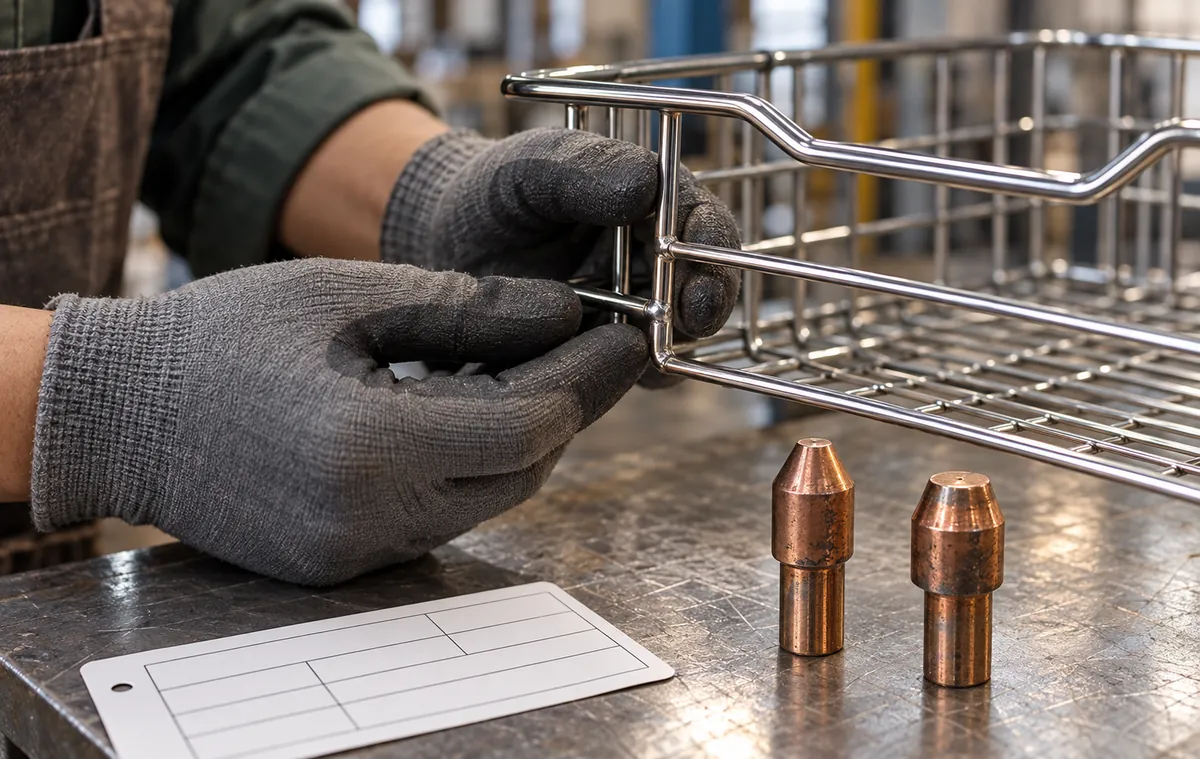
Resistance welding creates heat at interfaces while mechanical force holds the parts together. The electrode is both an electrical contact and a mechanical tool. Its electrical and thermal conductivity influences how energy is transferred; its hardness and softening behavior influence how the contact face changes under repeated pressure and heat. Neither property alone predicts a finished basket joint.
The public technical guidance from TWI on resistance-welding electrode materials describes electrode materials mainly as copper alloys with additions that improve hardness while maintaining useful conductivity. It discusses different alloy families for different work materials and applications. That is a process-selection reference, not a prescription for every wire-basket joint. Buyers should use it to ask better questions, then rely on application-specific trial evidence rather than transferring a table or recommendation without context.
The approval package should connect four items:
- the electrode alloy and supplier designation;
- the actual workpiece material, thickness, coating and surface condition;
- the joint type and electrode contact geometry;
- a production-intent sample and the acceptance evidence agreed for that product.
If the supplier proposes a change to one of these items, the buyer can decide whether it affects the approved process and whether a new sample review is warranted.
Why do conductivity and hardness need to be considered together?
Conductivity describes how readily current passes through a material. In resistance welding, heat is generated by electrical resistance in the workpiece and at its interfaces. A change in electrode conductivity can alter how current and heat are distributed, but the final result also depends on contact area, force, surface condition, geometry, cooling and machine behavior.
Hardness describes resistance to indentation or deformation under a specified method. For an electrode, the practical concern is whether the contact face holds its intended shape under the combination of load, heat and repeated cycles. A tip that mushrooms, wears, pits or becomes misaligned can change the contact area. That changes local current density and makes an earlier setting less representative.
These properties create a balance, not a simple ranking. A material with higher conductivity may be useful in one application, while a harder material may better preserve the contact face in another. The suitable choice depends on the material being welded and the joint’s required process window. TWI notes, for example, that common copper-alloy groups vary in conductivity and hardness and that some applications use higher-conductivity materials, while harder work materials may call for a different electrode class. This comparison should not be turned into a universal rule for bathroom hardware.
| Buyer comparison | What it can indicate | What it cannot decide alone | Provas a solicitar |
|---|---|---|---|
| Conductivity value or class | A property relevant to current transfer | Whether the complete weld will be acceptable | Material designation, test basis and intended application |
| Hardness value or class | Resistance to contact-face deformation under the stated method | Tip life or basket-joint strength by itself | Hardness method, condition, location and supplier traceability |
| Alloy family | A shorthand for a material composition range or recognized class | Suitability for every base metal, coating or joint | Exact designation plus application-specific sample results |
| Tip geometry and condition | The actual contact interface presented to the part | Consistency after repeated production without monitoring | Drawing, maintenance criteria and representative run evidence |
Ask the supplier which standard or classification system the alloy designation refers to and which edition or specification is being used. If the supplier shares a datasheet, confirm whether its values are minimum, typical or guaranteed values and whether they apply to the delivered condition. Do not compare numbers from different methods as if they were directly interchangeable.
Which product and process inputs change the choice?
The electrode alloy cannot be chosen responsibly until the workpiece and joint are identified. For a wire storage basket, several joints may look visually similar but differ in wire diameter, material, surface coating, overlap, access and the way parts are held. A spot-welded crossing between two wires is not automatically equivalent to a sheet-to-wire contact or a projection-welded fitting.
Start with the product drawing or approved sample. Record the relevant basket component, wire or sheet specification if known, finish before or after welding, joint location, expected appearance, and whether the joint is structural or mainly locational. If material grade or coating is unknown, mark it as an open item rather than assuming stainless steel or bare low-carbon steel from the product’s appearance.
The supplier should then explain the proposed electrode setup at a useful level. A buyer usually does not need to dictate a universal machine recipe. The buyer does need enough information to establish what is being held constant between sample approval and repeat production.
Ask about:
- Workpiece material and condition. What material form, thickness or wire diameter, coating, oxide, oil or surface treatment is relevant to the sample?
- Joint and access. Is the joint wire-to-wire, wire-to-sheet or another configuration? Can both sides be reached consistently? Is the contact point supported?
- Electrode contact. What tip profile and contact dimensions are proposed, and how will alignment be checked?
- Alloy identification. What is the electrode grade or recognized class, who supplies it, and how is a material substitution controlled?
- Cooling and maintenance. What condition checks, cleaning, dressing or replacement criteria are used? A buyer should avoid inserting a cooling flow number without process-specific evidence.
- Acceptance evidence. Which sample locations, visual checks, dimensional checks or qualified joint tests are relevant to this product?
TWI’s guidance on electrode wear and maintenance emphasizes that material and shape must suit the job and that alignment, cooling and maintenance are part of managing electrode condition. This reinforces the central sourcing point: alloy selection is only one part of a controlled joining system.
How can electrode wear affect a wire-basket sample?
Electrode wear matters because it can change the interface that produced the approved sample. The contact face may flatten, erode, collect material or lose alignment. Depending on the workpiece and process, a changed contact can affect local heating, surface marking, sticking, weld formation or repeatability. These are possible mechanisms to investigate, not proof that a particular supplier or basket has a defect.
Buyers should distinguish electrode condition from the separate decision of how much wear is acceptable. A maintenance rule such as “dress after a fixed number of welds” may be appropriate for one stable setup, but it should not be treated as a universal interval. The interval depends on the application and observed changes. Ask how the supplier establishes a maintenance trigger and what records show that sample and production conditions are comparable.
A practical production-intent review can include parts from the beginning, middle and later portion of a representative run when that is feasible. The point is not to prescribe a specific sample count without data. It is to avoid approving only one fresh setup sample when the buyer’s concern is consistency over time. Identify each sample, record the product/drawing revision and process date, and state which joint locations were reviewed.
For the finished basket, the evidence should match the actual failure concern. If the buyer is concerned about a loose joint, a visual-only check may not answer the question. If the concern is cosmetic marking, an undocumented destructive test may not answer it either. Agree the method, sample condition and acceptance criteria before production. Any numerical limits must come from the product specification or an agreed, technically justified project method—not from a generic blog article.
How should buyers compare supplier proposals?
A supplier proposal is easier to compare when it separates material facts, process assumptions and approval evidence. A brief statement such as “copper electrode” is not enough to evaluate a design change, while a long list of machine settings without product context may be no more useful.
| Proposal item | Useful buyer question | Red flag to clarify |
|---|---|---|
| Alloy designation | Which exact grade/class and supplier specification apply? | “Standard copper” without traceable identity |
| Property data | Are values typical or guaranteed, and by which method? | Hardness or conductivity numbers without method or condition |
| Application fit | Which workpiece and joint conditions were considered? | Claim that one alloy suits all metals and coatings |
| Tip geometry | Is the profile defined and controlled against the drawing or setup? | No record of contact shape or alignment |
| Maintenance | How is tip condition assessed and when is intervention triggered? | Fixed life claim with no application evidence |
| Sample approval | Which joints and production conditions are represented? | One hand-selected sample with no identification |
| Controlo de alterações | What substitutions require buyer review? | Electrode alloy changes treated as invisible consumables |
For a small-batch OEM project, a buyer can ask the manufacturer to document the proposed approach in plain language and retain the agreed production-intent sample. Koitor Hardware is a family-owned custom metal hardware factory that supports metal forming and resistance welding among its approved processes; exact electrode alloys, machine configuration and product-specific performance should be confirmed for the project. This is why a drawing or physical sample is more useful than a product name alone.
What should go into the RFQ and sample-approval checklist?
Put the boundary of the request in the RFQ so two suppliers are quoting comparable work. The buyer does not need to prescribe every process parameter. The buyer should define the finished-product requirement, identify known workpiece inputs and ask the supplier to list assumptions.
- Product name, drawing revision and the basket joints that require evaluation.
- Workpiece material and finish, or an explicit note that the supplier must confirm them.
- Any appearance-sensitive side, visible weld locations or post-weld finishing requirement.
- Proposed electrode alloy designation and the source of its material data.
- Tip profile and alignment control relevant to the joint.
- The supplier’s electrode inspection, cleaning, dressing or replacement approach.
- Representative sample identification and production conditions.
- The agreed visual, dimensional or qualified joint evidence and acceptance authority.
- Which material, coating, geometry, electrode or maintenance changes require renewed approval.
- Required records to be supplied with the sample and first production order.
Use an approved sample as a reference, but do not let a physical sample silently override a controlled drawing. If the drawing and sample differ, write down which features are authoritative. Record unresolved issues before the buyer’s approval rather than accepting a supplier’s assumption by default.
When does a change require renewed approval?
Not every routine maintenance action needs a full requalification. The buyer and supplier should define change triggers based on product risk. A change in electrode alloy or supplier designation may be significant if the process relies on its properties. A change in tip shape, workpiece material, coating, joint geometry, contact access or maintenance approach may also change the evidence needed.
Create a simple change-control rule:
- list the approved input and its source;
- identify changes that can affect the joint or visible surface;
- identify changes the supplier may make within the approved process;
- specify when the buyer must review a new sample or supporting data;
- retain the approval record against the current drawing revision.
The supplier should not need buyer approval for every minor production adjustment if the contract allows controlled process management. Conversely, a buyer should not assume that a different electrode alloy is equivalent merely because the supplier says it is “similar.” Ask what evidence supports the equivalence and whether the finished sample still meets the agreed criteria.
Perguntas frequentes
Is a harder resistance-welding electrode always better?
No. Hardness is one property. Conductivity, workpiece material, coating, joint geometry, tip contact and cooling also matter. Ask the supplier to explain why the selected grade suits the actual application and verify the result on representative samples.
Does higher conductivity guarantee a better weld?
No. Conductivity alone does not establish weld quality. It affects the electrical and thermal behavior of the electrode, but the joint also depends on force, current, time, contact geometry, surface condition and equipment. Use application-specific evidence.
Can buyers compare electrode hardness values from different suppliers directly?
Only when the designation, test method, condition and reporting basis are comparable. Ask whether the figure is typical or a specified minimum and where it was measured. Avoid treating unlike methods or material conditions as interchangeable.
Should the RFQ specify the exact electrode alloy?
If the buyer or qualified process owner has validated a specific alloy, it may be included. Otherwise, ask the supplier to propose and identify the alloy, justify it for the workpiece and state how substitutions will be controlled. The buyer’s acceptance criteria should focus on the finished joint and the agreed process evidence.
What samples should be reviewed?
Review samples that represent the actual material, coating, geometry, fixture access and production route. For repeatability concerns, agree a sample plan that includes more than one moment or condition in a representative run. Do not invent a sample count or pass limit without a project basis.
How can Koitor support the sourcing discussion?
Koitor can review buyer drawings or physical samples for custom bathroom and home storage hardware and discuss metal forming, resistance welding, finish, assembly and packaging requirements. The specific welding electrode material and process evidence must be confirmed for each project; this article does not claim a particular alloy, machine setting, test result or certified capability.
For a relevant product, buyers can review produção de cestos de armazenamento em metal personalizados and broader Hardware de armazenamento doméstico OEM options. When preparing an inquiry, send the drawing or sample, the identified joint, known material/finish information and the approval evidence you need. Contacte a Koitor to discuss a project-specific review.
What does a useful supplier record look like?
A supplier record for resistance welding electrode alloy conductivity hardness should identify the product revision, material condition, joint location, proposed electrode grade, tip profile, sample IDs and evidence method. Add a note about which changes need review. The purpose is traceability between the buyer’s approved product and the supplier’s repeat-production process, not collection of paperwork for its own sake.
For an importer or distributor, this record also makes supplier comparison more disciplined. One supplier may propose a different copper alloy from another. Instead of ranking those names in isolation, ask each supplier to state the same inputs and provide evidence against the same finished-product requirement. If the approaches differ, compare what changed and whether the validation is equivalent.
A useful record should not claim that a test was performed when it was not. Distinguish supplier-provided data, observed sample checks and any independent test report. If no qualified test is available, say so and agree what lower-level evidence is acceptable for the project. A clear unknown is more useful than a confident but unsupported claim.
How do cost and production efficiency enter the decision?
Electrode alloy has a purchase cost, but buyers should avoid evaluating it only as a line item. A more relevant commercial comparison includes material price, expected maintenance needs, sample approval effort, potential rework exposure and availability of replacement tips. These factors must be assessed for the actual production route; no generic alloy comparison can predict the net cost of a basket program.
Ask whether the proposed electrode is readily identifiable and replenishable, whether the supplier has a defined condition check, and whether a change would require another sample review. If a more expensive electrode is proposed, ask which product-specific risk it is intended to control and what evidence supports that choice. If a lower-cost grade is proposed, ask whether the supplier’s sample and repeat-production evidence remain adequate.
For trial orders, the buyer can keep the initial specification simple: identify the joint and material, require the supplier to disclose the proposed electrode alloy, approve a representative sample and record any agreed change triggers. As order volume or product variation grows, the buyer may request more detailed process and maintenance records. The documentation level should be proportionate to the risk and the commercial relationship.
What should buyers avoid claiming from a datasheet?
A datasheet for resistance welding electrode alloy conductivity hardness describes electrode properties; it does not establish the quality of a finished weld in a particular basket. Buyers should not convert an alloy-property sheet into a claim about joint strength, life, defect rate or process stability. Those outcomes require project-specific evidence and an appropriate evaluation method.
Likewise, a supplier’s general statement that an alloy is common in resistance welding does not establish that it is suitable for every material, coating, wire diameter or joint. Treat technical references as a starting point for questions. The supplier still needs to show the actual proposed setup and sample evidence, and the buyer still needs to approve the finished product against its specification.
This distinction matters in private-label programs where the same visual basket can be manufactured with different material grades or surface routes. The approved record should preserve what was evaluated, not just the product photograph or supplier name.

Review the Weld Joint Before Approving Basket Production
Send Koitor your wire-basket drawing or physical sample, known material and finish, plus the specific joint and approval evidence you want reviewed. Electrode choices and results remain project-specific.
OEM / MARCA PRÓPRIA
Transforme este guia de fornecimento num resumo do produto
Indique o produto pretendido, as dimensões, o acabamento, a quantidade a encomendar e os requisitos de embalagem. A sua equipa receberá uma análise prática da viabilidade de fabrico antes da apresentação do orçamento.


 English
 Español
 Português
 Français
 Deutsch
 العربية