

Stainless steel vs mild steel is a comparison between different steel material families and the protection approach used on the finished part. Stainless steel is an alloy family whose corrosion resistance is associated with a chromium-rich passive surface; mild steel generally refers to low-carbon steel and commonly relies on an appropriate applied protection system when corrosion exposure matters. Neither label identifies one universal grade or guarantees a finished product’s performance. Buyers should specify the actual material grade or supplier designation, the applied finish, the part condition, and the environment in which the product will be used.
The distinction matters when an importer compares a wire basket, bracket, frame, rack, or other metal hardware proposal. One supplier may quote stainless steel; another may offer mild steel with a coating. A black or bright finish does not reveal the substrate underneath. The comparison should therefore separate what the metal is from what surface protection is applied and what exposure the part will face.
Steel family and protective finish are different specification fields
“Stainless steel” does not mean that every part is immune to rust. Grade, surface condition, fabrication, contamination, cleaning, design, and exposure affect how the finished item behaves. “Mild steel” generally describes a low-carbon steel category, but the phrase alone does not identify a precise grade, chemistry, supplier standard, or mechanical condition. Buyers need the actual designation used on the quotation and supporting material records.
A coating or plating is an applied surface treatment. Powder coating, paint, plating, or another finish may be specified over a substrate, subject to the actual supplier’s process and project scope. These treatments do not turn mild steel into stainless steel. They also do not establish the substrate’s identity. The drawing and material declaration should state the base material separately from the finish.
A buyer should be able to read a purchase line like this without guessing:
- Substrato: exact stainless grade or identified mild/low-carbon steel specification.
- Form: sheet, tube, wire, strip, bar, or other material form, if relevant.
- Fabrication state: part drawing and revision, including relevant forming or joining details.
- Conclusão: specified coating or treatment and color/appearance requirements.
- Exposure: intended environment, cleaning, moisture, salt or chemical contact, and use conditions defined by the project.
- Acceptance: records, sample review, or test evidence required for that exact part and scope.
Compare the material and protection system, not just the names
The matrix below frames the buyer’s decision. It does not rank strength, cost, weldability, lifetime, or maintenance.
| Pergunta do comprador | Stainless steel route | Mild steel with protection route | Evidence or detail to request |
|---|---|---|---|
| What is the substrate? | Exact stainless family/grade and product form | Exact low-carbon/mild-steel designation and form | Material declaration, supplier code, lot or document linkage |
| How is corrosion addressed? | Alloy composition and surface condition are relevant; no “never rust” guarantee | Applied protection system is typically part of the specification | Finish definition, preparation and applicable supplier process record |
| What does the color prove? | A visible finish does not prove grade | A coating color does not prove the metal beneath it | Traceable material line item and controlled drawing |
| What affects fabrication? | Grade and condition may affect forming/joining choices | Grade, section, forming and coating sequence matter | Supplier review against actual drawing and sample |
| What exposure applies? | Actual moisture, cleaning, contamination and use conditions | Same exposure plus the protection system’s stated scope | Project-specific environment and maintenance assumptions |
| What does a test show? | Result applies to the tested sample and conditions | Result applies to the tested substrate/finish combination | Method, sample configuration, duration, evaluation and limits |
| What is being compared commercially? | Material, process, finish and inspection scope | Substrate, surface system, process and inspection scope | Quote assumptions, exclusions and revision |
Metals Supermarkets’ explanatory article describes mild steel as low-carbon steel, while thyssenkrupp Materials explains the distinction between stainless and mild steel and the role of chromium-related protection. These materials support broad identity and mechanism explanations, not a universal numerical chemistry cutoff, strength ranking, life estimate, or project approval. Use the exact grade documentation and current project evidence for a purchasing decision.
How the substrate and finish interact
A part’s protection is not just a label on a color chart. Surface preparation, fabrication sequence, edges, joints, recesses, fasteners, contact points, and handling can affect what is protected. If a part is formed or joined after a coating step, the exposed or altered areas may need to be considered. If a finished part has trapped moisture or difficult-to-clean geometry, the application may raise questions beyond material name. These are design-review considerations; they do not prove that a specific part will corrode.
For stainless steel, the word “stainless” should not be used as a claim that the surface can never corrode. Material grade and actual exposure matter. The surface can be affected by contaminants, damage, environment, design, and maintenance. Buyers should avoid translating “stainless” into an unconditional service-life promise.
For mild steel with a protective finish, do not assume that a thicker-looking or darker coating proves better corrosion performance. A coating’s suitability depends on the specified system, supplier process, preparation, coverage, geometry, and the test or evidence applicable to the project. The substrate and finish should be documented as separate controls. A test on a flat panel may not represent every cut edge, weld, fastener, or assembled feature unless the method and sample match the actual item.
A material and finish comparison can be represented as:
Substrate identity + fabrication/condition + applied protection + exposure + design geometry + inspection evidence = project-specific decision context.
This is not a formula for predicting life. It is a reminder that no single word describes the complete product. A supplier’s quote should state the assumptions under which the offered combination is expected to meet the buyer’s requirement.
Separate the protection question from the substrate question
A buyer can have a correct finish specification and still have an incomplete material specification, or the reverse. For example, a purchase line may name a coating color but omit the underlying steel designation. Another may name a stainless grade while leaving the actual surface treatment, finish appearance, or fabrication condition open. Keep a two-part question in the RFQ: “What is the base material?” and “What protection or finish is applied, and to which surfaces?” Then add the drawing revision and evidence requirements that apply to the actual part.
This separation also helps during a supplier change. A new coating supplier may use the same color reference but a different process, while a new steel source may provide a different grade under a similar commercial description. Record each change independently, identify the reviewer, and determine whether the project needs a revised sample or other evidence. An unchanged appearance does not make the underlying specification unchanged.
Define the actual application before requesting a comparison
Before choosing a route, describe where and how the hardware will be used. Is it in a dry indoor room, a bathroom with regular moisture, a shower zone, a coastal environment, a hospitality facility, or another setting? What cleaning products and frequency apply? Is the item frequently touched, loaded, or exposed to standing water? These details change the question the buyer is asking. Do not assume all bathrooms or all indoor uses create the same exposure.
State the project requirement in measurable or reviewable terms where the buyer has established one. If there is no approved test duration, acceptance criterion, or finish definition, mark that as a decision needed. Do not invent a universal threshold or imply that one coating result predicts years of field use.
The buyer should also clarify aesthetic and functional requirements. A particular color, gloss, texture, or metal appearance may be important for a private-label range, but appearance is not a substitute for material identity. If a finish is part of the product’s brand presentation, attach the approved sample, reference, or color system and identify the revision. Note which surfaces are cosmetic and which features affect fit, assembly, or contact.
For a project with multiple suppliers, assign responsibility clearly. The metal fabricator may form or join the part, a finishing supplier may apply a coating, and an importer may define acceptance. Record who controls substrate certificates, coating documentation, test reports, incoming inspection, and change approval. A supplier statement should not be stretched beyond its actual scope.
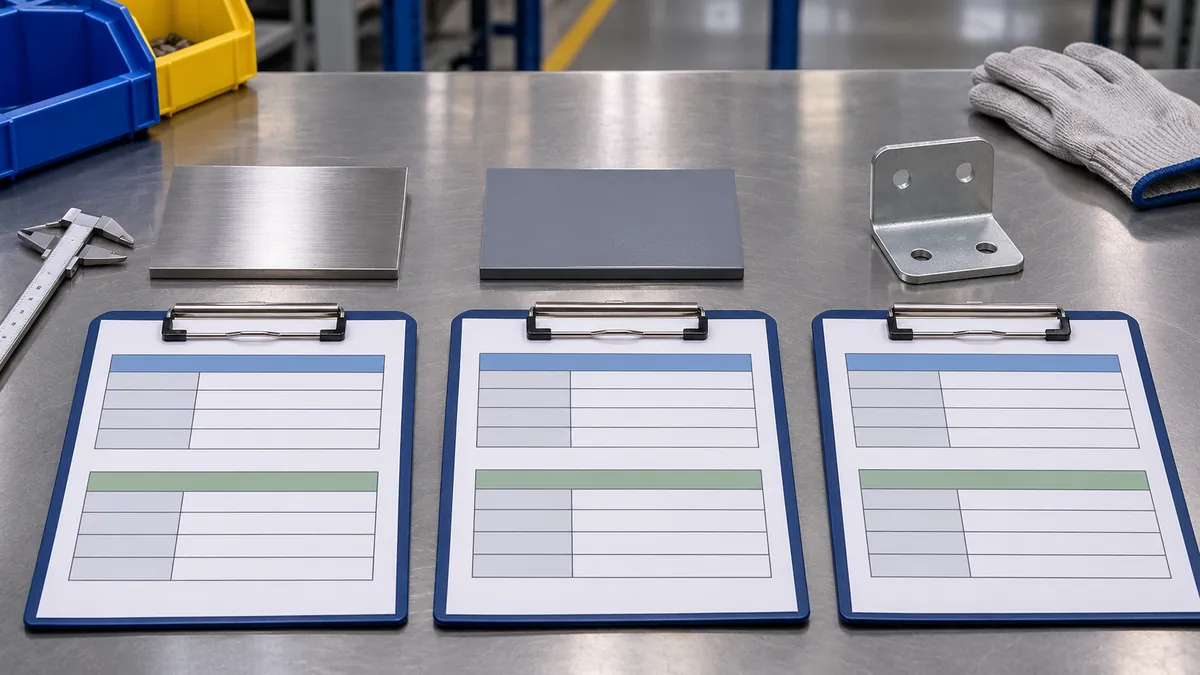
How to compare two supplier quotations
A quote comparison should preserve the details of each proposed route. A stainless quote and a coated mild-steel quote may differ in material, process, finish, inspection, packaging, and assumptions. Compare total scope rather than matching only the line price.
A structured comparison can include:
| Campo | Offer A | Offer B | Open issue |
|---|---|---|---|
| Substrate designation | Exact grade and form | Exact designation and form | Is either description generic? |
| Drawing revision | Current revision | Current revision | Do suppliers quote the same geometry? |
| Fabrication | Operations and sequence in scope | Operations and sequence in scope | Are post-finish operations different? |
| Concluir | Process name, color, appearance reference | Process name, color, appearance reference | Is the protection system adequately defined? |
| Environment | Assumptions stated | Assumptions stated | Are use and cleaning conditions aligned? |
| Evidence | Material and finish records | Material and finish records | What does each record actually cover? |
| Inspeção | Stated checks and sample basis | Stated checks and sample basis | Which checks apply to the delivered product? |
| Embalagem | Protection and labeling | Protection and labeling | Could transport or storage affect the finish? |
| Base de preço | Quantity, scope and exclusions | Quantity, scope and exclusions | Are commercial assumptions equivalent? |
A supplier should identify deviations from the drawing and state any assumptions about grade, finish, exposure, or evidence. “Stainless option” and “coated steel option” are not sufficiently precise if the technical line items remain unknown. If one supplier cannot confirm the exact material or process, record it as an open item rather than silently treating it as equivalent.
When a coating test or corrosion test is proposed, determine what it evaluates and does not evaluate. Confirm the material and finish configuration of the sample, the method, duration, evaluation criteria, and any exclusions. A test result is evidence about the tested sample under the described test, not an automatic lifetime guarantee or proof that every unit will behave identically. The project owner should decide what test is relevant and how results will be accepted.
Common mistakes when sourcing stainless or mild steel hardware
Treating “stainless” as “cannot rust”
Stainless steel is not a blanket immunity claim. Grade, finish, contamination, use environment, geometry, and maintenance can affect real outcomes. Specify the grade and conditions rather than promising absolute immunity to corrosion.
Treating coating as a steel grade
A coating is a surface system, not the substrate. State both. A black or bright appearance cannot identify what metal is underneath.
Comparing by weight or feel
Weight and hand feel do not identify a grade or establish strength, corrosion resistance, or finish quality. Use supplier records and appropriate evidence.
Using a generic phrase in the purchase order
“Steel,” “mild steel,” or “stainless” may be too broad for a controlled order. Confirm the exact designation, form, and finish. Resolve any supplier-specific terminology before release.
Assuming the finish covers every feature identically
Edges, holes, joints, bends, and handling can create different conditions. Review the complete part and process sequence with the supplier. Do not infer coverage from a flat sample alone.
Treating a test duration as service life
A test method creates a controlled exposure; it is not automatically a direct translation into years of field use. Keep the result’s scope and limitations visible.
Choosing only on unit price
The substrate, finishing process, inspection, packaging, and rejection or repair scope may differ. Compare quotation assumptions and the project’s total requirements before deciding.
Assuming all steel grades behave alike during fabrication
Material identity and condition can influence process choices. The supplier should review the actual grade and drawing. Avoid universal claims about formability, weldability, hardness, or impact based on the broad labels alone.
Keep material claims and records traceable
The purchase file should connect the drawing revision to the supplied substrate and surface system. Depending on the project, records may include material declarations, supplier grade documents, finish references, sample approvals, lot identifiers, inspection records, or test reports. The buyer should request only the evidence relevant to its requirements and define who controls each record.
When a supplier proposes a material or finish change, note the old designation, proposed designation, reason, affected surfaces, evidence, reviewer, approval, and first applicable order or lot. If the color remains the same but the substrate changes, that is still a material change. If the substrate remains the same but the coating process changes, that is a finish/process change. Keep those categories separate in the approval record.
A supplier’s certificate or statement should be checked for its scope. Does it refer to the exact grade, lot, part, coating line, or only a general product family? Does the report cover the same geometry and process as the finished item? If not, it may provide background but not the specific proof the buyer needs. Do not imply a certification or lab capability that has not been verified.
How a small-batch OEM factory can help
A custom metal hardware factory may help a buyer review drawing clarity, material callouts, forming or joining scope, finish references, sample revisions, and packaging for a metal product, within its confirmed capabilities. Koitor Hardware is a family-owned custom metal bathroom and home-storage hardware factory with customization from buyer drawings or physical samples and direct communication. This does not mean Koitor is a certified materials laboratory or that the factory can guarantee a universal stainless or coated-steel performance result.
For a small product development run, the buyer can provide a drawing, sample, intended environment, substrate preference, finish requirement, quantity range, packaging, and any established acceptance criteria. The factory can confirm what part of the project it can quote and which information remains unresolved. If a specialized corrosion test or grade certification is needed, identify the responsible provider and the exact scope rather than assuming it is included in a metal fabrication quote.
The practical value is scope alignment. An early discussion may reveal that the drawing specifies a finish color but omits the substrate, or names stainless without a grade. The buyer can then correct the specification before sample approval or production ordering. Whether a particular quantity, process, or finish is feasible must be confirmed for the actual project. No universal MOQ, lead time, cost, production volume, or test outcome follows from this guide.
For repeat orders, compare the new quote to the previously approved substrate and finish fields, not only to the last product photo. A reorder can look unchanged while a material code or finishing scope has changed. Ask the supplier to identify any difference and record the decision before the purchasing team releases the updated quantity.
For a new supplier, ask whether the quoted material and finish are standard offerings or project-specific assumptions. If the supplier proposes a substitute after sampling, compare it against the original designation and identify which visible and documented features changed. Keep the buyer approval linked to the actual order revision, and ensure later reorders use the same controlled specification unless a new change is reviewed. This prevents a familiar product photograph from masking a changed material or protection system.
For a stainless steel vs mild steel decision, separate the base alloy from any applied protection. The finished system must be compared against the actual environment and controlled specification.
For a related order handoff, see how to prepare drawings or samples for a custom hardware factory. The controlled revision should accompany material and finish details.
Buyer checklist before requesting a quotation
- What exact substrate is required: stainless grade or low-carbon/mild-steel designation?
- What product form and drawing revision apply?
- Is the finish specified separately from the substrate?
- What surface appearance, color, texture, or sample revision is required?
- What environment, cleaning, moisture and use conditions define the project?
- Which surfaces, edges, joints or interfaces require special review?
- What material or finish records are required, and which supplier provides them?
- Is a sample or test needed, and what does it need to demonstrate?
- Are method, duration, sample configuration and evaluation criteria defined?
- Does each quote include the same fabrication, finish, inspection and packaging scope?
- What deviations or assumptions has each supplier listed?
- Who approves a change to substrate, finish, or manufacturing sequence?
- Which claims must be held until supporting evidence is available?

For a stainless steel vs mild steel decision, separate the base alloy from any applied protection. The finished system must be compared against the actual environment and controlled specification.
Perguntas frequentes
Is stainless steel always better than mild steel?
No universal ranking applies. The material and finish should fit the product, environment, design, appearance, cost and evidence requirements. Compare exact grades and protection systems rather than relying on a family label.
Can stainless steel still corrode?
No. “Stainless” does not mean corrosion is impossible. Grade, surface condition, environment, contamination, geometry, and maintenance can matter. Avoid unconditional lifetime or immunity claims.
Is mild steel the same as carbon steel?
Mild steel is commonly used for low-carbon steel, but exact designations and commercial language should be confirmed with the supplier. Do not infer a precise chemistry or grade from the generic phrase alone.
Does powder coating make mild steel stainless?
No. Powder coating is a surface finish; it does not change the underlying steel into stainless steel. Specify the substrate and coating as separate items.
Can a coated mild-steel part work in a bathroom?
Suitability depends on the exact steel, coating system, design, exposure, cleaning, fabrication, and project evidence. A broad label cannot answer the question. Define the environment and obtain relevant supplier information.
Can I identify the substrate by looking at the color?
No. Appearance alone does not establish alloy identity or coating chemistry. Use a controlled drawing, material record, supplier documentation, and appropriate verification when required.
Does a corrosion test tell me how many years a part will last?
Not automatically. A test result applies to the method and sample conditions described. It should not be converted into a universal field-life promise without a validated basis.
What should I do if two suppliers quote different steel routes?
Record the exact substrate, finish, process, evidence, inspection and packaging in each quote. Compare the same drawing and conditions, list deviations, and have the designated technical owner approve the selected route.
Trabalhe com a Koitor Hardware
For a custom metal bathroom or home-storage hardware project, share the controlled drawing or sample, target quantity range, substrate and finish preference, intended environment, packaging needs, and unresolved questions. Koitor can discuss the confirmed manufacturing scope and flag missing project details; material performance claims require evidence for the actual grade and finish.
Discuss steel and finish requirements with Koitor Hardware.
Send your drawing, sample, target quantity, finish, packaging, and project questions for a scope discussion.
OEM / MARCA PRÓPRIA
Transforme este guia de fornecimento num resumo do produto
Indique o produto pretendido, as dimensões, o acabamento, a quantidade a encomendar e os requisitos de embalagem. A sua equipa receberá uma análise prática da viabilidade de fabrico antes da apresentação do orçamento.


 English
 Español
 Português
 Français
 Deutsch
 العربية