
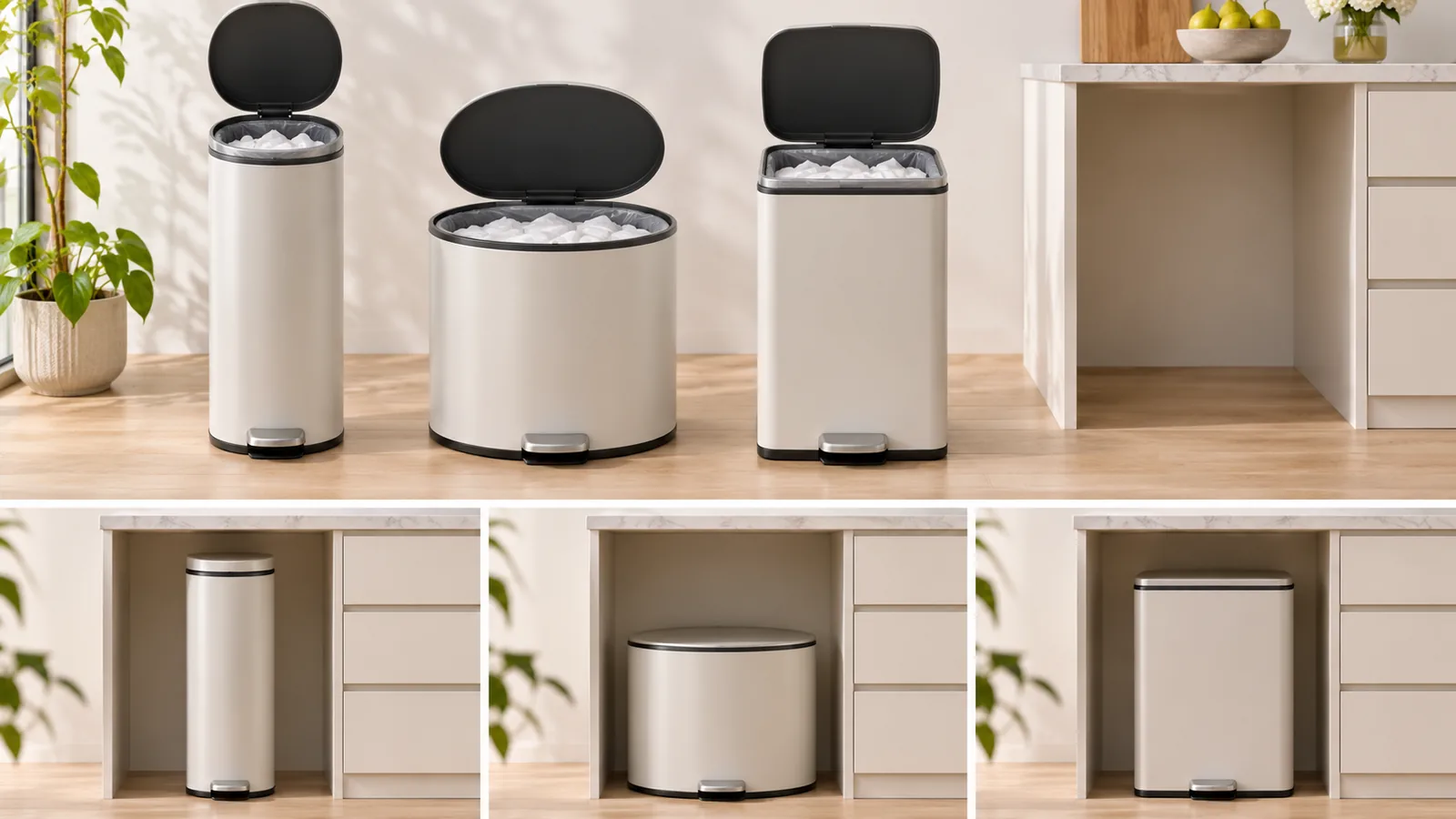
Trash can sizes are described both by nominal capacity and by physical width, depth, and height; one label does not determine the other dimensions. A 45-liter product can have a different shape and outside envelope from another 45-liter bin, and a divided model may allocate capacity among compartments. Simplehuman’s CW2148 semi-round step can is one model-specific example: its page lists 45 L capacity and dimensions of 15.8 inches wide, 14.3 inches deep, and 26.5 inches high. Those figures describe that model, not a universal household size. Compare the intended capacity and the actual available space separately.
When assessing household bins, keep the product range distinct from commercial dumpsters or service containers. Brabantia’s own guide shows products from 3 L to 60 L and above, plus separate divided-bin formats. Those are that maker’s offerings, not a required capacity per person or a standard range every supplier must follow. The practical buyer question is what the capacity label means for the chosen model and whether the outside shape fits the intended location.

Trash Can Sizes: Separate Capacity from Outside Dimensions
Capacity is a volume measure. Physical dimensions describe how much floor or cabinet space a particular product occupies. These fields are related but not interchangeable. A tall narrow bin and a short wide bin could have the same mathematical interior volume yet occupy very different footprints. Actual bins may taper, have rounded corners, include a lid or pedal, and use internal liners or partitions, so a simple volume calculation does not establish the capacity of a named product.
For a product comparison, record the maker’s stated capacity and the product’s listed width, depth, and height separately. If the maker supplies both total capacity and per-compartment capacity, keep both. Confirm whether dimensions refer to the body alone or include a lid, pedal, handle, or other projection. Do not infer these details from a photograph or from another model in the same product family.
| Comparison field | What it describes | What to verify on the model |
|---|---|---|
| Nominal capacity | The stated volume, such as liters | Whether the value is total or divided among compartments |
| Width | One horizontal outside dimension | Whether a pedal or lid projects farther |
| Depth | The other horizontal outside dimension | Which orientation the maker calls depth |
| Height | Vertical outside dimension | Whether a closed lid or handle is included |
| Opening and lid | Access to the bin’s interior | Model-specific opening path and clearance |
| Liner or inner bucket | A replaceable or fitted component where offered | Compatibility by model, not only nominal capacity |
This is a buyer comparison framework, not an assertion that every manufacturer defines dimensions identically. Use the specific maker’s drawing or product specification and record the source and model number.
Compare Equal Volumes with Different Shapes
A simple mathematical illustration shows why the same volume can produce different dimensions. A hypothetical rectangular interior measuring 25 cm by 20 cm by 60 cm has a volume of 30,000 cubic centimeters, or 30 L. Another hypothetical rectangular interior measuring 30 cm by 20 cm by 50 cm also has a volume of 30,000 cubic centimeters, or 30 L. The first is taller and narrower; the second is shorter and wider. These are idealized rectangular calculations, not dimensions of actual trash cans.
Real products may taper from top to bottom, have rounded corners, include thick walls, or reserve space for a liner, bucket, lid, and mechanism. The nominal capacity of a real model must come from its manufacturer rather than from multiplying outside dimensions. The illustration only demonstrates that a volume label cannot uniquely define a footprint or height. A buyer selecting for a narrow cabinet may care more about width and depth; a buyer with a low counter or shelf may care about total height. Verify the specific model’s outside envelope against the actual location.
If a product has multiple compartments, total capacity can hide how much space belongs to each section. Ask whether the published number is the combined volume or a compartment-level value, and compare the division with the intended sorting use. A two-section model and a single open bin can carry the same total nominal volume while offering a different organization pattern. Do not infer that divided capacity can be pooled when one section is full and the other is not.
Keep Manufacturer Examples Attached to Their Models
The Simplehuman CW2148 semi-round step can page lists 45 L capacity and a 15.8-inch width, 14.3-inch depth, and 26.5-inch height. Keep the model identifier next to every figure so that the values are not mistakenly applied to another can. The product name and its shape category also matter: a semi-round body may have different placement considerations from a rectangular or round body. This example illustrates the information a buyer should compare; it does not prove that 45 L is right for every household or location.
Brabantia’s guide presents its own selection from 3 L through 60 L and above and includes divided formats. These product examples likewise remain tied to Brabantia’s assortment. Different makers may use different product families, sizes, and dimensions. Avoid combining one supplier’s capacity with another supplier’s outside dimensions as if they describe the same model. If a category table aggregates products from several brands, retain a source column and make clear that each line is a separate listing.
Do not turn these examples into a household-per-person formula, a weekly waste estimate, or an environmental-performance claim. The research pack rejects universal per-person recommendations and product-life or hygiene guarantees. A buyer can decide which nominal capacity and shape to evaluate by considering the actual space and use case, then confirm the SKU-specific dimensions and instructions from the maker.
Measure the Location Before Choosing a Shape
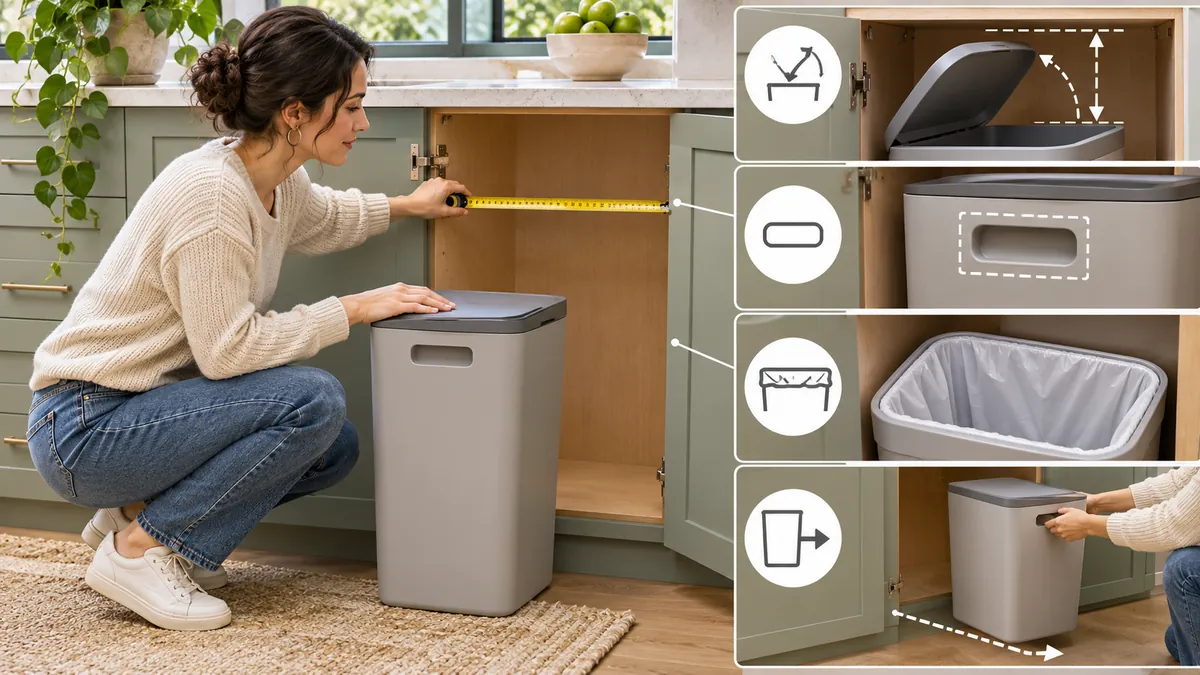
Start with the actual placement area. Record the maximum floor width and depth, the vertical space, nearby walls or cabinet sides, and any obstructions that affect how the product can be positioned. If the bin will sit under a counter, account for the dimensions of the opening and any shelf or door that changes the available envelope. The product page should state whether its lid, pedal, or other feature extends beyond the body; if it does not, ask for clarification rather than estimating from a photo.
For products with a lid or pedal, the motion path is a separate fit question. This article does not specify operating clearance or lid travel; the existing slim-bin article owns that mechanism. Use that model-specific information when the product is already selected. Likewise, an exact replacement inner bucket or service part belongs to its own model-compatibility owner. Capacity comparison cannot establish replacement compatibility.
Keep the measurement record explicit about orientation. If a supplier calls one horizontal dimension “width” and another “depth,” match the supplier’s product drawing. In an alcove, the longest wall dimension may not be the same direction as the can’s stated width. Mark the bin’s front and sides on a small plan if orientation could affect fit. That avoids turning a seemingly adequate footprint into a wrong-way placement during a later order or installation review.
What a Product Listing Does Not Establish
A capacity number does not automatically establish liner compatibility, pedal life, lid-opening clearance, odor control, or hygiene performance. Each is a separate model or use claim and requires relevant evidence. A product page may provide capacity and outer dimensions without addressing every buyer question. Mark missing values as unknown and request the maker’s current specification rather than filling gaps from another product or a retailer comment.
Similarly, physical dimensions alone do not confirm how the container will perform in a cabinet, near a door, or in a particular waste-sorting program. The project owner should check the proposed placement and intended use. This article does not state a universal household capacity or recommend a trash-can volume per person. It also does not claim Koitor manufactures household bins; the article is buyer-oriented size literacy, while Koitor’s documented scope remains metal bathroom and home-storage hardware.
Buyer Checklist Before Comparing Household Bins
- Record the exact product model and the maker’s stated capacity.
- Capture width, depth, and height separately, including any stated lid or pedal projection.
- Confirm whether a divided model’s capacity is total or per compartment.
- Measure the actual location and note its orientation and obstructions.
- Verify the lid or pedal clearance from the selected model’s own specification.
- Keep replacement-bucket or liner compatibility tied to the exact model.
- Separate maker-specific examples from general comparison criteria.
- Leave unsupported household-per-person and performance assumptions out of the selection record.
The checklist helps organize product data; it does not decide the correct capacity for a household or establish safety, sanitation, or performance claims.
Trash Can Sizes: Build a model-by-model comparison sheet
For each candidate, retain the maker, model identifier, capacity, width, depth, height, product shape, and source URL. Add separate fields for divided compartments, lid or pedal projection, liner reference, and inner-bucket reference only when the maker provides them. If a field is missing, mark it unknown rather than copying a value from a similar-looking model. This approach makes it possible to compare two 45 L products without assuming that their bodies, lids, or internal volumes are interchangeable.
Keep the original units as published. If a team also needs a converted value, preserve both the original and converted figures and state the rounding used. A dimension such as 15.8 inches is model-specific and should not become a generic “about 16 inches” envelope when a cabinet fit depends on a narrower margin. If the maker’s drawing and retail page appear inconsistent, ask which current document controls the quote and record the answer before confirming a purchase.
Make compartment capacity explicit
A divided bin may advertise a total volume and show more than one section. A buyer should verify whether a listed capacity applies to the combined unit or to each compartment. If a catalog provides only a total, do not invent an equal split; partitions can be unequal, and internal wall shapes can make a visual estimate unreliable. Ask the maker for the per-section information if the project depends on it. Compare sorting needs with the published construction rather than assuming the unused space in one compartment can be accessed by another.
Brabantia’s guide includes its own divided-bin formats alongside its capacity examples. Those offerings demonstrate that compartment count is one product characteristic to record; they do not establish a rule for every household or waste program. Keep the brand and model next to any capacity or section data. If the design changes from a single cavity to a divided format, review the actual SKU, total volume, and section allocation separately.
Let the placement location guide the dimensions to verify
If the bin sits in an open area, a buyer may prioritize its outside footprint and capacity. If it sits in a cabinet or beside a door, the available opening, interior width, depth, height, and orientation become important. Use measurements from the actual space and compare them against the selected model’s drawing. A product photo can make a slim shape look smaller than its listed width or suggest that a pedal is flush when it is not. Verify protrusions and motion separately with the maker’s model-specific information.
When reviewing a cabinet position, record whether the measurement refers to the cabinet’s outside face or the clear opening inside. The container has to occupy the intended envelope in the intended orientation. This article does not prescribe door clearance, lid travel, or a mounting method; those details depend on the model and the surrounding furniture. For a selected slim-bin lid path, consult the site’s existing owner rather than repeating that mechanism here.
Keep replacement parts tied to the exact model
Nominal capacity alone is not enough to identify a compatible inner bucket or liner. A 45 L label does not establish that two manufacturers’ replacement parts fit each other’s products. Record the original model code, product revision where supplied, and maker’s replacement reference. If the model is discontinued or a spare is being considered, confirm compatibility directly with the maker’s current documentation. The exact replacement-bucket question is a separate site owner from general bin size selection.
Similarly, a liner-fit statement should be tied to the product and bag specification that the maker names. The garbage-bag sizing article separately explains flat width, opening, and usable length; this page does not claim that every bag with a similar capacity fits a given can. Keep bag dimensions and bin dimensions as separate records, then verify the pairing for the actual model if it matters to the purchase.
Avoid household-size formulas that the evidence does not support
Neither a 45 L product example nor a maker’s range supports a universal size per person. Household behavior, collection schedules, waste streams, and room constraints vary, and the research sources do not establish a common capacity formula. Rather than assigning a standard number, the buyer can describe the intended placement, compartment arrangement, and product range under consideration, then select a model whose published features meet the project’s documented needs.
Do not infer how many days or users a given can serves from the capacity label. Such estimates depend on waste volume and use conditions outside this research pack. Also avoid claims about hygiene, odor, pedal longevity, durability, or environmental performance unless the exact model has relevant evidence. A size guide can help compare physical and nominal dimensions; it cannot substitute for a separate, properly sourced performance assessment.
Keep manufacturer examples distinct from project requirements
The Simplehuman CW2148 dimensions are a useful model-labeled reference for understanding what a product page may disclose. They do not set a required target for another bin or prove that all products in a 45 L class share those dimensions. Brabantia’s 3 L to 60 L-plus assortment is likewise that maker’s own range. A buyer should use these examples to structure a comparison, then obtain the current specification for the chosen model.
If a project team puts maker examples into an internal briefing, include the brand, model, retrieval date, and units beside each line. If the brief later becomes a purchase requirement, identify which values were adopted by the design owner and which were only comparison examples. That distinction prevents an illustrative catalog entry from becoming an accidental specification or an unapproved fit criterion.
Recheck the specification when the product offer changes
A buyer may compare a product page during early selection and receive a different model or revision in a later quotation. Check that the final offer still names the same product and that its dimensions and capacity match the source used in the comparison. If the supplier offers an alternative body shape, ask for that model’s own dimensions rather than carrying over the first option’s figures. A change in product code, lid type, compartment arrangement, or included components is a reason to refresh the comparison record, not to assume the nominal capacity settles the difference.
This step is useful when a purchase has multiple sizes or when one product family is being substituted because stock or assortment changed. Keep the accepted model, capacity, dimensions, and any placement notes on the same line in the purchase specification. If the buyer approves an equivalent option, state which features were compared and which require separate confirmation. Do not claim that two bins are functionally equivalent solely because both list the same number of liters.
Separate container dimensions from package dimensions
The size of the product and the size of its shipping carton are different records. This article focuses on the container’s stated capacity and product envelope. If a project also needs case-pack or carton dimensions, request those as logistics data from the supplier and label them separately. A bin may be shipped with components nested, assembled, or packed separately depending on the offer; do not infer package dimensions from the product’s outside size or assume a particular packing method without a specification.
Keeping the two records distinct helps purchasing compare the product itself while logistics teams work with the actual shipping configuration. It also avoids treating a transport package dimension as the space the bin occupies in a room or cabinet. Confirm the final unit and packaging scope for the selected model before using either set of dimensions in a downstream plan.
For instance, a comparison row can identify “Simplehuman CW2148” and list its stated 45 L capacity and published outside dimensions, while a second candidate remains marked “specification requested” until its maker provides equivalent data. That is more accurate than copying the CW2148 figures into a blank row to make the table look complete. The buyer can still shortlist the unknown option, but its fit remains unverified until the data arrives. Save a dated copy or citation to the current model specification so a later reviewer can trace where each capacity and dimension came from.
Perguntas frequentes
Does a 45 L label tell me how wide a bin is?
No. Capacity describes nominal volume, while width, depth, and height describe the model’s physical envelope. Check both for the exact SKU.
Is 45 L the standard household size?
No universal standard is established here. The Simplehuman CW2148 is one 45 L example; other makers offer different capacities and shapes.
Are Brabantia’s 3 L to 60 L-plus options a universal range?
No. Those examples belong to Brabantia’s product guide and should remain attributed to that maker.
Can I estimate a real bin’s capacity from its outside dimensions?
Not reliably from a simple rectangular calculation. Taper, corners, walls, liners, buckets, and mechanisms affect usable interior volume. Use the manufacturer’s capacity for the exact product.
Does total capacity show how much fits in each sorting compartment?
Not necessarily. Confirm whether the stated number is combined capacity or an individual section’s capacity for that product.
Does this guide identify the correct replacement bucket?
No. Replacement-part compatibility is model-specific and belongs to the maker’s compatibility information.
Source note: Technical definitions and product-specific examples are bounded by the research sources, including https://www.simplehuman.com/products/45l-semi-round-step-can; https://www.brabantia.com/int_en/waste-bin.
Trabalhe com a Koitor Hardware
Discuss a Metal Storage Hardware Project
Share the product drawing or sample, dimensions, finish, target quantity, and packaging scope. Koitor can discuss its documented bathroom and home-storage metal hardware work; this guide does not claim household trash-can manufacturing.
OEM / MARCA PRÓPRIA
Transforme este guia de fornecimento num resumo do produto
Indique o produto pretendido, as dimensões, o acabamento, a quantidade a encomendar e os requisitos de embalagem. A sua equipa receberá uma análise prática da viabilidade de fabrico antes da apresentação do orçamento.


 English
 Español
 Português
 Français
 Deutsch
 العربية