

Types of door stops are easier to compare when buyers separate three questions: where the device mounts, what part contacts the door, and whether the product merely limits travel or also holds the door open. Floor, wall, door-mounted and wedge descriptions refer mainly to mounting or placement; magnetic describes a holding arrangement that can overlap with those locations. A purchasing specification should state the intended opening limit, contact interface and application before comparing a sample or quotation. This guide covers ordinary interior home-hardware selection and does not specify emergency-route, fire-door, access-control or regulated hold-open systems.
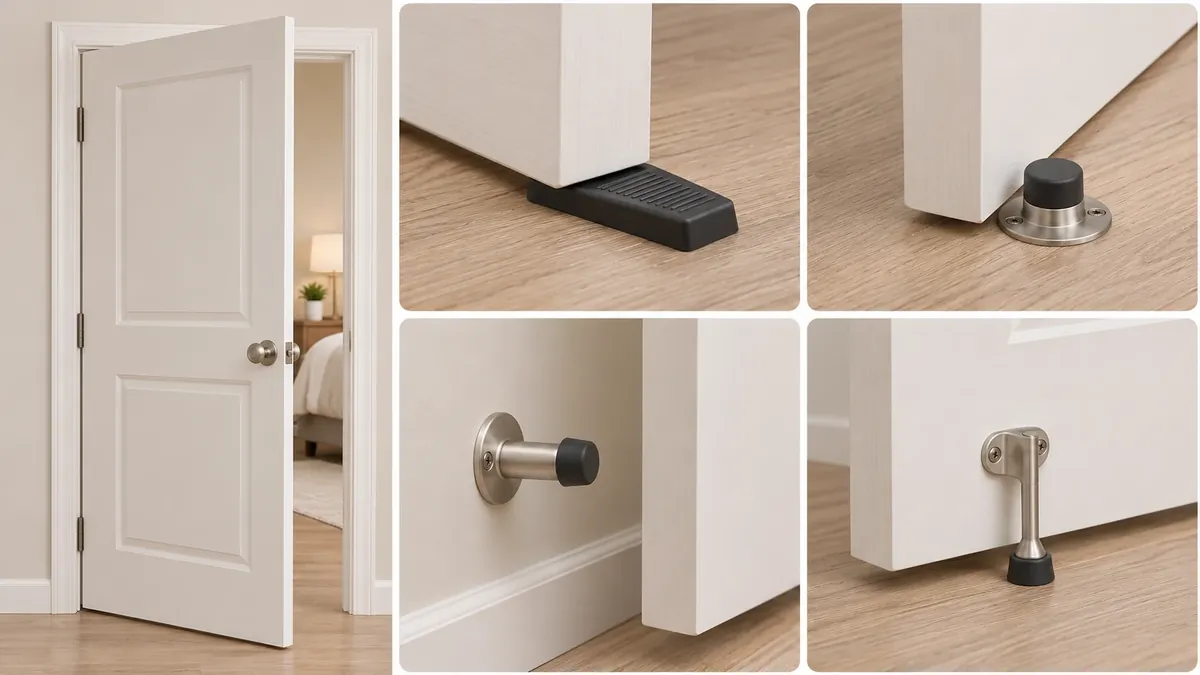
What problem do types of door stops help a buyer solve?
An importer may see “door stop,” “door holder,” “floor stopper,” “wall bumper,” “wedge” and “magnetic stop” used in product descriptions as though they were parallel, mutually exclusive categories. They are not always describing the same dimension. One label can identify where the hardware attaches, another can describe the part that touches the door, and another can describe what happens after contact. If a buyer compares two catalog rows only by their names, the products may not perform the same job even if both are filed under door stops.
The first commercial decision is therefore not “which label is best?” It is “what door movement or contact problem is this SKU meant to address?” A simple bumper can provide a stopping point by contacting the door or handle. A wedge is placed at the floor and relies on its shape and contact with the door edge. A holding product may combine a stop with a magnetic or other retaining interaction. A family map helps a distributor decide which product forms belong in an assortment, which accessories or receiving pieces are needed, and which buyer question each listing answers.
This classification is also useful before a sample review. A sample that looks similar from the front may have a different mounting plate, contact height, projection, fastener arrangement or receiving component. The physical sample and the controlled drawing should show the same interface. Where a design uses a separate magnetic pair, reviewing only one half is not enough to understand how the complete arrangement is intended to meet.
Koitor Hardware is a family-owned custom metal hardware factory serving bathroom and home-storage OEM programs. Its relevant expertise is drawing and sample communication for metal assemblies, finish, packaging and inspection requirements. This article does not claim Koitor currently manufactures door stops, magnets, door systems or specialist hold-open devices. It explains a sourcing framework that buyers can use when reviewing adjacent home-hardware products or coordinating metal components with a qualified supplier.
Which types of door stops are commonly compared?
Common ordinary interior forms include floor-mounted stops, freestanding or wedge-style stops, wall-mounted bumpers, door-mounted contact pieces and products that add a holding function. These groupings are useful for a product comparison, but they are not a universal catalog taxonomy. Suppliers may use different names, and product construction varies by model. The table identifies the question a label usually raises rather than promising a particular performance result.
| Product description | Main dimension it identifies | What the buyer should inspect | What the label alone does not establish |
|---|---|---|---|
| Floor-mounted stop | Attachment location | Base footprint, projection, contact surface, mounting interface and the floor condition assumed by the product documentation | Compatibility with every floor, door, handle or installation condition |
| Wall bumper | Attachment location and contact target | Bumper projection, wall-side attachment, contact height relative to the door or handle, and replaceable or exposed components | That every door will contact the bumper before another part reaches the wall |
| Door-mounted stop or contact piece | Attachment to the moving door | Fixing position, geometry, clearance through the swing and the intended contact partner | That the receiving surface or adjoining hardware is suitable |
| Wedge or floor wedge | Placement and shape-based contact | Wedge profile, floor contact, storage/placement expectations and whether the use is temporary or part of a product set | A fixed mounting arrangement or a hold-open capability under every condition |
| Magnetic stop or holder | Holding interaction, often with a receiving part | The complete pair, alignment, approach path, contact face and release behavior described by the supplier | That “magnetic” defines whether the base is on the floor, wall or another surface |
| Combined stop and holder | More than one function | Which part limits travel, which part retains the door, and how the assembly is intended to release | A regulatory approval, suitability for special doors or a quantified holding force |
The names in this table can overlap. A magnetic product may have a floor-mounted body and a door-mounted receiver, or it may use a different arrangement. “Floor,” “wall” and “door-mounted” answer a location question; “magnetic” answers something about the interaction. Buyers should preserve that distinction in a catalog, quote sheet and product data rather than forcing every SKU into one exclusive label.
The word “stop” can also be used casually for a product that holds a door in a position. A motion-limiting bumper and a holding device are not automatically interchangeable. Before approving a product title, establish what movement is intended and what the supplier says the unit does. Avoid promising that a component prevents damage, stays in place under a particular force or is suitable for a regulated opening unless project-specific evidence and the responsible requirements support the statement.
How do mounting location, contact and function differ?
Mounting location tells a buyer where a component is fixed or placed. Contact arrangement tells the buyer which surfaces meet as the door moves. Function tells the buyer whether contact simply limits travel, cushions a point, or includes a retaining interaction. Each axis can change independently, so the product family should be recorded across all three rather than inferred from a single keyword.
For example, a wall bumper and a floor bumper can have a similar visible cap while requiring different installation positions and contact geometry. A magnetic holder may be attached at the floor, but “magnetic” does not replace the location description. A wedge has no permanent mounting point in the same sense as a screwed floor stop, yet it can be described as a door stop because of the role it plays. A buyer who keeps the axes separate can compare like with like and recognize when two apparently different listings share a function or when two similarly named products serve different uses.
Mounting location
Record the attachment surface and component side: fixed floor, wall, door leaf, frame, or a freestanding placement. If the arrangement uses two components, identify both. A drawing should show the full assembly relationship, not only a close-up of the most visible part. The attachment description is not an installation instruction; actual installation conditions and hardware selection remain the responsibility of the product supplier and qualified project team.
Contact surface
Identify what makes contact: a bumper face, a shaped wedge, a door edge, a handle-side region or a separate receiving piece. Contact height and projection are drawing-level attributes when they affect fit. They should be measured from defined references on the actual product or controlled drawing. Do not assume a nominal product name establishes these dimensions, and do not infer a protective result from a soft-looking material or a cap color.
Limiting travel versus holding open
A travel stop establishes an endpoint for movement. A holder is intended to retain the door in a position through some interaction, such as a magnetic pair. A product may combine both functions, but the supplier should describe which function is intended and how the assembly behaves. “Magnetic” by itself is not a quantified force, a test result or an application approval. If a project needs a measurable holding or release requirement, it must be defined and verified for that specific model and use.

What should importers compare in a door-stop sample?
Compare the sample against the use case and controlled product information, not against a generic category label. Start with the complete product configuration, including any receiver, fastener, cover, pad or accessory the supplier says is part of the offered set. The sample should be identified by model or revision so a later quotation or production lot can be traced to what was reviewed.
- Confirm the product job. Write a one-sentence statement of the intended outcome: limit opening travel, provide a contact point, hold at a position, or combine functions. A mixed statement such as “stop/holder” needs clarification if the product data does not say which behavior is included.
- Identify every mounting location. Note whether the main body attaches to floor, wall, door or another surface, and whether a mating component attaches elsewhere. A magnetic arrangement should be reviewed as a pair when the supplier’s design requires two parts.
- Mark the contact surfaces. Use a drawing view or annotated sample photo to identify which face contacts the door and which component receives it. Record the reference points from which the position is measured. Avoid dimensions that are difficult to reproduce, such as a height taken from an undefined edge.
- Check clearances through the movement. Review the intended door path and adjacent handle or trim on the project drawing or a physical mock-up where available. The purpose is to identify fit questions before approval, not to claim that a generic stop is compatible with every door arrangement.
- List included and excluded parts. A quote should say whether a screw set, cover, receiver, adhesive element or other item is included. If installation depends on a component supplied by another party, identify the responsible supplier and the interface that must be confirmed.
- Agree what evidence matters. If the product requires a specific function, appearance or fit, state the inspection method and acceptance condition. A photograph can document visible arrangement; it does not establish hidden construction, force, durability or suitability beyond what the evidence actually measures.
- Control the reviewed revision. Record drawing number or date, sample identifier, material and finish description where supplied, and any approved deviation. If the product changes after review, evaluate the affected interface again instead of assuming the old sample still represents it.
These steps make the supplier conversation concrete. They also help a private-label team distinguish a product-description issue from a technical mismatch. If the functional story is unclear, revise the data sheet first; if the interface is unclear, mark up the drawing; if the product form is unclear, request a representative sample and identify the exact model.
How do materials, construction and finish affect the review?
Door-stop constructions vary, and the words in a listing do not identify the exact substrate, contact material or finish. Metal bodies, polymer or elastomer contact elements, magnetic components and separate fasteners may appear in different combinations. A buyer should ask the responsible supplier to identify the actual supplied construction rather than generalize from an image or a broad family name.
For a metal body, the relevant purchase description may include material designation, formed or machined features, visible surfaces, finish and any cosmetic faces. For a soft contact part, buyers may need the supplier’s material identity, shape, attachment method and replacement or change-control information. These details matter because the assembled product is a combination of parts and interfaces. A decorative metal cover does not prove what lies beneath it; a dark cap does not by itself identify an elastomer; and a magnetic icon does not identify the dimensions of a receiver.
The buyer should request only requirements that relate to the project. If a finish appearance matters, define the approved sample and viewing conditions rather than asking for an undefined “premium” finish. If a component must match a particular drawing, identify critical dimensions and agreed tolerances. If the product is packaged as multiple pieces, list the pieces and orientation so that the buyer can verify a complete set. Exact limits should be supplied or approved by the responsible product team; this guide does not invent them.
| Requisitos do comprador | What to record | Por que é importante |
|---|---|---|
| Product function | Travel limit, contact point, holding function or combination | Prevents a naming shortcut from hiding a different use |
| Mounting arrangement | Fixed surface and side for each component | Helps identify the correct interface and full assembly |
| Contact geometry | Contact face, projection and reference dimensions | Supports a repeatable drawing and sample comparison |
| Material and finish | Actual supplier designation and approved visual reference | Keeps broad marketing language separate from supplied construction |
| Included components | Main body, receiver, fasteners and other supplied items | Helps quotation, packing and receiving teams compare complete sets |
| Acceptance evidence | Inspection method, sample revision and pass condition | Makes review traceable without implying an unsupported performance claim |
Where a project introduces corrosion exposure, repeated impact, child access or special door requirements, those are application questions beyond a product-family table. The buyer should identify applicable requirements with the responsible technical or regulatory reviewer. Do not assume ordinary home-hardware product language establishes a code approval or a tested result.
How should a buyer organize an assortment?
An assortment is clearer when each SKU has a short family label plus structured attributes. The family label helps a retailer or distributor browse. The structured attributes let procurement, product management and quality teams compare the actual model. A practical entry might record “wall-mounted contact bumper; limits travel; supplied with one receiver” if that description is accurate for the exact product. A different model might be “floor-mounted magnetic holder with door-side receiving piece.” These examples illustrate data structure only and do not identify Koitor products.
Avoid stacking synonyms in a product title until the terms no longer distinguish the offer. A long string containing “floor, wall, magnetic, wedge, stopper, holder” can mislead a buyer if those are mutually exclusive models rather than options on one SKU. Instead, use a concise product name, then list location, function, contact arrangement, finish, dimensions and package contents as separate fields. In catalog filters, make the filters reflect distinct attributes. “Mounting location” and “holding function” should not be collapsed into a single menu if buyers need to choose them independently.
For a distributor range review, a simple matrix can reveal gaps without encouraging filler products:
- Which mounting positions are represented?
- Does the range include a fixed contact stop, a movable wedge, or both?
- Are products that hold open clearly distinguished from products that only limit travel?
- Does a magnetic model identify its full two-part configuration?
- Are replacement contact parts or fastener options documented where the supplier actually offers them?
- Are product titles and photographs consistent with the supplied model?
The matrix should describe current products and source data, not promise performance or claim market coverage. If the range is small, the buyer can record “not offered” rather than inventing a SKU. For custom development, it is more useful to begin with a drawing, the intended door interface and a clear functional requirement than to begin with a copied competitor title.
What common sourcing mistakes create confusion?
The most common mistake is treating all door-stop terminology as one classification system. That produces inaccurate product pages and weak quote comparisons. Other mistakes occur when the name is allowed to stand in for the actual assembly, when one sample is assumed to represent every revision, or when a visual feature is treated as proof of an unmeasured result.
- Treating “magnetic” as a mounting category. Magnetic describes an interaction, not necessarily the installation location. Record both the location and the holding arrangement.
- Calling every bumper a holder. A physical endpoint and a retaining function are different. State the intended action and confirm how the product is described by its supplier.
- Reviewing one part of a paired design. A base without its receiver may conceal alignment and contact questions. Request the full configuration when the design uses a pair.
- Comparing photographs instead of interfaces. A front-facing image can hide projection, fixing points, contact height or a supplied component. Use drawing views and a representative sample.
- Assuming a surface material proves performance. A polymer cap or magnetic-looking feature does not establish impact resistance, retention force, durability or compatibility with every substrate.
- Using an undefined acceptance phrase. “Good quality,” “strong magnet” and “no damage” are not measurable acceptance criteria. Translate the need into a specific attribute and evidence method.
- Approving the catalog image instead of the product revision. A later change to dimensions, material, finish or supplied components can make the old approval irrelevant. Connect the approved sample to a revision and change process.
- Using an ordinary product in a special opening. Fire doors, smoke-control assemblies, emergency routes, access-control openings and other regulated contexts need qualified review. Do not extrapolate ordinary interior product descriptions to these uses.
Each mistake can be reduced by a small amount of disciplined information: identify the model, define the job, show the interface, state what is included and document what was approved. That is more useful than applying a universal ranking to product forms.
What should appear in the request for quotation?
An RFQ should let a supplier identify the intended product and return a comparable proposal. Attach a controlled drawing or clear reference photos, identify which features may change, and state the target use. A buyer can adapt this short list to the project:
- Product or assortment role and the specific opening or furniture context.
- Intended function: limit movement, provide contact, hold a position, or combine stated functions.
- Mounting surfaces and the complete component arrangement.
- Main dimensions, datum points and any buyer-defined critical dimensions.
- Material and finish requirements, or a request for the supplier to state the actual proposal.
- Included parts, fasteners and packaging configuration.
- Required sample quantity, review steps and the person responsible for approval.
- Applicable market or project requirements, with the responsible reviewer identified where specialized rules apply.
- Inspection evidence and acceptance criteria that the project has actually approved.
- Expected order quantity, private-label requirements and shipment packaging needs.
The supplier response should identify assumptions and exclusions. If a material, component, magnet, fastener or installation accessory is sourced by a separate vendor, the response should make that boundary visible. If a requirement is unresolved, it should remain an open question rather than being silently converted into a promise.
For a model-specific example, the magnetic folding door-holder fit guide discusses that product’s interface and fit. For an OEM buyer, drawing and sample review is a practical way to discuss customization, small-batch trial work, finish coordination and packaging preparation with a factory that is qualified for the relevant metal components. A supplier’s ability to communicate about drawings does not establish that it makes every component in an adjacent product category. Koitor Hardware can review a metal hardware drawing or sample within its confirmed product and process scope; the exact product, components, finish, order conditions and quality requirements must be assessed for each project.
How can a buyer approve the product without overclaiming?
Approval should be tied to a defined sample and evidence set. A sample approval can show that the reviewed item matched the agreed visible configuration and specified dimensions under the agreed review method. It does not automatically establish long-term performance, compatibility with every door or wall, or compliance with requirements that were not part of the review.
The approval record can include the model and revision, date, drawing, photographs of relevant interfaces, actual supplier material or finish information, package contents and a list of unresolved deviations. If a performance criterion matters, record the method and acceptance result only after the responsible team defines and carries it out. Do not use an isolated sample check as a substitute for a separately required test or regulatory evaluation.
When receiving a shipment, compare the item and packaging to the approved configuration. Confirm the number of pieces, model identification and visible conditions defined by the receiving plan. If the product is a paired arrangement, check that the receiving component is present and correctly associated. Record nonconformities with the sample or lot identification and photographs. This supports a useful supplier discussion while avoiding unsupported conclusions about cause or incidence.
What is the buyer checklist before quotation?
- [ ] Is the intended job a travel limit, contact point, holding function or an explicitly described combination?
- [ ] Is the mounting location recorded separately for each supplied component?
- [ ] Is the contact surface or receiving part visible on the drawing or sample?
- [ ] Are dimensions tied to clear reference points?
- [ ] Does the quotation state the supplied material, finish and package contents?
- [ ] Is the reviewed sample identified by model or revision?
- [ ] Are project-specific requirements and responsible reviewers identified?
- [ ] Are the inspection method and acceptance criteria measurable and approved?
- [ ] Does the product listing describe the actual SKU rather than merge overlapping synonyms?
- [ ] Are special applications excluded until qualified reviewers confirm suitability?
Frequently asked questions about types of door stops
What are the main types of door stops?
Common ordinary interior forms include floor-mounted stops, wall bumpers, door-mounted contact pieces and wedge-style stops. Magnetic products can add a holding interaction and may overlap with more than one mounting arrangement. Product labels vary by supplier, so buyers should check the actual model and drawing.
Is a magnetic door stop always floor-mounted?
No. “Magnetic” describes a holding interaction, while “floor-mounted” describes location. A magnetic design may use a floor body with a door-side receiver or another arrangement. Confirm both sides of the exact configuration.
What is the difference between a door stop and a door holder?
A stop commonly limits travel by creating a contact point. A holder is intended to retain the door in a position. A product may combine the functions, but buyers should not infer a holding result from the word “stop” or the presence of a magnet alone.
Can a wall bumper be used with any door?
The product name does not establish universal fit. Contact height, projection, door path, handle position and the wall-side interface need to be checked against the specific door and installation conditions. The supplier’s approved product information should govern the exact application.
Should a buyer specify the finish or only the product type?
Specify both when finish is part of the purchase requirement. A family label cannot identify the actual metal, coating or appearance. Use the supplier’s material and finish description and an agreed sample where appearance matters.
Does a sample prove that a door stop will prevent damage?
No. A sample review confirms only the features and conditions included in the review. A damage-prevention claim needs an appropriate defined method and evidence for the exact product and application; it should not be inferred from appearance.
Can ordinary door stops be used on fire doors or emergency routes?
This guide does not approve products for those settings. Fire or smoke doors, emergency routes, access-controlled openings and regulated hold-open systems require review by the responsible qualified project team under the applicable requirements.
What should be sent with a door-stop RFQ?
Send the intended function, mounting arrangement, controlled drawing or sample, key dimensions, finish requirement, supplied-part expectations, target quantity, packaging needs and any project-specific acceptance criteria. Mark unresolved requirements clearly so the supplier can state assumptions.
Trabalhe com a Koitor Hardware
Koitor Hardware supports overseas buyers with drawing and sample communication for custom bathroom and home-storage metal hardware, including project-specific discussion of structure, finish, inspection requirements and packaging. If an adjacent product includes metal components, share the actual drawing or sample and identify the unresolved interface or sourcing question; capability and scope must be confirmed before quotation.
Review Your Metal Hardware Component Interface
Share the drawing or sample for a project-specific discussion of the metal product, component fit, finish and packaging requirements. Scope must be confirmed for each product and supplier.
OEM / MARCA PRÓPRIA
Transforme este guia de fornecimento num resumo do produto
Indique o produto pretendido, as dimensões, o acabamento, a quantidade a encomendar e os requisitos de embalagem. A sua equipa receberá uma análise prática da viabilidade de fabrico antes da apresentação do orçamento.

 English
 Español
 Português
 Français
 Deutsch
 العربية