
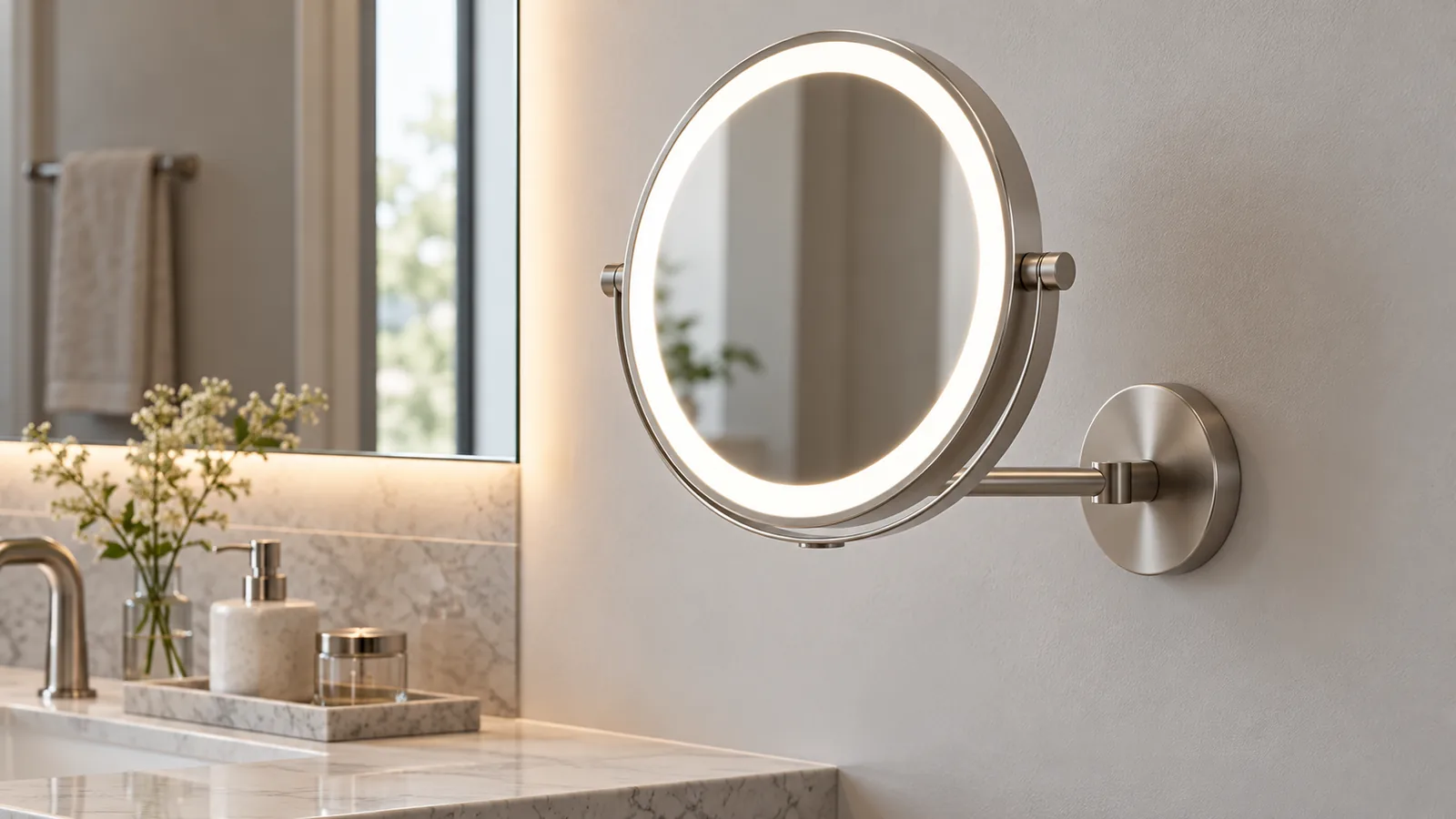
LED makeup mirror power options should match the planned installation, operating workflow, and service expectations. An illuminated wall-mounted makeup mirror may use a rechargeable battery, USB power, a plug-in adapter, or a fixed electrical connection. The right option depends on where the mirror will be installed, how the buyer expects the user to operate and service it, which accessories are included, and what documentation the target market requires. A product listing that says “rechargeable” or “USB” does not answer those questions.
A useful wall mounted LED makeup mirror OEM power options brief treats power as part of the complete product configuration. It connects the mirror model, mounting position, cable or connection route, controls, user instructions, accessories, service plan, and market-specific evidence. The goal is to compare options and approve a production-intent sample without implying that one architecture is universally safer, easier, or better.
This is adjacent buyer education. It does not claim that Koitor manufactures LED mirrors, batteries, chargers, power supplies, or electrical assemblies.
Start with the installation context and user workflow
Before asking for a quote, record where the mirror will be used: home bathroom, hotel room, vanity area, or another defined setting. Name the target installation surface and the mounting position. Sketch the mirror’s reach, wall plate, expected user viewing angle, and available power location. If the product is for a hospitality or contract project, identify whether the buyer has a site standard or an electrician-led design review.
LED makeup mirror power options should be evaluated against installation access, daily operation, charging or wiring responsibility, and service expectations.
Then describe the user’s workflow. Will the mirror stay connected to power? Should the user turn it on at the wall, with a control on the mirror, or through another interface? If it is rechargeable, how often might the buyer expect charging based on manufacturer information, and how will the cable be accessed? Do not invent battery life or charge-cycle expectations; request model-specific evidence and keep any public claim within that evidence.
List the exact accessories in the proposed unit: charger or adapter, USB cable, mounting parts, instructions, battery if replaceable, and any spare component. Note which parts are included, optional, or supplied by the buyer. A supplier page may show accessories that do not belong to every SKU. The purchase-order line should identify the intended package.
A product brief can make the decision concrete: “The mirror is for a hotel vanity wall with a nearby outlet, a specified cable concealment path, and a defined service contact.” If an outlet or connection is not available at the desired position, record that as a design input before choosing a power architecture. Do not defer the decision until the sample has already been styled and quoted.
Compare power architectures against buyer priorities
Each architecture creates different questions. Battery power may avoid a permanently visible cord but introduces charging access, battery identity, service, and transport-document questions. USB power can use a replaceable external cable or power supply, but the cable route and adapter inclusion must be clear. A hardwired configuration may suit a planned installation but generally requires coordination with the site’s electrical design and qualified installer. These are planning considerations, not a conclusion about product suitability or code compliance.
When comparing LED makeup mirror power options, define the accessories and user actions for each version before asking suppliers to quote.
| Buyer decision | Rechargeable battery | USB or plug-in supply | Hardwired connection |
|---|---|---|---|
| Installation location | Confirm wall mounting, charging access and service access | Confirm outlet position, plug, cable path and adapter scope | Confirm site wiring, junction location and qualified installation plan |
| User interaction | Define charging indicator, controls and charging instructions | Define switch/control and cable or adapter arrangement | Define switch/control and installer handoff |
| Included items | Identify battery model, cable and charger supplied | Identify cable, plug and adapter by destination | Identify connection parts and what is excluded |
| Service plan | Confirm whether battery is removable, replaceable and identifiable | Confirm cable or supply replacement route | Confirm service boundary and replacement parts |
| Market evidence | Request model-specific battery/electrical records | Request model-specific electrical documentation | Request exact configuration and installation documentation |
| Sample review | Test the proposed charge/control workflow per the approved plan | Fit the cable and power supply in the target setup | Verify only the physical interface; have electrical aspects reviewed by qualified personnel |
The comparison should be based on the buyer’s actual priorities, not on a broad “cordless is modern” or “hardwired is professional” assumption. A hospitality buyer may choose a hardwired option for a planned installation and a rechargeable version for a renovation where existing wiring is not available. A retail brand may prefer a USB configuration if it has a clearly defined adapter policy and destination assortment. The buyer should record the reason for the selected version.
Para um wall mounted LED makeup mirror OEM project, keep the power configuration and the mirror’s mechanical mounting specification connected. The cable exit, connector, wall bracket, battery compartment, and service access can affect placement and packaging. Ensure the sample, drawing, bill of materials, and product page identify the same version.
Translate the chosen option into a model-specific RFQ
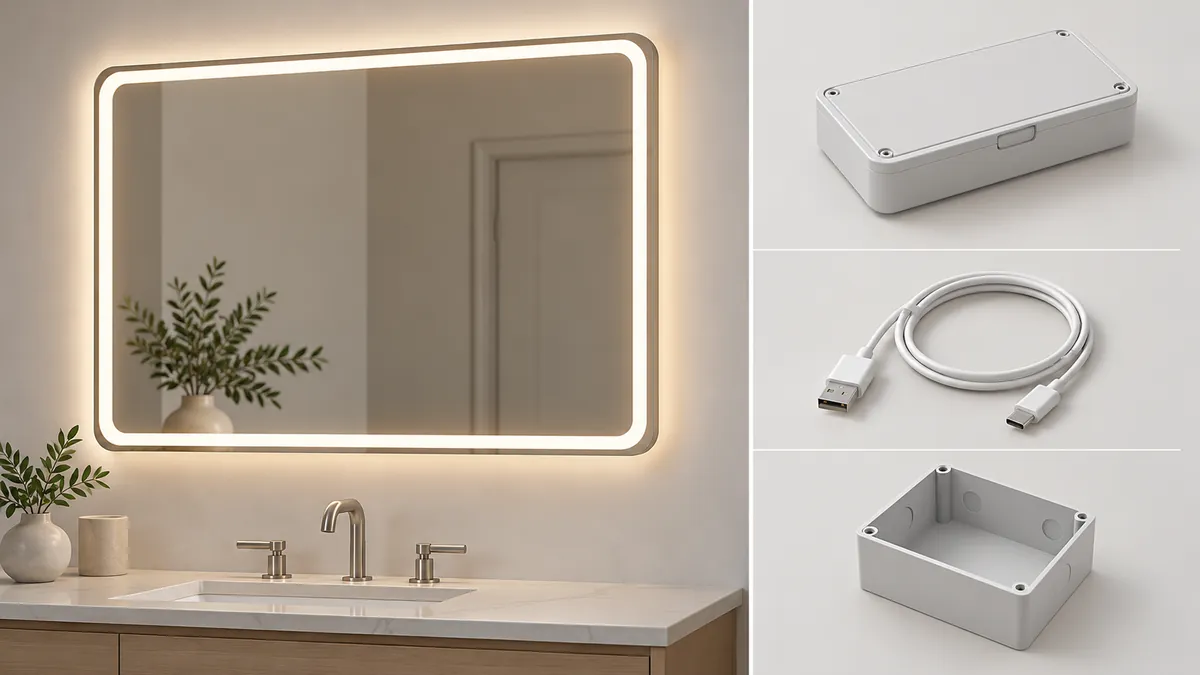
For a rechargeable model, request the battery’s exact identifier, chemistry and specifications, the product/BOM revision it belongs to, charging interface, charging cable and any adapter included. Ask the supplier which battery-related documents are available for the exact model and destination. If the battery can be removed or replaced, request the design and instructions that show how. A generic “USB rechargeable” statement does not establish the cell type or service route.
For USB or plug-in power, identify connector shape, cable length, exit direction, adapter inclusion, plug type, destination voltage/frequency requirements, and how the cable is routed in the installation. Have the buyer’s electrical reviewer identify the documentation or tests needed for the selected market. Do not assume that a connector fitting another product means its supply is interchangeable or compliant.
For a hardwired configuration, state whether the buyer expects a bare connection lead, a terminal, or another defined interface. Agree what is supplied by the mirror supplier and what is performed by the site electrician. The importer should not rely on a product drawing or a sample photograph as proof that the complete installation complies with local electrical and bathroom requirements. Qualified professionals must determine requirements for the exact site and product.
For every version, lock the model identifier and revision. A mirror family may have the same frame and magnification but different power architecture. Give each configuration a distinct SKU or bill-of-materials revision. The product listing, label, carton, manual, and spare-part record must not mix one version’s claims with another’s.
Review controls, charging, service and sample fit
A sample review should cover the entire user workflow. Install the mirror according to the proposed instructions on the agreed sample surface or fixture. Check reach, arm movement if any, cable routing, connector access, controls, and packaging components. For a battery model, follow the proposed charging procedure and record what is observed; do not turn one short sample charge into a public battery-life claim. For a corded model, use the buyer’s qualified electrical process and avoid unsupervised installation or testing.
Check whether the sample can be serviced as the buyer intends. Is the battery accessible? Are replacement parts identified? Can the user or authorized service person reach the cable and control without removing the entire mount? The design may trade a slim appearance against access. Write down the trade-off and ask the product owner to approve it rather than assuming a concealed assembly is automatically better.
Inspect the mirror’s physical and electrical components separately. A sample can show fit, finish, cable exit, control location, and included parts. It does not establish electrical safety, water-ingress protection, battery transport classification, or a product rating unless the right documentation and test evidence exist. If a supplier lists a specific ingress rating, request the applicable report for the exact SKU and configuration and check that the claim is permitted for the intended use. Never copy a rating from a different mirror model.
Record the sample’s revision, power parts, manual, label, and carton. If the adapter, cable, battery, connector, firmware or control changes, ask which records need review. The responsible product-safety reviewer should determine whether the change affects testing or market evidence. A buyer should not treat “same appearance” as proof of electrical equivalence.
Plan the compliance and shipping handoffs
The buyer should map which person is responsible for product design, electrical testing, market compliance, installation instructions, battery documentation, and freight preparation. The product supplier, importer, private-label brand, testing laboratory, electrician, carrier, or forwarder may each handle different parts. Contracts and applicable law determine duties; a sourcing checklist only prevents assumptions from remaining invisible.
For rechargeable products, request battery information early enough to support both product design and shipment planning. The details needed for a product-safety assessment and the information required by a freight professional may overlap but are not interchangeable. A battery test summary, product electrical report, transport classification, and packaging instruction answer different questions. Route the exact model and shipment configuration to qualified reviewers.
Avoid writing one generic compliance line into the PO. Instead, list the actual product records required for the buyer’s market, the party responsible for supplying each record, and the version that must be reviewed. Do not promise that a mirror is “waterproof,” “hotel safe,” “fully certified,” or suitable for every bathroom based on a product category or supplier statement alone.
Make the quote and sample decision comparable
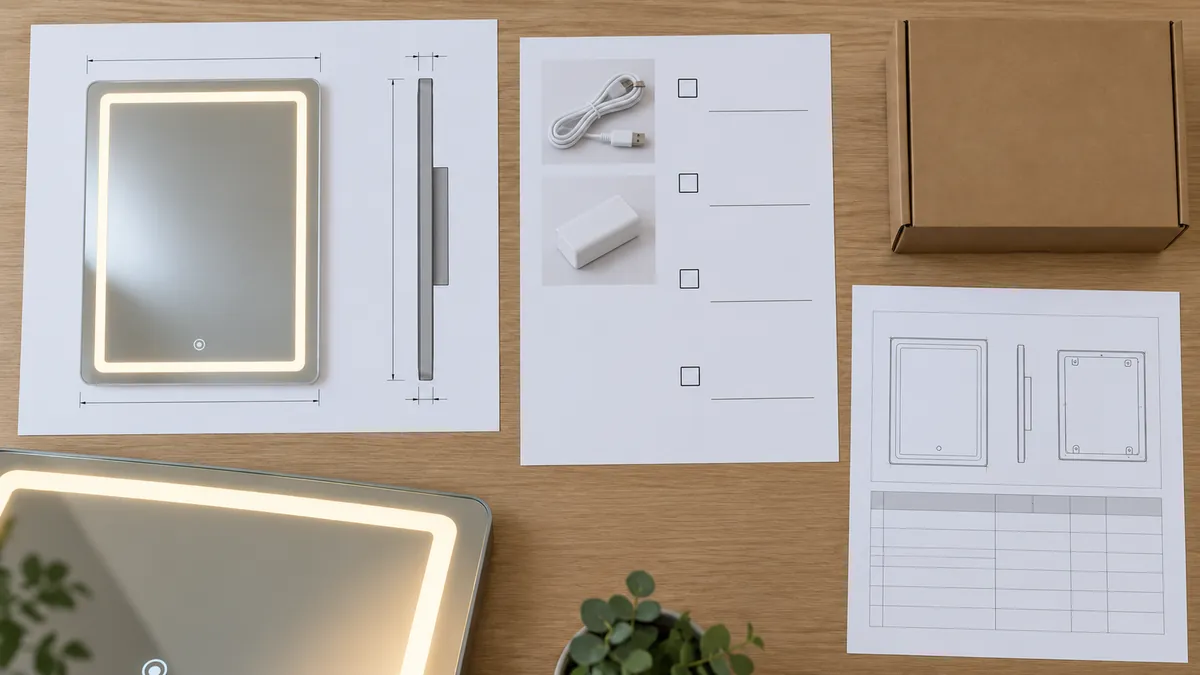
A supplier comparison should use the same mirror geometry, magnification, lighting controls, mounting method, power architecture, finish, cable or battery configuration, included accessories, labels, and packaging. Ask each supplier to disclose what is included and what must be purchased separately. Compare documentation readiness, support for revisions, service parts, sample lead time, and any buyer-funded testing separately from the unit price.
The selected LED makeup mirror power options should be recorded as a distinct model configuration so samples, documents and retail listings stay aligned.
A simple decision record can identify the selected architecture, user and installation context, reason for selection, evidence received, unknowns, and approval owner. Add a change trigger for switching from USB to battery, adding an adapter, changing the battery supplier, changing the connector, or modifying cable access. A seemingly small change can affect instructions, transport, installation, and the model’s technical file.
Is rechargeable power always best for a bathroom mirror? No. It depends on outlet availability, charging access, user workflow, service, design, and the exact product requirements. Compare it with the other available architectures for the intended installation.
Does USB mean the mirror is powered by any USB charger? Do not assume that. Confirm the exact connector, power-supply requirements, included adapter, cable, and approved documentation for the model and destination.
Is hardwired always the preferred hotel option? Not universally. Site wiring, installation planning, service, and project specifications determine whether it fits. A qualified installer and product reviewer should confirm the actual configuration.
Can an IP or water-protection rating be copied from a similar mirror? No. Ask for evidence associated with the exact model and configuration. Review the claim and installation context with the responsible product-safety professional.
Should the buyer approve one sample for all power versions? No. Give each power configuration its own model identity and approve its relevant components, instructions, evidence, and pack-out.
Who determines which electrical records are needed? The responsible compliance owner or qualified product reviewer for the target market. The supplier should provide model-specific facts and records; it should not be expected to guess the importer’s legal obligations.
Keep supplier claims within the documented scope
Koitor is documented as a family-owned manufacturer of bathroom and home-storage metal hardware, with OEM and sample-development experience. That does not establish production of illuminated mirrors, batteries, chargers, electrical assemblies, or mirror-specific compliance services. This guide helps buyers frame an adjacent-category decision; it is not a statement of Koitor capability.
For established bathroom hardware information, see fabrico de acessórios personalizados para casas de banho. A buyer may contact Koitor through the contact page with a drawing and a clearly defined supply scope, but should confirm any electrical-product capability separately before relying on it.
Sources and product examples
- ISH exhibitor example of a rechargeable wall-mounted cosmetic mirror
- Tianci Hongye OEM/ODM mirror power options
- Makeup-mirror FAQ comparing hardwired and cordless configurations
- Individual user discussion of a specific LED vanity mirror
Supplier pages and individual user reports describe their specific products or experiences; they are not independent performance verification or evidence of Koitor capability.
Discuss a bathroom-hardware product brief
Share the drawing, target market, installation context, product version, and documented supply scope. Any powered-mirror or electrical capability must be confirmed for the specific project.
OEM / MARCA PRÓPRIA
Transforme este guia de fornecimento num resumo do produto
Indique o produto pretendido, as dimensões, o acabamento, a quantidade a encomendar e os requisitos de embalagem. A sua equipa receberá uma análise prática da viabilidade de fabrico antes da apresentação do orçamento.

 English
 Español
 Português
 Français
 Deutsch
 العربية