
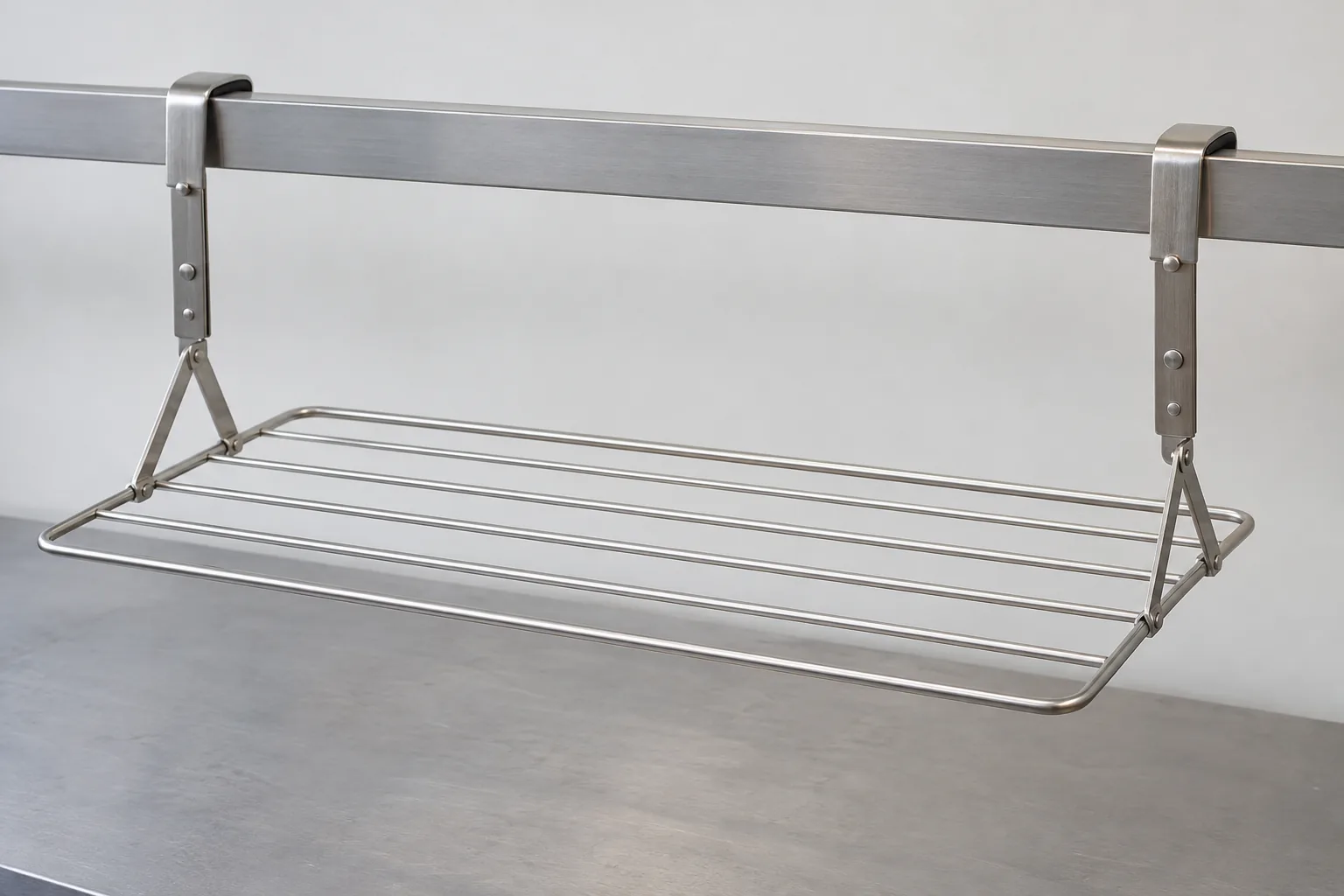
Over radiator drying rack bracket depth should be specified with the support interface—not by rack width alone. Importers should record the support’s depth and profile, the hanger’s contact geometry and adjustment range, then approve fit using the intended rail or radiator sample and the product maker’s instructions. A fit result for one model or support type is not a universal compatibility or safety claim.
For a private-label or OEM program, the practical deliverable is a support-fit matrix: which support profiles were reviewed, where each arm contacts, what adjustment positions were used, and whether the assembled rack seats and can be removed as intended. Koitor Hardware is a family-owned custom metal hardware factory with confirmed bathroom and home-storage experience; this article discusses an adjacent product interface and does not imply that Koitor currently manufactures radiator drying racks.
Why does nominal rack width fail to confirm interface fit?
A stated rack width describes only one dimension of the product. It does not establish whether the arms can pass over a rail, sit fully on the support, clear nearby surfaces or remain in the intended position. Two supports with the same nominal depth can still have different cross-sections, edge radii, ribs, lips or obstructions. Those differences can change the hanger’s contact points.
The buyer’s first question is therefore not “How wide is the rack?” but “What exact support profile is this design intended to engage?” Describe the actual interface: a flat radiator panel, ribbed section, balcony rail, shower edge or door may present a different shape and installation condition. Treat each permitted application as a separate fit case unless the supplier has reviewed evidence that supports grouping them.
The contact geometry matters because the hanger must have a defined path over the support and a stable seat after placement. A broad arm may rest on an edge but collide with a nearby wall. A narrow return may pass over a thin support but fail to reach its intended seating surface on a deeper one. A curved or ribbed surface can also shift where the arm touches. These are design-review questions, not conclusions that can be settled from a front-view product photo.
Buyers should separate three dimensions that are often collapsed into “fits most” wording:
- Entry clearance: the opening through which the support must pass during installation.
- Seated contact: the surfaces that carry the product in its intended position.
- Surrounding clearance: nearby walls, ledges or trim that may block placement, adjustment or removal.
A product may pass one check and fail another. For instance, an arm may pass over a rail but sit at an angle because its contact face meets an edge or projection. A claim such as “adjustable” does not identify the supported profiles, available range or approved positions. Ask the supplier to show the actual geometry and define which configurations were reviewed.
Which support dimensions should buyers identify first?
Start with the intended support rather than a generic household category. Ask for a representative physical sample, a dimensioned drawing or clear photographs that show its cross-section, edges and nearby obstructions. Record whether the measurement describes the support’s overall depth, its usable contact surface or a local rib or flange. Without a defined datum, two parties may use the same word for different dimensions.
For each intended support, capture the dimensions that can change arm engagement:
- Overall depth or thickness at the hanger location.
- Cross-section shape, including ribs, rolled edges, lips and rounded corners.
- The width and position of the surface available for contact.
- Any trim, bracket or adjacent wall that restricts the arm’s approach.
- The orientation in which the drying rack is expected to hang.
- Whether the support surface is fixed, sloped or interrupted where the arms sit.
These are inputs for fit review, not a universal dimensional standard. A buyer may group supports only when their interface features are sufficiently similar and the grouping has been checked. A single “maximum depth” may not be enough where an edge radius, rib or return lip changes the arm’s path.
The drawing should identify where each measurement begins and ends. If the support has a rounded front edge, for example, note whether depth is measured to the outermost point or to a flat contact face. For a ribbed surface, show the rib pitch or the specific rib selected for the arm. Mark the intended contact region on a cross-section view. A side photograph with a simple reference object can help explain an unusual form, but the approved drawing or physical sample should control when there is a conflict.
Buyers should also define the rack state used during the review. If bars extend, fold or adjust, the support interface should be assessed in the relevant positions. The supplier needs to know whether the product is reviewed empty, carrying representative items, folded for storage or being removed from the support. Do not translate one static fit check into a general performance statement.
What does an over radiator drying rack bracket depth range prove—and what does it not prove?
A manufacturer’s stated compatibility range can help buyers understand one product’s intended use, but it applies to that named model and the conditions described by its maker. Leifheit’s product page for model 81413 says it fits specified balcony railings, flat and ribbed radiators, showers or doors with a depth between 1 and 11 cm. That is a model-specific published range—not a design rule for every hanging dryer, a guarantee for every profile within that range or evidence about another supplier’s product. See the Leifheit product specification.
For an OEM buyer, use a public product range as a prompt for questions, not as a value to copy into a drawing. Confirm how the named manufacturer defines “depth,” which adjustment or attachment parts are included, which support types are explicitly shown, and whether its current instructions add restrictions. A range written for one design cannot be transferred to a visually similar design whose arm shape, contact surfaces or adjustment mechanism may differ.
Use careful language in product listings. “Designed for the support profiles listed in the approved instructions” is more defensible than “fits all radiators and rails.” “Reviewed with the buyer’s named sample” records a specific validation boundary. Neither phrase should imply a certified safety result, load rating or compatibility with an appliance condition that was not tested and documented.
This separation also protects the supplier relationship. If a buyer’s assortment includes several rail or radiator profiles, agree which ones are in scope before sampling. If new profiles are added later, treat them as new fit cases rather than assuming that a previous sample approval covers every related shape. Heating-system instructions and the product maker’s instructions remain separate from a mechanical fit review; this guide does not provide heater-safety approval.
How should the arm-to-support contact be reviewed?
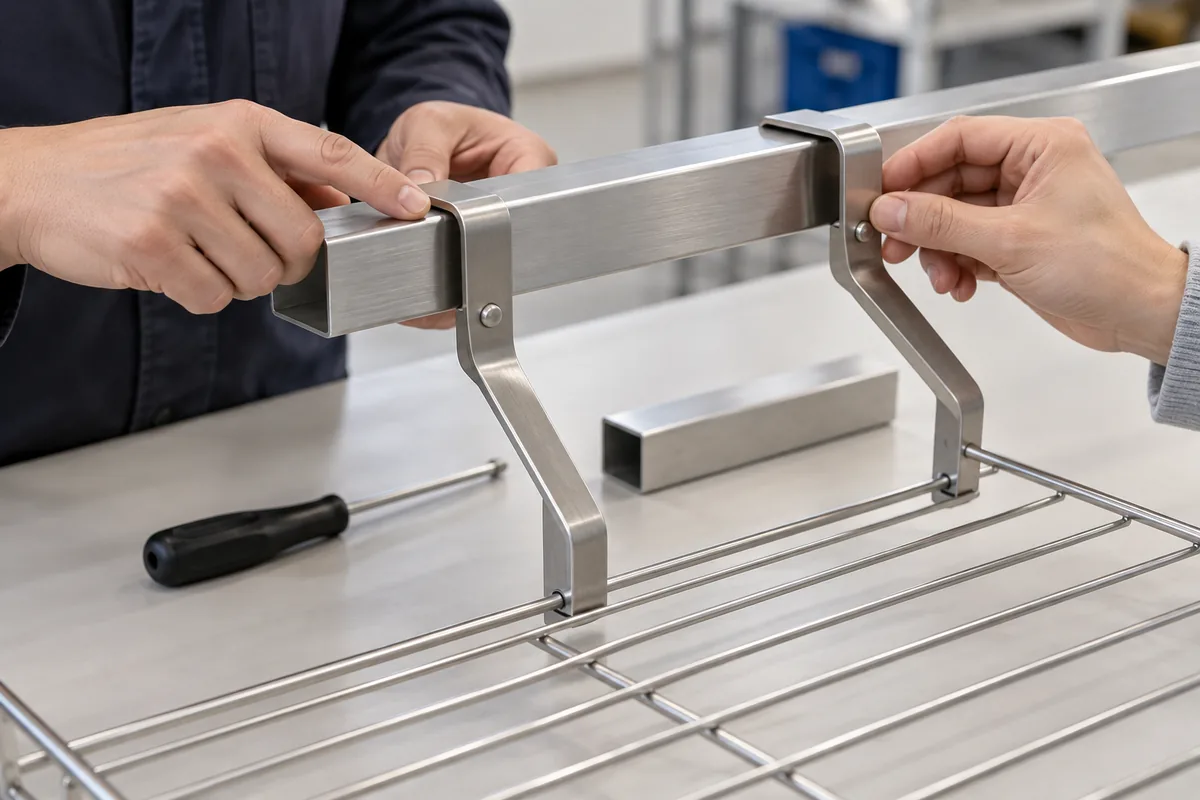
Review both arms together on the intended support. Check that the arms can be placed without forcing, that the intended contact surfaces meet the sample, and that the rack hangs in its intended orientation. Observe whether one arm seats differently from the other. A mismatched seat can indicate that the support is uneven, the sample is not positioned correctly or the arms do not share the same geometry; document the observation before deciding whether a design change is needed.
Inspect the full placement and removal path. The support may allow the rack to sit in place yet obstruct the motion needed to install or remove it. Nearby walls, trim or adjacent fixtures can reduce clearance. Where the arms are adjustable, record the setting and verify that the intended setting can be reproduced. If a stop, detent or other feature is part of the design, note its intended role and ask the supplier to identify how it should engage. Do not assume such a feature exists if it is not shown on the approved design.
A controlled fit review can follow this sequence:
- Identify the support sample and confirm it represents the buyer’s intended application.
- Record the support profile and measurement datums in the drawing or fit matrix.
- Place both arms on the sample using the supplier’s current instructions.
- Confirm the seating points, orientation and any adjustment position.
- Check for interference with adjacent surfaces through placement and removal.
- Repeat with each support profile included in the approved assortment.
- Record deviations, photos, configuration and responsible approval before release.
This is a fit-review sequence, not a load or lifetime test. If the buyer needs a load requirement, cycle test or other performance evidence, define that separately with a method, sample configuration, acceptance criteria and responsible party. Never infer a capacity from a product photograph, an arm’s apparent thickness or the fact that a rack remained on a sample during one observation.
What belongs in an OEM support-fit matrix?
A support-fit matrix connects the buyer’s physical environment to the supplier’s design configuration. It should state which support profile was reviewed and what the result covers. This avoids turning one successful sample into an unqualified fit statement.
| Matrix field | What to record | Why it matters |
|---|---|---|
| Support identity | Buyer’s sample name, drawing number or application | Keeps different support profiles from being treated as interchangeable |
| Cross-section | Depth, shape, edge and contact surface with measurement datums | Describes the geometry the hanger must engage |
| Rack configuration | Arm position, orientation and any included components | Makes the reviewed setup reproducible |
| Contact observation | Both seating points and any visible interference | Shows how the rack meets the support |
| Placement/removal | Path, nearby obstructions and clearance notes | Captures access issues beyond static fit |
| Evidence | Dated photos, drawing revision and sample identification | Ties the approval to a defined version |
| Scope statement | Exact profile and configuration reviewed | Prevents an unsupported “fits all” interpretation |
The matrix should distinguish an observation from an acceptance decision. “The arms were placed on sample A and sat on the marked contact faces” is an observation. “Approved for profile A in configuration B” is a decision by the responsible buyer or product team. “Compatible with all radiators” would be an unsupported extrapolation unless the scope and evidence truly support it—which a small sample set normally does not establish.
If several supports look similar, include side-by-side profiles in the review rather than relying on names such as “standard rail.” The matrix can record which profiles are accepted, which require another sample, and which are out of scope. Keep the list aligned with the product instructions and the buyer’s intended market claim. If the instructions are narrower than the tested sample observations, the published claim must not exceed the approved instructions.
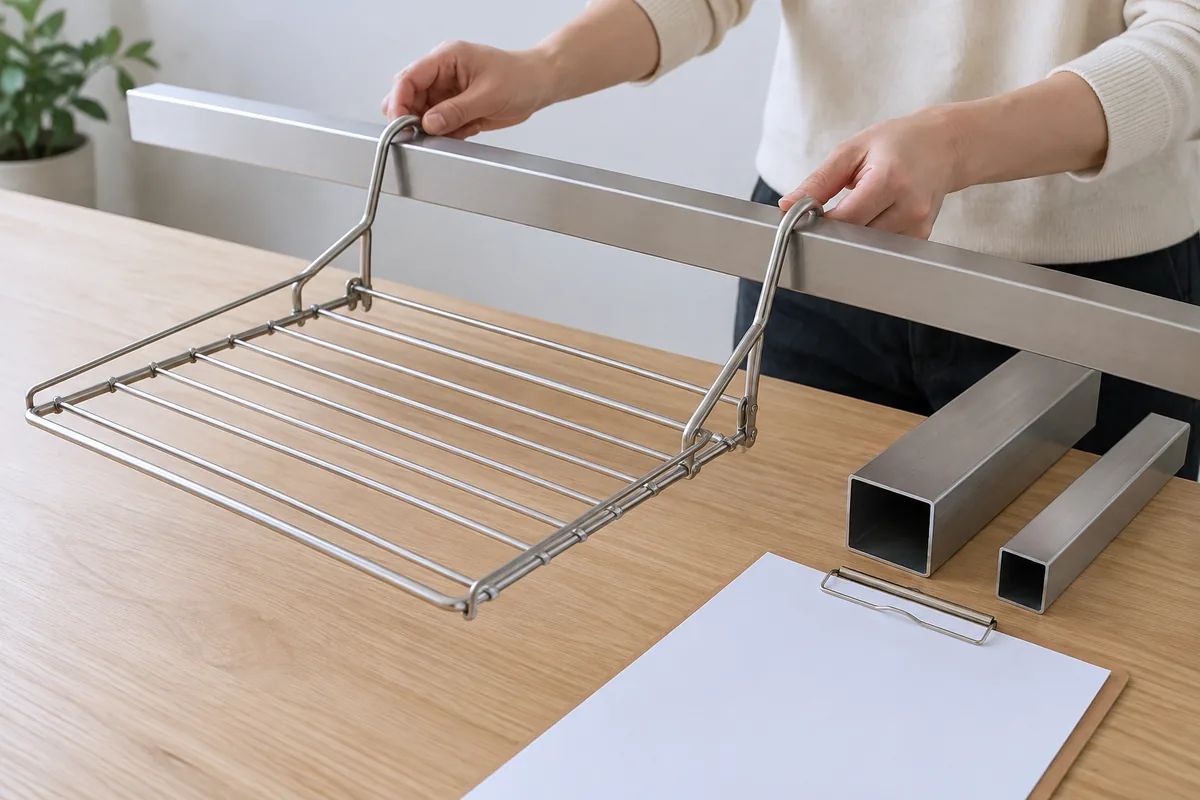
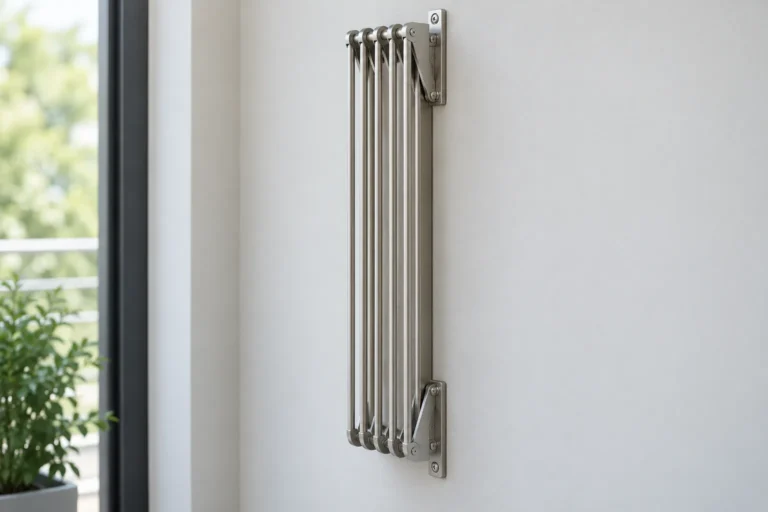
A photo is useful when it shows both arms, the support profile and the seating position without perspective hiding the interface. Keep the sample identification with the photo record, but do not use a generated illustrative image as proof of an actual supplier test. The images in this article are generic educational concepts; the buyer and supplier should document their own project evidence.
What should buyers put in the drawing, RFQ and approval notes?
A useful RFQ package for over radiator drying rack bracket depth gives the supplier enough information to assess the interface rather than guess from a product category name. Include:
- A drawing or representative sample of each intended support profile.
- The key support dimensions, datum definitions, cross-section and local edge shape.
- The rack’s overall envelope and the arm geometry or adjustment positions under review.
- The intended direction of installation and removal.
- Nearby walls, trims or obstructions that affect access.
- Any requirement for shared or separate arm configurations across the buyer’s assortment.
- The product instructions and compatibility wording the buyer expects to publish.
- The requested sample quantity and which configuration must be shown on each sample.
- The approval owner and the version-controlled drawing or specification reference.
Ask the supplier to identify assumptions in its quotation or sample plan. If a drawing does not show the support cross-section, request clarification before treating a proposed arm dimension as final. If the buyer supplies only a product-family name, such as “standard radiator,” the supplier may not know which geometry is intended. A physical sample can resolve ambiguity, but the sample should be labelled and tied to the relevant drawing revision.
Koitor’s approved expertise includes reviewing custom metal hardware drawings and physical samples, and discussing forming, assembly, finish and packaging depending on the confirmed project scope. Current production of radiator-hung laundry dryers is not established by the company facts. For that reason, this guide presents a buyer’s specification method—not a product offer or a claim that every such design is within Koitor’s current production range. Buyers can review the broader OEM home storage hardware scope and confirm project fit directly.
How should sample approval and design changes be controlled?
Treat the approved fit configuration as part of the product definition. Record the support sample or drawing revision, rack drawing revision, arm setting, photographs and any agreed scope note. This creates a traceable reference for later production review and customer-service questions.
When a design changes, compare the changed feature with the interface record. A revised arm opening, bend, return length, contact width, joining position or adjustment hole may affect fit. A finish or packaging change may not change the geometry, but should still be assessed under the product’s normal change-control process. The responsible buyer and supplier should decide which revision needs a new fit sample; do not make an automatic assumption that every change is harmless or that every small change requires a complete retest.
Before bulk production, confirm that the approved sample, drawing and purchase specification refer to the same revision. If the buyer later adds a new support profile or widens the compatibility claim, reopen the fit review and update the matrix. Keep unresolved profiles clearly marked as pending instead of allowing a tentative sample result to become sales copy.
A small-batch OEM program can help a buyer learn whether its documentation and sample process are clear before expanding the assortment. Koitor can discuss small-batch custom metal hardware projects when the product and manufacturing route fit its confirmed scope. For adjacent categories such as radiator drying racks, scope and process suitability require project-specific review. A drawing or sample is a starting point for that conversation, not a promise of acceptance or performance.
Frequently asked questions
Does an adjustable arm automatically fit more radiator profiles?
No. “Adjustable” describes a design feature but does not define the supported cross-sections, adjustment range or approved contact conditions. Buyers should list the intended support samples and verify each required configuration.
Can a buyer use one depth number for every support?
Not safely as a universal rule. Depth may be measured from different datums, and edge shape, ribs or nearby obstructions can affect how the arm seats. Identify the relevant profile and measurement points in the drawing.
Is over radiator drying rack bracket depth a universal value?
No. Leifheit’s published range for model 81413 is product-specific. It should not be copied as a generic specification for another rack or supplier.
Does a rack that sits on a sample rail prove its load capacity?
No. A static fit observation does not establish load capacity, durability, cycle life or heater suitability. Define and document any separate performance test before making a claim.
What if the buyer adds a different radiator or rail after sample approval?
Treat it as a new fit case unless the existing approval explicitly covers that profile. Update the matrix, confirm the instructions and approve the revised scope before expanding a compatibility claim.
Work With Koitor Hardware
Discuss a Custom Metal Home-Storage Project
Send Koitor a drawing or physical sample, the intended support profiles, required finish and packaging notes. We can review the confirmed metal-hardware scope and discuss manufacturability before quotation; radiator-dryer production remains subject to project review.
OEM / PRIVATE LABEL
Turn this sourcing guide into a product brief
Share your target product, size, finish, order quantity and packaging requirements. Your team receives a practical manufacturability review before quotation.
 English
 Español
 Português
 Français
 Deutsch
 العربية