

For procurement, the retail scan hook label holder compatibility starts with the exact reference parts and intended arrangement. A retail scan hook label holder compatibility review should cover the whole display kit: the metal hook, ticket arm, purchased sleeve or holder, printed ticket and merchandise loaded on the hook. A bare hook can look correct while a separately ordered label accessory uses a different connection or blocks product removal. Importers should verify the combined sample and define exactly what is included in each fixture SKU.
The focus here is the arm-to-holder interface and the ticket’s position during normal merchandising. It is not a tutorial about package hang holes, pegboard or slatwall panel fit, or a universal fixture standard. It also does not establish a barcode scanning result, safe load, proprietary design license or a current Koitor scan-hook product capability.
Is the label holder included or purchased separately?
Start by clarifying the commercial configuration. Some product listings show a hook and ticket accessory together, while other listings identify the holder as a separate item. Display Centre describes its Slatwall Euro Hook Ticket Arm as a welded wire and backplate construction and notes ticket holders are sold separately. Trion presents model-specific swivel scan-hook constructions with a particular label-holder format. Those pages illustrate different supply configurations; they are not interchangeable designs or evidence that a third-party holder fits either product.
For an importer, the difference affects the SKU, the quote, the planogram, replenishment and service. If the label sleeve is optional, the product data should identify the hook-only item and the compatible accessory separately. If the sold unit is a complete kit, the BOM and pack list should include the arm, sleeve, ticket or any other supplied component by reference. A filled display photograph must not silently imply that every pictured component is in the carton.
Ask the supplier to identify who controls each component and revision. Record whether the metal arm is welded or attached by another documented connection, whether the holder is clipped, sleeved or fixed, and whether a spare holder can be ordered independently. Avoid designing around a proprietary shape visible in a competitor’s catalog. A source image may clarify the type of interface, but the buyer should use an original drawing and a compatible, authorized component.
What should be measured on the ticket and holder?
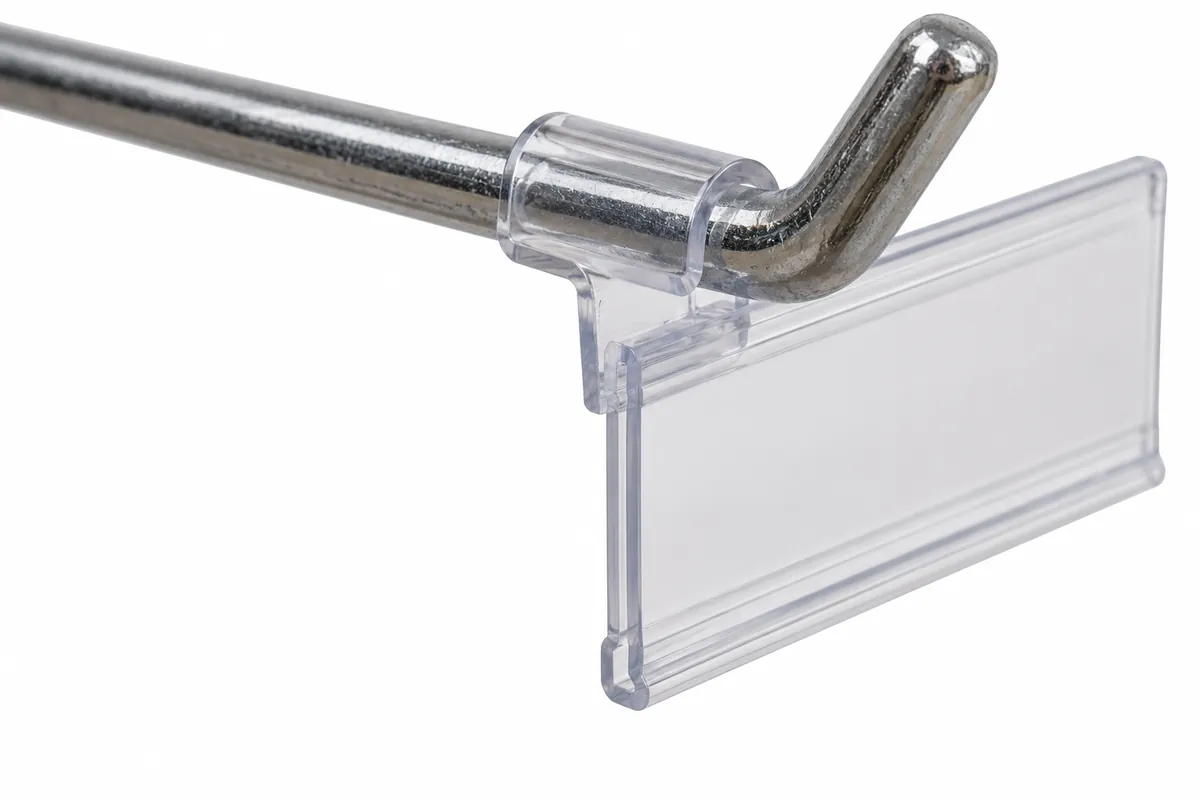
A label holder has at least three relevant envelopes: the holder’s connection to the arm, the ticket’s insertion channel and the visible display area. Record the sleeve’s overall profile and width, the channel opening, its depth, any end stop and the way a ticket is inserted or removed. For the ticket, identify the printed card’s width, height, thickness, orientation and whether it is single- or double-sided. The actual print stock can affect fit; do not approve with an empty transparent sleeve alone.
The arm also needs a controlled interface drawing. State its end shape, orientation, connection dimensions, angle and the intended holder position. The ticket plane should face the correct aisle or operator view. If the arm has a movable or swivel function, request the exact model drawing and agreed movement path; do not assume movement from the name “scan hook.” The selected arrangement must still be reviewed with the actual product identity and must not copy or imply rights to a branded mechanism.
The combined geometry determines what a shopper or merchandiser can see. A label may sit too low behind the product, project into an adjacent facing, twist away from the aisle or become obstructed when packages are loaded. A ticket sleeve can also make replenishment awkward if staff must remove the label before sliding stock onto the hook. These are observable layout issues to record with a sample, not universal failures.
| Interface item | Buyer records | Combined-sample question |
|---|---|---|
| Hook and arm | Part number, drawing revision, attachment type | Is the arm installed in the approved orientation? |
| Holder or sleeve | Supplier, item, profile and revision | Does it engage the arm without an unapproved adapter? |
| Printed ticket | Stock, thickness, size and orientation | Can it be inserted, read in the display plane and replaced? |
| Merchandise | Package size, hang opening and loaded count | Can the product be removed and replenished with the label in place? |
| Adjacent facing | Neighboring hooks and product width | Does the arm or ticket obstruct the next position? |
| SKU contents | Components supplied, optional parts and spares | Does the quote match the actual kit shown and packed? |
This is a procurement matrix, not a defined dimensional standard. The buyer should add controlled values from its own drawings and supplier samples. No universal ticket size, clearance, retention force or barcode-readability threshold is assumed.
How should a complete kit be tested on the display?
Use a real package, actual hook, proposed arm, purchased sleeve and printed ticket. A desk review with only the hook and empty sleeve misses the loaded removal path. Install the hook in the buyer’s intended display system through the responsible fixture supplier’s approved method, then place the intended merchandise and adjacent facings. Panel attachment and package hang-hole retention are separate decisions; they should not be revalidated in this article’s label-interface scope unless the chosen fixture system makes them relevant.
A repeatable review can follow these steps:
- Identify the hook, arm, holder, ticket and package references and revisions.
- Confirm the sellable SKU contents against the BOM and supplier quote.
- Install the metal component in the intended retail fixture sample.
- Insert the actual ticket and confirm its orientation and visible face.
- Load the intended merchandise and neighboring facing positions.
- Observe ticket visibility from the expected aisle or work position.
- Remove and replenish one package with the holder installed.
- Check whether the arm contacts the package, hang opening or adjacent product.
- Replace the ticket and any separately serviceable sleeve using the intended method.
- Photograph the accepted layout and record exceptions in the sample report.
The review should be repeated on each materially different hook length, arm form, ticket sleeve or package profile being sold. One successful combination is not proof that every variant in a catalog family fits. If a planogram has multiple facing widths, test the most constrained planned arrangement rather than relying on an isolated sample at a spacious bench.
Be careful with the word “scan.” Some commercial products use it to describe a ticket-holding feature or retail style. That name alone does not prove a barcode is readable by every scanner or from every angle. If barcode readability is a buyer requirement, define the ticket material, print, orientation, lighting, scanner, distance and process with the retail operator. Obtain the result from the responsible validation process. A metal-component supplier’s fit sample cannot establish scanning performance by itself.
What are common assembly and replacement mistakes?
A common sourcing gap is approving each component separately without ever assembling them together. A metal arm may be nominally compatible with an accessory family, yet a different holder opening, thickness or orientation may change the interface. The buyer should not treat “same supplier” as an engineering specification. Link the holder item number to the exact arm revision and request current compatibility confirmation.
A second gap is evaluating the holder only when empty. The package can obscure the ticket or make the sleeve inaccessible. Conversely, an empty display can overstate available clearance because a full package projects farther. Use the actual product pack, and keep the ticket in place throughout the removal and refill check.
A third issue is confusing “display hook” with “package retention.” K030 covers package hang opening and retention, while this topic covers a metal label arm and a separately sourced ticket holder. The package slot, the hook tip and the label accessory each have distinct owners and acceptance criteria. Keep the questions separate but coordinate them in the complete fixture sample when all parts are sold as a system.
Replacement parts should be easy to identify. Store the label-holder supplier and model in the SKU master and make the spare accessory code available to service or merchandising teams. If the holder is not part of the hook carton, the instructions and online content should say so. If a retailer is expected to print and insert tickets, provide the ticket envelope and orientation requirements. Do not imply that Koitor supplies printed labels or plastic extrusions; those parts remain with the relevant supplier.
What belongs in the RFQ and fixture sign-off?
Send the hook drawing or physical sample, proposed holder, ticket artwork and stock, actual package, adjacent facing layout, display-system details and target kit scope. Identify whether the hook arm and holder are included, optional or buyer-supplied. Ask the supplier to return a combined drawing or compatibility record that names the exact parts. Keep the ticket plane and service path in the approval rather than relying on a product render.
The RFQ should request the metal part’s material description, finish reference, connection details, drawing revision, sample timing and packaging. If the supplier uses a proprietary holder system, request authorized documentation and supply terms. Do not copy competitor art or assume a visible design is available for private-label reproduction. If custom adaptation is needed, define the original fit requirement with the supplier and have ownership and licensing reviewed through the buyer’s normal process.
A sign-off record can include the following:
- Finished fixture SKU and intended store system.
- Metal hook, label-arm and drawing revisions.
- Holder or sleeve supplier and item reference.
- Ticket dimensions, stock and print orientation.
- Merchandise package and neighboring facing layout.
- Removal, refill and ticket-replacement observations.
- Included components and optional accessories.
- Installation owner and display configuration.
- Accepted sample date and approved deviations.
- Change triggers for holder, package or arm substitutions.
A change to the ticket sleeve can affect its retention, visible plane or replacement action. A change to a package can affect merchandise removal. A change to the hook or arm can alter spacing or orientation. Route each change to the correct owner and rerun the relevant combination check; do not simply carry forward approval from the previous version.
Which questions belong to panel fit instead?
Panel fit is adjacent but separate. Pegboard, slatwall, gridwall and cross-system adapters have their own profile and engagement requirements. K314 and K315 own certain panel-side interfaces, while K1063 and K1209 cover other display-system contexts. This guide intentionally does not prescribe panel compatibility or a universal attachment. The buyer should confirm the selected hook’s panel-side fit with the appropriate supplier and record it in the complete display BOM.
The label arm is still important after panel approval. A hook can mount correctly and hold a package as intended while its ticket holder remains unreadable, incompatible or difficult to replace. Conversely, a well-positioned ticket sleeve cannot compensate for a mismatch at the display panel. Separate the questions in the RFQ but review the complete assembled merchandising sample before rollout.
For general supplier context on metal storage components, importers can review Koitor’s custom metal storage rack manufacturing and OEM home storage hardware pages. These are not a current scan-hook catalog. Buyers may share original drawings and samples through the contact page for a scoped discussion about metal wire or sheet parts.

A launch-ready specification is one that identifies every component, shows the label plane beside actual merchandise and defines how a ticket is inserted or replaced. If any piece remains buyer-supplied, say so in the listing, quote and packaging record. This keeps the assortment understandable without making an unsupported universal fit claim.
How should buyers compare hook variants?
Before selecting a scan-hook assortment, map each arm and holder combination to its intended merchandise package and ticket format. Different arm lengths, wire diameters, attachment methods or label-holder openings may look similar while presenting the package at a different position. Record the parent hook SKU, holder supplier, label dimensions and any adaptor in the BOM. Keep “compatible” tied to the exact pairing checked; a common retail vocabulary does not establish a shared mechanical interface.
During sample review, compare the empty fixture to the loaded display arrangement, then verify that the ticket remains visible from the intended viewing direction. If a package obscures the label, record the actual package model and position rather than claiming the hook is unsuitable for an entire category. A new package, arm extension or holder can change the presentation and should trigger review. Sales images must show the included parts and should not imply a barcode-scanning function unless the system has been separately evaluated.
Source basis: Display Centre Slatwall Euro Hook Ticket Arm and Trion swivel scan hooks. Product examples are limited to the named listings. Trion designs and marks are not claimed, copied or implied to be licensed.
Keep the retail scan hook label holder compatibility tied to the named sample, drawing revision and included components.
Reviewing a Metal Display Hook Component?
Share the original hook drawing, holder sample, ticket format, merchandise package and fixture layout for a bounded metal-component feasibility discussion.
OEM / PRIVATE LABEL
Turn this sourcing guide into a product brief
Share your target product, size, finish, order quantity and packaging requirements. Your team receives a practical manufacturability review before quotation.


 English
 Español
 Português
 Français
 Deutsch
 العربية