

A published standard robe hook height is a hook-specific datum file, not a towel-bar sentence and not a load or projection line. Name the measurement point, usually finished floor to the hook tip or to the backplate center, and name whether the hook is a wall-mounted or door-mounted program, before any figure is printed.
Combined consumer charts that place bars, rings, and hooks on one hanging line are useful only as demand evidence. They are not a Koitor standard and not an ADA standard.
This guide is for importers, distributors, and private-label teams approving artwork and install-sheet wording for bathroom robe hooks. Koitor Hardware manufactures custom metal bathroom and home storage hardware as a family-owned China OEM.
Send the hook drawing, whether it hangs on a wall or a door, the intended market, and any project rule the sheet must mention. We can review the wording and the named datum. We will not issue a universal height, a wet-load rating, or an accessibility determination.
What does a standard robe hook height file actually freeze?
It freezes a published-height file for a bathroom robe hook: the fixture type, the reference surface, the measuring point on the hook, and the wall-versus-door program. It does not freeze projection, wet-load claims, double-hook spacing, or towel-retention geometry. Those live hook pages already exist and should keep those decisions.
Searchers ask how high to hang a robe hook, or they look up bathroom robe hook height from the floor, because they want a bathrobe or a towel to clear the floor and to sit at a usable reach. That demand is real. That demand does not become a factory hook-height standard, and it does not turn this file into a bathroom hanging tutorial.
The live towel-bar and towel-ring height articles already tell writers not to reuse a bar or ring sentence as a hook sentence. This file is that hook brief. It should not repeat the bar thesis or the ring thesis, and it should not merge bars, rings, racks, and hooks into one consumer chart.
Entryway coat-hook height and generic towel-hook height are also different questions. A coat hook in a mudroom is often a different program, a different reach habit, and sometimes a different product. Do not treat those search phrases as this page’s target, and do not borrow their charts as a bathroom robe-hook default.
First-install kit language belongs on a companion robe-hook installation file: architecture, packed parts, template, and substrate notes. That companion file should not print hook-height inches, and this height file should not reprint the kit list. Keep the two decisions in separate documents even though they share a product family.
A custom bathroom hardware manufacturer can match a finish or a hook form to a bathroom collection. Matching the metalwork is not the same as inventing a universal hook height. If you are developing a hook to sit with other bath accessories, bring the intended datum with the drawing.
Which measurement point must be named before any figure?
Name the reference surface and the point on the hook before any number is printed. A figure without those two names is not a complete callout, even when the inch or millimetre value looks familiar.
The usual reference surface for a wall-mounted bathroom hook is the finished floor. If a project measures from another finished surface, write that surface by name. Do not assume a subfloor, a base tile course, or an unfinished wall mark is the same as the finished floor the user will see.
The usual choices on the hook itself are the hook tip, the lowest hanging point of a typical loop, or the backplate center. Those points are not interchangeable. A curved hook tip can sit well below the plate. A double hook can have two tips at different heights if the arms are staggered. If the sheet says only “hook height,” an installer can measure the plate, the upper tip, or the lower tip and still believe the sheet was followed.
Pick one point and keep it for every view that shares the callout: the elevation, the install sheet, the listing line, and any sample photo annotation. If a second point is required, for example a plate center used only to locate fasteners, give it its own named field. Do not bury two points inside one number.
Lifestyle photographs often show a robe already hanging on the hook. That image is useful as a use reminder, and it is a poor measuring document. The hem of the robe is not the hook tip, and it is not the backplate center. If the listing photo includes a dimension arrow, the arrow should point to the same named point as the sheet. If it cannot, leave the number off the photo.
A staggered double hook is a frequent source of silent error. If one arm is higher than the other, say which arm the published height uses, or state that each arm has its own named point. “The hook is at 65 inches,” even as a labeled third-party example, does not tell a reader which arm was meant. On an approved sheet, the arm has to be named before any project figure is applied.
Projection, the distance the hook stands off the wall, is a different measurement. It belongs on the existing robe-hook projection article. A projected arm can change whether a thick robe hangs clear of the wall, but it is not a substitute for the floor datum. Do not rewrite the projection file here.
Towel-retention geometry and wet-load claims are also different files. Whether a loop stays on the hook, and what may be said about a wet robe, are not answered by a height callout. Point to those live articles in plain language and leave their tests and geometry off this sheet.
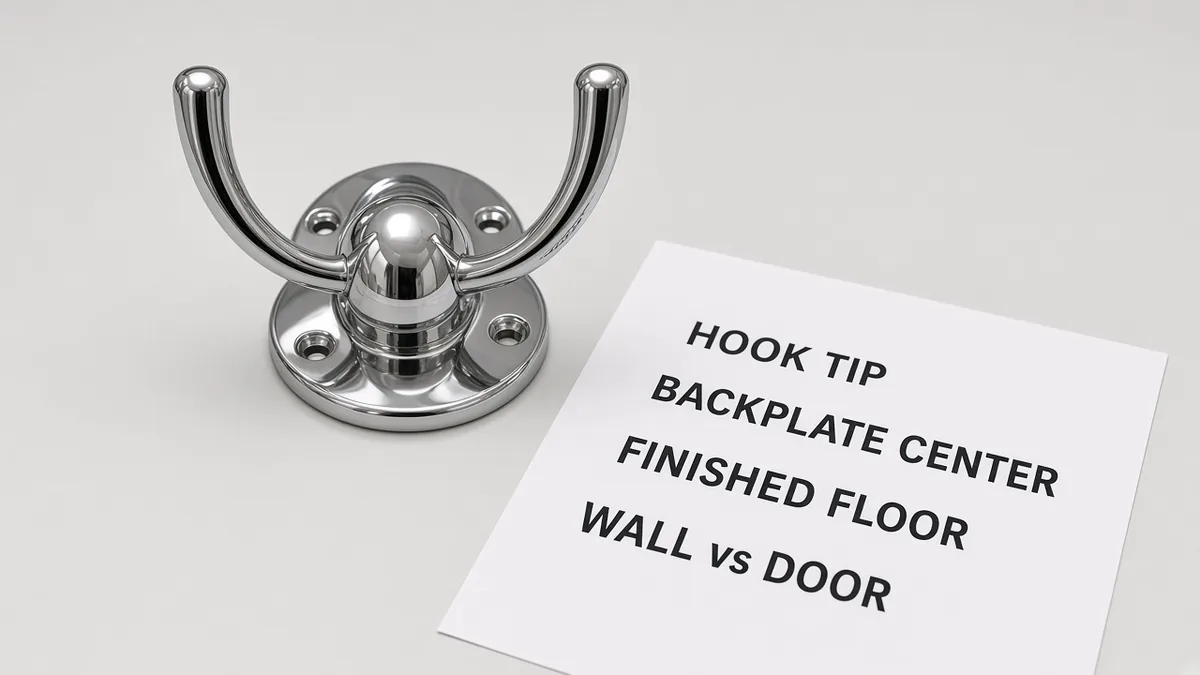
Why must wall-mounted and door-mounted programs stay in separate buckets?
A wall-mounted robe hook and a door-mounted robe hook do not share a height sentence just because they share a finish. The wall program usually starts from the finished floor and a named point on the hook. The door program has to say that the hook is on a door, and it may need a different origin, a door-thickness limit, or a clearance to the door edge or to the frame.
If the hook is on a door, name the door. A slab door, a louvered door, a mirror door, and a thin cabinet door are not the same substrate and are not the same placement problem. This height file should name the program. It should not turn into a door-hardware catalog, and it should not pretend an over-door consumer hook is the same SKU as a screw-mounted door hook.
Do not move a wall-height number onto a door and call the job finished. The finished floor may still be a useful reference, but only if the sheet says the hook is door-mounted and still measured from that floor. If the project instead measures from the door top, the door bottom, or a named stile, write that origin. An unlabeled number will be applied to the wrong edge.
If a collection includes both wall hooks and door hooks, give each program its own callout. A single “typical robe hook height” line on a shared catalog page will be applied to both. That is convenient, and it is also how a door hook is installed as if it were a wall hook.
The install-kit file can later say how the hook is fastened to a wall or to a door. This height file should stop once the program and the datum are named. Do not add an anchor list or a template here in order to “finish” the door discussion.
Why should a combined bar, ring, and hook chart not be copied?
Many consumer and trade pages put towel bars, rings, and hooks on one measurement diagram. Some of those pages also repeat unofficial figures such as about 65 inches from the floor, about 48 inches, or an ADA reach range. Those figures are labeled here only as third-party examples of what searchers already see. They are not a Koitor standard. They are not a building-code standard. They are not an ADA standard.
The live bar and ring height files already refuse to treat those combined charts as factory data. This hook file should do the same, for a different reason: a hook tip, a ring center, and a bar center are different measuring points, even when they are shown on one pretty diagram. Copying the diagram copies the confusion.
ADA or other accessibility language in those charts is a clue that some projects will ask about reach. It is not permission to print an unofficial reach range as if the factory had determined the rule. If a project requires a cited accessibility or building rule, name the rule and the official source the project already adopted. Do not “round” a blog figure until it looks official.
Coat-hook charts for halls and mudrooms have the same problem when they are dragged into a bathroom robe-hook sheet. The room, the garment, and the fixture may all be different. Use those charts only as labeled evidence that hook height is a common question, not as a default for this SKU.
Millimetre conversions belong in the same discipline. If the sheet must show both inch and millimetre values, they must describe the same named datum, the same hook point, and the same wall-or-door program. A converted unofficial figure is still not a factory standard.
| Published file | Reference to name | Point on the hook to name | Program to name | What this row is not |
|---|---|---|---|---|
| Wall-mounted robe hook, finished-floor datum | Finished floor, not a subfloor unless the project says so | Hook tip, lowest hanging point, or backplate center — one chosen point, written out | Wall-mounted bathroom robe hook, not an entryway coat hook | A towel-bar or towel-ring sentence reused on the hook |
| Door-mounted robe hook program | The named door surface and, if used, finished floor or another stated origin | The same class of named hook point, plus any door-edge or door-style limit the sheet must state | Door-mounted program, with the door type named if the hook depends on it | An over-door consumer hook treated as the same SKU, or a wall-height number moved onto a door |
| Unofficial combined bar, ring, and hook chart | Often mixed or left unnamed | Often mixed across bar center, ring center, and hook tip | Often one consumer hanging line for every bath accessory | A Koitor standard, a building-code standard, or an ADA standard |
Read the table as a filing rule, not as a menu of factory heights. The first two rows are the hook programs this article is willing to discuss. The last row is demand evidence. It is not a number you can drop into a carton.
Which neighboring hook and bathroom height files should stay separate?
Send projection to the existing robe-hook projection article. Send wet-load wording to the existing robe-hook wet-load claims article. Send center-to-center or hook-to-hook distance to the existing double robe hook spacing article. Send loop-stay and retention geometry to the existing robe-hook towel-retention article. Material and RFQ checks stay on their existing hook files. This height file should point to them in plain language, not rewrite them.
Towel-bar, towel-ring, and towel-rack height stay on those live bathroom files. Quote them only to keep the fixtures apart. A matching collection can share a finish without sharing a height sentence. If the collection also includes other towel hardware, a custom bathroom towel rack manufacturer can be a send-off for rack programs; it is not a hook-height shortcut.
The companion robe-hook installation file, when you use it, should own the first-install kit, the template, and the substrate notes. Do not preview that kit here, and do not print hook-height inches there. The two files can mention each other. They should not copy each other’s thesis.
If a project also needs an accessibility claim elsewhere in the bath, keep that claim on a claim-evidence file and on the official source the project cites. Do not use this hook-height article as a stand-in accessibility opinion.
What should be checked before a robe-hook height is printed?
Use the checklist below to review robe-hook artwork and install-sheet wording, not to hang a hook in the field. Koitor’s practical manufacturing insight here is that a small-batch OEM can match a hook form, a plate style, or a finish to a collection, but it should not be asked to “use the usual hook height” when no datum or wall-versus-door program has been named.
During sample and drawing review, the plant can help you see whether the printed callout names one measuring point and one program, and whether a double hook uses the same point on both arms. That is wording and drawing hygiene. It is not a load test, a projection check, or a code opinion.
If a hook program carries a residential suggestion, a project schedule, and a cited rule at the same time, keep those three labels apart. A suggestion can stay a suggestion. A cited rule must name the rule. Mixing those labels is how an unofficial combined chart becomes, in later reprints, “the required hook height.”
When more than one artwork view exists, check that the elevation, the install sheet, and the listing line use the same point and the same program. A hook photograph that shows an unlabeled dimension arrow will be read as a factory hook height, even when the drawing was more precise about the tip or the plate.
If a height callout changes during sampling, record the revision as a change to a named field. State whether the program changed from wall to door, the measuring point changed, or only a cited project figure changed. A revised number with no revision note will be read against the old datum.
Packaging copy should follow the same rule. A carton line that says “standard height” without a datum or a wall-or-door program will be treated as a complete callout in the field. If the hook carton cannot carry the full callout, point to the install sheet instead of inventing a shorter hook figure.
If two rooms in the same collection use the hook in different places, for example beside a shower and beside a dressing wall, do not assume one floor number serves both without checking the program. The fixture can be the same. The garment, the clearance, and the cited project rule may not be. It is cleaner to keep one hook SKU and two named programs than to print a blended height that is correct for neither wall.
If a showroom mock-up later disagrees with the sheet, ask which point was measured before changing the number. Many mock-up disputes are tip-versus-plate disputes, or wall-versus-door disputes, not evidence that a consumer chart was “wrong” or “right.”

- Name the fixture type as a bathroom robe hook, not a towel bar, ring, rack, or entryway coat hook.
- Name the measurement datum, usually finished floor for a wall program, and write any other origin if the project uses one.
- Name the point on the hook: tip, lowest hanging point, or backplate center, and use that point on every shared view.
- For a double hook, say whether one point applies to both arms, or whether each arm has its own named point.
- Name the program as wall-mounted or door-mounted, and do not move a wall number onto a door without restating the origin.
- Keep unofficial consumer examples, including third-party 65-inch, 48-inch, or ADA-reach figures, labeled as demand evidence only.
- Leave projection, wet-load claims, spacing, and retention geometry on their existing hook files.
- Leave first-install kit, template, and substrate notes on the companion installation file.
- If a project rule must be printed, cite the named rule or official source; do not treat a combined blog chart as that source.
- Do not ask the factory to fill a blank height with “the usual inch” for a new hook program.
Frequently asked questions
Can a listing print 65 inches or 48 inches as the standard robe hook height?
Not as a Koitor standard, and not as a building-code or ADA standard. Unofficial consumer figures may be mentioned only as labeled demand evidence. If a project requires a specific figure, print it as a cited project requirement after the datum, the hook point, and the wall-or-door program are named.
Is robe hook height the same decision as hook projection or wet-load claims?
No. Projection and wet-load wording are neighboring files. They can appear in the same collection, but they do not answer the published-height question. A familiar projection will not save a callout that never named the measuring point.
Can a door hook use the same number as a wall hook in the same set?
Only if the sheet still names the door program and the origin being used. Do not move a wall-height number onto a door and leave the program unnamed. If the door uses a different origin, write that origin as its own callout.
Should hook installation steps be included on this height sheet?
No. First-install kit, template, and substrate notes belong on the companion robe-hook installation file. This page should not reprint that kit, and that kit file should not print hook-height inches.
Can Koitor tell us the correct hook height for our market?
Koitor can review the wording, the named datum, and whether the wall-or-door program is stated clearly. Koitor will not issue a universal height, a load rating, or a regulatory determination. If your hook market or a named project rule supplies the figure, bring that rule with the hook drawing.
Is a towel-hook or coat-hook chart good enough for a bathroom robe hook?
No. Those charts may show that hook height is a common question, but they are not this fixture’s datum file. Keep entryway coat-hook height and generic towel-hook height off this target, and do not borrow them as a factory default.
Work With Koitor Hardware
Need a robe-hook height callout reviewed?
Send Koitor the hook drawing, whether it hangs on a wall or a door, the intended market, and any project rule the install sheet must mention. Our team can review the wording and the named datum, without issuing a universal height, a load rating, or an accessibility determination. MOQ can start from about 100 pcs depending on the product; samples usually take 5-7 working days after details are confirmed; bulk production usually takes 4-6 weeks depending on the project.
OEM / PRIVATE LABEL
Turn this sourcing guide into a product brief
Share your target product, size, finish, order quantity and packaging requirements. Your team receives a practical manufacturability review before quotation.


 English
 Español
 Português
 Français
 Deutsch
 العربية