

A printed inch figure is not a standard towel bar height until the measurement point and the program type are named. Consumer interior guides often repeat an unofficial about-48-inches-from-the-floor rule of thumb. That pattern is evidence of search demand, not a Koitor factory standard and not a project requirement by itself.
Freeze the datum first: floor to bar centerline, mounting-plate center, or post center. Then say whether the figure is a residential suggestion, a hospitality guest-room schedule, or a cited project rule. Keep bar length, first-install kit steps, and toilet-paper-holder height out of that sentence.
This guide is for importers, distributors, and private-label teams approving artwork, install sheets, and project schedules for wall-mounted towel bars. Koitor is a family-owned custom metal hardware factory. We can review the wording and the named datum. We do not issue an accessibility determination, and we do not invent a universal inch or millimetre.
What decision does a published height actually freeze?
The decision is whether a listing, carton, or install sheet may print a height, which point is being measured, and for which program. It is not a decision about how long the bar is, how the first holes are drilled, or whether the tube rotates in the posts. Those are separate files, even when the same SKU is on the page.
A height line that does not name the datum will be copied onto the wrong fixture. A buyer who later hangs a ring, a hook, or a toilet-paper holder from the same sentence has used the file incorrectly. The bar can still be a good product. The artwork was broader than the decision you actually froze.
Published height is also not a load claim. A towel bar is not a grab bar unless the project has specified a grab-bar product and the evidence that product requires. If the install sheet mentions reaching or mobility, treat that as a prompt to cite the project rule, not as a reason to paste an unofficial inch chart into the bar listing.
The useful freeze is narrow and written. Name the fixture as a towel bar. Name the measurement point. Name the program bucket. Say whether the figure is a suggestion the brand wants to print, or a requirement the project handed you. Leave everything else to the file that actually owns it.
If two markets will see the same SKU, do not assume one printed height travels. A residential insert and a hospitality schedule can share a datum name and still carry different figures, or one market can carry no figure at all. Record that split in the artwork brief before the first language version is locked.
Which measurement point must be named before any figure is printed?
Name the point before the number. Floor to the bar centerline, floor to the top of the tube, floor to the mounting-plate center, and floor to the post center are not interchangeable. A plate that sits below the tube will move a from-the-floor figure even when the towel hanging line has not changed.
If the sheet also mentions a vanity, name the vanity reference as well: top of the deck, top of the basin, or a finished opening the project already uses. Do not write above-the-vanity as if every vanity were the same height. The vanity-relative sentence is a second datum, not a substitute for the floor datum, unless the project says it is the only datum that matters.
A double bar needs an extra note: whether the printed height is the upper tube, the lower tube, or a mid-point the project named. Front-to-rear spacing on a double bar is a different decision from mounting height and should not be used to explain a missing floor datum.
On the sample or the drawing, mark the point you intend to print. A photograph of a bar on a tiled wall does not tell a later reviewer whether the tape was on the tube or the plate. If the first article will be used to lock artwork, the photograph should show the named point, not only a styled towel.
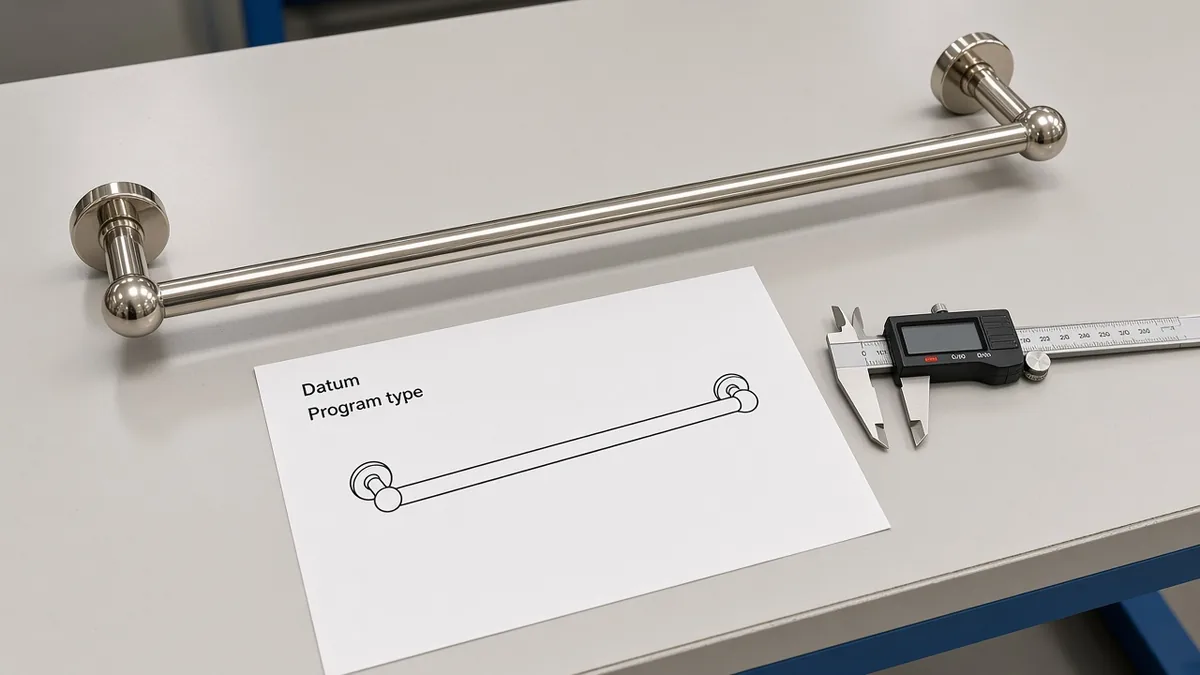
Do not invent a factory millimetre or inch to fill a blank cell. If the brand has not chosen a figure, print the datum name and leave the value to the project, or omit the height line. A made-up number is harder to unwind than a sheet that says the height will be confirmed against the program rule.
When you photograph a first article for this file, include a vertical reference that makes the named point readable later: the finished floor, the plate, and the tube in one frame, with the point marked. Do not add a dimension callout unless that dimension is the figure the program has already adopted. A styled beauty shot can sit in the listing. It should not be the only evidence of the datum.
If the hanging towel is part of the check, name the towel as well as the bar. A bar can sit at the agreed point and still let a long bath sheet drag, or sit high enough that a short hand towel feels awkward. That observation belongs in the program brief. It is not a reason to invent a second unofficial factory height and call both of them standard.
How should residential, hospitality, and project rules stay in separate buckets?
Keep the three buckets separate even when the same bar is sold into more than one channel. A residential suggestion is a brand choice about how the install sheet should help a home installer. A hospitality schedule is a room standard the operator or designer already uses. A project or accessibility rule is a cited requirement, not a retail slogan.
If the listing is for a residential program, say so. Do not title the line standard if you only mean the height we like to suggest. The word standard is how unofficial consumer charts get copied onto a carton. If the brand wants a suggested hanging height, call it a suggestion and keep the datum in the same sentence.
If the bar will appear on a hospitality schedule, ask for that schedule or for the room type the figure belongs to. Guest-room, public washroom, and back-of-house rooms are not automatically the same file. Do not borrow a residential suggestion and relabel it as a hotel standard. Koitor will not invent the schedule for you.
If the project cites an accessibility or facility rule, write the rule the project actually adopted and the scope the project assigned. The 2010 ADA Standards, where a U.S. project uses them, are a facility standard with a defined scope. They are not a towel-bar product rating and they are not a license to print ADA height on a bar that was never reviewed against the project cited sections.
The ADA claim-to-evidence checklist is the safer place to test whether an accessibility sentence is allowed at all. This height file only asks you not to paste a facility rule, or an unofficial inch chart, into a product line as if Koitor had rated the bar.
When a program later adds a second market, review the buckets again. A figure that was only a residential suggestion should not quietly become a project requirement in the second language version. If the translation wants the word standard, check that the source file actually froze a standard, not a suggestion.
Why is a consumer inch guide not a Koitor standard?
Third-party consumer guides, including pages that present about 48 inches from the floor and a 14 to 18 inch band above a vanity, often describe those figures as rules of thumb. One such guide, opened as a competitor example, says the numbers are rules of thumb and notes that mobility or children use may call for a different hanging line.
That is a fact about what that page says. It is not a Koitor measurement and it is not a validation that those figures fit any given SKU or room.
Those guides exist because people search for a single hanging height so towels clear the floor and stay reachable. That demand is real. It does not authorize a factory or a brand to print a standard 48-inch height as if the number had been measured on the bar, agreed as a program datum, and cleared as a legal or accessibility claim.
If a brand still wants to print a figure in that neighborhood, treat it as the brand chosen suggestion, name the datum, and keep the unofficial chart in the research file rather than in the artwork. Do not cite a blog as the authority on the carton. Do not let a measurement pin become the install-sheet source of truth.
The failure mode is familiar. A towel drags because the printed height ignored the actual towel length and the named hanging line. A bar blocks a door or a shower door because the sheet treated a blog number as a room layout. Or a consumer inch rule is later read as an ADA number. All three start with an unnamed datum and an unsourced figure.
Koitor can help you write a sentence that names the datum and the program bucket, and we can refuse a sentence that claims a universal standard we did not observe. We will not replace your missing project rule with a copied consumer chart.
Which neighboring fixtures need a different file?
A standard towel bar height sentence should not be reused as a ring or hook sentence. Towel rings and towel hooks are neighboring fixtures, not this page primary target. Vanity-relative ring height is a common separate question. If the set includes a ring or a hook, give each fixture its own datum sentence, even when the brand wants them to look like a collection. A shared mounting-plate family does not make the hanging lines the same.
Toilet-paper-holder height is already covered on its own guides. For a commercial holder, use the commercial toilet-paper-holder height importer guide rather than borrowing this towel-bar file. A residential or brand placement guide for holders is a different file as well. Do not merge those datums into a towel-bar sentence to save space on the install sheet.
Bar length, clear span, and room fit are also a different decision. A longer bar can still be hung at the same named height, and a short bar can be hung badly if the datum was never written. If length is the question you actually have, use the length file, not this one. Do not print overall length in the height cell for convenience.
First-install kit contents, templates, and substrate notes belong on the install-kit file, which is a neighboring decision in this batch and is not a live URL yet. You can mention in the kit brief that height is published elsewhere. You should not reprint a height chart as the kit article thesis, and you should not use this height file as a substitute for a missing template or the wrong anchors.
Replacement mounting brackets, removal, and tube rotation in the posts are likewise out of scope here. Those questions can send a reader to their own live files when you are writing a support answer. They do not change the datum you print for a new install.
If a support ticket arrives as the bar is too high or too low, separate the complaints before you rewrite artwork. A door swing, a shower door, a long towel, or a vanity that was never named can all look like a bad factory height. Fix the file that is actually wrong. Do not silently move the printed datum to satisfy one room and then leave the old sentence live in another market.
What should the importer freeze before a height line is approved?
Do not approve a standard towel bar height line until the datum and the program bucket are written down. A verbal agreement in a sample meeting is not a freeze. The next language version, or the next buyer on the account, will only see what made it onto the sheet.
Use a written height file, not a hallway average. The checklist and the matrix are reminders of the decisions this page asks you to freeze. They are not a substitute for the named datum, the program bucket, and the actual sentence you intend to print.
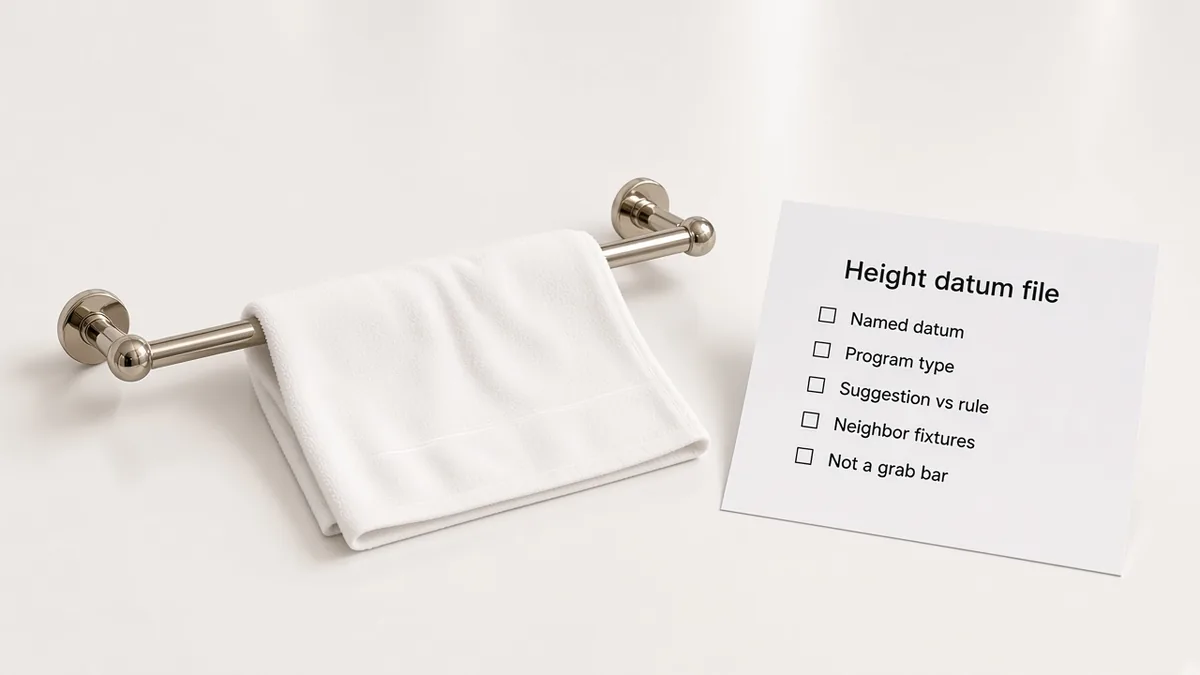
- Name the fixture as a towel bar, not as a generic bathroom accessory height.
- Name the measurement point: bar centerline, plate center, post center, or another point the drawing actually uses.
- If a vanity-relative sentence is also needed, name the vanity reference as a second datum.
- Place the figure in one program bucket: residential suggestion, hospitality schedule, or a cited project rule.
- If the figure is only a suggestion, do not title it a standard or an accessibility rating.
- Keep unofficial consumer inch charts in the research file, not on the carton or the install sheet, unless the brand has adopted a figure and still names it as a suggestion.
- Exclude bar length, first-install kit steps, rings, hooks, and toilet-paper-holder height from the same sentence.
- State that the bar is not a grab bar unless a grab-bar product and its evidence are actually in the program.
- If an accessibility phrase is requested, send it through the claim-to-evidence review rather than pasting a facility number onto the SKU.
- Record whether later language versions may change the bucket or must repeat the same named datum without inventing a new number.
| Impulse on the artwork | What to freeze | What the file should show | What to keep off the sentence |
|---|---|---|---|
| Print a standard height | Datum name, program bucket, and whether the figure is a suggestion or a requirement | The exact sentence plus the point marked on the drawing or sample | An unnamed standard 48-inch height copied from a consumer guide |
| Hang it above the vanity | The vanity reference and whether it sits beside or instead of a floor datum | The vanity point the project or brand actually uses | A vanity band copied from a consumer guide and presented as factory data |
| This is the ADA height | The project cited rule and the scope the project assigned, or a decision to drop the line | A claim-to-evidence review, not a blog chart | ADA height or a grab-bar implication on an ordinary towel bar |
| The whole bathroom set uses one number | A separate datum sentence for the bar, and for any ring, hook, or holder in the set | Each fixture named, even if the plates look related | A single chart that treats bars, rings, hooks, and holders as one hanging line |
| We already have a length drawing | A split between length or clear span and mounting height | Height written as its own cell or sentence | Overall length dropped into the height cell |
Send Koitor the drawing, the intended market, and any project rule the install sheet must mention. We can review whether the sentence names a datum and stays inside the correct bucket. We will not invent a universal height, and we will not certify the bar as a grab bar or as an accessibility-rated product from this file.
If the only thing you have is a consumer guide and a blank cell, the safer path is to omit the number or to print only the datum name until the brand or the project supplies a figure. A listing can still describe the bar, the finish, and the custom bathroom towel rack manufacturing path without pretending that a blog rule of thumb is a factory standard.
Frequently asked questions
Can we print a standard 48-inch height if consumer guides repeat it?
Not as a Koitor standard, and not as an unnamed factory figure. Those guides are third-party rules of thumb. If the brand still wants a figure in that neighborhood, name the datum, call it a suggestion unless a project rule says otherwise, and keep the unofficial chart out of the artwork authority line.
What is the standard towel bar height Koitor recommends?
Koitor does not publish a universal inch or millimetre as a factory standard. The useful recommendation is to freeze the measurement point and the program bucket, then print only a figure the brand or the project has actually adopted.
Can we use the same number for a ring, a hook, and a toilet-paper holder?
Not from this file alone. Neighboring fixtures need their own datum sentences. Toilet-paper-holder height already has separate importer guides. A collection with matching plates can still use different hanging lines.
Does a hospitality schedule automatically override a residential suggestion?
Only if the program actually uses that schedule and the artwork says so. Do not relabel a residential suggestion as a hotel standard. Ask for the room type and the schedule you are supposed to follow, or omit the number.
May we print ADA towel bar height on the listing?
Not as a product rating inferred from a consumer chart. If the project cites a facility rule, review the sentence against the claim-to-evidence checklist and the project scope. An ordinary towel bar is not a grab bar because an accessibility phrase was added.
Can Koitor write the height sentence for us?
We can review your draft, the drawing, and the intended market, and we can help you name the datum and the bucket. We will not invent the number or issue an accessibility determination. Send your drawing and the proposed sentence to Koitor when you want that review.
Work With Koitor Hardware
Need a towel-bar height sentence reviewed?
Send Koitor the towel-bar drawing, the intended market, and any project rule the install sheet must mention. Our team can review the named datum and the wording you want to print, without inventing a universal inch or issuing an accessibility or load rating. MOQ can start from about 100 pcs depending on the product; samples usually take 5-7 working days after details are confirmed; bulk production usually takes 4-6 weeks depending on the project.
OEM / PRIVATE LABEL
Turn this sourcing guide into a product brief
Share your target product, size, finish, order quantity and packaging requirements. Your team receives a practical manufacturability review before quotation.


 English
 Español
 Português
 Français
 Deutsch
 العربية