

A thick cabinet front can appear to fit when closed and still strike the adjacent cabinet side as it opens. The buyer decision is not simply which hinge is labeled for a thick door. The supplier needs the door edge profile, cabinet geometry, mounting position, required opening path, and exact hinge model so the assembly can be checked through its full movement. For sourcing, the useful requirement is an approved edge-sweep envelope: a clear record of what must pass what, at which stage of opening, on the identified sample.
The phrase thick door hinge minimum reveal is sometimes used as though it referred to one universal gap. It does not. A published reveal or minimum-clearance value belongs to a particular fitting model, mounting arrangement, and defined door geometry. Buyers should ask the component supplier to calculate or confirm the proposed application from controlled inputs, then verify the result on a representative assembly. A catalog value is a starting point for a named configuration, not a promise that a different edge shape or cabinet will clear.
What Does Minimum Reveal Mean in a Thick-Door Assembly?
Reveal is the visible or functional gap between a door and an adjacent cabinet surface. Depending on the fitting and construction, a minimum reveal value can describe the space needed for the door edge to move past a cabinet side without collision. A thick front changes the shape and location of the moving edge relative to the hinge pivot. A bevel, radius, decorative profile, or proud edge can change the clearance envelope again.
That is why thickness alone is not enough to select a fitting. Two fronts with the same nominal thickness can have different edge treatments and different movement paths. Similarly, the same door can behave differently with a changed hinge arm, mounting plate, cup position, cabinet-side setback, or overlay condition.
Manufacturer planning documents illustrate how reveal is tied to model-specific inputs rather than a universal cabinet rule. Hettich’s technical material, for example, provides application planning data for particular hinge families and configurations. Buyers should use the current documentation for the exact proposed model and confirm its assumptions with the component supplier. Do not copy a number from one catalog into a specification for another fitting or construction. See the Hettich hinge planning catalog.
The practical question for the sourcing team is therefore: what is the smallest clearance required by this identified door-and-hinge combination throughout its intended motion? That question leads to a verifiable drawing and sample check rather than an ambiguous request for a “thick door hinge.”
Use the phrase thick door hinge minimum reveal in the RFQ only when it is accompanied by the model, edge profile, and cabinet geometry that define the requested clearance.
Which Inputs Should Be Sent to the Hinge Supplier?
Provide a dimensioned section and plan view wherever possible. The supplier should not have to infer the moving edge from a front elevation. Include the door thickness and finished edge profile, including any bevel or radius; cabinet-side thickness and position; the intended inset or overlay; and the hinge model or the range of models being evaluated.
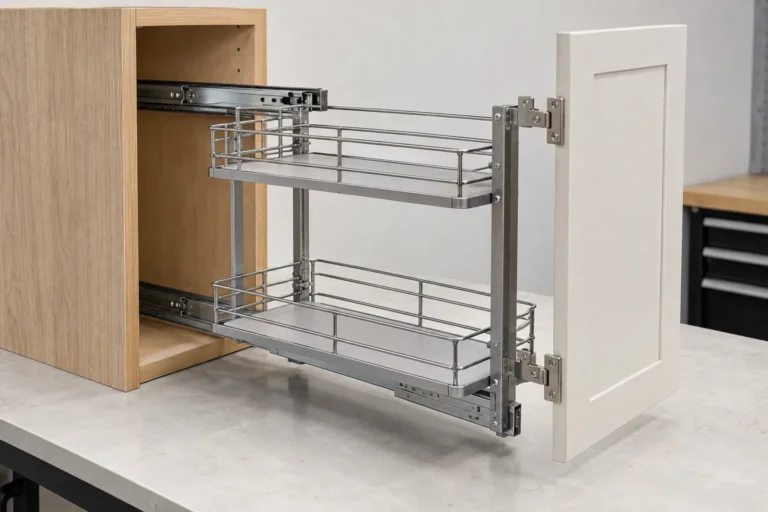
Also state the useful opening required by the product. A cabinet that can technically open a small amount may still fail the buyer’s access requirement. Include nearby doors, drawers, pull-out frames, handles, walls, fixed shelves, or other parts that occupy the motion path. If the door is part of a metal storage assembly, show the metal frame and its mounting interface in the same reference drawing. A hinge supplier can confirm fitting compatibility, while the cabinet or accessory supplier confirms the complete product interface.
| RFQ input | Evidence to provide | Question it helps answer |
|---|---|---|
| Door thickness and edge | Section drawing, edge radius or bevel, finish build-up if relevant | What contour must travel past the cabinet side? |
| Cabinet construction | Side-panel thickness, face-frame or frameless condition, panel position | Which mounting geometry is being evaluated? |
| Fitting identity | Manufacturer, exact model, arm and plate, revision or technical sheet | Which model-specific limits apply? |
| Required motion | Closed position, usable opening, and any stop or restrictor | What clearance is needed during the actual movement? |
| Nearby components | Handle, neighboring front, pull-out shelf, wall, and metal accessories | What else could intersect the moving door? |
| Approval basis | Dimensioned assembly drawing and representative sample | What exact configuration will production reproduce? |
Do not send only “door thickness” and request the supplier to choose a hinge. If the complete door assembly is not yet fixed, label the unknown inputs and ask for a conditional proposal that states the assumptions. A conditional proposal is useful for budgeting, but it is not final fit approval. Convert the assumptions into a controlled drawing and confirm them before tooling, large purchasing commitments, or repeat production.
How Should Buyers Compare Fitting Proposals?
Ask each supplier to quote an identified fitting and show the geometry behind the recommendation. At minimum, compare the arm configuration, mounting plate, drilling position, permitted door thickness or profile conditions, required reveal, adjustment range, and the evidence used to confirm the application. Depending on the product, the buyer may compare an alternative hinge family, a different mounting position, a modified edge profile, or a restricted opening. These are design options to evaluate with the supplier, not interchangeable fixes.
A useful comparison separates fixed design inputs from adjustable assembly settings. Adjustment can help align a door within a fitting’s intended range; it does not erase a wrong cup position, incompatible plate, excessive thickness, or collision in the swing path. If one proposal depends on being at the extreme of its adjustment range, ask the hinge manufacturer to confirm the application and document the limits. Compare the actual usable access and the fit of the complete assembly, not just whether the hinge can be physically attached.
Beware of comparing catalog values that use different assumptions. A minimum reveal measured for one edge radius may not apply to a square edge. A value for a specific arm and plate does not automatically transfer to another plate height. A result for a particular overlay may not prove an inset arrangement. Put each assumption beside its corresponding value and have the technical supplier confirm that the chosen document revision remains current.
For a private-label or multi-supplier project, request a concise application statement that names the proposed model, door range, mounting details, reveal condition, and any exclusions. This helps the buyer compare proposals on the same basis and reduces the chance that the eventual production fitting is substituted with a visually similar but geometrically different part.
What Should the Representative Sample Demonstrate?
Review a full assembly, not a loose hinge and door fragment alone. The sample should use the intended cabinet side, door thickness, edge treatment, hinge and plate, mounting position, and nearby parts. Label the sample with component and drawing revisions. If the commercial program includes multiple door sizes or profiles, identify which variants are represented and which still require review.
Move the door slowly from closed through the required opening and back. Observe the edge near the pivot, the corner that travels closest to the cabinet side, the face and edge clearances, the interaction with the handle, and any contact with adjacent fronts or pull-out parts. Check more than the fully closed and fully open positions; interference may occur midway through travel. Record the intended usable opening and any opening stop or restrictor included in the design.
Photographs can help document the result, but they should show a scale or reference surface and the exact assembly orientation. A short video may help show the motion, yet neither replaces the supplier’s dimensional confirmation. Record the sample conditions, what was checked, what remains untested, and the person responsible for approval.
A sample demonstrates the condition it represents. It does not prove all future door sizes, production tolerances, component substitutions, or long-term cycling performance. Where buyers need durability or safety evidence, specify an appropriate method and acceptance criteria with the hinge supplier and qualified test provider. Do not infer a service life from one successful open-close demonstration.

How Do Edge Profiles and Changes Affect Clearance?
The edge must be described as manufactured, not merely named. A square edge, small radius, bevel, or decorative contour can move the point of closest approach. If the door has a wrap, thick coating, edge band, or applied trim, identify how that finish changes its final envelope. The supplier should evaluate the finished dimensions rather than only the raw substrate drawing.
If the design team changes the door thickness, profile, panel location, hinge model, plate, cup position, or opening stop after sample approval, treat the change as a new compatibility question. The direction of the change may not be obvious: reducing thickness can alter the hinge’s seating or screw engagement, while changing a bevel may create more clearance in one region and less in another. Ask the technical supplier which checks must be repeated instead of assuming that every smaller dimension is safer.
A controlled change record should connect the old and new configurations. List the revised component, drawing, supplier data sheet, sample observations, and approval date. If only one variable is intended to change, preserve the other sample conditions so the comparison remains meaningful. This makes it easier to distinguish a hinge effect from a cabinet or door effect.
The thick door hinge minimum reveal record should travel with the approved purchase specification so a repeat order uses the same verified assumptions.
How Can the Buyer Avoid a False Fit Approval?
A closed-door photograph is insufficient because it shows only one position. A hinge may attach and align while closed but collide during opening. Likewise, a drawing that omits the edge section cannot fully describe the moving contour. Ask for both a plan or motion representation and the cross-section that captures the door edge, cabinet side, mounting position, and relevant surfaces.
Do not let “adjustable” substitute for a defined specification. Record the target position before adjustment and the range used to achieve it. If the sample only clears after an undocumented field adjustment, that setup may be difficult to reproduce across factories or lots. The supplier should state the setting or assembly reference that needs to be maintained.
Separate component approval from finished-product approval. The hinge supplier can confirm its fitting’s intended application based on the supplied geometry. The cabinet or metal-accessory supplier can confirm that its parts match the assembly drawing. The buyer owns the commercial acceptance criteria and change authorization. For products involving multiple factories, designate who consolidates those confirmations and who holds the final approved sample.
Finally, distinguish an assumption from a verified value. Mark preliminary dimensions as provisional and specify who must confirm them. A source table or catalog screenshot should include the model and revision so a future purchaser does not reuse an unrelated value. This simple traceability step is especially useful after a buyer changes supplier, product family, or cabinet construction.
Buyer Checklist Before Approval
- Drawing shows the finished door edge, thickness, cabinet-side position, hinge, and required motion.
- Hinge proposal names the manufacturer, model, arm, plate, mounting position, and document revision.
- Any model-specific clearance value is tied to the exact assumed door profile and mounting condition.
- Representative sample includes nearby fronts, handles, shelves, and pull-out parts that could collide.
- Motion is reviewed from closed through the required usable opening, including intermediate positions.
- Sample record identifies what passed, what was not evaluated, and which drawing revision it represents.
- Substitutions or geometry changes require renewed compatibility review and written approval.

Frequently Asked Questions
Is there one minimum reveal for every thick cabinet door?
No. The required clearance depends on the door contour, cabinet geometry, mounting position, and identified hinge model. Use the current supplier documentation for that configuration and verify the complete assembly.
Can a thicker door use a standard concealed hinge?
Sometimes a model family includes applications for thicker fronts, but the title “standard hinge” is not enough to determine compatibility. The component supplier should confirm the exact door range, edge condition, plate, mounting details, and opening path.
Does a catalog reveal value guarantee the door will clear?
It supports only the model and assumptions covered by that catalog entry. It does not automatically account for a different edge profile, cabinet, handle, neighboring front, or installation position.
Is a wider gap always safer?
Not necessarily. A larger gap may avoid one collision but create a visible or functional problem elsewhere, reduce alignment quality, or fail the design brief. Specify the acceptable appearance and movement together with the required clearances.
Who approves a hinge change after sample approval?
The buyer should control the change. The hinge supplier should confirm technical compatibility, and the product supplier should verify the revised full assembly against the controlled drawing and sample criteria.
Work With Koitor Hardware
Koitor’s verified role is in metal bathroom and home-storage hardware manufacturing, drawing and sample coordination, basic assembly, finish coordination, and supplier communication. Specialist concealed-hinge design and performance must be confirmed by the qualified fitting supplier. If a metal rack or accessory interfaces with a cabinet front, share the relevant drawing or physical sample so the interface question can be reviewed within those limits.
Confirm the complete door interface
Share the door-edge section, cabinet geometry, exact hinge proposal, and unresolved clearance question before the representative sample is approved.
OEM / PRIVATE LABEL
Turn this sourcing guide into a product brief
Share your target product, size, finish, order quantity and packaging requirements. Your team receives a practical manufacturability review before quotation.


 English
 Español
 Português
 Français
 Deutsch
 العربية