

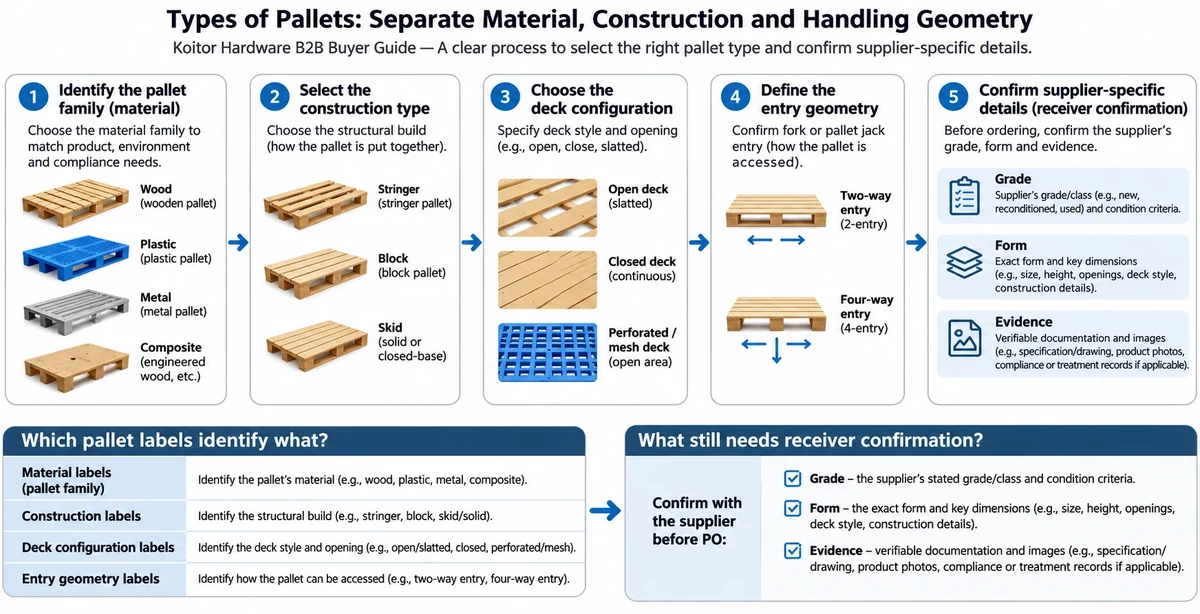
Types of pallets can be described across several different axes: material, construction, deck configuration, and handling-entry geometry. A pallet may be wooden, built with blocks, use a particular deck arrangement, and permit entry from more than one side at the same time. Those labels are not mutually exclusive, and none alone specifies the pallet’s dimensions, load capacity, deck support, or fit with a receiver’s pallet jack or forklift. Importers should identify the actual pallet proposal and compare it with the warehouse, carrier, and shipment requirements.
What does a pallet type description help a buyer decide?
A pallet label helps a buyer understand what kind of platform is proposed, but the label may describe only one aspect of the pallet. A buyer comparing “wood pallet,” “block pallet,” and “four-way pallet” may be comparing material, construction, and access geometry as if they were alternatives in one list. In reality, a single pallet can be wooden, block-built, and designed for entry from multiple sides.
This distinction matters when a supplier prepares a palletized shipment of metal racks, baskets, or bathroom hardware. The shipper needs a platform that fits the planned carton arrangement and can be handled by the equipment at pickup and receiving. A general label does not confirm footprint, height, entry clearance, bottom structure, load rating, or acceptance by the receiving facility. Each of those details may need a drawing, dimensions, or written receiver confirmation.
This guide provides a classification framework and a buyer checklist. It does not rank pallets by price, strength, durability, or hygiene. No specific pallet standard, treatment, load rating, or carrier acceptance is implied. Koitor Hardware can discuss packaging preparation and agreed shipment handoff for a confirmed metal-product project; pallet manufacture, pooling, and specialist pallet-load testing are not established company capabilities.
Which classification axes describe a pallet?
Pallet descriptions should separate the material used to make the platform, the way the support structure is built, the arrangement of its deck, and how handling equipment can enter. Suppliers may use additional commercial names, so the exact drawing or product code should accompany shorthand.
| Axis | Example descriptions | What a buyer should confirm |
|---|---|---|
| Material | Wood, plastic, metal, paper-based or composite | Exact material and any required supplier documentation |
| Support construction | Block-built, stringer-supported, or another frame | Bottom structure, support locations, and clearance |
| Deck layout | Open, partial, close-boarded, single-face, double-face, or reversible | Deck-board spacing, support, and intended loading orientation |
| Entry geometry | Two-way, four-way, or equipment-specific entry | Actual entry openings and fit with the receiver’s equipment |
| Dimensions | Footprint, height, overhang, and load arrangement | Whether the unit fits the shipment, storage, and receiving plan |
| Identification | Supplier model, drawing, or pallet code | How the selected pallet can be reordered or verified |
These descriptors can intersect. A pallet may be plastic and block-supported, or wooden and stringer-supported, with a deck layout and entry arrangement described separately. Buyers should avoid treating each term as a unique “type” when the terms answer different questions.
How do material and construction descriptions differ?
Material describes what the pallet is made from; construction describes how its supports and deck are arranged. Material choices can include wood, plastic, metal, paper-based, or composite products. Construction terms such as block and stringer refer to support configurations. Neither axis alone predicts capacity or fit.
A wood pallet can use blocks or stringers. A plastic pallet can have its own molded support structure. A metal pallet can be designed with a different geometry. These broad examples only explain how classification works; they do not establish that one material or construction is appropriate for a particular buyer, industry, or shipment.
The buyer should request the supplier’s exact model or drawing, rather than assume a label has one universal meaning. If the pallet is part of a new export pack-out, record the dimensions, height, support positions, deck arrangement, and intended orientation. If the product cartons overhang or do not align with the deck, the buyer should discuss the arrangement rather than infer that a pallet name guarantees support.
Construction terms can also matter to the handling interface. A block-style support structure may provide access openings in one arrangement; a stringer-style design may have different entry restrictions or notches. Yet the word “block” or “stringer” alone cannot confirm compatibility with every forklift, pallet jack, or conveyor. The actual clearances and receiver equipment need to be checked.
What do deck configuration and entry labels tell the receiver?
The deck is the upper surface that supports the load. Deck boards or panels may be spaced, partially covered, or configured on one or both sides. The bottom structure supports the platform and affects how handling equipment approaches it. Buyers should inspect both faces when relevant and compare the pallet to the receiving method.
Entry labels such as two-way and four-way are shorthand for access directions, but a label alone does not describe all clearances or equipment compatibility. Forklifts and pallet jacks do not necessarily have identical access needs. A pallet may have an opening that works for one type of handling equipment but not another due to tine dimensions, approach angle, clear height, or load arrangement.
The receiving warehouse can confirm whether a specific drawing or sample fits its equipment. The supplier can provide the pallet model and dimensions. The buyer should bring those two sources together before authorizing a shipment. Avoid assuming “four-way” means every pallet jack can enter from every side without obstruction. Actual receiver confirmation controls.
What should be checked for a palletized metal hardware shipment?
A palletized shipment includes the platform and the way cartons are arranged, secured, and identified. The pallet type is only one part of that unit load. For a hypothetical shipment of boxed towel racks or storage baskets, the buyer may need to align the carton footprint, pallet dimensions, orientation, edge overhang, and handling route.
| Buyer requirement | What to check | Why it matters |
|---|---|---|
| Receiver compatibility | Pallet drawing, access openings, and equipment requirements | Entry labels do not guarantee fit with a particular pallet jack |
| Carton support | Deck layout, gaps, carton footprint, and overhang | A platform description alone does not show where each carton is supported |
| Unit-load dimensions | Overall length, width, height, and orientation | Supports storage, handling, and receiving planning |
| Construction identity | Model, material, support design, and supplier | Helps the buyer compare and reorder the same configuration |
| Packaging arrangement | Carton count, stack pattern, and securing method | Describes the complete shipment unit rather than the pallet alone |
| Acceptance evidence | Receiver confirmation and any specified inspection | Prevents assumptions about carrier or warehouse acceptance |
| Change control | Drawing revision and substituted pallet notice | Keeps the approved shipment configuration identifiable |
The table is a planning tool, not a load calculation. The actual pallet’s capacity, condition, and permitted handling depend on the design and relevant supplier information. A buyer should not infer a rated load from the material or construction name. If the shipment includes unusual dimensions, concentrated loads, or equipment constraints, ask the responsible packaging or logistics professional to review the arrangement.
What mistakes should buyers avoid when specifying pallets?
Treating material, construction, and entry as competing types
These labels describe different attributes. A pallet may have one descriptor from each axis. Asking only “which pallet type?” can leave the supplier unclear about the actual platform.
Assuming an entry label guarantees equipment compatibility
The receiver’s equipment and the pallet’s opening geometry determine whether the platform can be handled. Confirm actual dimensions and clearances with the warehouse or logistics provider.
Inferring capacity from the material name
Wood, plastic, metal, or a block design does not by itself establish a load rating. Capacity claims require the actual product specification and conditions relevant to how the pallet is used.
Assuming common dimensions or standards
The article does not establish a universal pallet size, treatment, regulatory status, or market requirement. Buyers should specify the actual footprint and request supporting documents if a standard or treatment requirement applies.
Ignoring the complete unit load
Carton pattern, overhang, load distribution, securing method, and total height can matter as much as the pallet platform. A pallet selected without the carton arrangement may not meet the receiving plan.
Treating supplier descriptions as receiver approval
A supplier can describe its own product, but the destination warehouse or carrier may have separate acceptance requirements. Obtain confirmation from the party operating the receiving equipment.
How can a buyer document the pallet choice?
A purchase file can include the pallet supplier, model, material, construction, deck arrangement, dimensions, and drawing revision. The packing instruction can add carton placement, orientation, count, and securing details. If the receiver has approved a particular geometry, retain the confirmation with the shipment record.
When alternatives are proposed, ask the supplier to mark the differences against the baseline. A new material may preserve the footprint but alter the support layout. A new construction may retain the deck but change the entry access. The buyer can then ask the receiving party whether the alternative is acceptable. Do not treat a verbal “equivalent” statement as approval when the equipment fit or load arrangement has not been checked.
The record should distinguish confirmed facts from open questions. For example, the drawing may confirm dimensions, while receiver compatibility remains pending. This is clearer than marking the entire pallet “approved” based only on its commercial name. If a project uses a specified test or performance requirement, record the method and acceptance criteria rather than suggesting the pallet has an unverified rating.
How can a small-batch OEM factory support the packaging handoff?
Koitor Hardware is a family-owned custom metal hardware factory focused on bathroom and home storage products. For an OEM order, buyers can discuss product packaging preparation, carton arrangement information, and agreed handoff details with the factory. Product drawings and samples help make the metal product, finish, and pack-out context clear before the shipment instructions are finalized.
Koitor does not thereby become the pallet manufacturer or logistics provider. Pallet pooling, load testing, carrier acceptance, and warehouse-equipment approval are not established company capabilities. The buyer should confirm the pallet design and receiver interface with the responsible pallet supplier, warehouse, carrier, or packaging specialist.
When the pallet is nominated by the buyer or logistics provider, share the approved drawing and packing instruction with the factory, and identify who may authorize substitutions. This reduces the risk that the supplier interprets a general term as permission to change the platform. For product scope, see OEM home storage hardware and use the contact page to share the drawing or sample.
Buyer checklist before approving a pallet

- Confirm the material and exact supplier model or drawing.
- Separate material from construction, deck, and entry descriptions.
- Record dimensions and overall unit-load height.
- Confirm the bottom structure and clearances required by handling equipment.
- Ask the receiving site to verify the actual pallet drawing.
- Review the carton footprint, support, and any overhang.
- Identify who supplies and who approves a substituted platform.
- Clarify any standard, treatment, or documentation requirement with the responsible party.
- Do not infer rated capacity from a generic material or construction label.
- Keep the approved pallet and pack-out revisions with the purchase record.
- Identify the contact who resolves a receiving discrepancy.
- Treat carrier or warehouse acceptance as a separate confirmation.
What information should accompany a pallet substitution?
A substitution request should identify the original platform and the proposed model, then list the differences in material, dimensions, support construction, deck, entry openings, and supplier. The buyer can compare those details with the approved drawing and ask the receiving party to review any altered clearance or footprint. If the shipment configuration changes, the packing instruction should also be checked because the carton pattern may no longer align with the platform.
The request should state whether the substitution is temporary or intended for future orders. It should include the reason for the change, the effective shipment, the source of the revised pallet, and who approves the proposal. This creates a clear record without assuming that a similar commercial name means the design is identical. If load capacity or a regulatory treatment requirement matters, request the specific evidence for the alternative from its supplier rather than transferring a statement from the original pallet.
How should the receiving site be involved before shipment?
The receiving site can translate its handling process into concrete pallet requirements. Ask which equipment will unload and move the unit, whether the pallet will pass through a dock plate or conveyor, and whether the pallet is stored in a rack or on the floor. Those details identify which dimensions and entry openings need review. A generic “four-way” description may not answer a question about a particular jack, fork, or conveyor.
The buyer can send the site the pallet drawing, the proposed carton pattern, and the overall load dimensions. The receiver can then confirm whether the geometry matches its process or identify a clearance that needs clarification. Keep that confirmation with the approved pack-out record and state who will be notified if the supplier proposes a different model. This review does not create a load rating or guarantee acceptance by every carrier; it records a decision for the named receiving operation.
What records help make a pallet order repeatable?
A repeatable pallet order needs a clear identifier and a controlled configuration. Retain the supplier and model, material description, dimensions, support construction, deck layout, and drawing revision. If the pallet is part of a specified pack-out, keep the carton arrangement and orientation with the pallet record. A photograph can help show visible features, but the drawing and written product identity should remain the reference when a dimension or clearance is critical.
At receiving, record any visible mismatch between the ordered platform and the delivered one. For example, the model name may match while a bottom support or opening differs. Document the observation, shipment reference, and affected quantity, then route the question to the responsible buyer or provider. Do not assume that a visual difference automatically proves a performance problem; determine whether the changed feature affects the receiver’s stated requirement and obtain the supplier’s explanation.
For a planned substitute, preserve the original baseline and record the proposed replacement as a new revision or separately approved option. State whether the approval applies to one shipment or future orders. That distinction matters when purchasing teams, factories, and receiving warehouses use different product names for similar platforms. A simple record reduces the chance that a later buyer reorders by shorthand without knowing which geometry was actually checked.
The same principle applies when a pallet is nominated by a carrier or warehouse. The buyer should identify who owns the selection, who provides the drawing, who confirms fit, and who approves a change. A pallet type guide supports that conversation, but it cannot replace the receiver’s equipment information or the supplier’s exact product specification.
When the receiver cannot confirm a proposal from a label, ask for the exact entry opening and support dimensions in the supplier drawing. This turns “will it fit?” into a checkable, documented comparison between the named pallet and the receiving equipment before the order is released.
A buyer can note the confirmation date and the receiving site or equipment group that reviewed the drawing. If a different warehouse will receive a later order, repeat the fit check instead of assuming the earlier approval applies everywhere.
What should be confirmed between pallet selection and receiving?
A pallet description should connect the buyer’s classification terms to the dimensions and interfaces that the receiving operation actually uses. Record the required length, width, overall height, deck arrangement, entry sides, and any relevant load distribution details in the approved specification. Then ask the receiving site or logistics provider which handling equipment will approach the load and whether the proposed configuration fits its process. A material name such as wood, plastic, or metal does not answer those geometry questions.
The sample or drawing should also show how cartons or bundles are arranged on the pallet. A pallet can be described as block or stringer construction, for example, while the assembled unit load has separate dimensions, overhang conditions, and restraint components. Specify those separately. A visual sketch is useful for communicating an intended layout, but it does not prove that the pallet or unit load meets a carrier, warehouse, or export requirement. Where a program imposes a special construction, marking, treatment, or return condition, confirm it with the responsible party and current applicable instruction.
Before approving a substitution, compare each attribute against the original requirement rather than asking only whether the replacement is “the same type.” Types of pallets may share a material while differing in entry geometry, deck layout, construction, or size. Get receiver acceptance for any attribute that affects unloading, storage, or reuse, and record the approved revision with the packaging specification. This is a procurement handoff checklist, not a universal pallet standard or a claim about a particular shipment’s suitability.
When comparing types of pallets, keep material and construction separate from deck layout, entry geometry, and receiver fit.
CHEP’s pallet guide and Pallet Trader’s construction overview provide additional terminology references.
Frequently asked questions
Can one pallet be wooden, block-built, and four-way?
Yes. The labels describe separate axes: material, support construction, and entry geometry. The specific design still needs a drawing and receiver confirmation.
Does pallet material establish rated capacity?
No. The material name alone does not identify the exact design, condition, load distribution, or applicable rating. Use supplier information for the specific pallet.
Is four-way entry alone enough to confirm pallet-jack fit?
No. The receiver’s equipment and the pallet’s actual opening and clearance dimensions matter. Confirm the specific model with the receiving site.
Are block and stringer pallets the only construction options?
No. These are common construction descriptions, not an exhaustive list. Suppliers may use other designs or commercial terms, so identify the actual model or drawing.
Does a pallet type guarantee carrier or warehouse acceptance?
No. Acceptance depends on the applicable provider and receiver requirements. The buyer should verify those requirements for the shipment.
Confirm the Pack-Out for Your Hardware Shipment
Share the product drawing or sample and the receiving requirements to discuss packaging preparation for a confirmed OEM scope.
OEM / PRIVATE LABEL
Turn this sourcing guide into a product brief
Share your target product, size, finish, order quantity and packaging requirements. Your team receives a practical manufacturability review before quotation.

 English
 Español
 Português
 Français
 Deutsch
 العربية