

A UK REACH SVHC supplier declaration should tell a Great Britain buyer which product revision, components, UK Candidate List review date and evidence basis it covers; an EU declaration should be checked against the EU market and its current Candidate List separately. Great Britain and the EU have distinct REACH frameworks, and buyers should not assume that every list update is automatically identical across them. For a bathroom hardware SKU sold in both markets, request a clear, product-scoped evidence handoff, then have the responsible importer or qualified compliance reviewer decide which legal duties apply. This is a sourcing checklist, not legal advice or a claim that any particular product contains a listed substance.
Why do dual-market buyers need separate UK and EU evidence checks?
“REACH compliant” is not enough information to show what a supplier reviewed. A declaration can be useful only when the buyer can connect it to a destination market, a product identity, a revision and a stated review basis. That is especially important when one assortment is sold into both Great Britain and the European Union.
UK REACH is the chemical regulatory framework for Great Britain: England, Scotland and Wales. The Department for Environment, Food & Rural Affairs (Defra) published a new approach to the UK REACH Candidate List on 24 February 2026 and states that the interim principles used after the UK’s exit from the EU no longer apply. Its current policy seeks closer alignment with other jurisdictions, especially the EU, but “alignment” should not be read as proof that the two Candidate Lists are identical at every point in time. Buyers need to identify the official list and review date their evidence references.
The European Chemicals Agency (ECHA) maintains the Candidate List under EU REACH. The UK Health and Safety Executive (HSE) publishes the UK REACH Candidate List and guidance for Great Britain. These are the official starting points for an importer’s review:
- HSE guidance on UK REACH substances of very high concern explains the UK Candidate List and supplier duties for articles.
- Defra’s current approach to the UK REACH Candidate List describes the policy effective from 24 February 2026.
- ECHA’s supply-chain communication guidance explains the EU REACH communication duty for affected articles.
Northern Ireland must not be silently grouped with Great Britain. Its chemical regulatory arrangements differ; an importer selling to Northern Ireland should ask its compliance reviewer to confirm the applicable framework rather than using a GB-only checklist. This article therefore uses “UK REACH” specifically for Great Britain and treats EU-market evidence separately.
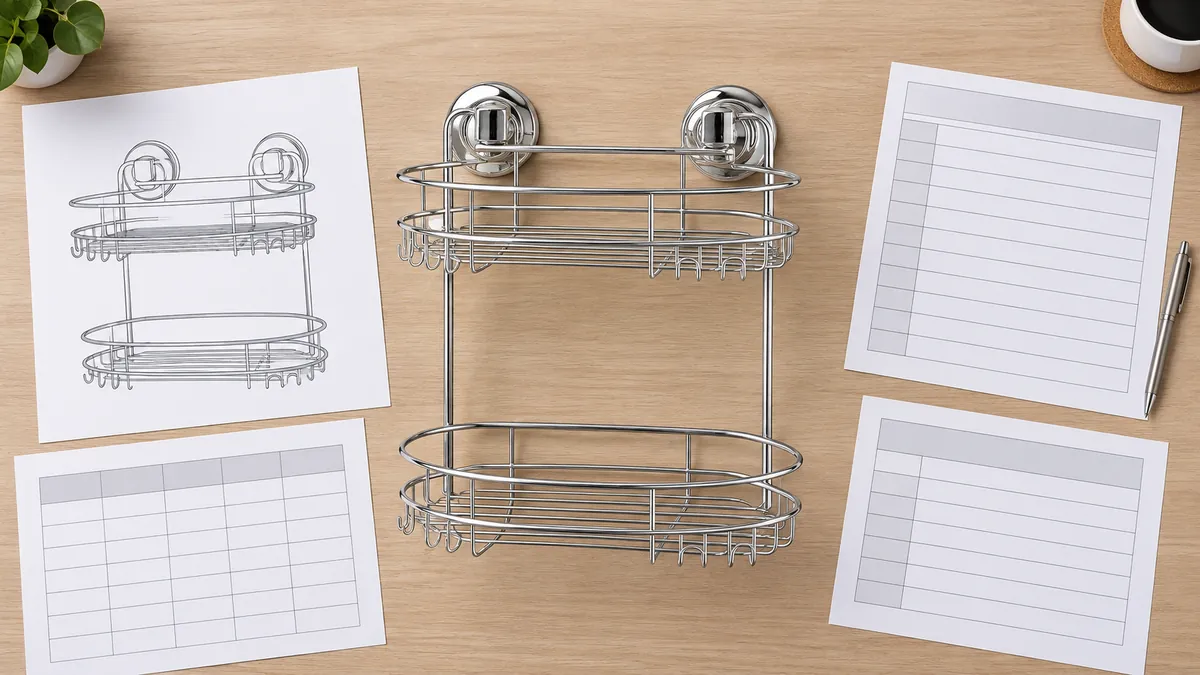
For a metal shower caddy, towel rack, storage basket or other bathroom accessory, the review must also match the sold configuration. A change in coating, fastener, polymer part, supplier or finish can change which component information is relevant. These are examples of possible product elements, not a statement about the bill of materials for any Koitor product.
How are supplier communication and importer notification different?
An evidence request should not merge two different kinds of legal duty: communication down a supply chain and notification to a regulator. They can involve related substance information, but the trigger, responsible actor and next action are not interchangeable.
Under UK REACH, HSE says a supplier of an article containing a UK Candidate List substance above 0.1% weight by weight must provide the recipient with sufficient information for safe use, including at least the substance name. HSE separately describes notification under Article 7(2): importers or producers may need to notify HSE when the substance is above 0.1% w/w and the relevant total quantity is over one tonne per producer or importer per year, subject to the regulation’s conditions and any applicable provisions. HSE says the notification is due within six months of the substance’s inclusion on the Candidate List. A buyer should not mistake the 0.1% communication threshold for the complete notification test.
EU REACH Article 33 has a supply-chain communication duty for suppliers of articles containing a Candidate List substance above 0.1% w/w, with enough information for safe use and at least the substance name. ECHA separately explains the notification conditions for producers and importers of articles. The relevant importer must check the current EU rules and the facts of its own role and products; a factory’s information does not itself settle who must act.
HSE’s guidance on notifying substances in articles and ECHA’s candidate-list guidance for articles should be consulted for the current, detailed criteria. In particular, do not generalize from a supplier’s short “below threshold” statement or assume that a communication duty automatically means a notification duty—or that no notification reference means no communication obligation.
The practical role split is usually clearer when documented explicitly:
- The manufacturer or upstream supplier provides accurate product, component and substance information it can support, and explains gaps or exclusions.
- The market-side importer or other responsible operator determines its role and evaluates the current legal criteria for the destination market.
- The importer’s compliance owner or qualified adviser resolves interpretation, records the determination and manages any required communication or filing.
This division is an operational framework for a buyer-supplier handoff, not a legal allocation of duties for every transaction. The importer remains responsible for understanding its own obligations.
What should a buyer ask a supplier declaration to identify?
A useful UK REACH SVHC supplier declaration is specific enough to trace to the actual item being purchased. The buyer should not ask only for a generic certificate or one sentence stating “compliant.” Instead, define what the document is expected to cover and ask the supplier to state what it does not cover.
At a minimum, the importer’s request can identify:
- Destination: Great Britain, EU, or both as separately reviewed markets. If Northern Ireland is included, list it distinctly for regulatory review.
- Product identity: buyer SKU, supplier part number, product name, drawing or sample revision, and the exact finish or colour variant.
- Component scope: the product and component identifiers covered, including purchased components where information is available. Use the actual drawing or bill of materials rather than assuming common parts are present.
- List and date: the official Candidate List and the date or version used for the supplier’s review. If the document uses one assessment for two markets, ask how it checked each market’s list.
- Evidence basis: whether the response is based on material declarations, upstream supplier information, a test, internal records or another stated source. A conclusion should not imply a laboratory analysis if none was performed.
- Result and limits: known information, excluded parts, unavailable data, assumptions and any unresolved follow-up. A blank cell is not the same as a confirmed absence.
- Change follow-up: which product, material, finish, component or supplier changes require a fresh response or review.
- Responsibility: which supplier contact can answer data questions and which importer-side person owns the legal assessment.
Where a supplier uses a non-disclosure or confidentiality process, buyers can still request a useful summary and evidence scope without asking for unrelated confidential formulation detail. The information should be proportionate to the reviewer’s needs and handled through the parties’ agreed data controls. A UK REACH SVHC supplier declaration is most useful when the buyer can trace each statement to a named SKU revision and destination market.
| Buyer check | What to request or record | What it helps clarify | What it does not prove by itself |
|---|---|---|---|
| Market | Separate GB and EU scope; identify NI separately if relevant | Which framework and official list the reviewer should consult | That a single statement covers all UK destinations |
| Product | SKU, supplier part, revision, finish and options | Whether the evidence matches the item ordered | That other variants are identical |
| Components | Actual assembly/component list and exclusions | What the supplier reviewed and where follow-up is needed | That every component has been chemically tested |
| Review basis | Candidate List name/date and information sources | How current and traceable the statement is | That the underlying evidence is complete or independently verified |
| Decision owner | Supplier data contact and importer compliance owner | Who supplies facts and who evaluates obligations | That the supplier has taken over importer duties |
| Change control | Events requiring an updated response | When a previous assessment may need review | That no change can affect the product’s assessment |
How should importers handle a product with multiple components?
The evidence should preserve the relationship between a finished SKU and the components actually included in that revision. A metal wire basket may be a simple article or part of a more complex assembly; its mounting hardware, finish, caps or accessories must be listed only when those items are genuinely part of the sold configuration. The buyer should not add hypothetical components to a compliance file simply because they are common in the category.
For each product family, keep a controlled product identity record: sales SKU, supplier part number, drawing revision, finish code, included accessories, market variant and evidence date. If one source declaration covers several related items, require an explicit list of the covered variants and a rationale for treating them together. The supplier can identify manufacturing similarities, but the importer should decide whether the grouping is acceptable for its review.
For complex objects, legal analysis may depend on how the applicable rules define an article and the relevant component boundary. Do not replace that analysis with a whole-product average, an informal assumption that all parts are one article, or a simplistic spreadsheet formula. Ask the qualified reviewer to determine the required assessment level and retain that decision with the evidence.
The goal is not to build a large dossier for every low-risk-looking item. It is to make the evidence traceable enough that the importer can find the relevant product version, identify missing component data, and understand whether the previous review remains usable after a change.
How do buyers compare UK and EU declarations without overclaiming?
Use a side-by-side review instead of treating the word “REACH” as a single global approval. A practical comparison can use one row per market and one column per evidence question. If the same supplier document is used for both destinations, record separately which list was checked, on what date, and which product components were in scope.
| Review field | Great Britain | European Union |
|---|---|---|
| Framework reference | UK REACH; verify current HSE/UK Candidate List information | EU REACH; verify current ECHA Candidate List information |
| Product destination | England, Scotland or Wales as applicable | Relevant EU member-state market placement |
| Evidence identity | Same buyer SKU, supplier part, revision and finish | Same SKU and revision, with any market-specific variant identified |
| List/date | Record the UK list and review date stated by the supplier | Record the EU list and review date stated by the supplier |
| Supplier response | State known substance information, evidence basis, exclusions and gaps | State the corresponding EU-market evidence basis, exclusions and gaps |
| Decision owner | Importer’s GB compliance reviewer | Importer’s EU compliance reviewer or responsible operator |
The table is a documentation aid, not a legal opinion that the two regimes have identical duties or that every importer needs two separate reports. A compliance owner may decide that one evidence package can support multiple markets if it demonstrably checks the correct scope and current sources. The file should make that reasoning visible, rather than relying on an unexplained “global REACH” label.
An importer should also distinguish a supplier’s factual declaration from the importer’s regulatory conclusion. A declaration may describe a material, component, or supplier record. It does not automatically establish that the product complies with every applicable chemical, product-safety, labelling or waste requirement in a destination market.
When should buyers request an updated declaration?
Revisit the evidence when the product or the market basis changes. Common review triggers include a new drawing revision, revised bill of materials, new coating or plating, substituted raw material, changed component supplier, alternate adhesive or polymer part, additional accessory, new finish, or a new destination market. These triggers do not prove that the previous evidence is invalid; they indicate that a reviewer should decide whether its scope still matches.
The buyer should agree a simple change-notification route with the supplier. The route can ask the supplier to identify the affected SKU and revision, describe the change, state the effective date or lot, and provide updated component or material evidence where available. The importer’s compliance owner then determines whether the change affects its existing assessment, customer communication or any notification decision.
Review Candidate List updates through the official UK and EU sources rather than copying a date from an old questionnaire. Defra’s 2026 UK approach specifically changes the policy context from the interim principles that had applied after the UK’s exit from the EU. Because rules and lists can change, a declaration should state when it was prepared and should not promise future coverage indefinitely.
For a private-label bathroom hardware range, the commercial team, supplier-quality contact and compliance reviewer may each own a different step. Koitor’s private-label bathroom accessories page describes the product-development context buyers can discuss with a manufacturer; it is not evidence of chemical testing or regulatory approval. Koitor’s custom bathroom hardware manufacturing page is likewise a product-sourcing reference, not a compliance service claim.

What questions should buyers ask before relying on supplier evidence?
Use these questions to decide whether the supplier response is ready for importer-side assessment:
- Does the record identify the exact SKU, revision, finish and destination market?
- Does it name the relevant official list and state when it was checked?
- Does it describe the actual product and component scope, including exclusions?
- Does it distinguish verified facts, upstream statements and unavailable information?
- Does it explain whether the basis was a supplier record, material document, test or another source?
- Is the supplier contact able to clarify the evidence, and is the importer’s compliance reviewer identified?
- Is there a change-notification route for revised parts, materials, finishes or suppliers?
- Has a qualified reviewer separately assessed the importer’s communication or notification duties?
If an answer is missing, mark it as open and assign an owner. Do not convert “not available” into “none present,” or infer a legal outcome from a supplier’s marketing language. This approach helps importers avoid both unsupported reassurance and unnecessary requests for documents that do not address the product decision.
For buyers discussing drawings, materials, finish variants or product revisions with a bathroom and home-storage hardware factory, the useful manufacturing-side contribution is accurate product identity and clear change communication. A specialized OEM manufacturer may be able to clarify which revision, components and options it supplied; that does not replace substance testing, legal review, or the importer’s own assessment. Buyers considering a custom assortment can contact Koitor Hardware to discuss product scope and sourcing questions.
Frequently asked questions
Is UK REACH the same as EU REACH?
They are separate frameworks. UK REACH applies to Great Britain, and the EU operates EU REACH. Defra’s 2026 policy aims to draw more from other jurisdictions, especially the EU, but a buyer should check the current official list and market scope rather than assume the lists or every duty are identical.
Does every bathroom hardware SKU need an SVHC declaration?
The buyer should determine what evidence is appropriate for the SKU and market. Legal duties depend on the substance, article, concentration, role and other applicable criteria. This guide does not conclude that every product contains an SVHC or requires the same declaration or filing.
Does a supplier statement transfer the importer’s legal responsibility?
No. Supplier information can support an importer’s review, but the responsible market-side operator must assess its own role and applicable requirements. A supplier should state what its evidence covers; the importer’s compliance owner should record the legal determination.
Can one document cover both Great Britain and the EU?
Possibly, if it clearly records how each destination’s current rules and lists were checked and matches the same SKU, components and revision. A generic “UK/EU compliant” line without scope, dates or evidence basis is difficult to evaluate.
What if the supplier cannot provide test data?
Ask what information is available, what source supports it, which components are not covered, and what follow-up is possible. Do not imply a test was performed or treat a missing test as proof of either compliance or non-compliance. The importer’s reviewer should decide whether the available evidence is sufficient for its assessment.
Aligning supplier records with a bathroom hardware SKU?
Share the product revision, destination markets and manufacturing-side data questions. Regulatory conclusions remain with the responsible importer and its qualified reviewer.
OEM / PRIVATE LABEL
Turn this sourcing guide into a product brief
Share your target product, size, finish, order quantity and packaging requirements. Your team receives a practical manufacturability review before quotation.



 English
 Español
 Português
 Français
 Deutsch
 العربية