

For vinyl vs powder coated wire shelving, importers should compare the exact coating system and finished part, not just two product-page labels. “Vinyl-coated” may describe a thermoplastic covering, while “powder-coated” describes an application form that can include different resin families and process routes. Ask for the substrate, coating product or family, application process, coverage at welds and cut ends, finished dimensions, intended use and evidence for any cleaning or environment claim. Then review a production-intent sample against the same requirements. Neither label alone proves which shelf will be more durable, easier to clean or more suitable for a particular market.
What do suppliers mean by vinyl-coated and powder-coated wire?
The terms do not identify two universal, directly comparable materials. “Vinyl” or “PVC-coated” wire often describes a thermoplastic covering over a metal wire, but commercial language can be abbreviated. Buyers should confirm whether the named material is PVC, polyethylene, polypropylene, nylon or another specified polymer, and how it is applied to the wire assembly. Request the product or system name and the supplier’s technical data for the actual finish.
“Powder-coated” usually describes applying powder and curing or fusing it to a prepared substrate; it does not name one chemistry. Thermosetting polyester or epoxy systems behave differently from thermoplastic powders such as PE or PP. Some thermoplastic coating suppliers market powder products for wirework, including encapsulating systems. For example, Axalta describes PE and PP thermoplastic powder coatings for wirework, while Protech Group’s ENCASE product information discusses thermoplastic coatings for wire goods. These vendor pages describe their own products; they do not establish the chemistry or performance of a generic shelf sold as “vinyl” or “powder coat.”
That distinction matters when comparing quotations. One supplier might mean a relatively thin decorative thermoset powder film; another might mean a thick polymer encapsulation applied to wire. A seller’s word “vinyl” may also be a catalog descriptor rather than a full resin specification. Ask the supplier to spell out the actual coating family and process so that both parties are comparing like with like. This is the decision behind the search phrase “vinyl vs powder coated wire shelving.”
Do not infer material composition from color, gloss or a close-up photograph. If the coating system is proprietary, a buyer can still require a named product code, supplier declaration or agreed specification reference without requesting confidential formulation details. Document whether any substitute needs reapproval.
Which differences should an importer compare?
Compare the variables that affect the intended product, buyer requirement and acceptance method. A coating can change the wire’s outside diameter, contact surface, appearance and fit; the direction and magnitude depend on the actual system and geometry. A generic statement that one coating “covers better” or “chips less” is not enough to predict a particular shelf’s result.
| Comparison point | What to request from the supplier | What the importer should verify |
|---|---|---|
| Substrate | Metal type or grade, wire diameter and any pretreatment information applicable to the design | Match the agreed material record and sample identification |
| Coating system | Resin family, product or system reference, application and cure/fusion process where available | Check supplier documentation for the specified system, not a broad label |
| Coverage | Requirements for intersections, welds, cut ends and contact points | Inspect the areas named in the drawing under consistent lighting |
| Dimensions | Finished outside diameter, clear spacing and mating dimensions after coating | Check fit against the intended post, sleeve, clip or accessory |
| Surface and color | Color reference, gloss, texture and allowed visual variation | Compare against the approved visual sample and reference conditions |
| Use and cleaning | Intended indoor, damp or other environment and named cleaning agents | Request evidence for the exact product and conditions behind each claim |
| Packaging contact | How coated wires contact each other, carton dividers and accessories | Review the packed sample for abrasion or pressure marks after agreed handling |
One thermoplastic-coating supplier brochure describes products for wire goods, while manufacturer product literature may compare its own vinyl-covered and epoxy-coated options. For instance, ClosetMaid product literature and Organized Living’s epoxy-coated shelf selection sheet are evidence of how those brands describe their own products, not universal independent tests. Use such sources to learn what attributes suppliers publish and then request data for the specific candidate product.

Review the finished wire shelf and coating samples as separate, identified references; do not infer a chemistry from color or gloss.
When might a buyer consider each coating approach?
Consider an encapsulating or thicker thermoplastic system when its documented attributes match a defined design need—for example, a specified contact feel, a required degree of coverage, a particular geometry or a stated application environment. Axalta lists product-specific wirework requirements such as flexibility and metal coverage in its own market description, and Protech Group describes its own wire-goods offerings. These supplier statements help frame questions, but they do not guarantee that every vinyl or thermoplastic product achieves those outcomes.
A powder-applied system may be appropriate when the named system, substrate preparation, geometry, appearance and intended environment meet the buyer’s requirements. “Powder coat” can refer to several chemistries, film builds and application controls. A powder coating on a flat, accessible face does not prove the same coverage at a wire intersection, sharp edge or concealed weld. Confirm which of those locations matter for the target design and how the supplier will verify them.
The shelf’s geometry may make a difference. Closely spaced intersections, small wire diameters, welded crossings, cut ends, hooks and post interfaces can be difficult to compare using one generic thickness number. A coating that is thicker may change the clearance through a sleeve or support. A smooth or soft-feeling sample does not by itself establish adhesion, abrasion resistance, corrosion performance or cleaning compatibility.
Start with the destination and use case: closet, pantry, garage, retail display, damp room or another named environment. State expected contact with containers, packaged goods, wet items or cleaning agents. If food contact, chemical resistance, UV exposure or hygiene is a requirement, ask for evidence that covers the actual finish and application; do not infer compliance from the coating name or a supplier’s market page. Where the buyer has no defined requirement, avoid selecting a finish solely on a presumed universal advantage.
What should the RFQ specify about the coating and shelf?
An RFQ should name the substrate and coating reference where known, then describe the finished part and acceptance points. If the buyer is still comparing systems, ask each supplier to quote a clearly described construction and list assumptions rather than let “vinyl” and “powder coat” stand in for missing details.
Include these fields where they apply:
- Intended product use, destination environment and any relevant cleaning or contact conditions.
- Substrate and wire dimensions before coating, with material identification supplied by the manufacturer.
- Coating family or named product reference, supplier and application route, if selected.
- Finished wire diameter, opening size, post/sleeve fit and any other clearance affected by the coating.
- Required coverage locations, including weld intersections, cut ends or contact areas.
- Color reference, gloss, texture, cosmetic faces and approved visual standard.
- Inspection method and acceptance criteria for coating discontinuity, damage or visible variation.
- Evidence required for a performance, chemical, corrosion, food-contact or environment claim.
- Packaging method and separation points where coated surfaces could rub or press against each other.
- Sample and drawing revision, approved substitute process and change-control owner.
For a product comparison, request the same information for each offer. If the coating vendor or product code is not disclosed, ask for a stable specification or declaration that lets quality teams identify the approved finish. Ask what changes trigger notification: resin family, coating supplier, pretreatment, film build, cure or fusion conditions, color, substrate or line. The buyer does not need to invent process limits; the supplier should confirm what can be controlled for the proposed design. A useful "vinyl vs powder coated wire shelving" RFQ makes the two quoted systems identifiable before sample approval.
Do not specify a numeric coating thickness without defining the measurement location and method. A single reading on an accessible straight wire may not represent a weld crossing or concealed region. If thickness matters, state the required measurement method, locations, sampling approach and responsible party, and have the supplier confirm feasibility. If the finish is an encapsulation over wire rather than a conventional thin film, clarify how dimensions will be measured after coating.
How should a buyer inspect the sample without overclaiming?
Use a sample that matches the quoted substrate, wire geometry, coating route, color, accessories and packaging state. Identify it by supplier, date, drawing revision and coating reference. Check the finished shelf as a whole, then inspect agreed critical locations such as welded intersections, cut wire ends, hooks, contact points and interfaces with posts or clips.
Record visible observations, measured dimensions and functional fit separately. A sample may have an acceptable color while failing a post-fit dimension; a coating may look continuous on visible faces while hidden surfaces remain unobserved. Use consistent lighting and viewing distance for visual comparison. If an appearance limit matters, mark the cosmetic faces and reference sample rather than rely on phrases such as “good finish.”
Fit the shelf to the actual mating post, bracket or sleeve using the approved method. Check assembly and removal where part of normal use, but do not treat a successful fit as proof of load capacity. If a buyer needs a load, abrasion, impact, adhesion, corrosion or chemical-resistance test, agree on the exact specimen, method, conditioning, acceptance criteria and evidence before testing. A generic supplier brochure or a test result on a different coating system cannot automatically be transferred to the offered shelf.
For packaging, inspect how finished wire contacts another shelf, the carton, a clip or an accessory. A rub mark after one review can identify a question to investigate; it does not establish a transit failure rate. If the buyer requires a shipping simulation, define the packed configuration and method separately. Keep the approved uncoated substrate record and finished sample identity connected so a later change does not silently reset the acceptance basis.
What should the importer record before production release?
Keep one approval record that connects the finish decision to the actual SKU, drawing and sample. It should identify the substrate, coating system or controlled reference, finished dimensions, critical coverage locations, color and texture standard, use conditions, cleaning requirements, inspection evidence, packaging contact and revision. Include any supplier qualification or test documents that apply to that exact construction and state their scope.
Before release, confirm:
- The quote and drawing name the same substrate and finish reference.
- The supplier has confirmed the coating product or a buyer-approved control reference.
- Finished dimensions work with posts, sleeves, clips and accessories.
- Weld intersections, cut ends and contact areas match the agreed inspection requirement.
- Visual acceptance uses a named reference and identifies cosmetic faces.
- Cleaning or environment claims have evidence tied to the actual system and use.
- Packaging protects the approved finish under the agreed packing configuration.
- A replacement coating, supplier, material or process needs written review before use.
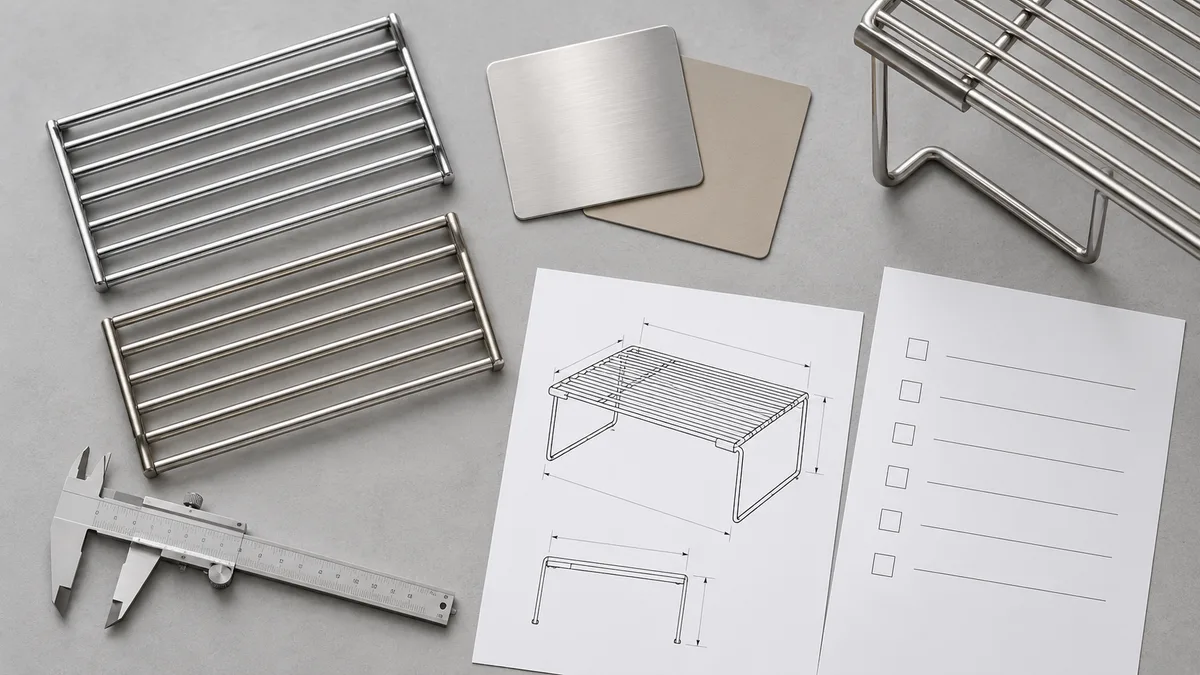
Keep the finish reference, dimensional checks and approval revision connected to the same shelf sample.
FAQ: Is vinyl-coated wire always thicker than powder-coated wire? No universal comparison follows from those two labels. Measure the actual finished wire and compare the specified construction. Is powder coating always more durable? The category name does not establish that; performance depends on the system, substrate, preparation, application, geometry and use. Can a sticky-feeling sample prove the coating is failing? It is an observation worth recording and investigating, not proof of a common failure mechanism or a particular cause.
The sourcing decision is complete when supplier offers are described on the same basis and the buyer approves a production-intent sample with the intended use, dimensions, finish reference and change controls recorded. Koitor’s current manufacture of vinyl-coated wire shelving is unconfirmed; this guide is an adjacent-category framework for requesting comparable evidence, not a product capability claim.
Work With Koitor Hardware
Koitor Hardware is a family-owned custom metal hardware factory focused on bathroom and home-storage products. For projects within its confirmed scope, buyers can share a drawing, physical sample, finish target and packaging needs to discuss manufacturing practicality before sampling. Current vinyl-coated wire shelving production is unconfirmed, and any coating-specific claim should be supported by the responsible supplier’s evidence. See Koitor’s OEM home-storage hardware information or send the team a project brief.
Need Help Defining a Metal Storage Finish?
Share the drawing, substrate, intended use, finish target and packaging plan. Koitor can discuss custom metal hardware requirements within its confirmed bathroom and home-storage scope.
OEM / PRIVATE LABEL
Turn this sourcing guide into a product brief
Share your target product, size, finish, order quantity and packaging requirements. Your team receives a practical manufacturability review before quotation.



 English
 Español
 Português
 Français
 Deutsch
 العربية