
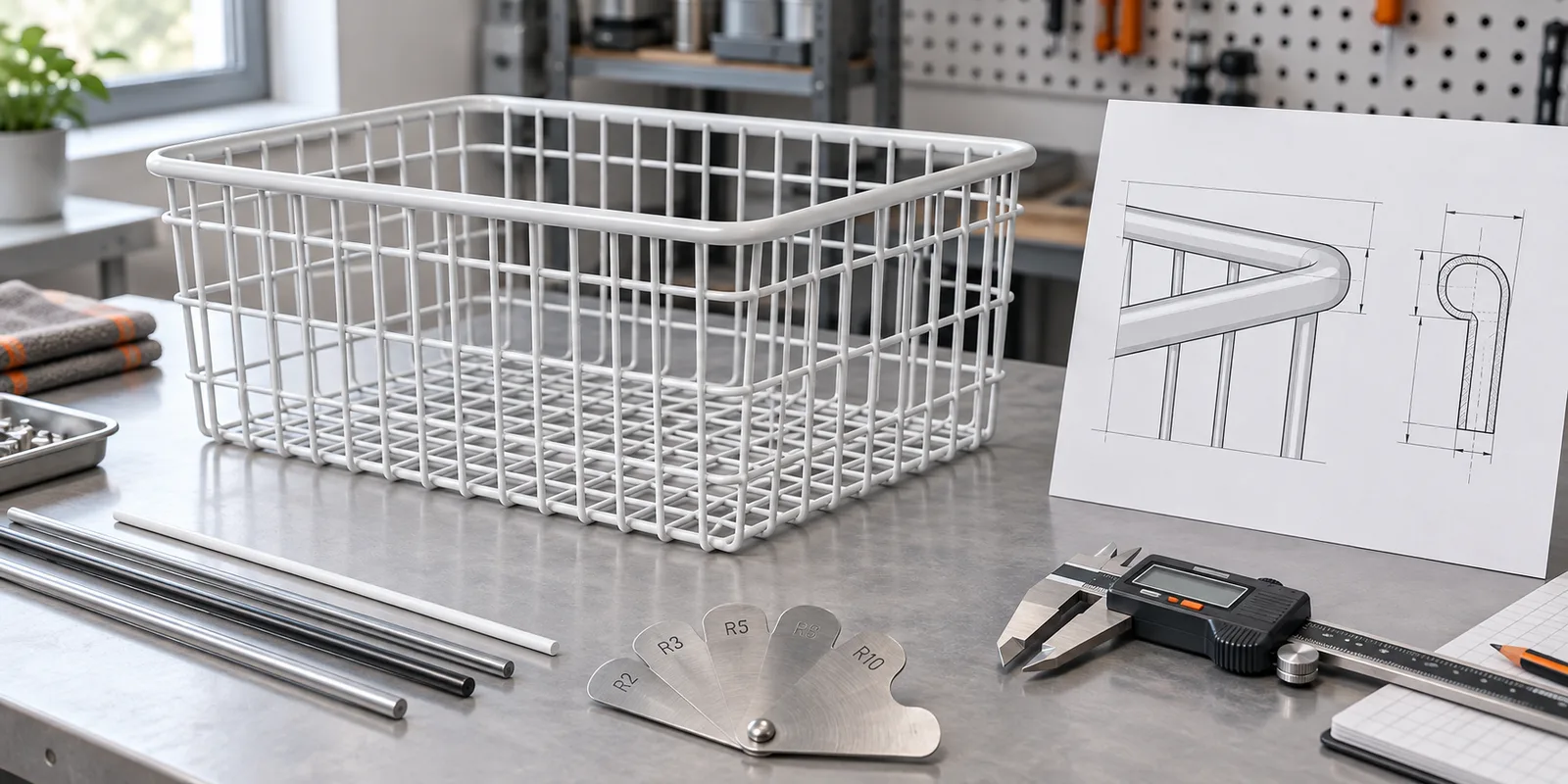
Wire basket rim design controls the opening shape, side-wall stability, item retention, handling comfort, weld layout, finish appearance, and packaging interface of a custom storage basket. OEM buyers should define the rim profile, material size, corner geometry, joint method, intended contents, and inspection points before comparing quotations. A reference photo can communicate style, but it cannot replace a dimensioned top view and rim section.
What Does the Rim Control in a Custom Wire Basket?
The rim is the upper frame that establishes the basket opening and connects the side wires or panels. It helps the product hold its intended shape during welding, finishing, packing, transport, installation, and normal handling. A rim that is too flexible may allow the opening to twist; an unnecessarily heavy rim may add material, forming effort, visible bulk, and carton weight.
Start with the basket’s job. A pantry basket, bathroom basket, wardrobe basket, pull-out cabinet basket, and retail display basket do not share the same requirements. The intended contents influence opening size, side height, front access, and wire spacing. Installation also matters: a free-standing basket experiences different interfaces from a basket fixed to slides, hung beneath a shelf, or mounted on a wall frame.
The buyer should specify both outside and usable inside dimensions. Overall width may determine cabinet fit, while inside width determines whether the target products actually fit. Rim wire size and corner radius reduce usable space, especially in smaller baskets. State which dimensions are critical and which are references.
Define these points in the inquiry:
- Maximum outside width, depth, and height.
- Minimum usable opening and internal base area.
- Rim wire, tube, strip, or sheet dimensions.
- Front, rear, and side rim heights.
- Corner radii and tangent transitions.
- Side-wire termination and weld positions.
- Handle, mounting, divider, or lid interfaces.
- Target contents and smallest retained item.
- Material and finish direction.
- Unit packaging and nesting expectations.
Koitor Hardware is a family-owned custom metal hardware factory that can review buyer drawings or physical samples. Buyers developing related products can use the custom metal storage basket production page to organize the first sourcing discussion.
Which Rim Construction Should Buyers Compare?
Buyers should compare a single perimeter wire, double-wire frame, formed tube, flat strip, and folded-sheet edge according to rigidity, appearance, manufacturing sequence, surface finish, and product cost. No construction is automatically best for every custom storage basket structure.
| Rim construction | Practical advantage | Main control point | Buyer sample check |
|---|---|---|---|
| Single perimeter wire | Clean and light appearance | Wire diameter, span, joint location | Does the opening remain square? |
| Double-wire rim | More visible reinforcement | Parallel gap and weld alignment | Is spacing even around corners? |
| Formed tube rim | Broad, smooth handling surface | Bend quality and end closure | Are corners and ends consistent? |
| Flat strip rim | Strong visual edge | Flatness, edge treatment, corner forming | Is the edge comfortable to touch? |
| Folded-sheet rim | Integrated wall and upper edge | Bend radius, drainage, edge return | Are edges safe and surfaces flat? |
| Wire rim with separate lip | Flexible styling and retention | Lip attachment and alignment | Does the lip stay stable in use? |
A single wire frame suits many open baskets, but the required diameter depends on the opening span and attached grid. A large basket can need cross members, a stronger perimeter, or a different side construction. Double-wire rims add visual and structural presence but also add welds and finish intersections.
Tube and strip rims can improve hand comfort where users pull or carry the basket. They require different bending tools and end treatments. If hollow tube is used, the design should address open ends, drainage where relevant, and visible closure. A flat strip should have controlled edges and corners rather than relying on finishing to hide an unclear geometry.
The rim should be evaluated as part of the entire product. A strong upper frame does not compensate for weak side joints, an unstable base, or an unsuitable mounting system. Likewise, a lighter rim may perform well when the surrounding basket geometry supports it.
Request quotations against one defined construction. Otherwise, suppliers may quote different wire diameters, corner radii, joint locations, and finish assumptions while appearing to offer the same basket.
How Should Opening Geometry and Corner Radius Be Specified?
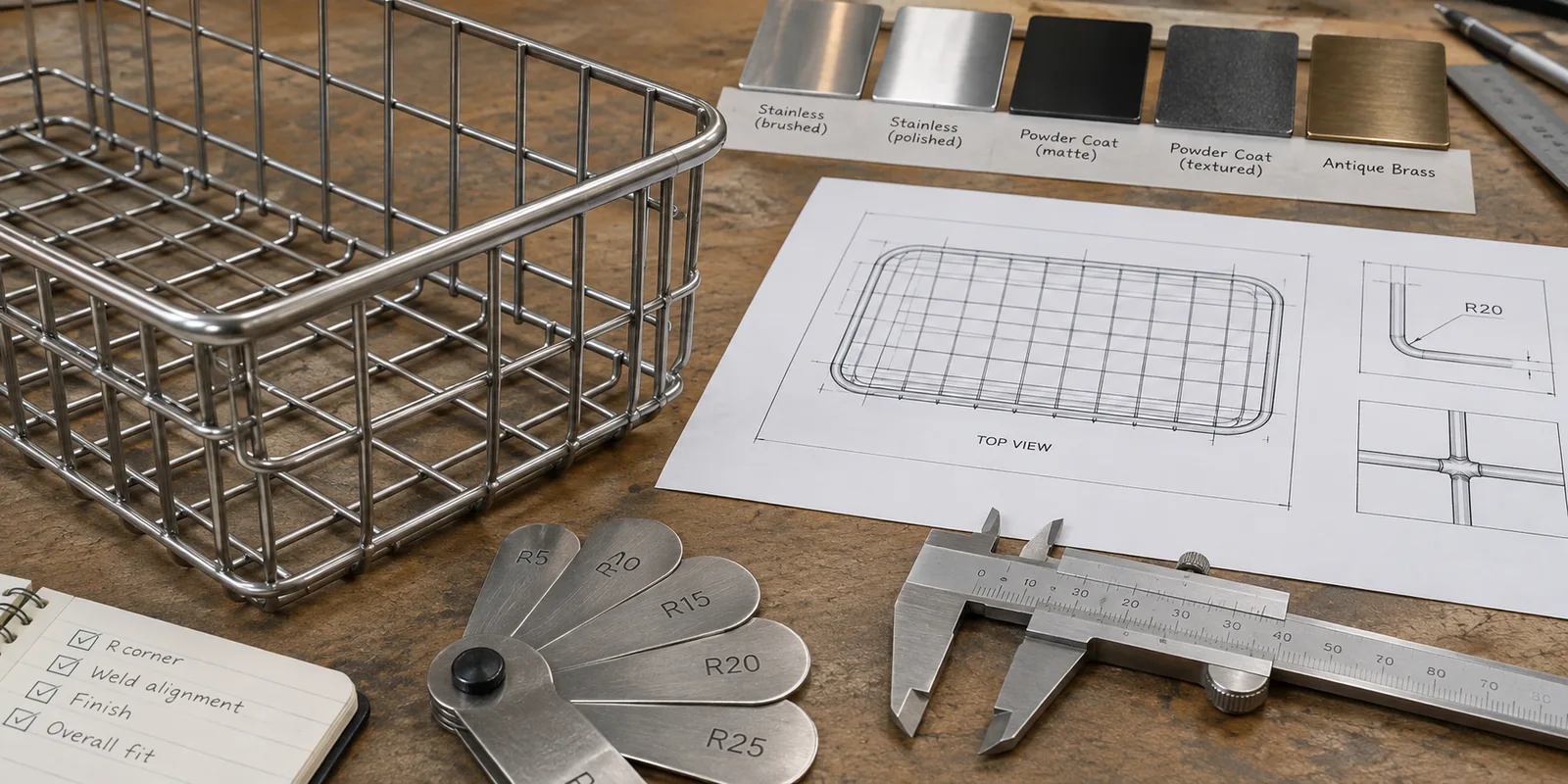
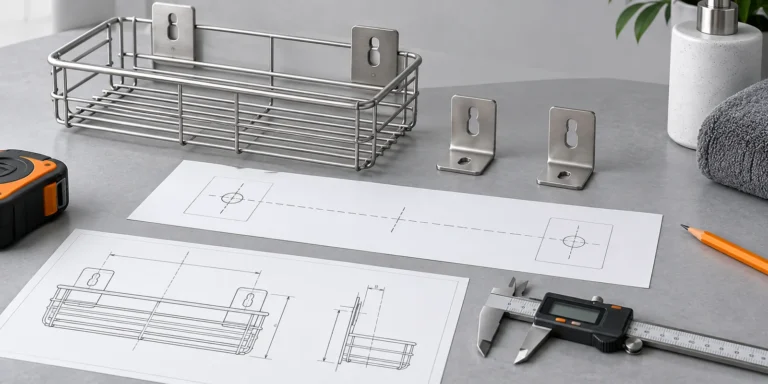
Opening geometry and corner radius should be shown in a top view with a clear measurement reference. Buyers should state whether a radius is measured at the wire centerline, inside surface, or outside surface. For complex shapes, provide coordinates, tangent points, a full-scale template, or a physical sample.
Rounded corners affect usable space. A container that fits inside a rectangular outline may collide with the curved corner. Compare the smallest internal opening with representative products rather than relying on overall width and depth. If the front corners are softer than the rear corners, dimension them separately.
Corner radius also affects manufacturing. A tight radius may require another forming method or show more distortion. A broad radius changes the length of straight side sections and the positions where vertical wires meet the frame. The drawing should not leave the supplier to choose a visually similar curve.
Joint location is part of the geometry. A welded perimeter needs a controlled joining point. A joint on the front center may be easy to see; a joint inside a tight corner may be difficult to access and finish. Discuss whether the joint should sit on a rear straight section, a side, or another practical location supported by the production process.
Use this geometry review:
- Mark maximum outside dimensions.
- Mark minimum usable inside dimensions.
- Define all corner radii and their measurement basis.
- Show front, rear, and side orientation.
- Locate the perimeter joint and visible cosmetic zones.
- Check handle, divider, lid, slide, or mounting interfaces.
- Test representative contents at corners and near the front edge.
- Confirm the carton and insert clear the finished rim.
Where a basket nests with another unit, specify the nesting direction and pitch. A small rim change can stop nesting, increase carton height, or create finish contact between units.
How Do Wire Size, Spacing, and Weld Placement Affect the Rim?
Wire size, spacing, and weld placement work together to control the shape and appearance of a wire basket top frame. Increasing rim diameter may improve stiffness, but it also changes bend force, visual scale, weight, weld settings, fixture dimensions, and finish coverage. Adding more vertical wires reduces gaps while increasing joint count.
Side wires should meet the rim at consistent heights and angles. Uneven terminations make the opening look irregular even when the overall size is acceptable. A welding fixture can control positions, but the drawing must still define the intended spacing and reference surfaces.
Welds need enough access for production and inspection. A joint hidden beneath a return can be difficult to verify. A joint placed on a prominent front face may require stricter appearance control. The supplier should identify the proposed welding sequence and the dimensions most likely to move during heat input.
| Design variable | Product effect | Manufacturing effect | Inspection point |
|---|---|---|---|
| Rim diameter | Shape stability and visual weight | Forming force and fixture size | Diameter and opening shape |
| Vertical-wire spacing | Item retention and appearance | Weld count and cycle time | Gap consistency |
| Corner radius | Usable volume and style | Tooling and bend repeatability | Radius and symmetry |
| Joint location | Cosmetic visibility | Welding and finishing access | Alignment and cleanup |
| Cross member | Span control | Additional parts and joints | Position and flatness |
| Weld sequence | Distortion behavior | Process consistency | Diagonals and rim level |
Avoid unsupported “heavy-duty” claims. Basket performance depends on the complete geometry, material, joints, mounting, loading distribution, and test method. If performance is important, agree on the intended use and a project-specific verification plan.
Inspect the frame after joining and again after finishing. A bare frame may be square while subsequent handling or coating reveals or creates variation. The approved finished sample should represent the product the buyer expects to receive.
What Finish, Handling, and Safety Details Matter at the Rim?
The rim deserves close finish and handling review because it is highly visible and may be touched whenever the basket is loaded, removed, or cleaned. Buyers should inspect the real corners, joints, wire intersections, ends, and underside instead of approving only a flat finish coupon.
For powder-coated steel, define the color reference, gloss direction, texture, and coverage expectations. Coating can build differently around welds and intersections. Check for visible bare areas, excessive buildup, rough projections, and marks created by racks, bags, inserts, or nested units.
For stainless steel or another metallic finish, define visible surface direction, joint cleanup, end treatment, and acceptable appearance variation. A broad material name does not establish every cosmetic requirement. If polished or plated surfaces are planned, the supplier should confirm the practical process for the selected rim geometry.
Touch surfaces should be comfortable. Control sharp wire ends, exposed burrs, weld spatter, abrupt transitions, and rough corners. This does not require an exaggerated promise; it requires a clear sample standard and inspection method.
The finish reference should be linked to the drawing revision and sample tag. Photographs help record appearance, but lighting and screens can shift color and gloss. Keep a physical reference when the finish is commercially important.
How Should Samples, Inspection, and Packaging Be Approved?
Approval should connect the dimensioned drawing, physical basket, finish reference, inspection points, and packed sample. A rim should not be approved from one front photograph when its opening, corners, underside, side joints, and carton contact have not been checked.
Begin with a structural sample if the geometry is new. Measure overall size, usable opening, diagonals, rim height, corner radii, selected gaps, and relevant interfaces. Test representative contents and normal hand access. If the basket attaches to slides, shelves, frames, or cabinets, test the complete installation.
Then inspect the finished sample. Review shape, weld cleanup, color or surface direction, touch points, and contact marks. Tag the sample with product code and drawing revision. Record any accepted variation rather than leaving it in a message thread.
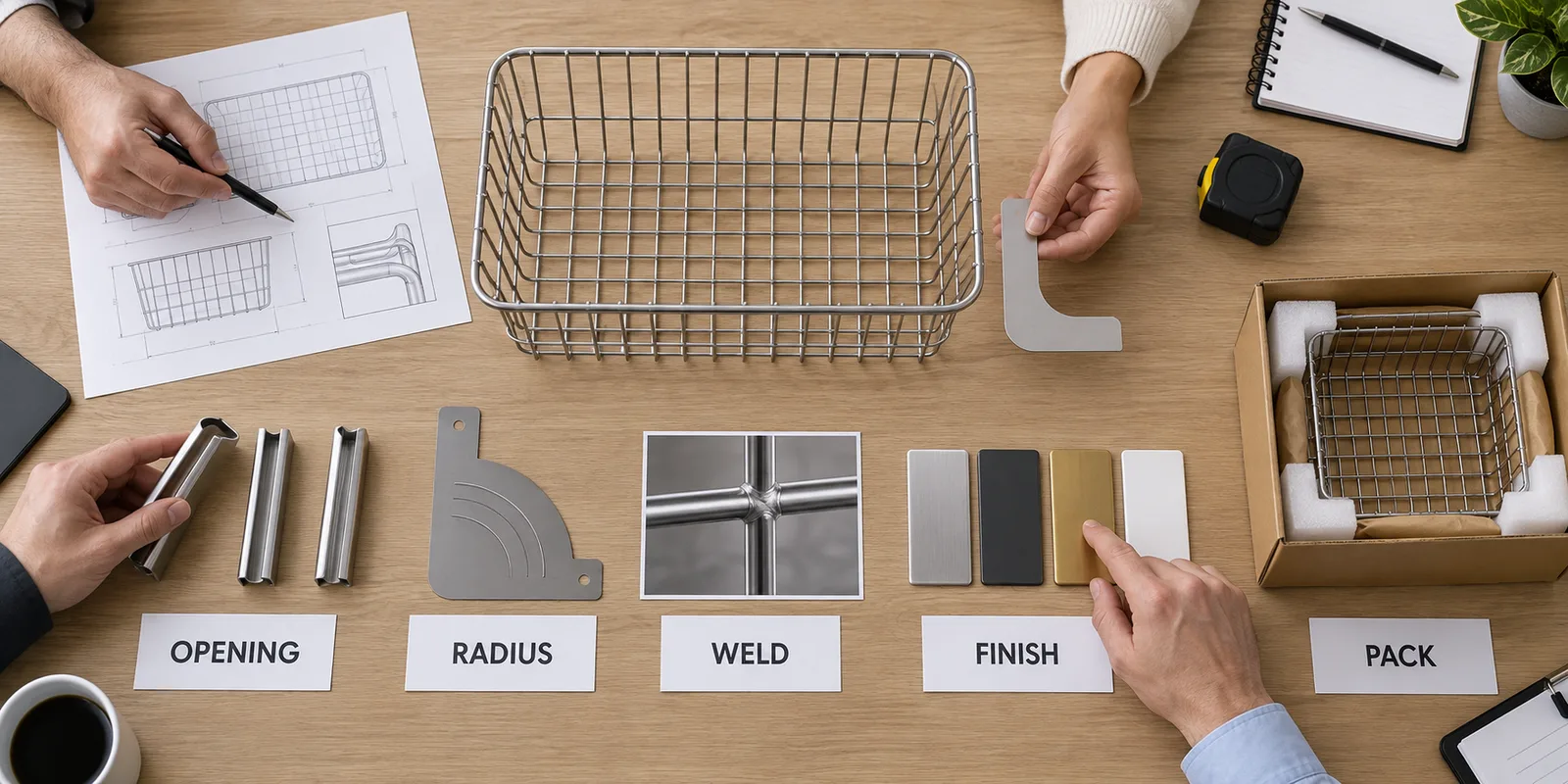
Use this buyer checklist:
- ☐ Outside and usable inside dimensions match the released drawing.
- ☐ Rim construction and material size are confirmed.
- ☐ Corner radii and front/rear orientation are correct.
- ☐ Vertical wires meet the rim consistently.
- ☐ Weld location and cleanup match the approved sample.
- ☐ Touch surfaces have no unacceptable sharp projections.
- ☐ Finish coverage and appearance are consistent at joints.
- ☐ Representative contents fit and remain retained.
- ☐ Mounting, slides, dividers, handles, or lids fit correctly.
- ☐ Packaging prevents rim pressure and metal-to-metal contact.
Packaging should support stable frame areas without pressing directly on a flexible rim. If baskets nest, use controlled separation and test removal with finished products. Keep accessories away from cosmetic surfaces. Confirm unit-carton and master-carton orientation using the final product revision.
Common sourcing mistakes include defining only the outside size, omitting the radius reference, choosing wire diameter from appearance alone, and changing the rim after inserts or fixtures are prepared. Another mistake is approving an empty basket without checking the smallest intended item and the user’s hand path.
More practical product-development guidance is available in Koitor’s OEM hardware resources.
Frequently Asked Questions
Why is wire basket rim design important?
It controls the opening, shape stability, side-wire attachment, item retention, handling feel, visible silhouette, finish review, and packaging interface. It is a functional frame feature as well as a design feature.
Is a double-wire rim always stronger?
Not automatically. Performance depends on wire size, span, geometry, joints, material, mounting, and loading. Compare the actual design and agree on a suitable verification method.
Should the corner radius appear on the drawing?
Yes. Define whether the radius is inside, outside, or centerline and show its relationship to the straight sections. A physical sample can supplement but should not replace the controlled drawing.
Can the rim be changed after sampling?
Yes, but the change may affect side wires, fixtures, finish, nesting, packaging, cost, and lead time. Issue a new revision and review the affected sample before production.
What should a buyer inspect at the rim?
Inspect dimensions, diagonals, corner symmetry, wire alignment, welds, touch surfaces, finish, content access, adjacent-part fit, and packaging contact against the approved revision.
Can Koitor develop a rim from a physical basket sample?
Koitor can review a drawing or physical sample. The final scope depends on the target geometry, material, finish, quantity, required fixtures, components, packaging, and approval plan.
Work With Koitor Hardware
Review Your Custom Wire Basket Rim
Send Koitor your basket drawing, physical sample, target contents, finish reference, packaging idea and expected order quantity. Our team can review rim geometry, corner forming, weld layout and flexible small-batch OEM options before quotation.
OEM / PRIVATE LABEL
Turn this sourcing guide into a product brief
Share your target product, size, finish, order quantity and packaging requirements. Your team receives a practical manufacturability review before quotation.
 English
  Español
  Português
  Français
  Deutsch
  العربية