

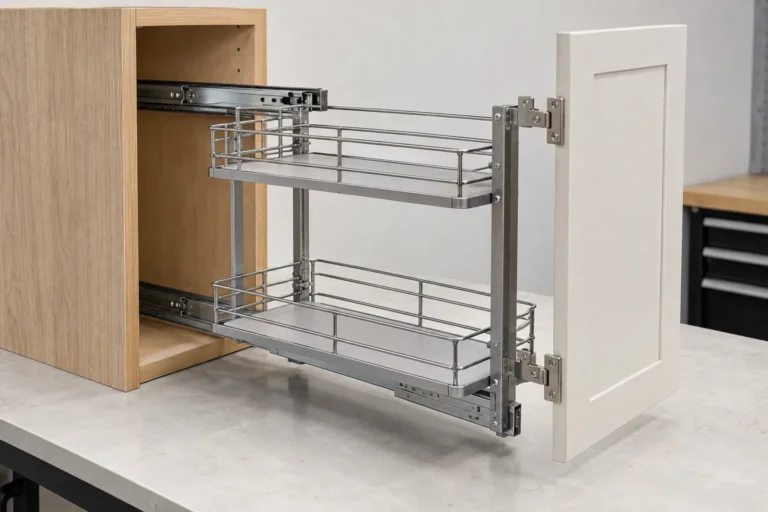
An internal basket can be easy to reach only if the cabinet door moves far enough out of its path. A hinge label alone cannot establish that. Buyers need to coordinate the door’s opening envelope, the basket’s extraction path, the cabinet opening, and the exact fitting model. Zero protrusion hinges pull out shelves is therefore a system-compatibility question: will the open door leave the complete basket travel path clear in the actual cabinet, with its frame, handle, and contents allowance included?
Some hinge families identify configurations for internal pull-outs or zero-protrusion applications. Those terms describe a supplier’s particular fitting and use case; they do not mean every product sold under that label works with every basket. Blum’s manufacturer catalog, for example, lists model-specific hinge configurations for internal pull-outs. Treat the catalog as evidence for the named system, then confirm the current model and geometry with its supplier. See the Blum catalog reference for internal pull-out applications.
Why Must the Door and Pull-Out Be Checked Together?
A basket travels through space occupied by the door while the door is moving. If the door remains partly across the cabinet opening, a basket frame or its load may catch the edge. A handle can create a collision even where the door panel itself clears. The issue is not only whether the door opens; it is whether the required access and extraction sequence can be completed without interference.
Start with the closed cabinet and define which parts are fixed and which move. The door rotates about its hinge axis. A pull-out basket translates along its slide or support path. The cabinet sides and opening are fixed boundaries. The relevant envelope combines these movements, so a single front-view measurement can miss an interference that appears at an intermediate door angle or basket position.
The wording “zero protrusion” should not replace an assembly drawing. Confirm what the component supplier means by the term, which hinge model it applies to, and whether the fitting assumes a specific cabinet construction, plate, door thickness, or opening condition. The product team’s required access may differ from the fitting’s nominal opening angle. Define the user access outcome, not only the catalog label.
Which Dimensions and Components Belong in the RFQ?
Provide the cabinet’s internal width, depth, and opening geometry, together with the door dimensions, edge profile, thickness, overlay or inset condition, and handle projection. Show the basket’s external frame, slide or support attachment, maximum intended travel, and any stop or soft-close component. If the final loaded condition changes the basket alignment, clarify whether the project review should use a loaded representative sample; do not imply an unverified load rating.
Ask the hinge supplier to name the exact model and supporting planning document. Ask the basket or cabinet supplier to show the closed, intermediate, and fully open positions. Each supplier may own only part of the interface, so the buyer should nominate who checks the combined assembly and maintains the approved drawing.
| Interface item | What to provide | What the review should confirm |
|---|---|---|
| Door | Finished size, profile, thickness, hinge-side location, and handle projection | Hinge application and clearance around the moving edge |
| Cabinet opening | Side-panel position, opening width, interior depth, and face-frame condition | Mounting compatibility and remaining access space |
| Pull-out | Basket frame, support/slide identity, travel, and stopping position | Extraction path and potential contact points |
| Hinge system | Manufacturer, model, arm, plate, opening limit, and revision | Supplier-confirmed use case and assumptions |
| Full assembly | Controlled drawing plus representative door and basket | Door opening and basket movement work in the intended sequence |
| Change record | Approved component list and sample reference | Substitutions trigger the right compatibility recheck |
Avoid asking separate suppliers to approve the system in isolation. The hinge manufacturer can confirm the hinge’s intended application, while a slide or basket supplier can confirm its own component. Neither statement alone proves that the combined assembly clears. Assign a system integrator or buyer-side engineer to reconcile the drawings and own final fit approval.
How Should Buyers Compare Hinge and Access Options?
Compare the proposed hinge configuration with alternatives only on the same cabinet and basket geometry. Options may include a fitting intended for internal pull-outs, a different hinge arm or mounting position, a limited basket width or travel, or a revised opening sequence. Some alternatives require a redesigned cabinet or basket. Availability and suitability are model-specific, so have the fitting manufacturer confirm each option rather than assuming that a generic hinge can be swapped into the same holes.
Assess access in functional terms. Can the user reach the basket contents? Can the basket be pulled through the complete travel without touching the door, handle, frame, or adjacent cabinet? Does the door need to remain open while the basket is extended, or can the intended sequence be different? If a restrictor or opening stop is part of the solution, specify it and verify its effect on access.
Do not compare only the hinge’s listed opening angle. The installed door can be stopped earlier by a wall, neighboring front, protruding handle, or cabinet detail. Conversely, a broader opening may not solve a basket collision caused by its width or mounting position. For zero protrusion hinges pull out shelves, a full swept-path review exposes those trade-offs before the project commits to tooling, packaging, or product photography.
Price comparisons should include every component and assembly operation required by each proposal. An apparent hinge saving may be offset by a narrower basket, changed rail, extra fitting, special installation step, or more complicated quality check. Record the functional outcome and acceptance criteria before deciding which quotation is lower cost.
What Should the Representative Sample Demonstrate?
Build a sample using the intended hinge, plate, cabinet side, door, handle, basket, and travel components. Review it in the proposed installation orientation. Move the door through its entire intended opening and then operate the pull-out at several positions. Check whether the basket can begin moving, pass the door edge, reach its use position, and return without collision or binding.
Mark or photograph the points with the least clearance. Include intermediate positions, not only fully closed and fully open states. Verify that the specified door stop or hinge opening limiter is present if the proposal relies on one. Record what is adjustable, the adjustment range actually used, and whether the final position remains stable under the conditions specified by the project.
If accessories or contents can change the basket’s path, define the representative configuration. This is a geometry and access check, not a universal load test. Any load or cycle-performance test needs a separately agreed method, acceptance criteria, and qualified responsibility. A successful hand-operated sample does not automatically prove repeated-use durability, production consistency, or a particular payload.
Keep the sample identification attached to the component schedule and drawing revision. If the hinge model or plate changes, repeat the relevant clearance check. If the basket width, support, or handle changes, recheck the combined envelope even when the hinge is unchanged. Approval should apply to the complete combination, not just to one item in the purchase order.
For an efficient review, divide the motion into observable states: door closed, door beginning to open, the point where the hinge-side edge passes the cabinet opening, door at the intended access position, basket beginning to move, basket at its full extension, and basket returning. The buyer does not need to prescribe a universal test speed or force to make this useful. The purpose is to identify where the interaction occurs and to document whether the representative assembly follows the intended operating sequence. If the user must open the door fully before pulling the basket, make that sequence part of the product-use assumption and verify that a stop or neighboring cabinet does not prevent it.
Include tolerances in the combined review when they are available from the component and cabinet suppliers. A nominal drawing can show a theoretical gap while production variation reduces it. Ask the suppliers to identify which dimensions control the closest point and how they plan to keep the approved relationship. Do not invent a blanket tolerance or clearance target when the project has none; have the responsible engineer establish criteria for the actual design and confirm that the sampling method represents the intended production range.
If the first sample reveals a collision, capture the exact door and basket positions before changing parts. A small adjustment may resolve a setup issue, but a change to the hinge, mounting plate, cabinet depth, basket travel, or handle should be treated as a design revision. Retain the original observation with the revised sample record so the buyer can see what changed and why the new configuration is acceptable.

What Common Sourcing Mistakes Restrict Access?
One mistake is interpreting “zero protrusion” as a guarantee of complete access. The term may refer to a specific hinge behavior, while other components still obstruct the basket. Ask the fitting supplier to define the term for the named model and then validate the use case in the assembly.
Another mistake is sizing the basket to the cabinet’s internal width without accounting for the door, hinges, mounting plates, side rails, and handle. The static interior dimension is not necessarily the available moving clearance. Use assembly sections and motion checks to set the basket’s actual envelope.
A third mistake is approving a hinge sample and basket sample separately. Each can be correct on its own yet incompatible together. The project needs one representative cabinet with all moving components installed. A fourth is skipping intermediate positions: a frame may clear at the two endpoints but collide while the door is opening or the basket is partway out.
Lastly, a part substitution can change the interface subtly. A different plate height, arm shape, basket side profile, slide travel, or handle projection may alter access. The approved bill of materials and drawing should identify the parts that determine the envelope. Require a review when one changes rather than relying on nominally similar product descriptions.
Keep the zero protrusion hinges pull out shelves compatibility record tied to the complete cabinet drawing and the exact component revisions.
If the cabinet has paired doors, confirm which one opens first and whether both fronts can be open simultaneously. A combined access sequence may be different from a single-door mock-up. Also document the basket’s intended stopping point: access that is adequate for partial extension may not be enough for removal or replenishment. These details help the buyer specify the actual use case without assuming a particular hinge or slide performance.
Pull-Out Clearance Approval Checklist
- The hinge model, mounting plate, cabinet construction, and door geometry are identified.
- The basket frame, support or slide, travel, and stopping position are on the same drawing.
- Handle, adjacent door, frame, wall, and other likely obstructions are included.
- Door movement and basket extraction are checked at intermediate positions.
- The operating sequence and minimum usable access are stated.
- Sample photos record the least-clearance locations and approved component revisions.
- Any change to the hinge, door, basket, support, or handle triggers a defined recheck.

Frequently Asked Questions
Does a zero-protrusion hinge guarantee a pull-out will clear?
No. The term applies to a supplier-defined fitting or application. The door, cabinet opening, handle, basket dimensions, and travel path still need a combined compatibility review.
Can the basket be made narrower instead of changing the hinge?
Possibly, but the buyer should compare the effect on usable storage and access. A narrower basket is one design variable; it should be evaluated with the hinge configuration and cabinet geometry.
Should the hinge opening angle be the only acceptance criterion?
No. The useful opening is determined by the installed assembly and the access requirement. A nominal angle does not show whether the basket clears throughout its travel.
Who confirms the combined fit?
The component suppliers confirm their own documented application limits. The buyer or designated system integrator should consolidate them and approve a representative full assembly.
Is the fit sample also a load test?
No. It demonstrates the represented interface and movement. Load, cycle, or durability claims require a separately defined test plan and evidence.
Work With Koitor Hardware
Koitor’s verified scope covers metal bathroom and home-storage hardware manufacturing, drawing and sample coordination, basic assembly, finish coordination, and supplier communication. Specialist hinge and slide design or performance must be confirmed by the relevant component supplier. For a metal basket or accessory that interfaces with a cabinet pull-out, share the drawing or sample and identify the interface question.
Review the moving cabinet interface
Share the cabinet section, hinge model, basket travel, and sample-clearance question for a coordinated OEM discussion.
OEM / PRIVATE LABEL
Turn this sourcing guide into a product brief
Share your target product, size, finish, order quantity and packaging requirements. Your team receives a practical manufacturability review before quotation.


 English
 Español
 Português
 Français
 Deutsch
 العربية