
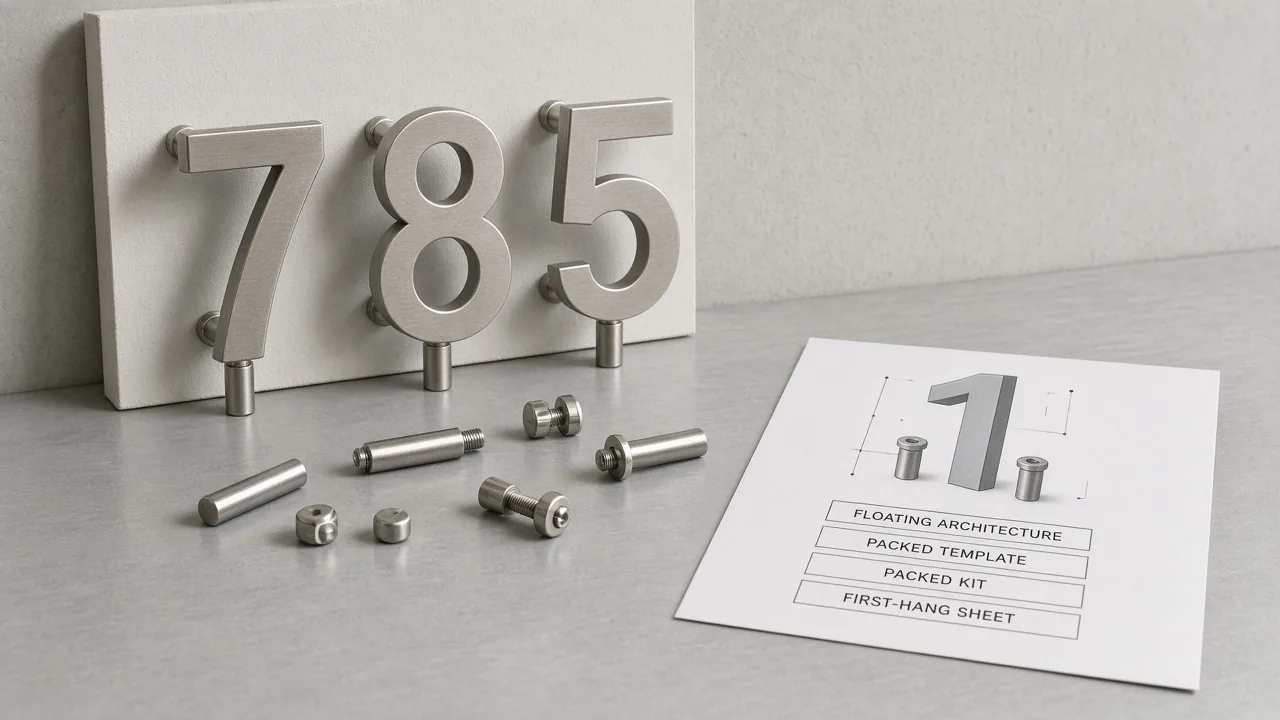
An install sheet can tell a buyer how to install floating house numbers only after the packed floating-mount architecture and the packed template and kit revision are named. The architecture is a standoff-rod or spacer kit, a projecting-fastener kit, or another documented floating kit the carton actually ships.
The template and kit revision are the packed layout aid and the parts list that belong to that architecture, not a copied competitor template and not a universal hole layout invented on this page. Height, typography, and flush-mount plaques belong on other files.
Procurement of the mounting template as a pack-contents question belongs on the live floating house numbers mounting template file. That neighbor should stay a template RFQ. This first-hang leaflet must not reprint its pack-contents table, and it must not treat a generic house-numbers head as this thesis.
This guide is for importers, distributors, and private-label teams approving a first-hang leaflet for floating house numbers treated as an adjacent decorative metal line in the live library. Koitor Hardware is a family-owned China OEM manufacturer of custom metal bathroom and home storage hardware.
That published-library context is not a claim that Koitor currently manufactures a named numeral SKU. Send the character drawing, the packed kit list, the template revision, and the intended wall. We can review the wording and the named architecture. We will not issue a universal standoff or spacing chart, an address-visibility or code determination, or a copied template.
What does a how to install floating house numbers file actually freeze?
It freezes the packed floating architecture and the packed template and kit revision, or an explicit exclusion for those fields, with a named substrate treated only as a condition. It does not freeze a template-procurement RFQ, a flush-mount architecture, a typography file, or a code conclusion.
Searchers often ask how to hang house numbers, or they arrive with a vinyl-siding substrate question, because a carton arrived without a named template revision. That demand is real. For an importer, the usable decision is whether a listing may say the numbers are easy to install, and which architecture, template, and kit that sentence is allowed to assume.
A floating character that stands off the wall on standoffs is not a flush plaque, even when the typeface looks similar. If the sheet does not say which architecture shipped, an easy-to-install line will be applied to the wrong fasteners and the wrong template. This file is not a consumer typography guide, and it is not a product listing.
A custom bathroom hardware manufacturer can review whether a first-hang sentence and a packed floating kit stay together for this adjacent decorative line. Matching a finish to a collection is not the same as inventing a default standoff length, a default hole layout, or a without-drilling bypass.
A published easy-to-install claim is only as complete as the named architecture and the named template and kit revision. If the photograph shows standoffs and the bag holds a flush-mount plaque, the sheet has already failed. The same is true of a missing template revision, or of a copied layout that does not belong to the packed kit.
This file can precede a first-hang review. It should not be turned into a template RFQ, a typography catalog, or an accessibility or address-code opinion. Those jobs already have, or should keep, their own files.
Which packed floating architecture and template or kit revision must be named first?
Name the packed floating architecture first, in the supplier’s terms: standoff rods or spacers, projecting fasteners, or another documented floating kit. Do not start with a generic house-numbers sequence, and do not start with a without-drilling question that has not been excluded.
Name the packed template and kit revision. The template is the layout aid that actually ships, identified by the supplier’s revision or equivalent wording. The kit list is the characters, standoffs or fasteners, and any sold-separately items that belong to that revision.
Name the intended substrate only as a condition the sheet must face, not as a universal method. A vinyl-siding condition, a masonry condition, or a finished wall condition may be written if the packed kit and the data actually address it. This page must not invent a one-wall-fits-all sequence.
If the program packs a flush-mount option in the same collection, the sheet must say that flush-mount is a different architecture. A mixed photograph that shows standoffs and a flush plaque in the same first-hang panel is how the wrong template is promised for the wrong SKU.
Do not print spacing, height, or hole-layout numbers unless they come from the packed template or the cited data for that revision. Even then, this leaflet must not become a second template RFQ or a copied competitor layout.
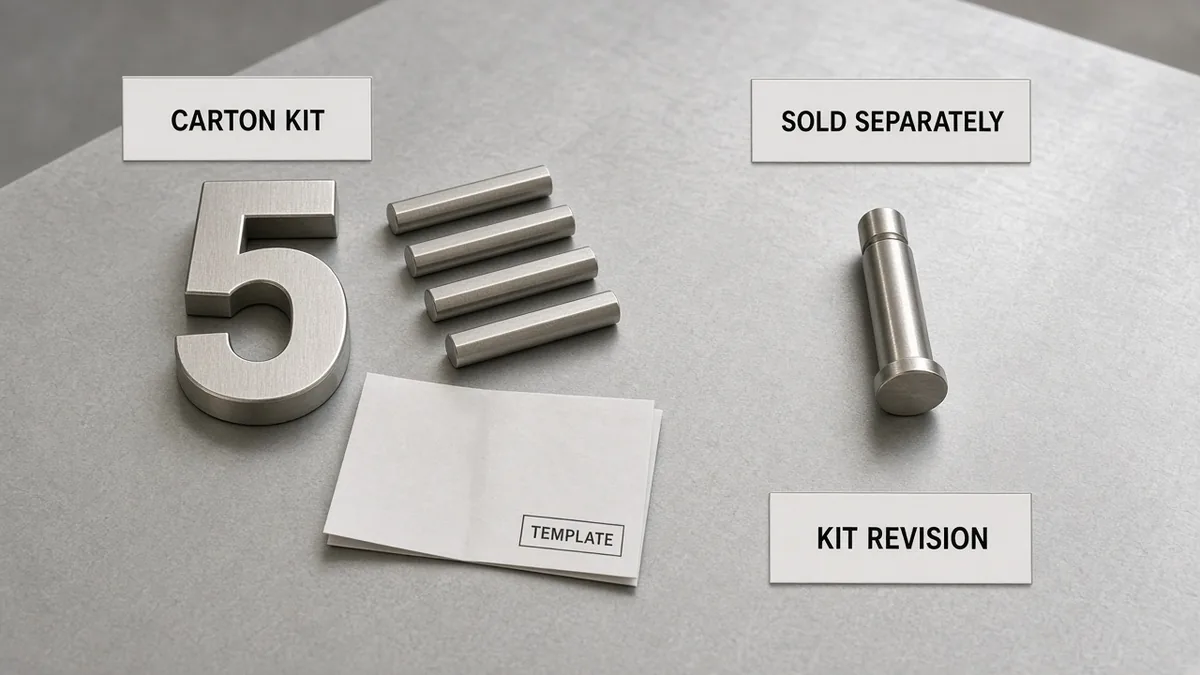
What belongs in the first-hang kit list, and what must stay out?
The kit list should name what the carton actually ships for this first hang, and what the cited data requires the buyer to supply. It is not a shopping list, and it is not a place to merchandise typography as the thesis of the page.
If a template sheet, standoff set, or fastener bag ships in the carton, say so in those terms. If a standoff, backing part, or substrate-specific fastener is sold separately, the sheet should say so on its own line. A hardware kit packing inspection checklist is useful only for that packing-honesty check, not as a substitute for the named architecture.
A blank or revision-marked template is not an invitation to copy a competitor’s typography or hole pattern. If the packed template is blank because the program expects the buyer to use a cited data sheet, say that. Do not fill the blank with an unofficial layout.
Without-drilling bypasses stay off the list. Demand for a no-drill hang is evidence that the packed architecture and the substrate condition must be named. It is not a license to print an unofficial method.
| Field or claim | What must be named | What belongs in the kit or data | What this row is not |
|---|---|---|---|
| Packed floating architecture | The floating-mount kit the carton actually ships, in the supplier’s terms | The characters, standoffs or projecting fasteners, and matching instructions | A flush-mount plaque, or an invented Koitor numeral SKU |
| Packed template and kit revision | The template aid and revision, or a named field left blank | Only the layout aid and parts list that actually belong to that revision | A copied competitor template, or a reprinted pack-contents RFQ |
| Named substrate | The wall or siding condition the packed kit actually addresses, as a condition only | Only what the cited data supports for that architecture | A universal method for every wall, or a without-drilling bypass |
| Easy to install | The architecture, template, and kit the sentence is allowed to assume | Nothing beyond that named list and cited data | A spacing or height chart presented as a Koitor standard, or a code determination |
The table is a decision map for the first-hang leaflet. It is not a standoff-length standard, an address-code opinion, or a claim that Koitor manufactures a current numeral SKU. If a row cannot be filled from the supplier’s current data, leave the field named and blank rather than inventing a number.
Why are unofficial spacing charts and no-drill threads not a factory method?
Marketplace listings and blogs often print a remembered inch chart, or they promise a hang without drilling. That wording is a real demand signal. It is not a method this sheet may teach, and it is not a reason to official a without-drilling phrase as a bypass-style secondary.
A first-hang leaflet that prints an unofficial layout will be copied onto kits that never intended it. The buyer then treats a remembered spacing as if it were the packed template revision. When the characters do not land on the intended wall, the listing still said the numbers were easy to install.
The honest response is to name the packed architecture and the packed template revision, and to exclude unofficial charts and without-drilling workarounds. If the packed template does not include a layout, keep that field named and point to the cited data. Do not invent a Koitor spacing table to fill the gap.
Address-visibility, numbering-code, or accessibility commentary stays off this method section. This file is not a determination of what an address must look like, how high it must sit, or whether a local rule is met. If the buyer needs that conclusion, the question does not belong on this first-hang sheet.
The official generic head how to install house numbers failed a thin-SERP gate and is not a secondary target here. Informal how to hang house numbers wording may be coverage of the same floating first-hang decision. It is not a license to absorb every house-number volume into this leaflet.
Which neighboring house-number files should stay out of this sentence?
The live floating-house-numbers mounting-template file should stay a pack-contents and template-procurement RFQ. This first-hang leaflet may link it when the sentence is about that pack-contents job. It must not reprint the RFQ table or turn this page into a second template-procurement file.
Flush-mount house numbers, if they appear in the same collection, stay a different architecture and should be named only as not this kit. Do not invent an href for a flush-mount neighbor if the official lock-copy list does not carry one.
Typography, character-style, and finish-selection questions belong on their own files when those files exist. This first-hang leaflet may mention a finish only as part of the packed kit. It should not become a typeface catalog.
Substrate-specific later pages, including a vinyl-siding coverage note, should stay coverage of a condition, not a second thesis. If a later file owns a particular wall, point to it in prose when the lock copy omits the href. Do not rewrite this first-hang file around that one wall.
If a later file owns lighting, contrast, or night-visibility, keep those questions there. A first-hang sentence that tries to settle every neighboring RFQ will be wrong for the kit that actually shipped.
What should be checked before a listing tells a buyer how to install floating house numbers?
Use the list as a first-hang review, not as a shop sequence and not as a pass-fail audit grade. If a line cannot be answered from the drawing, the carton, or the cited data, keep the field named and unresolved rather than inventing a value.
- Name the packed floating architecture in the supplier’s terms before any install sentence is printed.
- Name the packed template and kit revision, or keep the field named and blank; do not copy a competitor layout.
- State clearly whether standoffs, fasteners, or a template sheet are in the carton or sold separately; do not merge those states on one label.
- Treat the intended wall or siding only as a named condition the packed kit actually addresses, not as a universal method.
- Keep the live mounting-template RFQ on its own file; link it for pack-contents questions, and do not reprint its table.
- Keep flush-mount as a different architecture, named only as not this kit.
- Exclude unofficial spacing or height charts and without-drilling bypasses.
- Do not issue an address-visibility, numbering-code, or accessibility determination, and do not claim a current Koitor numeral SKU.

If the listing still wants an easy-to-install line after this review, the line may only assume the architecture and the template and kit revision that were just named. A sentence that cannot point to those fields is not ready to print.
A missing template revision is a packing or wording defect, not a reason to publish a remembered inch chart. The same is true of a photograph that shows flush-mount hardware, or of a bag that mixes standoffs with a plaque kit.
If a buyer arrives with only a no-drill video, stop the first-hang sentence until the packed architecture and the substrate condition are named from the kit and the data. A desire to avoid holes is not a method this leaflet may invent.
When the official lock-copy of the internal-link list omits a flush-mount or typography href, name that neighbor in prose and stop there. Do not invent a URL. The live template file that is in the lock copy may be linked; other missing neighbors may only be named.
If the intended product is a flush plaque or a non-floating sign, this sheet is the wrong file and should say so. Point the buyer off this leaflet rather than improvising a method. This file will not issue a code conclusion to keep that buyer on the page.
A replacement character later in the program still needs the same named architecture and the same template revision. A spare bag that drops those fields will recreate the original wording defect, even if the first carton was correct.
Do not let a typography conversation rewrite the first-hang kit. The character shape may matter to the buyer, but the install sheet still has to freeze the architecture and the packed template before any easy-to-install line is printed.
A first-hang program that later changes the standoff family must revise the template and kit revision as well. A layout written for one packed architecture will not travel safely onto a flush plaque or a different projecting fastener, even when the character style looks the same. Stop the easy-to-install sentence until the new architecture is named.
Painted walls, uneven siding, and replacement characters can all change how a packed template is used. Those conditions may be named as conditions if the cited data actually addresses them. They are not a license to invent a Koitor spacing chart, and they are not a license to print an unofficial no-drill sequence.
If two architectures share a collection photograph, keep the first-hang map tied to the kit that actually shipped. A shared finish does not make a standoff kit and a flush plaque share a template. The photograph should separate the exclusion, just as a review layout separates a carton kit from a sold-separately part.
Sales teams sometimes want a single sentence that covers typography, template procurement, and first hang together. Resist that merge. The live mounting-template file owns pack-contents questions. This file owns the packed floating architecture as an install-sheet decision. One project can use both files. One leaflet should not reprint both jobs.
When a later character is added to an existing line, the added character still needs the same named architecture and the same template revision. A spare that arrives without those fields will recreate the original wording defect, even if the first carton was correct.
The question how to install floating house numbers is a first-hang question about a packed floating architecture and a packed kit. It is not a second template RFQ, not a flush-mount file, and not a code opinion. Keep those neighbors in their own sentences.
If incoming inspection is part of the program, inspect against the named architecture and the named template revision, not against a remembered inch chart from another brand. A character that looks familiar in a photograph can still be packed with the wrong standoff family.
Do not let a typography catalog rewrite the first-hang kit. The letterform may matter to the buyer, but the install sheet still has to freeze the architecture and the packed template before any easy-to-install line is printed.
Substrate questions should be written as conditions, not as new theses. A vinyl-siding note may appear if the packed kit actually addresses that wall. It should not turn this file into a siding-only manual, and it should not become a universal method for masonry or wood.
When the official lock-copy list already carries the live template href, use it for pack-contents sentences only. When it omits a flush-mount or typography href, name that neighbor in prose and stop. Inventing a URL is a worse defect than leaving the neighbor unlinked.
A private-label team can still use this page when the numerals are an adjacent decorative metal line rather than a current named Koitor SKU. The usable service is a wording and kit-scope review. The unusable request is a code determination or a copied competitor template.
If the carton includes both a template sheet and a sold-separately standoff, those two states must stay visually and verbally separate. A merged label that reads as if the extra standoff were already in the carton is the same class of defect as a merged kit photograph.
Hardware finish and character finish should be named only as packed-kit fields, not as a substitute for the architecture. A matching color chip does not tell the buyer which standoff family shipped, and it does not replace a missing template revision.
If a project later asks for a taller character or a longer line, treat that as a kit-revision question, not as permission to stretch an old layout. The first-hang sentence has to be rewritten against the new revision, or it should stay off the listing until that revision is named.
Night-visibility, contrast, and lighting accessories belong on their own files when those files exist. This leaflet may mention a finish as part of the packed kit. It should not become a visibility manual or a lighting catalog in order to fill word count or to chase an unofficial search phrase.
Frequently asked questions
Can the listing say the floating house numbers are easy to install?
Only after the packed floating architecture and the packed template and kit revision are named, and only if unofficial spacing charts and without-drilling paths are excluded. An easy-install line is not a substitute for a missing template revision.
Is this the same file as the mounting-template RFQ?
No. The live mounting-template file owns pack-contents and template-procurement questions. This file owns the first-hang architecture and the packed kit as an install-sheet decision. Link the RFQ when the sentence is about pack contents, and do not reprint it here.
Does this sheet also cover flush-mount house numbers?
No. Flush-mount is a different architecture. This leaflet may name it as not this kit. It should not become a flush-mount first-hang, and it should not invent a flush-mount href if the official lock-copy list does not carry one.
What should the sheet say if the buyer asks how to hang the numbers without drilling?
Exclude an undocumented no-drill path and point the buyer to the packed architecture and the substrate condition actually addressed by the data. Do not official a without-drilling phrase as a bypass-style method on this page.
Can the sheet print a spacing or height chart?
Only values taken from the packed template or cited data for that revision may appear, and even then this page must not become a second template RFQ. If the data is incomplete, keep the field named and blank. Do not invent a factory-universal chart.
Will Koitor determine whether the address meets a local code?
No. This file will not issue an address-visibility, numbering-code, or accessibility determination. Those conclusions belong with the authority that owns them, not on a first-hang kit leaflet.
Work With Koitor Hardware
Review a floating house-number first-hang sheet
Send the character drawing, the packed kit list, the template revision, and the intended wall. We can review the wording and the named floating architecture. We will not issue a universal spacing chart, a copied template, or a code determination.
OEM / PRIVATE LABEL
Turn this sourcing guide into a product brief
Share your target product, size, finish, order quantity and packaging requirements. Your team receives a practical manufacturability review before quotation.
 English
 Español
 Português
 Français
 Deutsch
 العربية