
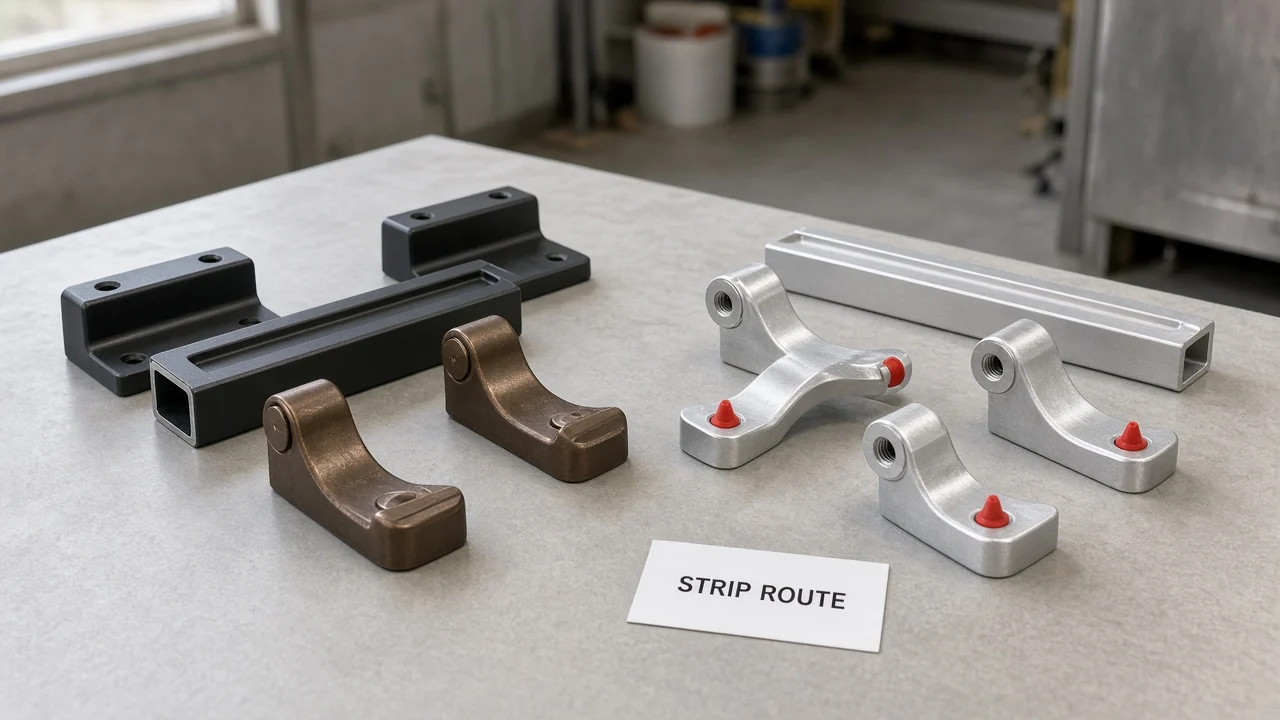
A rework order can only explain how to remove anodizing from aluminum hardware once it names the anodic layer on the parts, the alloy and temper underneath, the strip route the finisher documents, the masking for threads and fits, and the checks that decide whether the stripped parts are acceptable. Stripping is not a cleaning step. It removes the anodic layer chemically and, in doing so, also removes some of the aluminum below it.
Importers usually face this question for practical reasons. A batch came back the wrong color. Dye has bled out of the sealed layer. Racking marks are visible on show faces. The design is switching from anodizing to powder coating. In each case, the decision is not whether stripping is possible, but whether the parts will still meet the drawing after it.
This guide is for importers, distributors and private-label teams who buy anodized aluminum hardware and need to authorize or refuse a strip-and-refinish rework. Koitor Hardware is a family-owned China OEM manufacturer of custom metal bathroom and home storage hardware. The guide covers the rework order. It gives no home recipes, chemical concentrations, temperatures or immersion times.
Care of anodized parts is covered by the live how to clean anodized aluminum guide. Removal of other finishes is covered by how to remove powder coating and how to remove chrome plating. This page covers removing an anodic layer as part of a controlled rework.
What does how to remove anodizing from aluminum depend on first?
It depends on what the layer is, what the metal is, and what the parts must look and measure like afterwards. Those three facts decide whether a strip is worth doing, which route the finisher uses, and what the acceptance checks are.
Anodizing is not a coating painted onto the metal. It is an oxide layer grown from the aluminum surface in an electrolytic process. Part of the layer grows outward and part grows inward, consuming metal. Removing it chemically dissolves that oxide, and the strip chemistry usually attacks some of the base metal as well.
That is the key point for buyers. After stripping, a part is not back to its pre-anodized state. It has lost the metal that the original anodizing consumed, plus whatever the strip removes. On a decorative bracket, that may not matter. On a part with a threaded hole, a press fit or a tight slot, it may.
Type II sulfuric anodizing, often dyed and sealed, is the usual decorative finish on hardware. Type III hardcoat anodizing is thicker and harder and is used for wear resistance. Hardcoat is generally more difficult to strip and leaves more dimensional change behind. The Type II versus Type III anodizing guide explains the difference.
Alloy and temper matter too. Different aluminum alloys respond differently to strip chemistry. Cast alloys and alloys with higher copper or silicon content can pit or etch unevenly. The alloy also affects how well a re-anodized part matches the original color, which is covered by anodized aluminum color variation by alloy and temper.
For a brand, the question is whether the reworked parts can be sold as the same product. The rework order should answer that with acceptance checks, not with assumptions.
Strip, remake or accept: the first decision
Before authorizing a strip, the buyer should compare three options: strip and refinish, remake the parts from new material, or accept the parts with a concession. Stripping looks cheaper because the parts already exist, but trial parts, masking, inspection and the risk of failed checks all add cost and time.
For simple decorative parts in a soft alloy, stripping and re-anodizing is often practical. For machined parts with threads and fits, or for hardcoat, remaking can be faster and more predictable. A concession may be reasonable for small color differences on hidden faces. The rework order should record which option was chosen and why.
Dye problems versus layer problems
Not every color problem needs a full strip. Some issues come from dyeing or sealing and may be correctable in other ways, depending on the finisher’s process. Others are in the layer itself or the metal underneath. The finisher should diagnose the cause and say whether a full strip is required. The rework order should record that diagnosis.
Parts with inserts, rivets and assemblies
Threaded inserts, rivets, press-fit pins and bonded parts complicate stripping. Strip chemistry can attack steel or brass inserts, get trapped in joints and cause later corrosion, or loosen press fits. As a rule, assemblies should be taken apart before stripping, or the rework should be refused. The order should list every non-aluminum component.
Which anodic layer and alloy are on the parts?
The rework order starts by recording what is there. This is mostly paperwork, but it decides everything that follows.
Original anodizing specification
The order should reference the specification the parts were anodized to: type, class (dyed or clear), color, sealing method and nominal thickness range, as stated on the drawing or the finisher’s certificate. If the original specification is unknown, that is a risk to record.
Alloy and temper
The drawing or material certificate gives the alloy and temper. The order should repeat them. If parts in a batch came from different material lots, note it, because they may strip and re-anodize differently.
Reason for rework
Record why the parts are being stripped: color mismatch, dye bleed, racking marks, surface defects, or a change of finish. The reason determines the acceptance checks. A color rework needs a color match check; a switch to powder needs a pretreatment and adhesion check.
Quantity and part condition
Note how many parts, whether any have been assembled, and whether any have inserts, bushings, rivets or other components. Assembled parts and parts with inserts may not be suitable for stripping at all.
Dye bleed and sealing faults
If the reason is dye bleed, the anodizing sealing and dye bleed hot water test page explains how sealing faults show up. Some sealing faults can be addressed without stripping, which the finisher should confirm before a strip is authorized.
Racking marks
If the reason is visible contact marks, the anodizing racking contact marks page explains where they come from and how they are controlled. A strip and re-anodize will create new rack marks unless the racking plan changes.
What strip routes and masking does the finisher document?
The finisher chooses the strip route and documents it. The rework order should ask for that documentation and record it, without specifying the chemistry itself. Buyers do not need to know concentrations or times, but they do need to know which route will be used and what it does.
Alkaline etch routes
Some strip routes use alkaline solutions that dissolve the oxide and etch the aluminum underneath. They are effective but remove base metal and can leave a matte, etched surface. On parts with polished or brushed show faces, the original texture may be lost.
Acid strip routes
Other routes use acid solutions designed to dissolve the oxide while limiting attack on the base metal. They may preserve surface texture better, but they still affect the metal, and some alloys respond poorly. The finisher chooses based on alloy, layer type and surface requirements.
Masking threads and critical fits
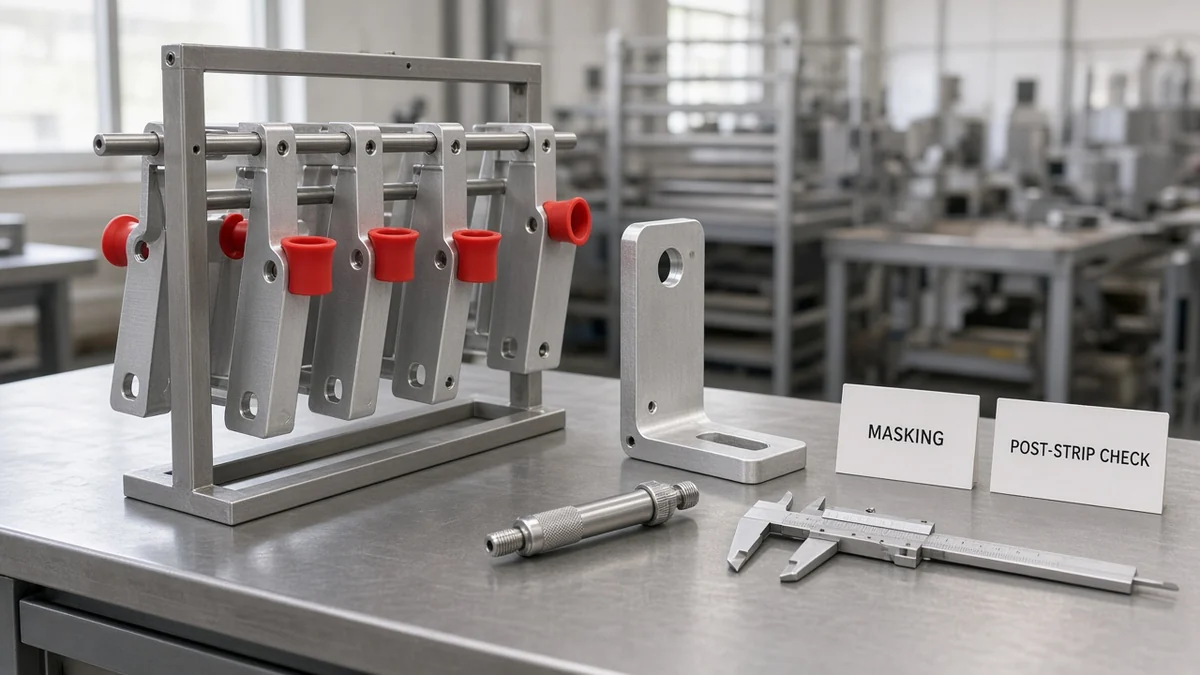
Threads, bores, press-fit diameters and mating faces can be masked to protect them from the strip. Masking must be specified on the drawing or rework order and agreed with the finisher. Unmasked threads may lose enough material to fail a thread gauge after rework.
Racking and handling
Parts are racked for stripping as they are for anodizing. Rack contact points may leave marks, and parts that touch each other may strip unevenly. The finisher’s racking plan should be part of the documented route.
Safety and handling of chemicals
Strip chemicals are hazardous and are handled under the finisher’s safety program. OSHA’s information on chemical hazards and toxic substances gives general background on workplace chemical safety. This is one reason the rework belongs with a qualified finisher, not with improvised methods.
Surface texture before re-anodizing
Brushed, bead-blasted and polished finishes are created before anodizing. Stripping, especially by alkaline etch, can change that texture. If the show face must match the original, the rework may need to repeat the mechanical finishing step before re-anodizing. That adds metal removal and cost, and it should be part of the route discussed with the finisher.
Masking materials and removal
Masking is done with plugs, caps, tapes or lacquers suited to the strip and anodizing chemistry. Masking left in place too long or removed carelessly can leave residue or mark the surface. The finisher’s process should cover masking application and removal. The order only needs to say what is masked.
Lead time and capacity
Rework batches compete with new production for finishing line time. Trial parts, inspection and a second anodizing run can take as long as the original finishing. The rework order should state the agreed lead time and the point at which a remake becomes the better option.
What should the rework order list?
The rework order is a short document that records the layer, the alloy, the route, the masking and the acceptance checks. The table is a template. It has no chemistry, times, temperatures or etch rates.
| Field | What to write | Source |
|---|---|---|
| Original finish | Anodizing type, class, color, sealing and nominal thickness | Drawing or finisher certificate |
| Alloy and temper | As on drawing or material certificate | Drawing and material certificate |
| Reason for rework | Color, dye bleed, racking marks, defects, or finish change | Buyer inspection report |
| Strip route | Alkaline etch, acid strip, or other, as the finisher documents | Finisher’s process sheet |
| Masking | Threads, bores, fits and faces to be masked | Drawing and rework order |
| Next finish | Re-anodize to the same specification, or pretreat for powder coating | Rework order |
| Acceptance checks | Dimensions, threads, surface, color match or adhesion | Drawing and rework order |
| Disposition | Accept, re-route, or scrap, with who decides | Buyer and supplier agreement |
Agree acceptance before stripping
The most important step is agreeing the acceptance checks before any part is stripped. If a thread gauge or a fit check is going to fail after stripping, it is better to know from a trial part than from a whole batch.
Trial parts first
A small trial batch, stripped and refinished through the full route, shows whether the parts survive. The trial results should be recorded and reviewed before the full batch is released to rework.
Keep traceability
Stripped and re-anodized parts should be traceable to the rework order. If a later problem appears, the record shows which parts were reworked and by which route.
Mixed lots and partial batches
If only some parts in a shipment are rejected, the reworked parts will later be mixed with parts that were not reworked. Any difference in color, texture or dimension will then show up in the same carton or on the same installation. The rework order should say whether reworked parts are kept separate, labeled, or mixed only after passing a color comparison against the unreworked parts.
Packaging and labeling after rework
Reworked parts should be packed and labeled so they can be traced. A small mark on the carton label, such as a rework order number, is enough. If a complaint comes in later, the label shows whether the parts were reworked and by which route.
Learning from the rework
A rework is also evidence. If parts are being stripped for color, the root cause may be alloy lot variation, racking or process control. If they are being stripped for racking marks, the racking plan may need to change. The rework order can include a short root cause note, so the same problem does not return in the next production run.
What checks decide whether stripped parts are acceptable?
After stripping and refinishing, the parts must still meet the drawing. The checks depend on the reason for rework and the next finish.
Dimensions and fits
Measure critical dimensions against the drawing. Anodizing grows the part and stripping removes material, so dimensions can shift in both directions over the full cycle. The anodized aluminum thickness, dimensional growth and thread fit page explains the effect.
Threads
Check threads with the gauges the drawing calls for. Tapped holes in aluminum are particularly sensitive, and unmasked threads may fail after a strip and re-anodize cycle. Threads that fail may need re-tapping or inserts, which the order should address.
Surface condition
Inspect show faces for pitting, etching, loss of brushed or polished texture, and rack marks. Some alloys pit after stripping. If the surface no longer meets the appearance standard, re-anodizing will not hide it.
Color match after re-anodizing
Re-anodized parts may not match parts that were not reworked, especially if the alloy lot or the surface texture has changed. The order should define how color is judged, for example against a retained sample under agreed lighting.
Pretreatment for powder coating
If the parts are being switched to powder coating, the stripped surface needs pretreatment for adhesion. The anodized aluminum powder coating adhesion and pretreatment page covers that. The choice between finishes is discussed in anodizing vs powder coating.
Salt spray and corrosion checks
If the parts were anodized partly for corrosion resistance, the buyer may want the reworked parts checked the same way the originals were, for example by the same corrosion test the drawing references. The order should name the test if one applies and avoid inventing new pass criteria.
Who decides the disposition
When reworked parts fail a check, someone must decide whether to accept, re-route or scrap them. The order should name that person or role on both the buyer and supplier side. Without it, failed parts tend to wait in a corner until the delivery date forces a rushed decision.
Industry references
The Aluminum Association publishes industry information on aluminum alloys and tempers. The National Association for Surface Finishing represents the surface finishing industry. These are useful neutral references when discussing rework with a finisher.
Why home methods are a poor fit for hardware buyers
Online videos show anodizing coming off with household products. Those methods are uncontrolled: the operator cannot predict how much base metal is removed, how the alloy will pit, or what happens to threads. They also involve caustic chemicals with real injury risks. For a buyer responsible for a batch of parts that must meet a drawing, those methods offer no evidence and no traceability.
The useful question is not whether anodizing can be removed, but whether a controlled route exists that leaves parts within the drawing. That is a conversation with a finisher, backed by trial parts and inspection.
Questions to ask the finisher
A short set of questions keeps the conversation focused. Which strip route would you use for this alloy and layer? What base metal loss do you expect, and where? Which features should be masked? Will the show-face texture survive? Can you re-anodize to the original specification, and how will color be matched? The answers, in writing, become part of the rework order.
What must an anodizing rework order not include?
Check the order against this list before release.
- Home recipes using lye, oven cleaner or drain cleaner.
- Chemical concentrations, temperatures, immersion times or etch rates.
- A promise that dimensions or threads will be unchanged after stripping.
- A promise that any part can be re-anodized to match the original color.
- Stripping of assembled parts or parts with inserts without supplier review.
- Bicycle, firearm or automotive part instructions.
- Release of a full batch without trial parts and agreed acceptance checks.
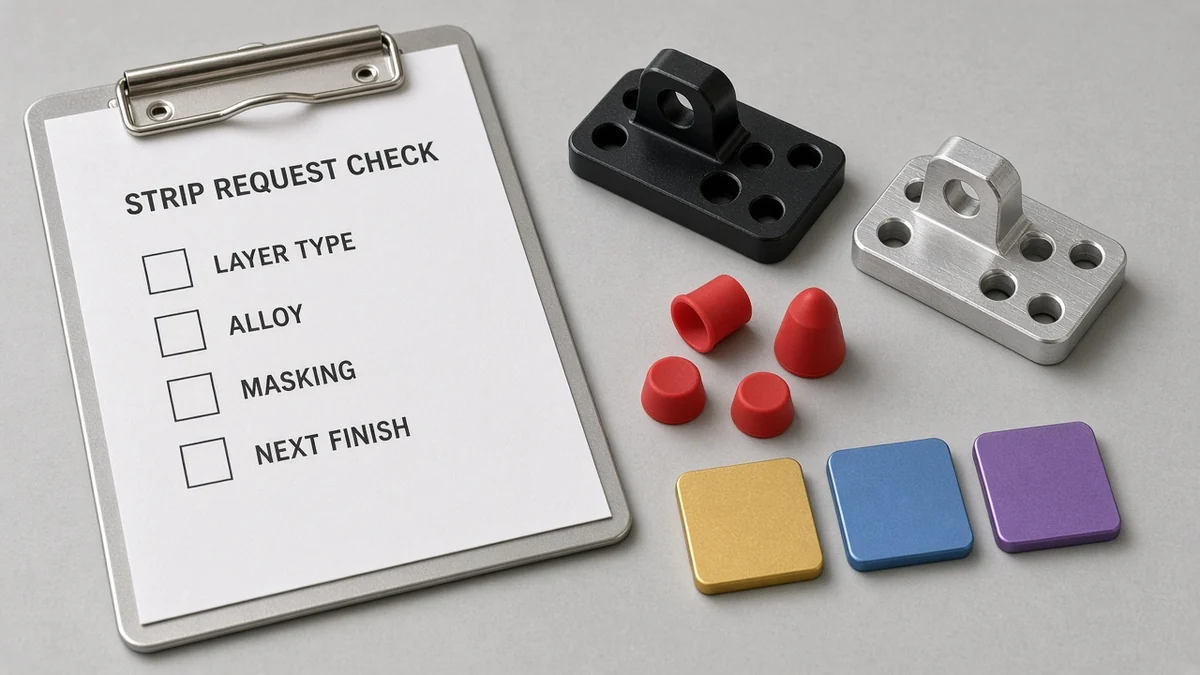
After the list check, review the order with the finisher and the quality team together. If everyone agrees the route, masking and acceptance checks, the order is ready.
Sign-off
The buyer approves the rework order and the finisher documents the route. Koitor can review the order against the drawing and flag missing masking, acceptance checks or unsupported promises.
Frequently asked questions about removing anodizing
Can anodizing be removed from aluminum?
Yes, chemically, by a finisher using a documented strip route. It also removes some base metal, so parts must be checked afterwards.
Will stripping change the part dimensions?
Usually, yes. The original anodizing consumed some metal, and the strip removes more. Critical dimensions and threads must be checked.
Can I re-anodize after stripping?
Often, but the color may not match parts that were not reworked, and the surface may have changed. Agree color acceptance first.
How long does an anodizing rework take?
It depends on the finisher’s capacity, the trial results and the next finish. A strip, re-anodize and inspection cycle can take as long as the original finishing. Agree the lead time in the rework order.
Can stripped aluminum be powder coated instead?
Often, if the surface is pretreated correctly for adhesion. That is a finish change, and the pretreatment and adhesion checks should be part of the rework order.
Is hardcoat harder to strip?
Generally yes. Type III hardcoat is thicker and harder, and stripping it usually leaves more dimensional change.
Why did my anodized parts come out a different color after rework?
Stripping changes the surface, and re-anodizing depends on alloy, surface texture and process conditions. Parts from different material lots or with changed texture often anodize to a slightly different shade.
Should threads be masked when stripping anodizing?
Usually, if they are critical. Unmasked threads lose material in the strip and may fail the thread gauge afterwards. Masking should be on the rework order.
Can I strip anodizing at home?
This guide does not cover home methods. Stripping uses hazardous chemicals and affects the part’s dimensions. Use a qualified finisher.
Does Koitor strip anodizing?
Koitor makes custom metal bathroom and home storage hardware and reviews finish rework orders for parts in its programs. Whether rework is offered for a specific program is confirmed by quote.
Work With Koitor Hardware
Review an anodizing rework order
Send the part drawing, alloy and temper, the original anodizing specification and the reason for rework. We can review whether the rework order names the layer, strip route, masking and post-strip acceptance. We will not supply stripping chemistry or promise unchanged dimensions.
OEM / PRIVATE LABEL
Turn this sourcing guide into a product brief
Share your target product, size, finish, order quantity and packaging requirements. Your team receives a practical manufacturability review before quotation.


 English
 Español
 Português
 Français
 Deutsch
 العربية