
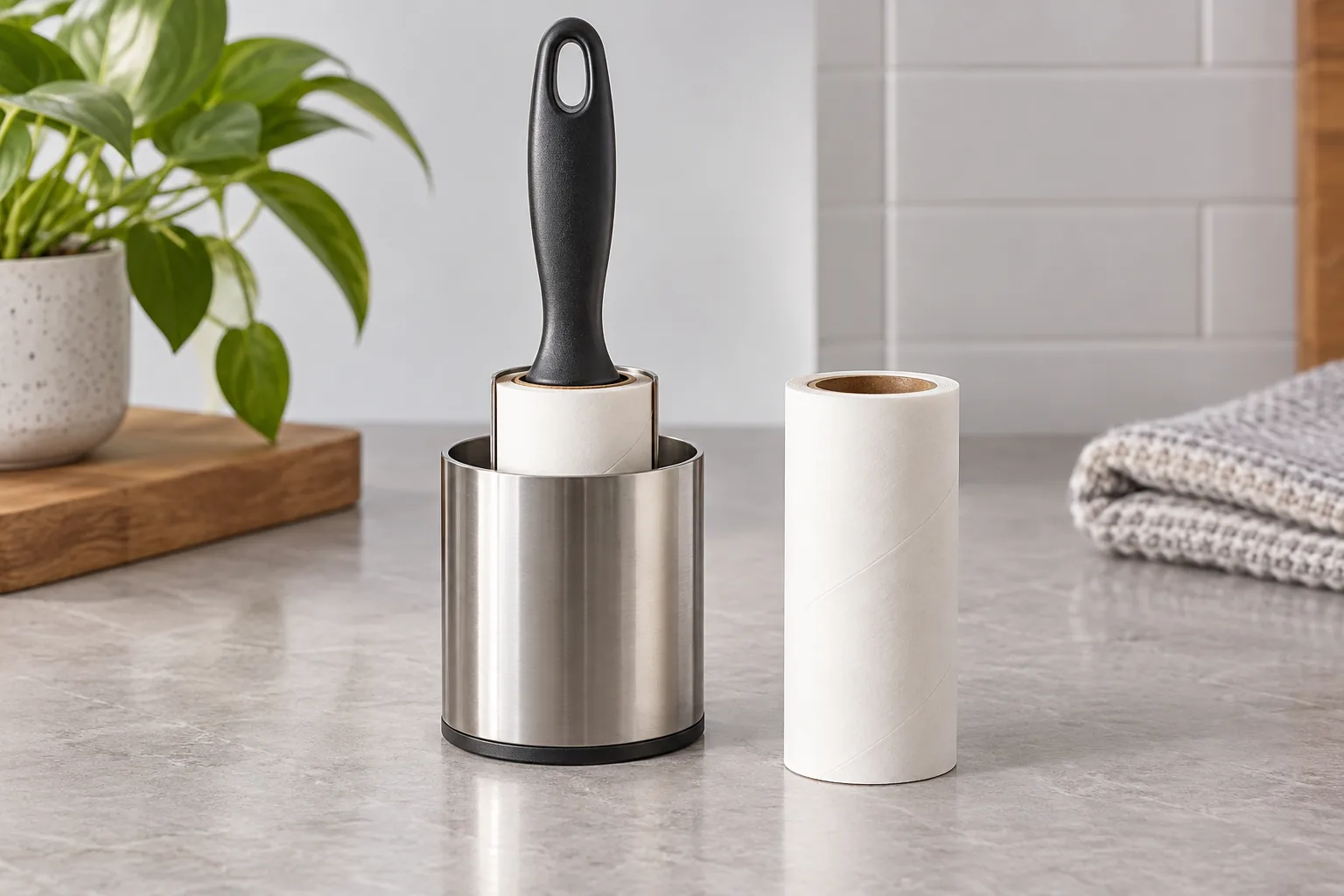
Metal lint roller holder fit depends on the exact roller body, handle, refill and storage orientation. A holder that accommodates the roller sleeve may still block the handle, expose the adhesive surface, interfere with a cover or make a replacement refill difficult to reach. Importers should list the complete cleaner reference and review the assembled product through storage, removal and refill rather than buy by the generic label “lint roller holder.”
Which lint-roller architecture is in the range?
Start by documenting what the holder is designed to store. A hand roller may have a detachable sleeve and short handle; a floor cleaner may have a long handle and upright rest; a holder may include a waste-paper container, cover, spare-roll compartment or removable insert. These functions change the envelope and the way a user retrieves the tool. An assortment that includes more than one architecture should use a separate fit record for each.
Identify the roller brand, model and revision, then record the physical dimensions that govern the interface. Useful reference features can include total length, handle cross-section, sleeve diameter, exposed sticky width, end caps, and where the roller separates for refill. If the holder is intended for multiple rollers, define the allowed references explicitly and test each one. Avoid writing “fits most” without a current, documented compatibility list.
A current Yamazaki Home Tower lint-roller holder product page describes one model-specific architecture with a steel housing, a separate removable waste insert, an upright cleaner envelope and storage provision. It is a useful example of a holder that accommodates components beyond the roller sleeve. It does not establish compatibility with every cleaner or prove the same construction in a different product. Confirm the current version, dimensions and included parts directly before using product details in an offer.
The buyer should decide whether the holder is sold alone, bundled with the cleaner, or supplied as a combined unit with extra rolls. Product photos and packaging must agree with the offer. If the cleaner is not included, show that clearly and identify the reference roller used for fit approval. If a reusable insert or waste receptacle is included, list its material, removal path and cleaning responsibility as separate product facts to verify.
How should orientation and access be checked?
Test the holder in its intended orientation: upright, horizontal, wall-mounted or stored within a cabinet. Do not assume the same body fit works in each position. Gravity, a cover, nearby shelves and the direction of the handle can change whether the tool can be placed or removed without twisting. If a holder is intended for both display and storage, define and approve both positions.
Check the access path from the user’s hand to the handle. Can the roller be lifted straight out, or must the user angle the handle around a rim? Does a cover need to be opened first? Is there enough space above the holder to remove a long-handled cleaner? For a wall-mounted item, consider the installation height and nearby wall or cabinet boundaries. Record the intended clearances from the actual fixture, not from a generic concept image.
The roller’s adhesive surface is a contact-sensitive part. Identify whether it should remain covered, whether the holder touches the adhesive, and how the user removes it without peeling material inadvertently. The buyer should provide the exact roller reference; do not claim the holder preserves adhesion or cleanliness unless the complete design and evidence support that claim. If a dust insert or receptacle is part of the assembly, review how it is accessed and returned to its seated position.
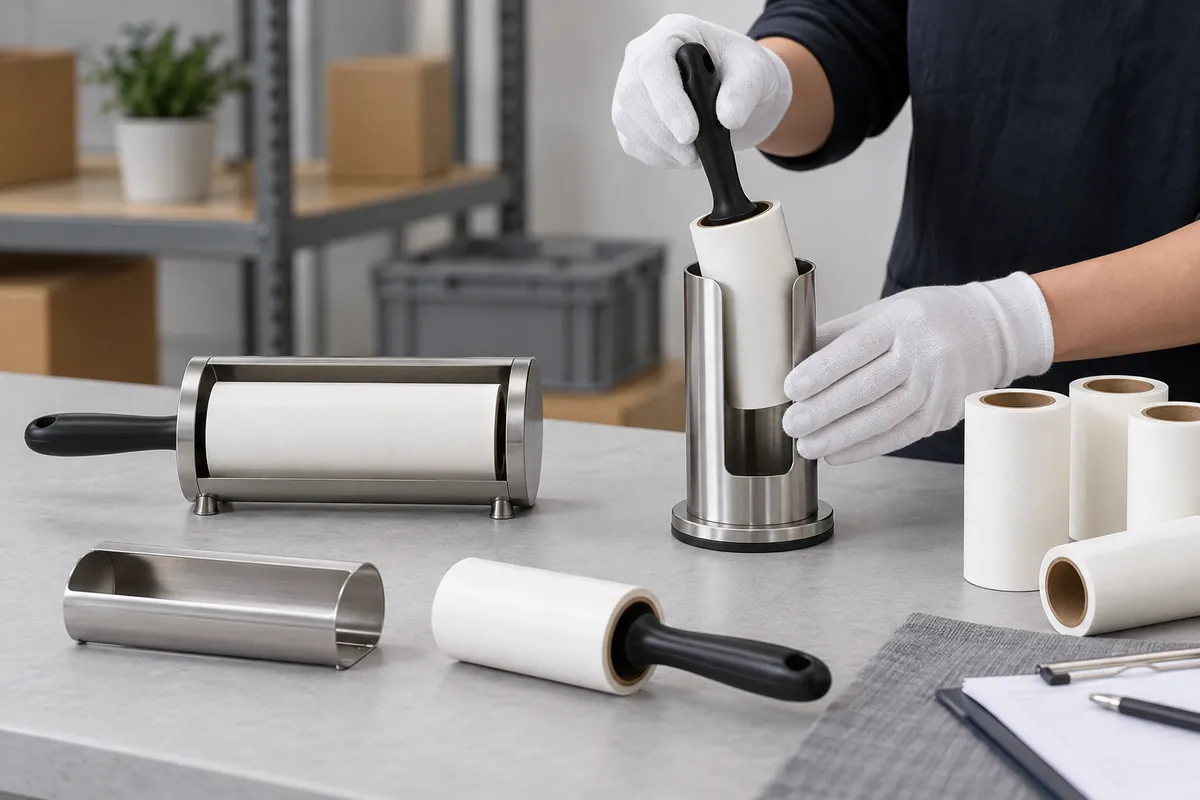
Use the process view to set up the physical check: place the exact roller in its intended rest, retrieve it by the handle, return it, then access any removable liner or waste insert. Record the movement and any part that catches or rocks. A visual review identifies fit and access questions; it does not establish performance under use, cleaning or repeated cycles unless those criteria are separately defined.
Which dimensions should the supplier control?
Draw the outer holder envelope and the internal contact surfaces separately. Mark the support points, opening, rim height, handle clearance, insert cavity and any detents or locating features. Identify the datum for each measurement and show which part owns each interface. A supplier should not have to infer whether a handle rests on the top rim, inside a slot or against a separate bracket.
Where the roller is cylindrical, use an actual sample or model-specific drawing for the diameter and length. A tapered sleeve can sit differently from a constant-section sleeve. A wide handle may need a larger access opening than the body itself. If the holder includes a bag, pad or removable insert, include its installed and removed envelope. Do not substitute dimensioned artwork for a production drawing.
| Interface | Buyer reference | Approval evidence |
|---|---|---|
| Roller body | Brand/model, sleeve length and diameter | Named item seated in the holder |
| Handle | Length, cross-section and orientation | Lift and return without unintended obstruction |
| Refill | Replacement sleeve or roll model and access sequence | Refill installed in the stated direction |
| Holder opening | Clear width, rim and contact surfaces | Sample inspected from the approach side |
| Removable insert | Part identity and seated position | Insert removed and reinstalled as intended |
| Installation | Counter, cabinet or wall position | Access checked with neighboring boundaries present |
| Pack contents | Holder, tool, cover, insert and spare roll | Order list agrees with packaging and instructions |
For a metal housing, specify the material, finish, formed edges, joints and visible faces that need review. If an insert or accessory uses another material, make it a separate bill-of-material line. The buyer should state where dissimilar components contact and whether a cosmetic or protective pad is part of the offer. Avoid asserting a material property such as stain resistance or adhesive compatibility without product-specific evidence.
How should a sample be evaluated?
The sample review should follow the order in which a person uses the product. Begin with the holder empty; inspect the opening and installation. Load the roller in the specified orientation, confirm that it seats at the intended locations, and retrieve it using the normal hand path. Return it without forcing or scraping the roller against the finish. If the holder includes a lid or cover, operate it as part of the sequence.
Next, remove the refill or insert using the documented method. Confirm the buyer can identify the replacement part, reach the release point and put the item back in the correct orientation. If the unit is mounted, test service access with the product installed at the specified height and spacing. A bench-top check does not answer whether a door, shelf or wall limits access in the intended location.
Use a written sample form. List each check, the model tested, the observed condition, the pass/hold/deviation decision and the approver. “Pass” should name the actual roller and storage position. “Hold” may be appropriate if the refill sample is not yet available. A deviation should state which opening, insert, cover or accessory differs and whether it changes the product drawing or package contents.
If several roller models are included in the assortment, make a compatibility matrix rather than a general compatibility statement. The table can list model identifiers across columns and holder versions down rows, with each cell showing tested, not tested or excluded. Keep revisions linked to actual measurements. When a roller supplier changes its handle or sleeve, the buyer can then tell which fit decisions need to be repeated.
A metal lint roller holder fit record should include a model-by-holder matrix, separating verified references from untested rollers.
What do production and packaging controls need to cover?
The drawing should connect holder dimensions to stable datums. If the top opening locates the roller while the bottom supports it, control both features and their relation. A change to bend angle, joint position or finish build can affect a close interface, so the supplier should identify the critical-to-fit characteristics. The acceptance limits must be agreed for the actual product; this guide cannot supply universal tolerances.
A production reference should include the approved holder, roller model, insert, cover, hardware and finish. Photograph the assembled product in each relevant state and retain the drawing revision. If the metal supplier buys the insert or cleaner, list the purchasing specification and change-notification responsibility. If the buyer provides those parts, the order should say who verifies compatibility and who pays for rework if the reference changes.
Packaging should keep parts from shifting or contacting one another in a way that can scratch or deform the finished product. Define whether the handle, holder and refill ship assembled or separate. If the adhesive roller is bundled, provide suitable packaging directions from the roller supplier and make sure the holder’s insert does not damage it. Labels should identify the holder version and any compatibility boundary; a carton code that cannot be matched to a purchase order makes receiving harder.
Koitor’s home storage hardware manufacturing page describes its current product scope, but does not confirm a lint-roller holder SKU. Buyers considering a metal housing can submit the intended roller and drawing through contact Koitor to ask whether the formed metalwork falls within its documented capabilities. A feasibility discussion does not replace confirmation of the actual bill of materials, insert supplier or product performance.
For a distributor building an assortment, keep a compatibility matrix by holder version and roller model rather than merging different cleaners into a single “universal” SKU. The matrix can identify upright versus horizontal orientation, whether a removable insert is present, and which refill references were actually reviewed. This helps purchasing decide whether one holder serves several named items or whether separate SKUs reduce fit ambiguity. A shared component may simplify stocking, but only if the controlled interfaces remain compatible after every model revision.
Buyers should also decide how replacement parts will be identified after launch. A refill reference, insert code or lid part number printed in an instruction sheet can reduce mis-picks, provided the supplier has confirmed those identifiers and can maintain them across reorders. If replacement parts are not offered, say so instead of suggesting serviceability. Store the compatibility record with listing copy so a later marketing update does not broaden the fit claim beyond the original sample evidence.
Use the metal lint roller holder fit result to control listing language, replacement parts and repeat-order revisions.
Which sourcing errors create avoidable returns?
One error is approving only the sleeve diameter. A long handle, end cap or side release can interfere with the holder even when the roller body fits. Include all parts and the movement needed to use them.
Another is choosing orientation from a photograph. An upright holder may require a particular base or insert, while a horizontal cradle may rest on different surfaces. Approve the actual position and show it in the instructions.
A third is overlooking refill access. A user may be able to store the roller but unable to remove the used sleeve or reach the replacement. Verify the full replacement operation, including any parts that must be taken off or set aside.
A fourth is treating a removable insert as a cosmetic accessory. Its location and fit can govern whether a waste receptacle can be emptied or cleaned. Identify the insert and its seating surfaces in the drawing and packing list.
A fifth is expanding the compatibility claim beyond the tested models. A product page listing one model does not prove universal fit. Name the references actually checked and keep the untested models out of the claim.
What should the importer approve before placing an order?
Before RFQ, submit the intended holder architecture, roller model and revision, refill reference, installation mode, expected use position, materials, finish, target order quantity, package contents and any compatibility statement planned for the listing. Identify who supplies the cleaner, insert, cover and other purchased parts.
Before approval, perform the load, retrieve, return and refill sequence with the complete sample. Check internal clearances, hand access, cover movement, mounting position, insert seating, finish and included components. Freeze the drawing, photographs, model references and deviation decisions. At shipment, compare a packed sample and the carton identification with the approved configuration.
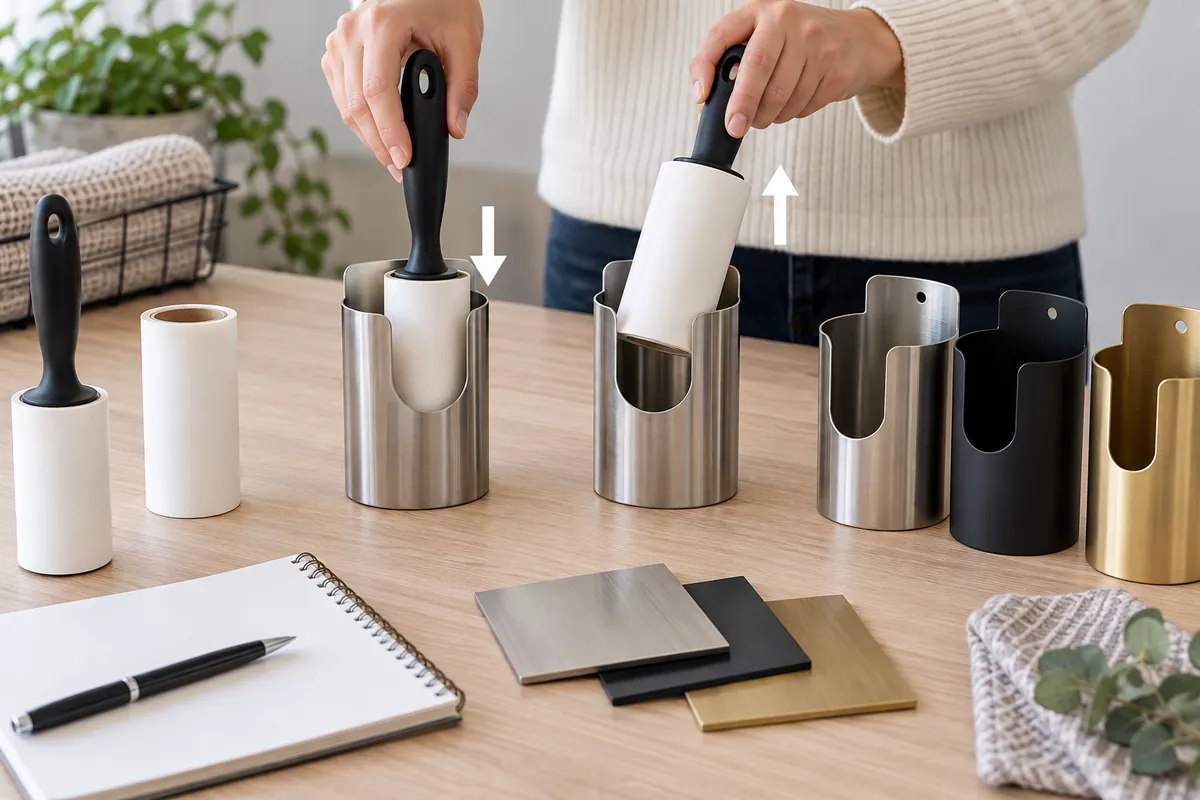
Does the roller body fitting mean the handle will fit?
No. Handle length, cross-section, orientation and retrieval path need their own check with the intended holder.
Should a buyer test replacement refills?
Yes, if refills are part of the product’s use or compatibility promise. Use the identified roll and document its model.
Does a removable waste insert come with every lint-roller holder?
No. The bill of materials and current product listing must identify included parts. Verify the sample and pack list.
Can a holder be described as fitting all lint rollers?
Only if that claim is supported by a defined, adequately broad compatibility review. Otherwise list the tested references and exclusions.
Reference example: Yamazaki Home Tower lint-roller holder documents one model-specific holder and insert architecture; confirm current product details directly.
Review a metal storage concept with Koitor
Share the housing drawing, roller references and included-part list. Koitor can confirm whether the metalwork fits its documented capabilities before a product scope is assumed.
OEM / PRIVATE LABEL
Turn this sourcing guide into a product brief
Share your target product, size, finish, order quantity and packaging requirements. Your team receives a practical manufacturability review before quotation.

 English
 Español
 Português
 Français
 Deutsch
 العربية