
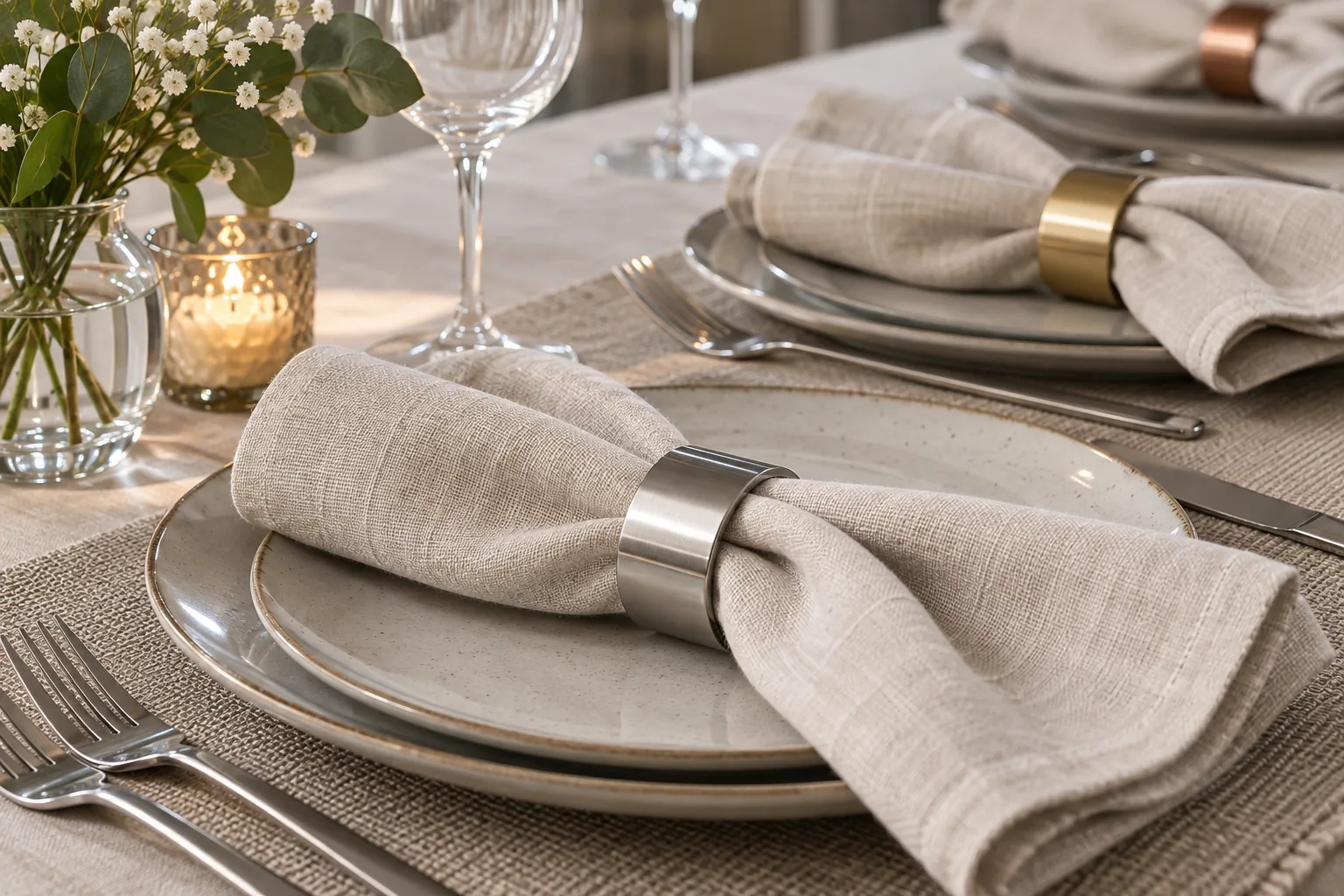
Metal napkin ring linen fit should be evaluated with the actual napkin folded in its intended presentation, then checked through insertion, placement and removal. Outside diameter alone does not show how much clearance remains inside, how a seam or ornament contacts the textile, or whether the folded material can be pulled out without snagging. Importers should define the napkin references and the set configuration before approving a sample.
What does “fit” mean for a napkin ring?
For a single ring, fit has at least three parts: the folded napkin must enter the opening, the ring must sit in the intended position, and the napkin must come out in the expected way. A product that passes only the first step may bunch or catch when a customer removes it. Conversely, a very loose ring may not present the folded napkin as intended. The buyer should define the intended appearance and handling instead of relying on the unqualified word “fits.”
Specify whether the product is designed for cloth napkins, paper napkins or both. A cloth napkin has seams, hem thickness and fabric recovery; a paper napkin has creases, layers and a different stiffness. Even within one type, fold method and material change the compressed profile. If the product is sold for a broad range, name the tested references and keep unsupported compatibility promises out of the listing.
An official WMF Grace napkin ring page identifies a particular ring set for cloth and paper napkins. Alessi’s Girotondo ring page documents another model-specific shape and product. These references show that ring form and marketed use can vary by model. They are not a universal textile fit standard; verify current versions and assess the buyer’s own napkins.
The buyer should decide whether napkins are included, used only as fit references, or shown only for styling. If they are not included, state that in the product details. Images can demonstrate intended use, but they cannot silently expand the commercial package to include linen.
How should the napkin reference be prepared?
Use a physical napkin from the target assortment or a named controlled sample. Record the supplier, style, material, dimensions, hem, seam location and revision where available. Then describe the folding sequence and final folded envelope. A square napkin folded once is not equivalent to a napkin rolled, pleated or folded into several layers.
The ring’s internal opening should be considered at its narrowest point and along the path where the fabric travels. For a round ring, the inside diameter may be useful, but it does not define the opening if the ring is oval, sculpted or interrupted by a joint. For an asymmetric shape, identify the orientation of insertion and any local narrowing. A buyer should not infer the usable opening from the exterior silhouette.
Check the complete textile profile. A hem crossing the opening can form a thicker region; a decorative stitch or corner can catch at a joint or edge. If the ring will be used with a particular fold that places a seam on the outside, record that position. When several fold styles are commercially relevant, test them individually and list each result rather than averaging them into a single fit statement.
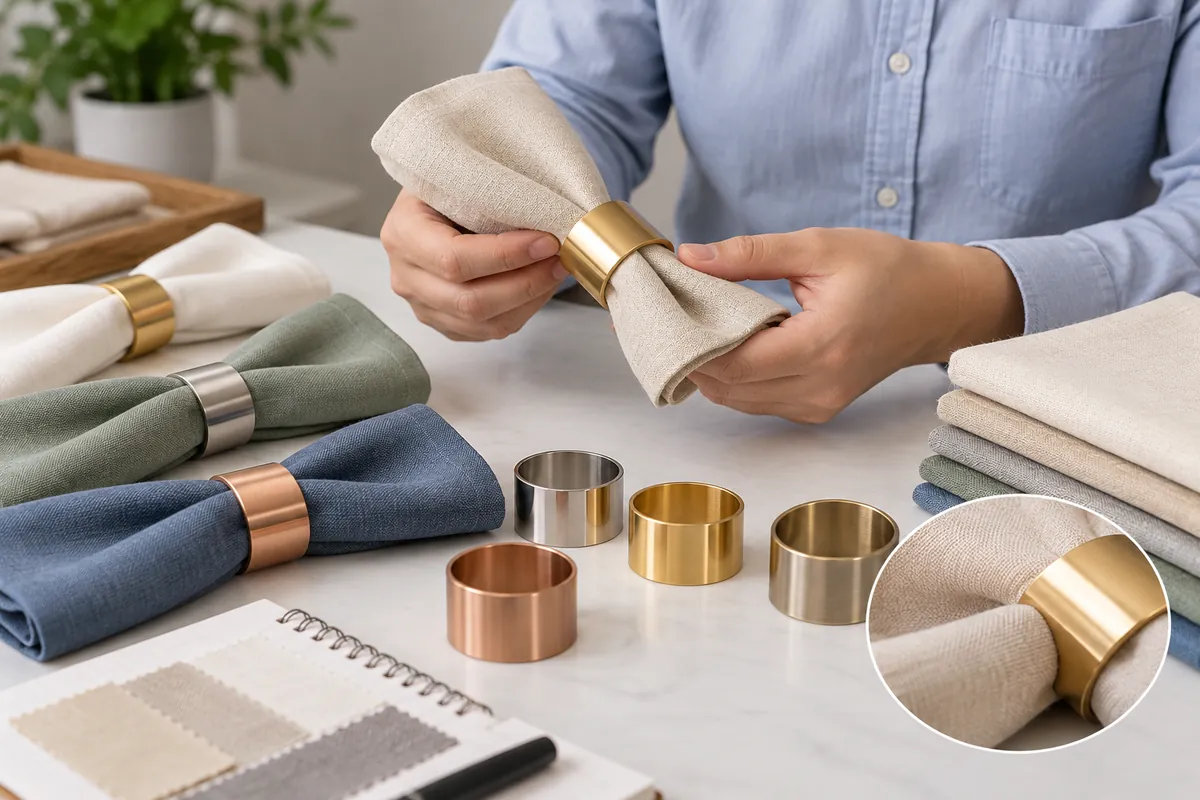
Use the process image to plan a simple sequence: prepare the napkin, pass the intended end or folded bundle through the ring, place it on the table, then remove it by the expected method. The actual sample and linen govern the review. A concept picture cannot establish opening dimensions or prove that a finish will not snag a particular fabric.
A metal napkin ring linen fit review should state which folds and textile references were actually tested.
Which ring dimensions and finish features should be controlled?
The drawing should show the inside opening, outside envelope, material section, ring width, joint or closure, ornament and any contact edge. Identify how the ring rests on the table and whether its shape is symmetric. If there is an opening or gap, mark its dimension and the intended direction of entry. Clarify whether the design is a closed continuous ring or a formed loop with a joint.
Specify the material and finish by the evidence the buyer needs. If the product is described as stainless or plated, request confirmation for the actual model and parts. Define which surfaces are visible and which contact linen. A smooth appearance is not proof that there are no burrs or sharp edges, and a polished look does not prove resistance to discoloration. State the inspection criteria and verify them on the sample.
| Buyer requirement | Reference detail | Sample acceptance question |
|---|---|---|
| Napkin type | Cloth, paper or both; named model | Is the tested material the one the product is sold for? |
| Fold | Sequence, layers and hem position | Does the folded reference pass through as intended? |
| Opening | Inside profile and narrowest region | Does the whole insertion path clear the textile? |
| Contact | Ring edges, joint and ornament | Does the sample snag or visibly mark the reference? |
| Removal | Direction and grip location | Can the napkin be withdrawn in the planned sequence? |
| Set | Number of rings and pack arrangement | Does each piece and the package match the offer? |
| Revision | Drawing, finish and textile reference | Can later orders be compared with the approved set? |
If the ring is made from bent wire or formed strip, record the section and the closure method. If the product has a welded joint, locate it relative to the visible side and napkin path. These details help buyers review appearance and contact without making a blanket claim about strength or durability. The supplier and buyer should agree which dimensions affect the opening and which are primarily cosmetic.
How should the sample be tested with linen?
The trial should begin with a clean, identified sample ring and a controlled napkin. Prepare the fold exactly as the intended user will. Insert it using the expected direction, place the ring and textile on a representative surface, then remove the napkin using the normal grip. Inspect the material at contact locations for pulled threads, visible marks or distortion. Record observations without claiming that a brief check predicts every fabric’s long-term behavior.
If the ring is intended to be reusable, repeat the insertion and removal sequence with the buyer’s chosen number of cycles only when a specific cycle test is required. Define the napkin, method and acceptance rule before the test. Do not create a universal cycle count or call a ring “fabric safe” based on a visual inspection alone. Where fabric damage has commercial consequences, define a product-specific test with the textile supplier and the ring manufacturer.
Check the pieces in the set for variation. A display may use multiple rings together, so differences in opening, silhouette or finish can be visible. The buyer should decide whether visual matching matters and how it will be inspected. If a set contains several designs, identify each SKU and its corresponding napkin use rather than assume all pieces share one opening.
What set, display and packaging information belongs in the RFQ?
The RFQ should state the number of rings, material and finish requirements, packaging unit, labeling, intended napkin types and any gift-box or private-label needs. If the product is sold in sets, specify whether all rings should match exactly or whether a coordinated assortment is acceptable. Include any separator, pouch or insert that protects contact surfaces from rubbing in transit.
The product display should identify whether napkins are included. If the ring is photographed with cloth or paper, avoid implying that the textile is part of the package unless it is. Retail copy should describe tested napkin references accurately; if only one folded cloth style has been reviewed, do not claim universal fit. For e-commerce, the buyer can show the ring opening and a scale reference, but the photo should be illustrative and not replace written dimensions.
Packaging review should check whether rings contact each other in a way that can mark the finish. Confirm that each ring is identified, the set count is correct, and instructions or care information match the approved materials. Packaging requirements depend on the distribution route and product presentation. A gift box can protect a product from ordinary contact in a defined pack, but it does not guarantee against shipping damage.
Koitor’s business is centered on bathroom and home-storage metal hardware; the company home page provides that current context but does not confirm a napkin-ring SKU. A buyer with a new metal-forming concept can share the drawing, material and finish request through contact Koitor to ask whether a project falls within documented capabilities. Any tabletop product should be treated as a new feasibility discussion until explicitly confirmed.
For hospitality assortment planning, define the number of rings required per table setting and whether replacement pieces should match earlier lots. A buyer may use several linen colors or napkin-fold styles across a property. That does not mean each combination needs a different ring, but the combinations that will be represented as compatible should be listed and checked. Record which textile references were tested, which remain unreviewed and whether the same ring finish is used across the set.
A replacement plan is useful when rings are sold in multi-piece packs. Identify the pack count, spare quantity if one is offered, product code and how a single replacement is ordered. Do not imply that replacement singles are available unless the supplier confirms them. The carton and retail label should make the set quantity clear, and the product listing should distinguish the ring from napkins used only for photography. These details help buyers align initial orders, visual merchandising and repeat-purchase expectations without turning the fit check into a claim about every linen or dining environment.
For a private-label launch, approve the product name, finish description and reference napkin together. A name such as “linen ring” can sound broader than the tested use. The buyer can instead describe the actual ring profile and show the defined napkin arrangement, while keeping any untested fabric types out of compatibility copy. If the assortment later adds a thicker hem, paper fold or different opening shape, update the sample matrix before expanding the listing.
Keep the metal napkin ring linen fit decision with the ring finish, set count and sample revision so retail claims remain bounded.
Which sourcing errors should importers prevent?
The first error is checking only the outside diameter. That dimension does not describe the interior opening, joint or textile path. Specify the opening where it matters and test it with the folded napkin.
The second is testing a different cloth than the product will be used with. A reference without the same hem, fold or thickness can lead to a misleading approval. Use the real target textile or a controlled sample from the same supplier.
The third is using the word “universal.” A ring can fit one paper fold and fail with a bulky cloth fold. List the actual references and state the limits plainly.
The fourth is approving one ring from a multi-piece set. All pieces should be checked if they have different shapes, sizes or finishes. The approved pack should include the correct count and each component revision.
The fifth is treating appearance as a substitute for contact review. A bright finish may look smooth while a seam or edge catches the napkin. Inspect the actual contact path and define a finish acceptance method.
What should the buyer checklist cover?
Before quotation, provide the ring style, napkin references, fold method, set count, material and finish requirements, retail presentation, labels and packaging. Clarify whether napkins are supplied, photographed only, or used strictly as sample references.
Before approval, insert and remove the actual folded napkin, inspect the contact edges and joint, check every piece in a set, compare visible finishes, record the accepted drawing revision and document any exclusions. At receiving, confirm the count, packaging condition, SKU identification and correspondence between product listing and delivered components.
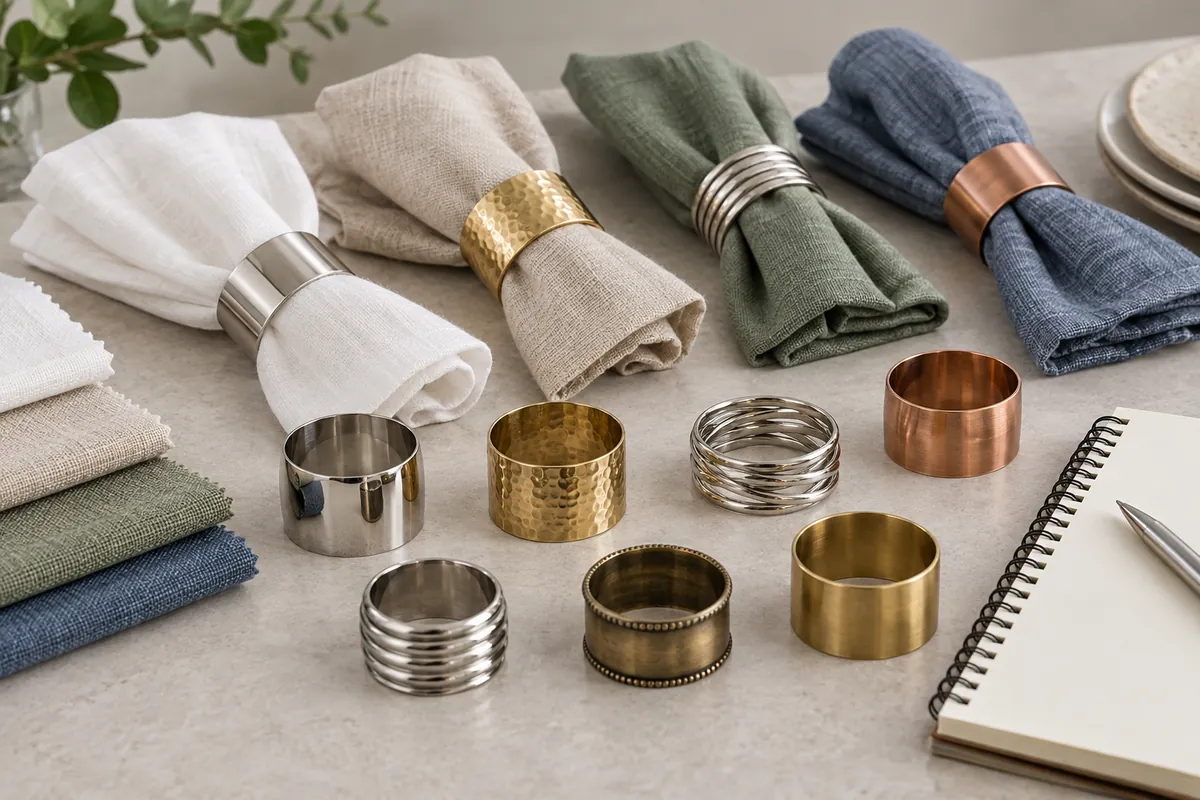
Should the ring be measured using outside diameter?
Outside diameter is useful for the product envelope, but it does not describe the usable opening. Record the internal profile and test the actual fold.
Can one ring be listed for both paper and cloth napkins?
Only when the buyer has checked the intended references for both. Material, thickness and fold can change insertion and removal.
Does a polished finish guarantee that fabric will not snag?
No. Review the real contact surfaces and seam with the actual textile. Appearance alone is not a snag test.
Should napkins be included in the product photography?
They may be shown as a use reference, but the listing and package description must say whether they are included.
Reference examples: WMF Grace napkin rings and Alessi Girotondo are distinct current product references; check live versions before using specifications.
Discuss a formed-metal product concept
Share the ring drawing, material and finish requirements, and intended textile reference. Koitor can confirm whether the metalwork fits its documented manufacturing scope before capability is assumed.
OEM / PRIVATE LABEL
Turn this sourcing guide into a product brief
Share your target product, size, finish, order quantity and packaging requirements. Your team receives a practical manufacturability review before quotation.


 English
 Español
 Português
 Français
 Deutsch
 العربية