
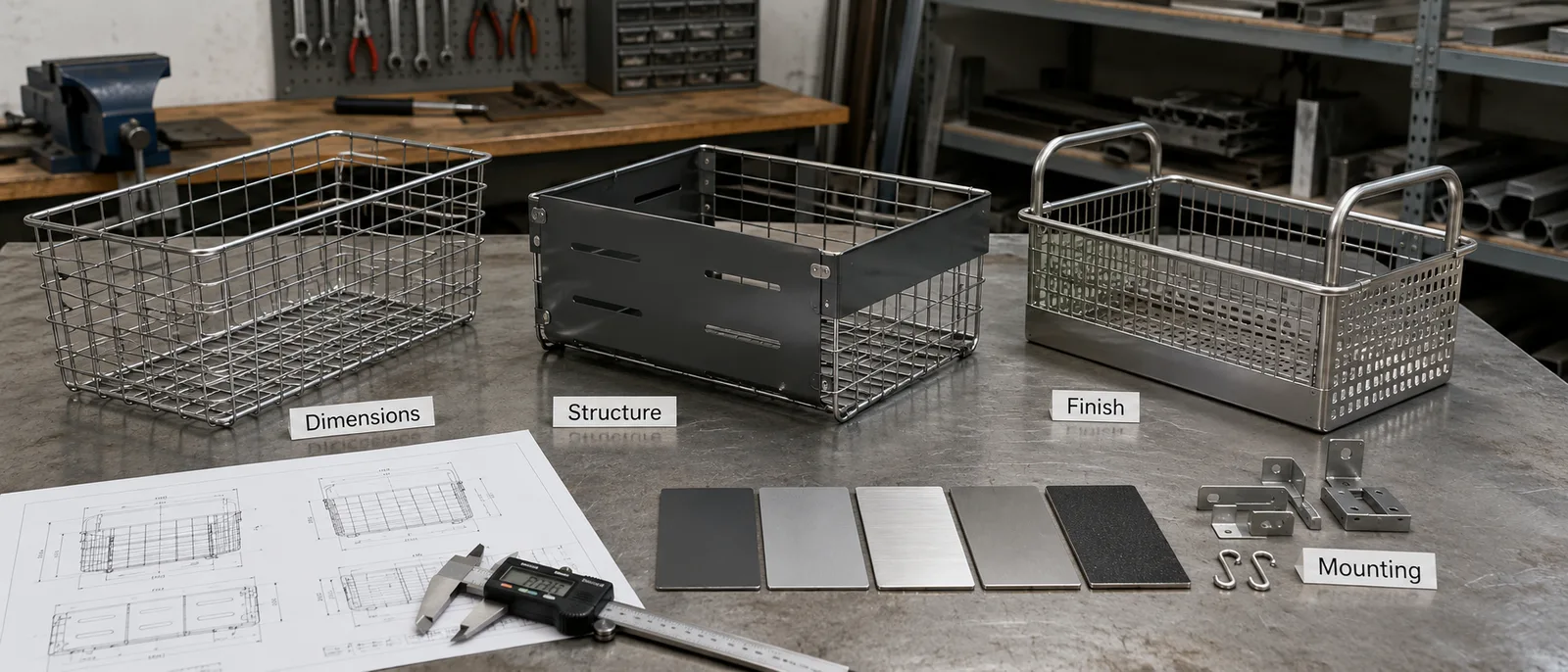
Importers developing custom metal storage baskets should define the product’s intended use, overall dimensions, usable internal space, wire or tube structure, mounting method, finish, packaging and approval tests before requesting a final quotation. A reference photo can communicate style, but an OEM project needs measurable specifications. The safest path is to convert the buyer’s idea, drawing or physical sample into a controlled product specification, approve a prototype and keep the same revision for production and inspection.
Metal baskets look simple, yet small structural choices affect manufacturability and buyer experience. Wire spacing changes containment. Rim construction affects rigidity and appearance. Feet or brackets affect stability and installation. Weld locations influence both strength and finish quality. Buyers who define these relationships early receive more comparable quotations and reduce late sample revisions.
What Specifications Should an Importer Define First?
An importer should first define where the basket will be used, what it must hold and how the user will install, carry or access it. These three decisions guide the dimensions, structure, finish and packaging more reliably than choosing a basket from appearance alone.
Start with the product environment. A shower basket faces moisture and drainage concerns. A kitchen rack may need space for bottles, dishes or cleaning items. A cabinet organizer must fit a fixed opening and may interact with runners, doors or shelves. A freestanding home storage basket needs stable contact points and safe edges. The same visual design cannot be copied across these uses without reviewing function.
Record both external and usable internal dimensions. Overall width, depth and height determine shelf fit, packaging and shipping volume. Internal dimensions determine whether the target items actually fit. If the basket has a tapered wall, rolled rim or inward-facing bracket, the opening and base dimensions may differ. A drawing should show the critical measurement locations rather than listing only three overall numbers.
Define the expected contents in practical terms. Product examples and approximate weight distribution help a manufacturer understand the use case, but any claimed load capacity should be confirmed through a project-specific test and agreed acceptance criteria. A basket holding folded towels behaves differently from one holding tall bottles concentrated near one side.
The mounting or support method must also be explicit. Options may include wall brackets, hooks, cabinet mounting points, feet, handles or placement on a shelf. Buyers should supply hole spacing, wall clearance, mating-part dimensions and intended hardware where relevant. Installation components are part of the product specification, not an afterthought.
Initial Basket Specification Checklist
- Target room, storage task and sales channel.
- Overall width, depth and height with measurement points.
- Usable opening and base dimensions.
- Target contents and expected weight distribution.
- Wire spacing and smallest item that must be retained.
- Rim, handle, foot, bracket and mounting arrangement.
- Material and finish direction.
- Required installation hardware and instructions.
- Retail packaging and master-carton expectations.
- Sample approval and project-specific inspection criteria.
How Do Wire, Tube and Sheet Structures Compare?
Wire, tube and sheet structures offer different balances of visibility, drainage, rigidity, weight, forming complexity and product presentation. Many baskets combine more than one form, such as a wire body with a heavier rim, sheet mounting plate or tube handle.
| Structure type | Typical role | Buyer advantage | Key review point |
|---|---|---|---|
| Parallel wire | Basket sides, base and dividers | Open appearance, drainage and flexible spacing | Wire diameter, spacing, end treatment and weld position |
| Wire mesh or grid | Small-item containment and flat panels | More frequent support points | Grid size, cut edges, alignment and visual density |
| Solid or perforated sheet | Base, decorative side or mounting plate | Continuous surface and controlled perforation pattern | Thickness, drainage, edge forming and scratch visibility |
| Tube or heavy rim | Top frame, handle or structural rail | Defined outline and improved hand contact | Bend radius, joint location, alignment and cap treatment |
| Mixed construction | Retail baskets combining function and appearance | Each material form serves a specific role | Joint compatibility, finish coverage and production sequence |
Wire diameter should be selected together with span length, spacing, rim support and expected use. Increasing diameter can change weight, bend radius, visual proportion, welding behavior and cost. It should not be treated as a single shortcut for strength. The complete structure needs review.
Wire spacing is equally important. Tight spacing retains smaller products but creates more material, welds and visual density. Wider spacing can make a basket feel lighter and improve drainage, but small items may fall through or tilt. Buyers should place real target items in the prototype rather than approving spacing only from a screen rendering.
A custom metal storage basket production project should therefore identify which parts provide containment, which parts provide support and which parts are mainly visual. That distinction helps the factory propose a practical construction without silently changing the buyer’s intended function.
How Should Material and Surface Finish Be Selected?
Material and surface finish for custom metal storage baskets should be selected according to product environment, target appearance, formed structure, maintenance expectations and buyer budget. No finish should be described as universally rust-proof; corrosion risk depends on material, preparation, coating coverage, exposure, cleaning and product design.
Powder-coated steel can provide broad color and texture options for bathroom and home storage hardware. The buyer should define a color reference, gloss or texture direction and acceptable appearance on visible and hidden surfaces. Edges, welds, hooks and contact points deserve particular attention because geometry can affect coating coverage.
Stainless steel can be suitable where the buyer wants a metallic appearance or a material choice associated with improved corrosion resistance. The grade, surface direction, polishing expectation and weld cleanup should be confirmed for the project. The term “stainless” alone does not define the finished appearance or guarantee performance in every environment.
Plated or other decorative finishes may be considered when technically appropriate, but the process, substrate and color reference need confirmation. Buyers should compare physical finish samples under useful lighting and check how the finish looks on welds, bends and large flat areas, not only on a small swatch.
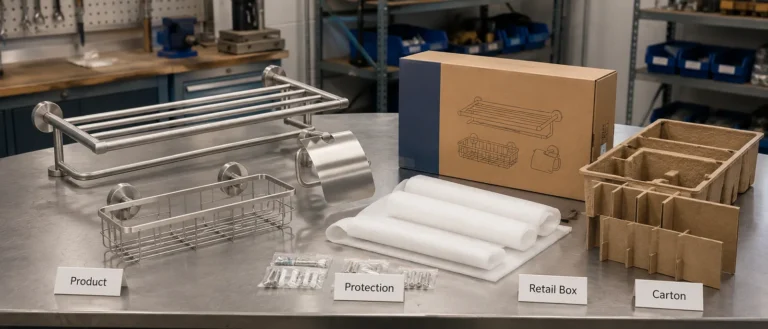
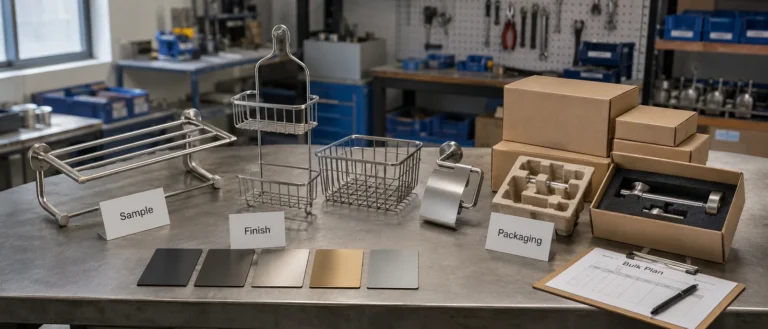
Finish selection also affects packaging. Polished or smooth dark surfaces may reveal rubbing marks more easily than some textured finishes. Sleeves, separators and hardware-bag placement should be reviewed with the actual finish. A packaging sample that protects an unfinished prototype may not be adequate for the final decorative surface.
Why Do Rim, Weld and Support Details Matter?
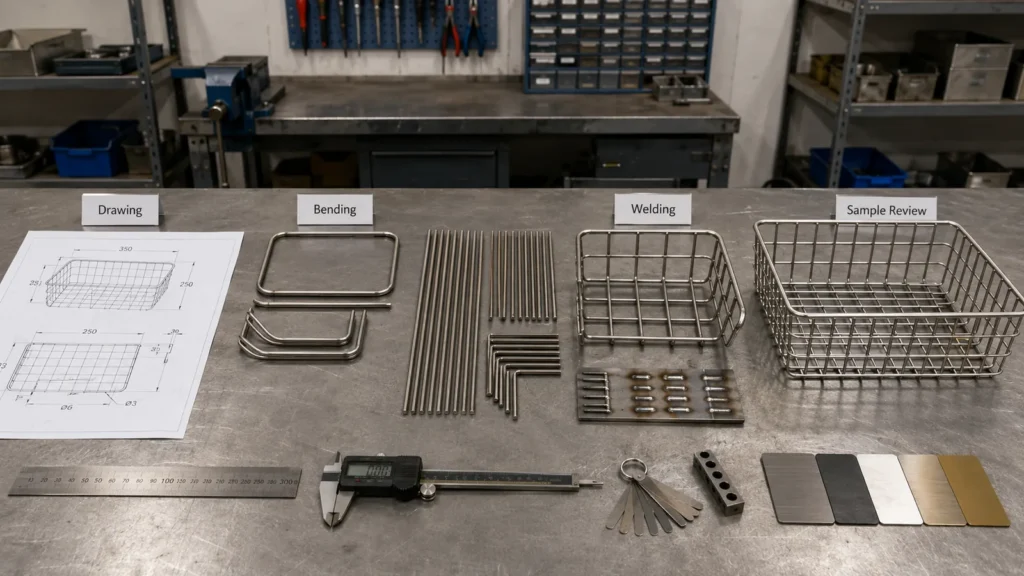
Rim, weld and support details matter because they determine whether the basket holds its shape, sits or hangs correctly and presents clean visible lines. A visually simple outline may require careful control of bending, joint location, welding sequence, grinding and inspection.
The rim establishes the upper geometry and often carries handles, side wires or hanging features. Buyers should define whether corners are rounded or sharp in appearance, where the rim joint may be located and how the internal wires meet it. If several baskets must nest, stack or align on a shelf, rim dimensions and taper become critical interfaces.
Weld quantity alone is not a quality specification. The drawing should identify necessary attachment points, while sample review should examine joint position, alignment, sharp projections, visible marks and distortion. Resistance welding, laser welding or TIG welding may be considered depending on the structure and required appearance. The appropriate process should be discussed for the specific product rather than prescribed from a generic photograph.
Base supports help distribute contents and control shape. Long unsupported wires may move differently from short spans. Crossbars, frames, feet or formed sheet areas can support the base, but they also affect cleaning, drainage, weight and packaging. Any project-specific load requirement should be checked with an agreed sample and test method before bulk production.
Mounting brackets create another structural interface. Hole spacing, bracket thickness, wall clearance, fastener access and decorative cover fit should be shown in the drawing. For a freestanding basket, foot height and contact points should be checked on a flat surface. For a hanging basket, hook shape and mating dimensions should be tested with the intended rail or cabinet feature.
Koitor Hardware’s practical approach is to review the basket’s rim, wire layout, welding points, supports, finish and packaging as one manufacturing system. As a family-owned custom metal hardware factory, Koitor can discuss resistance welding, laser welding, TIG welding, bending, grinding, polishing, powder coating, assembly and packaging preparation according to the project structure.
What Should Buyers Send for Quotation and Sampling?
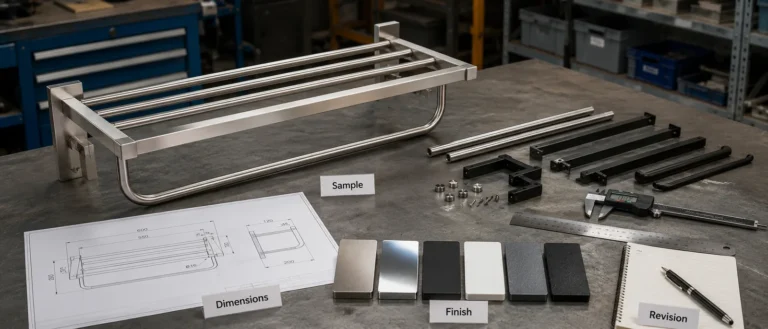
Buyers should send a dimensioned drawing or physical sample, product-use brief, material and finish direction, target quantity, packaging idea and list of critical approval points. Clear inputs allow a metal wire basket manufacturer to identify assumptions before quotation instead of hiding them inside a price.
A drawing does not need to begin as a complete engineering file, but it should distinguish confirmed requirements from open questions. Mark overall and internal dimensions, wire diameter and spacing, rim size, bracket or foot positions, mounting holes and visible surfaces. Include photographs of target items or installation context when they clarify use.
A physical reference sample is useful when the buyer wants to preserve proportions, feel or construction details that are difficult to describe. The buyer should state what must remain, what should change and whether the reference is owned or legally usable for development. The factory can measure it, but measured dimensions still need buyer confirmation in a controlled drawing.
RFQ and Sample Package Checklist
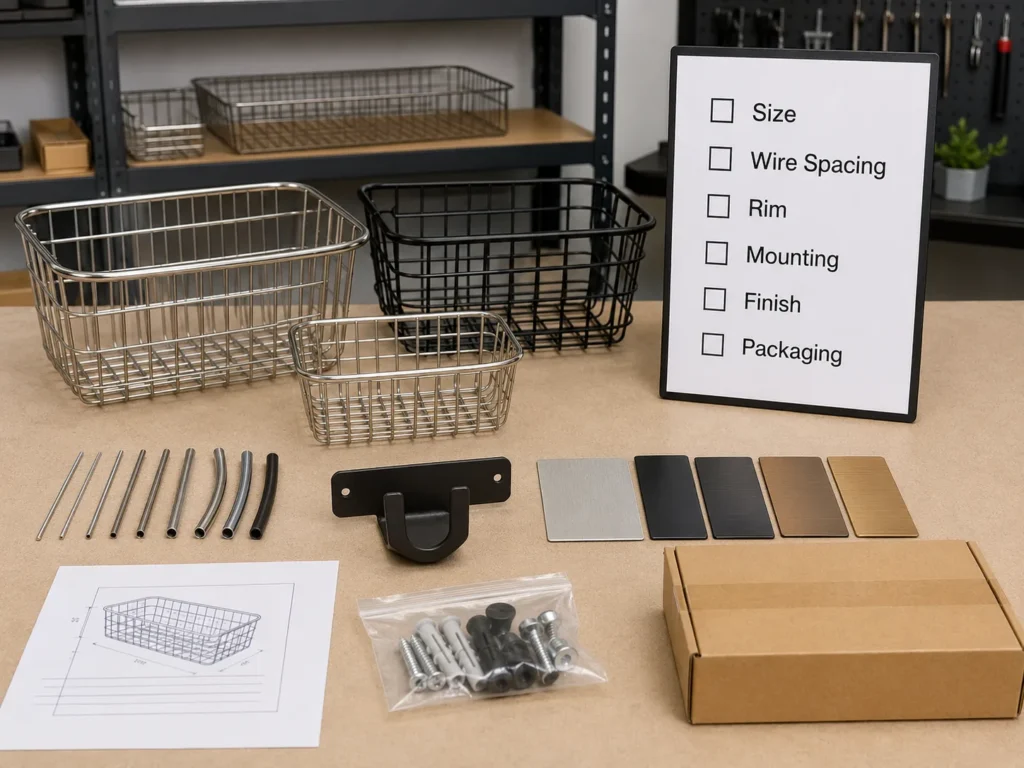
- Product name, intended use and target market.
- Drawing revision or physical sample identification.
- Critical dimensions and acceptable variation where defined.
- Wire, tube, sheet and bracket dimensions.
- Target material and finish reference.
- Mounting hardware, feet, handles or accessories.
- Project-specific performance and inspection requirements.
- Retail pack, label, instruction and master-carton concept.
- Expected trial and repeat-order quantities.
- Requested sample timing and decision deadline.
MOQ can start from 100 pieces depending on product structure, material, finish and packaging. Samples usually take 5-7 working days after the main details and materials are confirmed, while bulk production usually takes 4-6 weeks depending on quantity, complexity, material availability, finish and packaging. These are planning references, not fixed guarantees.
A prototype for custom metal storage baskets should be reviewed with real target items and the intended installation method. Measure the basket, inspect alignment and joints, assess the finish, verify hardware and place it in the proposed package. Record revisions with dated photographs and an updated drawing so the approved configuration can guide production.
For broader coordinated ranges, buyers can also review Koitor’s OEM home storage hardware capabilities.
Which Customization Mistakes Cause Rework?
The most common causes of rework are incomplete dimensions, undefined product use, finish approval from screen images, changing several variables at once and approving appearance without checking installation or packaging. Each mistake leaves the factory to interpret a decision that belongs in the specification.
One frequent problem is copying overall dimensions from an existing basket while ignoring usable internal space. A thicker rim, inward bracket or tapered wall can reduce capacity. Buyers should evaluate the items the basket is intended to hold and mark dimensions at the opening, base and any narrow point.
Another problem is requesting a stronger basket without identifying the actual failure concern. The issue may be base deflection, rim distortion, bracket movement, instability or weld separation. Each concern can require a different structural response. A specific use case and test plan are more useful than a vague request for heavier wire.
Changing wire spacing, finish, mounting and packaging in one sample revision also makes evaluation difficult. Revise the controlled drawing, list each change and identify whether another physical sample is required. Production should not begin from comments scattered across messages.
Buyers should also avoid approving the product without its hardware and packaging. Missing screws or unstable carton restraint can create customer complaints even when the basket itself is correctly manufactured. The approved unit should include the complete selling configuration.
Additional product-development guidance is available through Koitor resources.
Frequently Asked Questions
Can a custom storage basket supplier quote from a photo?
A supplier may provide an early estimate from clear photos and approximate dimensions, but a reliable quotation needs confirmed structure, material, finish, mounting parts, packaging and quantity. Hidden supports and joints can materially affect production.
Should a buyer specify wire diameter or performance?
Ideally, specify both known construction requirements and the intended use. Wire diameter is only one part of performance; span, spacing, rim support, welding and mounting also matter. Any load requirement should use a project-specific test method and acceptance criteria.
Can OEM wire baskets be developed from a physical sample?
Yes. A physical sample can guide dimensions, proportions and construction, while the buyer identifies required changes. The measured result should be converted into an approved drawing and revision before production.
When should the finish be approved?
Approve the finish direction before the final prototype where possible, then confirm it on representative product geometry. Review visible surfaces, weld areas, bends, edges and packaging contact points rather than relying only on a flat color swatch.
Is a trial order useful for a new basket design?
A small-batch trial order can help buyers review production consistency, packaging, installation and market response before planning a larger repeat order. Quantity and feasibility depend on the structure, finish and packaging components.
Work With Koitor Hardware
Have a Metal Basket Drawing or Physical Sample?
Send Koitor your basket drawing or sample, target contents, critical dimensions, material, finish, mounting method, packaging idea and expected quantity. Our team can review manufacturability, sample development and small-batch production options before quotation.
OEM / PRIVATE LABEL
Turn this sourcing guide into a product brief
Share your target product, size, finish, order quantity and packaging requirements. Your team receives a practical manufacturability review before quotation.
 English
  Español