
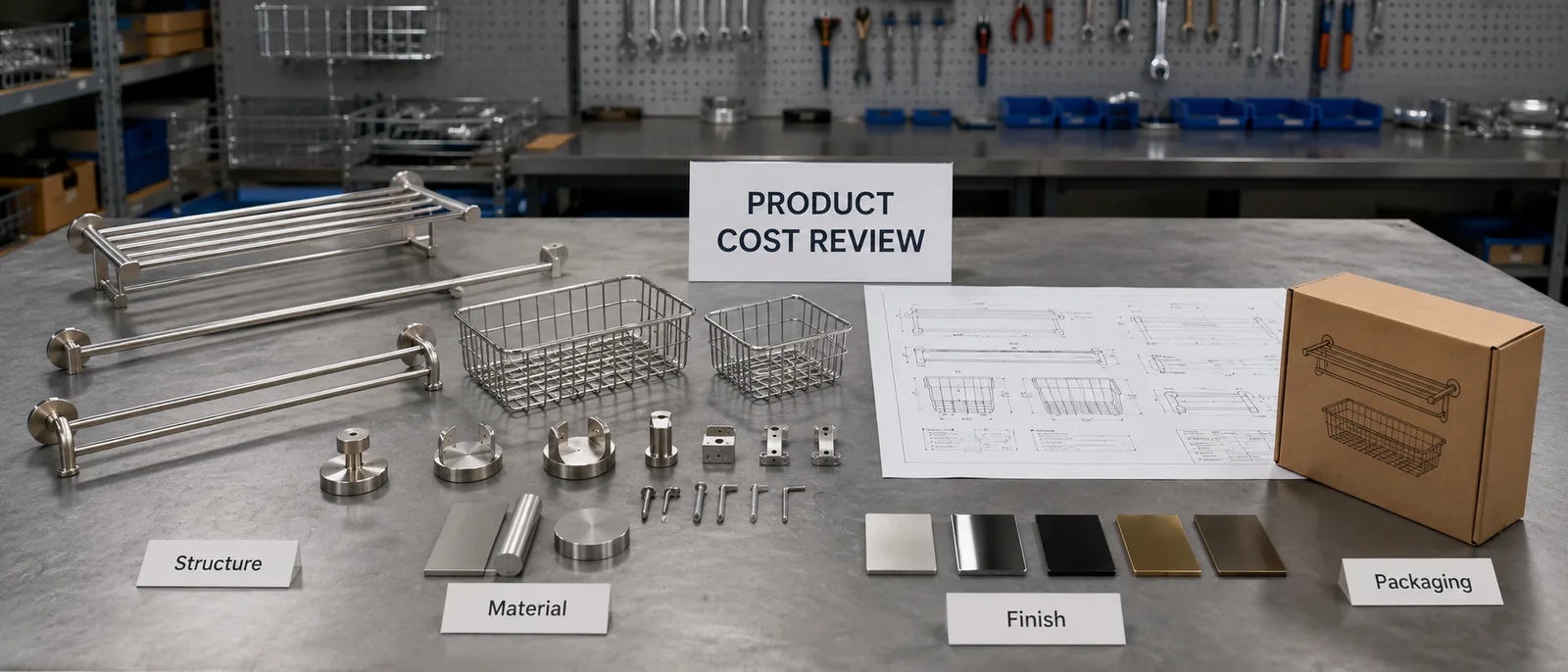
Buyers can reduce OEM hardware cost without lowering quality by protecting the product’s critical functions while simplifying noncritical geometry, using practical material sizes, limiting unnecessary finish variations, sharing components across a range, planning order quantities and reducing packaging waste. The process should begin before sampling, with the buyer and manufacturer agreeing which dimensions, strength points, surfaces, installation features and customer-facing details cannot change.
Cost reduction is not the same as asking for a lower price after the specification is fixed. Sustainable savings usually come from removing avoidable manufacturing complexity or purchasing inefficiency. A good review shows each proposed change, its cost driver, its effect on appearance or function and the confirmation needed before production.
Where Does OEM Bathroom Hardware Cost Come From?
OEM bathroom and home storage hardware cost comes from material, forming and welding work, surface finishing, purchased components, assembly, inspection, packaging, order quantity and project complexity. Buyers need to understand this cost structure before deciding which variable can change safely.
Material cost includes more than total product weight. Wire, tube and sheet dimensions affect purchasing options, cutting loss, bending behavior and the tools or fixtures needed during production. A special tube size used by only one product may be less efficient than a practical standard size that can serve several models, even if the weight difference is small.
Processing cost reflects the number and difficulty of operations. Every bend, punched feature, weld, ground joint, polished surface and assembly step requires time and control. Tight access, hidden joints and highly decorative transitions may slow production. A product with fewer parts is not automatically cheaper if the remaining parts require complex forming or difficult finishing.
Surface finishing has its own preparation, handling and minimum-batch considerations. Multiple colors or gloss levels can divide an order into smaller finish batches. Areas that need masking, polishing or cosmetic rework add operations. Buyers should distinguish a customer-visible finish requirement from a decorative detail that does not influence purchasing or use.
Packaging cost includes retail boxes, labels, instructions, protective sleeves, inserts, hardware bags and master cartons. It also affects packed volume and handling. A lower-priced box can create higher total cost if it increases movement, scratches, missing parts or shipping volume.
Quality cost should not be treated only as inspection labor. Clear drawings, approved samples, stable components and repeatable fixtures can prevent confusion and rework. Removing control points to reduce a quotation may simply move cost into claims, replacements or delayed launches.
Which Design Changes Can Lower Cost Safely?
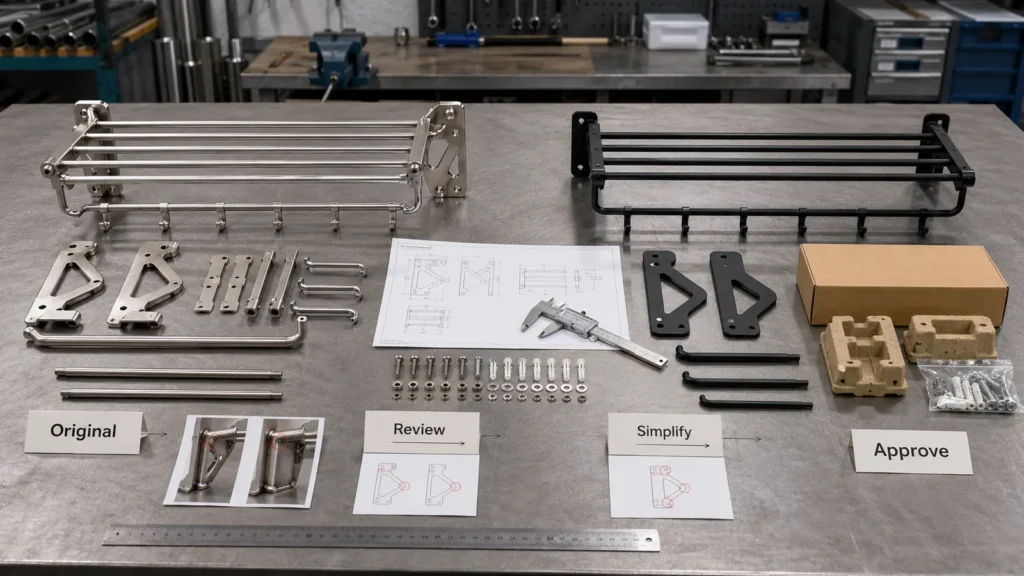
Safe design changes reduce manufacturing work while preserving the product’s intended storage function, installation, stability, appearance and packaging fit. This approach is often called value engineering: reviewing each feature by the value it provides compared with the complexity it creates.
| Cost driver | Possible review | Do not compromise without confirmation | Approval method |
|---|---|---|---|
| Many unique parts | Share brackets, caps or hardware across models | Fit, installation access and product identity | Assembly test and controlled parts list |
| Complex bends | Simplify radii or remove nonfunctional transitions | Usable space, clearances and visible proportions | Revised drawing and physical sample |
| Excessive weld or grinding work | Review joint location and necessary attachment points | Structural path, alignment and safe edges | Prototype and project-specific functional check |
| Special material size | Evaluate a practical available wire, tube or sheet size | Performance, mating dimensions and visual balance | Drawing revision and sample comparison |
| Too many finish variants | Consolidate colors or finish families | Brand positioning and market assortment needs | Physical finish reference and range plan |
Part consolidation is often a useful starting point. A towel rack, hook bar and tissue holder may be able to share certain mounting hardware or decorative covers when dimensions and installation requirements allow. Shared components can simplify purchasing, assembly instructions and spare-part control. The buyer should still confirm that each product installs correctly and retains its intended appearance.
Geometry should be reviewed with manufacturing sequence in mind. A decorative bend that adds no storage function may require a special fixture or additional handling. Moving a joint to a less visible and easier-to-access location may reduce grinding work. However, changes cannot be approved from cost alone; they must be checked for stability, safe use, wall clearance and packing.
For a coordinated range of OEM home storage hardware, a component matrix can identify which tubes, wires, feet, caps, brackets and fasteners are shared. This makes differences visible and prevents accidental creation of near-identical parts.
How Can Material and Finish Choices Be Optimized?
Material and finish choices can be optimized by selecting only the performance and appearance the product requires, using practical dimensions and grouping finish variants where possible. The objective is not to substitute a cheaper material blindly, but to align the specification with the actual environment and buyer value.
Steel with powder coating may suit many bathroom and home storage products when the structure, preparation and finish are developed for the project. Stainless steel may suit products requiring a metallic appearance or a different corrosion-resistance strategy. Neither option is universally best. The buyer should compare material, construction, surface direction, color, expected exposure, maintenance and packaging together.
Material thickness or wire diameter must be considered with span, supports, rim construction, weld positions and mounting method. Reducing one dimension can change deflection, visual feel or process behavior. Increasing it can add weight without correcting the real weak point. Use a physical sample and project-specific test criteria when performance is critical.
Finish consolidation can support bathroom hardware cost reduction. If a launch contains several similar black textures or metallic tones, the buyer can ask whether the assortment truly needs each variation. Larger, consistent finish batches may be easier to manage than many small variants, depending on the project and supplier process.
Visible-surface definitions can also prevent unnecessary work. A hidden mounting plate does not always need the same cosmetic standard as a front-facing towel bar, although it still needs suitable coverage and safe edges. The drawing or inspection document should classify important visible surfaces rather than leaving the expectation implicit.
A specialized custom bathroom hardware manufacturer can review how material and finish interact with forming, welding, polishing and packaging before the buyer freezes the specification.
How Do MOQ and Order Planning Affect Unit Cost?
MOQ and order planning affect unit cost because setup, fixtures, samples, finish preparation, printed packaging and purchased components are distributed across the order quantity. Buyers can improve efficiency by planning families, repeat orders and packaging materials instead of treating every SKU as a separate one-time project.
MOQ can start from 100 pieces depending on product structure, material, finish and packaging. A small trial order can be useful for testing a new product, but it may carry a different unit-cost structure from a repeat order. Buyers should ask which cost elements are one-time, quantity-sensitive or reusable.
Combining products is not automatically efficient. Two SKUs may share material and finish but require different fixtures, packaging and assembly. Ask the manufacturer which operations can genuinely be grouped. A production plan based on real shared processes is more useful than combining unrelated products only to reach a total quantity.
Forecast visibility can help with purchased parts and packaging. If a buyer expects repeat orders, it can discuss whether certain labels, boxes, screws or caps should be standardized across the range. Inventory arrangements create their own risks and should be agreed clearly; the factory should not assume future demand without buyer confirmation.
Sample approval also protects cost. Samples usually take 5-7 working days after details and materials are confirmed, while bulk production usually takes 4-6 weeks depending on quantity, complexity, material availability, finish and packaging. Rushing into production before the drawing and sample are stable can create rework that exceeds the time saved.
Can Packaging and Logistics Reduce Total Landed Cost?
Packaging and logistics can reduce total landed cost by controlling packed volume, preventing movement, sharing suitable packaging components and matching protection to the sales channel. The cheapest retail box is not necessarily the lowest-cost solution once damage, repacking and freight are considered.
Start with product orientation and empty space. A wall-mounted basket with projecting brackets may fit more efficiently if certain components are assembled later, but additional assembly can shift labor to the buyer or end user. Knock-down construction should be considered only when installation remains clear and the joint is suitable for repeated handling.
Retail packaging, inner packs and master cartons should be reviewed as one system. A smaller product box may improve carton utilization, but it must still restrain the product, hardware bag and instructions. Protective sleeves and separators should focus on real contact points rather than filling every space with material.
Packaging standardization can support OEM product cost optimization. Several related products may share instruction formats, label layouts or carton materials, while retaining product-specific dimensions and component lists. Buyers should not use a generic instruction sheet if it creates installation errors or incorrect hardware information.
Compare packed dimensions and weight after a physical packaging sample is approved. Early calculations based on product size alone can miss inserts, hardware and carton thickness. Freight planning should use the final selling configuration and confirmed master-carton arrangement.
How Should Buyers Compare Cost-Reduction Proposals?
To reduce OEM hardware cost responsibly, buyers should compare the original and revised specification side by side, with the expected benefit, quality risk and approval evidence stated for every change. A lower total price without an assumptions list is not a reliable cost comparison.
Cost Optimization Review Checklist
- Identify the current product revision and quotation basis.
- List each proposed change separately.
- State the cost driver being reduced: material, process, finish, component, quantity or packaging.
- Confirm which dimensions and functions remain unchanged.
- Review installation, stability, safe edges and intended storage use.
- Confirm visual changes on a drawing, finish reference or physical sample.
- Define any project-specific performance check and acceptance criteria.
- Update the bill of materials, packaging and inspection points.
- Separate one-time cost from recurring unit cost.
- Approve the final revision in writing before production.
Request transparent alternatives rather than one unexplained discount. For example, option A may keep the current structure with consolidated packaging, while option B may use a revised bracket and shared hardware. This allows the buyer to choose a trade-off intentionally.
Koitor Hardware’s practical approach is to review product structure, welding points, material sizes, surface finish, assembly and packaging before sampling. As a family-owned custom metal hardware factory, Koitor supports direct discussion of small-batch OEM options and manufacturability based on the buyer’s drawing or physical sample.
The final decision should protect the product attributes that drive buyer acceptance. A lower metal rack manufacturing cost is not useful if the rack becomes unstable, difficult to install, visibly inconsistent or expensive to ship. Cost, function, appearance and repeatability belong in the same approval process.
Additional sourcing and product-development guidance is available through Koitor resources.
Frequently Asked Questions
What is the fastest way to reduce OEM hardware cost?
The fastest responsible step is to ask the manufacturer for a cost-driver review before final sampling. Focus on unique parts, complex bends, difficult weld access, finish variants, packaging volume and low-quantity custom components. Approve every change against function and appearance.
Does reducing product weight always reduce cost?
No. Lower weight may reduce material use, but a thinner or different structure can require extra supports, create processing difficulty or fail to meet the intended function. Review the complete design and confirm it with a sample.
Should buyers negotiate price before or after sample approval?
Buyers can discuss budget targets early, but the final comparison should use a stable specification. If price changes after approval, confirm whether the material, process, finish, accessories, inspection or packaging basis also changed.
Can one mounting system be shared across several products?
Potentially, yes. Shared brackets, covers or fasteners may simplify a product family when wall clearance, product load, installation access and visual requirements are compatible. Each model still needs an assembly and installation check.
How can a trial order support cost optimization?
A trial order can reveal production, packaging, installation and market issues before a larger repeat order. The buyer can use the results to freeze common components and remove unnecessary variation, while recognizing that trial-order unit cost may differ from future quantities.
Work With Koitor Hardware
Need a Practical Cost Review for an OEM Hardware Project?
Send Koitor your drawing or sample, critical quality requirements, finish, packaging idea, target quantity and cost concern. Our team can review manufacturability and discuss practical options without silently changing the approved specification.
OEM / PRIVATE LABEL
Turn this sourcing guide into a product brief
Share your target product, size, finish, order quantity and packaging requirements. Your team receives a practical manufacturability review before quotation.



 English
  Español
  Português
  Français
  Deutsch
  العربية