

A combination paper towel dispenser waste receptacle may look like one wall-mounted cabinet, but it creates two separate operating paths. Someone replenishes clean towels through one access point; someone removes waste through another. The buyer must check that both operations work in the selected washroom layout and that the project team agrees on the wall envelope, consumable reference, access method and model revision before approval.
Manufacturer technical sheets show why this distinction matters. For example, product-specific documents for Bobrick B-3947 and Bradley 2A05 describe combined configurations with separate towel and waste compartments, but their dimensions, capacities, mounting options and door arrangements belong to those individual models. They are examples of an interface to evaluate, not universal requirements. This guide gives importers and project buyers a way to coordinate the pair without assuming that every combination unit is built the same way.
Why a combination paper towel dispenser waste receptacle has two service paths
A combined cabinet saves wall space by bringing two functions together, but the service tasks do not become one task. Replenishment may require opening an upper door, loading a particular towel fold and confirming the feed path. Waste removal may require a separate lower door, a removable bin, a liner or a collection container. The buyer should map each action and its user before deciding that the unit suits a room.
Manufacturer literature commonly identifies the actual configuration and model-specific dimensions. Bobrick’s B-3947 technical sheet, for instance, names a combined towel dispenser and waste receptacle with its own compartment arrangement. Bradley’s 2A05 documentation describes particular mounting options and component access for that model. A buyer can use these sources to see what a product-specific spec sheet should contain, but should not copy their sizes, refill capacities or cabinet openings into another project.
The distinction affects daily operations. A facility team may restock towels more often than it empties the waste receptacle, or one service contractor may perform both. In another building, janitorial routes may divide tasks. If the refill door is behind a door swing or the waste bin cannot be lifted past nearby fixtures, the unit may be inconvenient even when the nominal cabinet fits the wall.
This article uses combination paper towel dispenser waste receptacle as a buyer decision, not as a direct product recommendation. The right question is not simply whether a combined unit exists or whether it fits a wall opening. It is whether the selected model supports the specified refill and waste tasks in the actual room, using the chosen towel format and waste-handling method.
Separate product specification from room approval
The manufacturer defines the unit: outer dimensions, mounting, doors, locks, towel compatibility, bin configuration and service instructions. The project designer defines the wall construction, opening, adjacent fixtures, mirrors, doors and required installation context. The facility or procurement team defines who replenishes towels, who removes waste and what consumables are stocked. These inputs must meet at the sample or submittal review.
Do not ask an accessory supplier to approve the whole washroom installation unless that scope has been confirmed. A technical sheet may list a mounting approach, but the wall’s backing, substrate, electrical or plumbing adjacency and local project requirements still need the responsible designer or installer. This guide does not set universal mounting heights, accessible reach ranges, code clearances or structural requirements. Those belong to current project documents and the applicable professional.
A combined unit can include a metal shell or cabinet as well as proprietary mechanisms, locks or bins. A company that can fabricate metal does not automatically make or service the dispensing mechanism. Confirm the supplier’s actual scope by part number and BOM. If the buyer is sourcing only a metal surround, bracket or support, describe that part separately and avoid implying that the source manufactures a complete dispenser.
Start with the exact model and the actual wall
Before comparing offers, identify the manufacturer, model, revision and current technical sheet. Note whether the selected model is recessed, semi-recessed or surface-mounted. The enclosure method changes the wall opening, projection, installation sequence and service access. Do not use the outer width of one surface unit to infer the recess dimensions of another.
The room drawing should show finished wall faces, opening dimensions, adjacent mirror or sink, door swing, grab or support hardware if applicable, trim, corners and any projected fixtures. The project designer should confirm the wall construction and any reinforcement or backing required. A product sheet can describe a specific installation, but it cannot confirm that the buyer’s site has the same wall structure.
Record the selected towel format by manufacturer part, fold, size, pack or other supplier identifier. Terms such as “multifold” or “folded towel” may not fully identify the supply that will be used. Confirm the load method and operating instructions from the dispenser maker. Similarly, identify the waste container, liner or disposal procedure that the project expects; a product’s nominal capacity alone does not tell the buyer how it will be serviced.
An RFQ should also call out lock or key arrangements if the selected model uses them. Document who holds the key, how replacement keys are controlled and whether the facility has existing maintenance procedures. Do not assume that two cabinets with similar doors use the same lock family. If keyed components are important, obtain the maker’s current product details.
A compact scope table could capture:
| Input | Buyer evidence | Why it matters |
|---|---|---|
| Exact unit model | Current manufacturer data sheet and revision | Establishes which doors, compartments and mounting style are being evaluated |
| Towel supply | Approved towel SKU, fold and pack reference | Keeps replenishment assumptions tied to actual consumables |
| Waste method | Bin/liner reference and removal direction | Identifies what must be lifted, pulled or replaced |
| Wall location | Elevation and adjacent fixture plan | Exposes door, reach and projection conflicts |
| Wall construction | Project designer’s detail | Confirms installation responsibility and backing |
| Service owner | Facility/janitorial route | Defines who performs refill and waste tasks |
| Sample revision | Dated sample record or submittal | Prevents later model changes from being mistaken for the approved unit |
The buyer should distinguish confirmed inputs from assumptions. If a towel supplier or bin liner has not been selected, record a representative placeholder and state that the final refill fit remains open. A sample review cannot settle a compatibility question for an unknown consumable.
Compare vendor sheets without mixing model-specific numbers
When offers arrive, put model-specific dimensions side by side only after confirming that they describe comparable measurements. A recessed unit’s cabinet size is not the same as its finished faceplate size. A stated towel capacity can depend on fold and pack thickness. A waste capacity may be given by volume or by a named container. Record the original wording and reference; do not convert a product-specific number into a universal buying threshold.
If a supplier proposes a substitute, ask for the substitute’s current sheet and installation instructions. Check that the substitute keeps the two service paths, wall envelope and consumables acceptable. Even when a replacement has a similar appearance, the upper refill door can swing differently and the lower bin may need a different removal motion. The buyer should compare operations rather than relying on a shared product category label.
Approve the clean-towel refill path
The refill path starts before someone touches the dispenser. Confirm that the selected towel pack reaches the room in the right format, that staff can unlock or open the refill access, and that they can replenish the unit without removing an unrelated fixture or moving a cabinet. The chosen unit’s maker instructions should describe how towels are loaded and what orientation is expected. Preserve those instructions with the approved model and consumable.
During a sample review, open the refill door fully. Check its sweep against the mirror, partition, nearby shelf or other fixture. Confirm that staff can place the selected pack inside without crushing the towels or damaging the feed area. Close the door and operate the mechanism according to its instructions. This verifies the sample’s interface with that pack under the observed conditions; it does not guarantee performance with every towel brand or future pack revision.
Some technical sheets specify capacity in a way that assumes a certain towel style, fold or size. The buyer should not treat a capacity number as a promise about every consumable. Ask the dispenser maker or authorized supplier which towel format is compatible and whether pack dimensions or loading instructions matter. If the buyer plans to private-label consumables, check the actual production sample before releasing the unit and the consumable together.
Door access can be affected by a lock, hinge, wall opening or installation depth. Note the key type or maintenance access method from the model documents. If staff need a tool, a dedicated key or a particular opening sequence, add that to the facility handoff. A front-view rendering rarely shows how a maintenance worker reaches the inside.

Evaluate towel replenishment and waste removal one at a time, then check that both remain practical in the assembled wall location.
If the unit is installed in a high-traffic commercial washroom, the project owner may want a spare consumable plan. That is an operational choice, not an inherent feature of the dispenser. Record the approved refill SKU, who holds stock and what happens if the pack is unavailable. Do not claim that a named capacity will provide a certain number of days of service unless the facility has its own documented usage data.
Approve waste removal separately
The waste path starts when the receptacle is full enough to require service. Identify whether the bin swings, lifts, slides or is removed from the front. Confirm whether the bin stays attached to the cabinet or is carried to a waste-handling area. Check how the liner fits, how it is removed and whether a replacement liner is part of the procurement package. Each detail is specific to the chosen model and facility routine.
Open the lower access in the sample and perform the intended removal step. Observe the bin’s path past the wall edge, nearby sanitary fixtures, floor, door and any adjacent towel dispenser. If the project design expects the bin to tilt, note where that movement occurs. If a liner is required, use the exact liner or a representative dimensional sample. A product capacity listed by the maker does not establish that any liner will fit or remain in place.
The buyer should distinguish the emptying task from cleaning. Some facilities may wipe the receptacle in place; others may remove it for a separate process. Use the maker’s care guidance and the facility’s approved cleaning procedure. Do not imply a hygiene outcome or chemical compatibility from the metal appearance. A cleaner’s compatibility, if it matters, must be confirmed for the actual surface and product according to its supplier’s instructions.
Waste collection itself may be governed by the building’s internal procedures or a service contract. The dispenser manufacturer does not automatically define those routes. Record who removes waste, how often the facility expects to service it and where the receptacle goes, but avoid converting an estimate into a performance claim. The project buyer may use observed usage later to refine replenishment planning.
A combination product is not always operationally simpler than two separate pieces. One combined cabinet might reduce the number of wall locations but couple two service tasks to one unit. If a towel refill component is unavailable or a bin door is damaged, the replacement process may affect both functions. Compare the combined option with separate devices using the actual site layout, maintenance skill and spare-part plan.
Check both tasks when adjacent doors or room traffic are present
The refill door and waste receptacle can open into different parts of the room. A plan may show enough wall space but not enough room for a staff member to stand, reach and perform the task. Where a nearby room door, cubicle partition or basin creates an obstruction, test the actual operating position with a physical mock-up or coordinated full-size drawing. This is not a substitute for applicable accessibility review; it is a practical service-path check.
If the washroom has multiple units, label them by room or location in the project documents. A maintenance team may need to identify which model uses which key, towel pack or bin liner. Similar-looking product fronts can conceal different internal arrangements. Preserve the model label and revision in a controlled asset register where the facility requires it.
Use a paired-service matrix for project approval
A matrix allows a buyer to compare the refill and waste tasks independently while keeping them tied to one selected unit. Use the manufacturer’s own terminology for the model, components and instructions. Add project-specific values only when the relevant owner has confirmed them.
| Service step | Upper towel path | Lower waste path |
|---|---|---|
| Component identifier | Dispenser model and current revision | Receptacle/bin model or part reference |
| Consumable reference | Towel fold, size and pack SKU | Liner or disposal method, if applicable |
| Access method | Door, lock, key and opening direction | Door, lock, bin release and removal direction |
| Space to operate | Refill pack handling envelope | Bin lift/tilt/pull envelope |
| Service owner | Person or team responsible for replenishment | Person or team responsible for emptying |
| Evidence | Maker instructions and sample refill photo | Maker instructions and sample removal photo |
| Open issues | Door conflict, pack fit or key control | Liner fit, bin route or adjacent obstacle |
| Sign-off | Project buyer/facility owner | Project buyer/facility owner |
The table is intentionally paired: a single “service access: pass” box can hide a failure in one of the operations. If the upper compartment is easy to refill but the lower bin cannot be removed, record the lower path separately. If the reverse is true, document that instead. A clear approval should capture the exact model and context, not just a generic product family.
When the buyer compares several manufacturers, add columns for model, mounting style, wall projection, warranty document if relevant and replacement-part identification. Keep every value linked to the source sheet. If two products use different capacity definitions, do not rank them by a bare number. Explain the basis and the operational impact for the facility.
A submittal register should also note the source revision, date and person who approved it. If a manufacturer updates a technical sheet, the project can check whether the change affects the relevant interfaces. That does not require blindly repeating every inspection; it means tracing the change to the decisions it may affect.
Review the assembled sample before procurement release
The best sample review uses the actual product model or a fully identified sample. Confirm that it matches the data sheet and intended finish. Where the room wall is not ready, use a mounting board or full-size elevation that represents the project position. Note the limitations. A unit held by hand at a table cannot prove installed access or wall suitability.
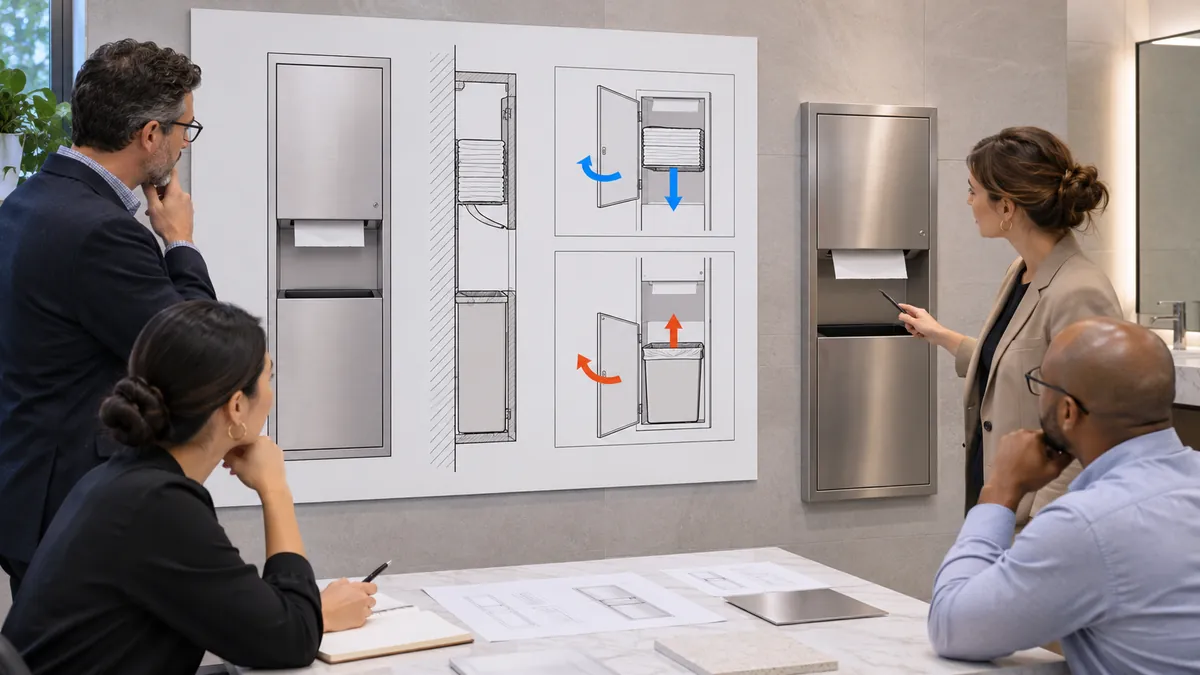
Proceed in a repeatable sequence:
- Verify the model label and current revision against the submittal.
- Compare the outside and cutout dimensions with the controlled drawing.
- Mount or mock up the unit at the intended height and orientation, using project-approved details.
- Load the selected towel format using the maker’s instructions.
- Close and operate the dispenser as instructed, recording any feed or door interference observed.
- Open the waste path and remove the receptacle with the intended liner or handling method.
- Repeat both service actions with nearby doors, fixtures and partitions represented.
- Photograph the installed, refill and emptying states with location and date.
- List open actions, their owners and the next release condition.
- Approve only the tested model and stated project configuration.
If the project does not yet have the exact wall, document the mock-up’s differences: thickness, backing, recess, adjacent fixture and floor condition. The correct technical owner should approve the method for extrapolating to the final installation. Do not let a sample sign-off imply that hidden wall construction or jurisdictional requirements have been reviewed when they have not.
The sample may be a factory-produced article, a supplier demonstration model or a drawing-based mock-up. Each has different evidentiary value. A demonstration model is useful for understanding doors and bins; it may not represent the finish or revision that will be purchased. A photo of a similar product is weaker still. Keep the evidence aligned to the decision.
For a metal scope, a buyer can review Koitor’s custom bathroom hardware manufacturing information as general context. That link is not a representation that Koitor manufactures proprietary towel-dispenser mechanisms or complete combined units. Buyers should describe the exact metal part requested and confirm capability before treating it as an offer.
FAQs for importers and project buyers
Are towel refill and waste removal the same approval?
No. They are different tasks, often performed at separate access points with different consumables and movements. Approve the refill path and waste path individually, then confirm that both work in the installed room arrangement.
Does a listed towel capacity tell me how often a unit must be refilled?
Not by itself. Capacity is model-specific and may assume a particular towel fold or pack. Refill frequency also depends on actual use and facility operations. Use the manufacturer’s compatible consumable information and the hotel’s own operating data rather than turning capacity into a universal service interval.
Can I assume any waste liner fits the lower bin?
No. Confirm the selected unit’s bin dimensions and the liner format with the manufacturer or supplier. Test a representative liner if it affects the facility’s procedure. Do not use a generic capacity label as proof of fit.
Should I choose a recessed or surface-mounted combination unit?
The wall construction, project design, model availability, service path and intended projection determine the suitable option. The manufacturer’s sheet defines the specific model. The project designer and installer must confirm wall opening and mounting details; this article does not prescribe one mounting style for every site.
Does one combined unit always save service time?
That cannot be assumed. Combining functions can reduce the number of separate wall locations, but the facility still performs two service operations. Compare the real refill and emptying motions, replacement-part scope and maintenance route in the target room.
Who approves wall reinforcement and installation?
The project designer, installer or other qualified owner responsible for the wall and mounting conditions. Product literature may describe a specific installation but does not establish that the buyer’s site has the same substrate or backing.
What should a buyer send with an RFQ?
Send the exact product model or target configuration, towel and liner references, wall elevation, opening and projection constraints, nearby fixtures, key/service expectations, sample criteria and scope boundaries. Mark unconfirmed values so a supplier does not treat them as approved.
For a buyer exploring related metal hardware, Koitor can review drawings and samples within confirmed manufacturing scope. Use the drawing and sample preparation guide to organize technical inputs, then contact Koitor with the specific metal-part request. Do not request appliance or wall approval from a metal accessory supplier.
Coordinate a Commercial Washroom Metal Part
Share the project drawing, selected product model and the specific metal component within scope. Appliance, wall and accessibility approvals remain with their responsible project owners.
OEM / PRIVATE LABEL
Turn this sourcing guide into a product brief
Share your target product, size, finish, order quantity and packaging requirements. Your team receives a practical manufacturability review before quotation.
 English
 Español
 Português
 Français
 Deutsch
 العربية