

Sanitizer dispenser drip tray specification should begin with the exact dispenser model, not with a generic tray width. The buyer needs to know how the dispenser attaches, where product exits, which tray is compatible, how a person removes it and what cleaning access is required. A metal bracket may carry or position a separate tray, but the bracket does not establish that the dispenser or tray is compatible, hygienic, slip-resistant or effective at catching every drip.
Manufacturer documents illustrate that these are product-specific decisions. OPHARDT documentation for a particular dispenser configuration identifies an option without a drip tray and names a compatible tray accessory for a specific product family. Other manufacturer data describe different mounting approaches. Those examples show why the buyer should verify model and revision; they do not prove that every sanitizer dispenser needs a tray or that Koitor supplies the named accessories.
Confirm the actual configuration before specifying a bracket
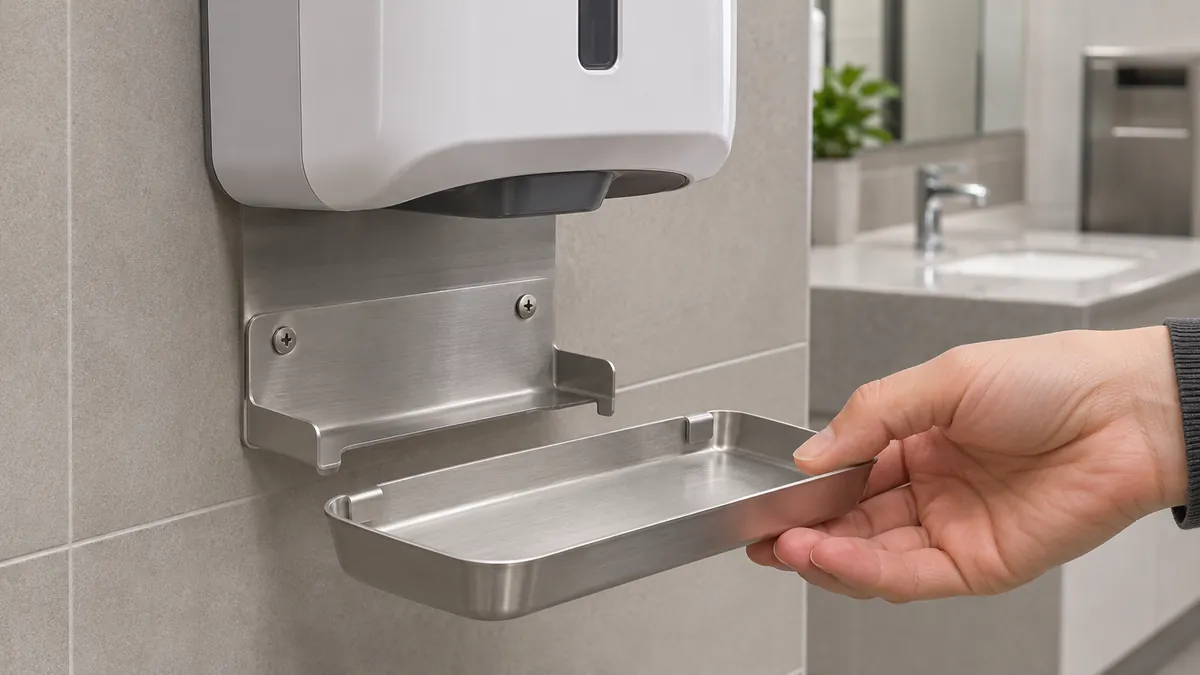
A dispenser with an integrated drip edge is not the same as a dispenser paired with a separate tray. A tray that attaches to the dispenser is different from one that mounts independently to the wall. A metal bracket below a dispenser may position the tray, protect a mounting interface or provide a removable support. These product architectures affect the bracket’s geometry, fasteners, cleaning route and spare-part owner.
Use sanitizer dispenser drip tray specification as a prompt to name the full configuration. Identify the dispenser manufacturer, model, revision, actuation method and mounting arrangement. Identify whether the tray is included, optional, third-party or still under evaluation. If there is a bracket, identify who supplies it and how the tray and dispenser connect. Do not let a single line item such as “catch tray” hide the parts and compatibility assumptions.
For example, OPHARDT’s official data for specific manual dispenser products lists configurations with and without a drip tray and identifies a compatible accessory for one model. This supports a narrow observation: tray use and pairing can be product-specific and optional. It does not establish that a tray is required for every washroom or that a separate metal bracket can be substituted without validation.
The buyer should ask the dispenser supplier for current technical data, installation instructions and any accessory list. Match the document to the exact product code and revision. If a reseller page shows a compatible tray but the manufacturer’s latest data do not, ask for confirmation before freezing an RFQ. A visual resemblance or nominal bottle capacity is not a compatibility test.
Identify the requirement behind the tray
A tray might be specified for appearance, product drips, a project cleaning routine, fixture protection or another reason. The buyer should state the purpose without assuming a health or safety benefit. A drip tray does not establish infection control, reduce contamination, prevent a slip or prove a hygienic outcome. Such claims require appropriate evidence and the responsible product or facility owner.
If the project only wants a removable catch component, define how it is emptied, cleaned and replaced. If it needs a performance requirement, identify the exact test, fluid, volume, installation condition and acceptance owner. Do not infer performance from a tray’s depth or from a photo showing liquid. Koitor’s relevant confirmed expertise is in metal hardware manufacturing and drawing/sample review; dispenser chemistry, plastic tray molding, hygiene testing and safety certifications are outside any unverified claim.
The intended user matters too. A public washroom dispenser may be replenished by facility staff, contractors or guests. A tray positioned too close to the dispenser could interfere with a hand or container; a tray too far away may not serve its stated purpose. The buyer must decide which interaction matters and have the actual owner review the installed sample.
Map the dispenser-to-bracket interface
The metal bracket should be drawn from controlled interfaces. At minimum, show the dispenser’s attachment holes or wall-mount pattern, outlet location, projection, lower edge, actuation zone and tray relationship. The project owner should provide these dimensions from the official drawing or an approved sample. Mark datums and distinguish the wall face from any spacer or backing plate.
The tray itself needs a separate drawing or sample. Record the outside envelope, wall height, lip, corner radii, handle or grasp points, drain slots if present, and the direction in which it is removed. Identify its material, finish and supplier. If the tray has locating tabs or a channel, capture those features. A tray described only as “fits beneath the unit” is not a controlled component.
The bracket drawing then defines how the metal part attaches to the wall or dispenser, where it supports the tray, and what clearance remains for use and cleaning. It should also identify material and surface-finish requirements for the metal component. Any fasteners, anchors, washers or plastic inserts need their own owner and specification. Do not assume that the bracket supplier selects the appropriate wall substrate or installation hardware without project approval.
| Interface | Buyer input | Evidence for review |
|---|---|---|
| Dispenser model | Maker, model code and revision | Current official sheet and installation instructions |
| Mounting pattern | Hole position, bracket or wall-plate arrangement | Dimensioned interface drawing or approved sample |
| Outlet and operation | Outlet projection, actuator and user hand envelope | Model-specific drawing and in-place mock-up |
| Tray | Maker/model, material, outer envelope and removal direction | Tray drawing and physical sample |
| Metal bracket | Attachment, support points, material and finish | Controlled supplier drawing and sample |
| Wall | Surface, backing and installation owner | Project wall detail and installer review |
| Cleaning | Access path and approved care procedure | Dispenser/tray supplier instructions and facility procedure |
| Change control | Revision trigger and approver | BOM/register with sign-off record |
Avoid reverse-engineering a branded dispenser from a catalog image when a technical drawing or sample is available. A picture may hide the wall plate, lock, refill door, nozzle or required hand clearance. If the manufacturer will not provide a drawing, request a controlled sample and document what was measured. Clarify that any measurement derived from a sample applies to that sample revision only.
The buyer’s job is to make the interface reproducible. A named model, drawing number, bracket revision and tray part number allow a new buyer or factory contact to understand the exact arrangement. Without those identifiers, replacement orders can accidentally pair a new dispenser with an old bracket or a new tray with a mounting system it was not designed for.

A dimensioned interface review helps separate what the dispenser maker controls from the metal bracket and removable tray supplied by other parties.
Design for removal and cleaning access
Removal is more than the tray’s ability to come off. The person servicing it needs a direction of travel, a grasp point, room for their hand and a way to reinstall it correctly. A bracket may obstruct the tray if it has a front lip, inward return or side flange. Wall-mounted fixtures nearby can reduce the space available to pull or tilt the tray. Check the actual operation in the room or representative mock-up.
The cleaning method should follow the tray and dispenser suppliers’ current care instructions. Different tray materials and finishes can have different limitations. A metal bracket’s cleanability should not be confused with chemical compatibility of a separate plastic tray or dispenser housing. If a cleaning agent or temperature matters, obtain product-specific confirmation from the owner of each affected part.
Do not add drainage holes, edge gaps or extra depth to a tray by assumption. Those features may change fluid retention, cleaning, appearance or mounting. Only the tray designer or responsible product owner can approve them. The bracket can be designed to support the selected tray; it should not silently redesign the tray’s function.
Make replenishment and tray service separate operations in the maintenance plan. The dispenser may need to be opened to refill soap or sanitizer, while the tray may be removed for inspection or cleaning. The bracket should not force the user to loosen a dispenser that is supposed to remain fixed. If service requires tools, a key or a particular order, include the sequence in the product documentation.
Test a representative installation
During a sample review, mount the named dispenser at the project location or on a mock-up that matches the wall and adjacent fixtures. Attach the metal bracket and tray in the intended configuration. Test the actuator or refill door according to the manufacturer’s instructions. Remove and replace the tray using the expected hand motion. Record whether the sequence causes contact with the dispenser, wall, adjacent fixture or user’s intended hand area.
Use the actual tray and the actual dispenser whenever possible. A dimensional dummy can verify rough space but cannot confirm latch fit, locating features, surface interaction or refill access. If the sample uses a different model or revision, label it as representative and leave final compatibility open. Do not approve production based on an unmarked generic unit.
A useful sample record includes the date, dispenser model, tray model, bracket revision, mounting arrangement, photo from the user’s view, photo during tray removal, observed interference and action owner. State the limitations. For instance, a fit review may confirm that a tray can be removed in the mock-up, but it does not prove a claimed fluid capacity, hygiene result or performance under every installation condition.
If the dispenser is wall-mounted on a tile, stone or panel surface, installation suitability belongs to the project designer or installer. The metal bracket drawing can show hole locations and component loads if supplied by the responsible engineer, but the installer determines anchors and substrate suitability. Do not claim that a bracket design automatically works on all wall types.
Build a compatibility matrix for each dispenser SKU
Importers often manage a range of dispenser models, finishes or room packages. Use a compatibility matrix rather than treating “fits sanitizer dispensers” as one SKU. Create one row per named dispenser/tray/bracket combination. If a supplier lists multiple models, verify each against source documents and samples.
| Field | Example of what to record |
|---|---|
| Dispenser maker/model/revision | Exact product identifier from current maker documentation |
| Actuation and outlet | Model-specific outlet and control details |
| Mounting method | Existing wall plate, fastener pattern or separate mounting |
| Bracket revision | Drawing number, material, finish and supplier |
| Tray identity | Maker/model, material and revision |
| Tray position | Relationship to outlet and intended use |
| Removal direction | Lift, slide, tilt or other maker-approved motion |
| Cleaning instructions | Source document and owner |
| Sample evidence | Photos, mock-up conditions and date |
| Approved market/room variant | Project and room configuration, if the program uses more than one |
| Open limitation | Any fit, cleaning or performance question not yet resolved |
| Reapproval trigger | Change to dispenser, tray, wall, bracket or approved process |
Use exact manufacturer wording for compatibility. If a tray is listed by a manufacturer as an accessory for a particular model, record that pairing and source. Do not translate it into a universal claim. If a buyer’s bracket has been developed around one model, do not advertise it for another without checking its interface, outlet, mounting and service envelope.
A replacement-part strategy should also identify which component the buyer can reorder independently. A tray may have a distinct part number and supplier. A bracket may be custom. The dispenser may be replaced during a bathroom renovation. The BOM should show whether a discontinued component triggers redesign or whether an approved substitute exists. That information helps distributors manage availability without inventing interchangeability.
Avoid ambiguous “universal fit” labels
A universal fit claim requires evidence covering a defined range of products and installation conditions. A single successful sample demonstrates only the tested combination. If a buyer has five dispenser models, test or otherwise substantiate all five. Record the exact revisions and restrictions. A generic tray silhouette cannot prove mounting compatibility.
Avoid using “universal” as shorthand for “we can adjust the bracket.” Customization is a process decision, not a guarantee of cross-model fit. If a buyer needs multiple variants, identify shared dimensions and model-specific inserts or brackets. The supplier can then quote actual configurations and the buyer can assess part count and stocking complexity.
Keep scope and change control explicit
A project may involve several suppliers: dispenser maker, tray maker, metal bracket manufacturer, installer and cleaning-product owner. The buyer should name the owner for each requirement. The dispenser maker confirms its interface and use instructions. The tray supplier confirms tray material and care. The bracket supplier confirms its own metal drawing and fabrication scope. The project installer controls wall mounting. The facility owner controls its service procedure.
Koitor should only be represented within confirmed scope: metal hardware fabrication and drawing/sample development. Do not imply that Koitor currently makes a specific sanitizer dispenser, molded tray, pump, chemical, branded-compatible accessory or tested hygiene system. If a buyer wants a metal bracket, the request should clearly state whether it is a standalone part or part of a larger assembly.
A change to the dispenser can affect bracket holes, tray placement, outlet projection or door access. A change to the tray can affect support points, removal travel and cleaning. A change to the wall or room layout can affect mounting and user approach. Set a reapproval trigger for each class of change. A new finish or coating may also require updated appearance and care review based on the project specification.
Keep supplier communication tied to the controlled drawing. If the buyer asks for a shorter bracket, specify the required dimension and reference surface; do not rely on a verbal note. If the metal supplier proposes a change, ask for a revised drawing and sample where needed. The buyer decides whether the change is acceptable in the complete product configuration.
For buyers preparing project drawings, Koitor’s drawing and sample preparation guide can help organize the metal-part request. The company’s custom bathroom hardware information provides manufacturing context only. Neither source establishes dispenser compatibility; the exact interface must be supplied and approved for the project.
FAQs for washroom accessory buyers
Does every sanitizer dispenser need a drip tray?
No. Product configurations and project needs vary. Manufacturer documentation may list a tray as optional, included or unavailable for a particular model. The buyer should verify the selected product and avoid presenting an optional accessory as a universal requirement.
Can a metal bracket fit several dispenser brands?
It may be possible to design a bracket for a defined set of models, but that requires checking each mounting pattern, outlet, lower edge, refill access and tray position. One fit sample does not substantiate every brand or model. Keep compatibility claims limited to documented combinations.
Who supplies the tray and confirms its material?
The buyer should identify the tray maker or project owner in the RFQ. That party supplies the part information, material and care guidance. A metal bracket supplier should not infer the tray’s chemical compatibility or molded geometry from a generic product photo.
Sanitizer dispenser drip tray specification: model compatibility control
The first approval should identify which exact dispenser and tray combination the bracket supports. That record needs to survive beyond the sample stage. Buyers often discover the risk later, when a dispenser supplier changes a housing, mounting plate, outlet, refill mechanism or accessory package while keeping a familiar product name. A visually similar model can move its fixing points or alter the space needed to remove the reservoir. The bracket may still attach to the wall while the tray no longer sits below the outlet or cannot be lifted out without loosening the dispenser.
Create a simple compatibility register with one row per approved combination. Record the dispenser manufacturer, model, revision or date code if available; the tray identifier; bracket drawing revision; mounting-hole coordinates; overall projection; outlet location; removal direction; finish; and the sample or drawing used for approval. Mark unknown fields explicitly. A blank field is a question for the responsible supplier, not permission to assume that two versions are identical.
When a component changes, classify the change by interface. A cosmetic color update may leave the metal bracket unchanged, but a housing or outlet revision may affect fit and cleaning access. Ask the dispenser owner to provide a drawing, change notice or representative sample. Overlay the old and new mounting patterns and compare the outlet-to-tray relationship. Then check whether a technician can still refill or remove the dispenser, and whether the tray can be detached along the intended path. If the change is outside the approved envelope, treat it as a new configuration and request a revised sample before releasing repeat orders.
This discipline also helps spare-part planning. A distributor may hold replacement brackets separately from dispensers, while a project contractor may expect every component to arrive as a matched kit. Decide whether the bracket is sold under its own SKU, packed with the tray, or supplied as a project-specific assembly. The answer affects carton labeling, instructions, replacement ordering and which supplier is responsible for compatibility confirmation. It does not establish that any one supplier manufactures all parts.
For a metal-part RFQ, list the interface dimensions and the documents that define them. Attach a controlled drawing or sample reference, note which surfaces are visible, and identify the wall substrate or fixing method only to the extent that it is known and within the responsible installation party’s scope. Keep the approval record with the purchase order and inspection plan. A sample sign-off without model and revision identifiers is difficult to reproduce when the next shipment arrives.
Buyers should also define what happens when a proposed substitute is offered. Require a side-by-side comparison of mounting positions, projection, outlet location, tray footprint and service path. Request written confirmation from the component owner where the metal supplier cannot verify the dispenser’s performance or compatibility. A substitution can be reasonable, but its approval belongs to the buyer and the accountable product owner after review of the changed interface.
Does tray removal prove it is easy to clean?
No. Removal is one step. The cleaning routine, surface material, detergent, contact time and reinstallation are separate questions. Use the product maker’s care instructions and the facility’s approved process.
Can a bracket claim to prevent slips or improve hygiene?
Not without appropriate product-specific evidence and approval. The presence of a tray does not prove a safety, infection-control or hygiene outcome. Use only claims substantiated for the exact product and conditions.
What should a buyer send for a quote?
Provide the dispenser model and revision, official drawing or sample, mounting pattern, outlet and hand envelope, tray reference, tray removal direction, wall conditions, finish, packaging and intended room layout. Mark responsibilities for dispenser, tray, bracket and installation separately.
What should happen when the dispenser model changes?
Recheck the affected interface before reorder or release. Compare mounting, outlet, projection, tray position, service path and cleaning access with the approved matrix. A similar-looking replacement is not automatically compatible.
For a metal bracket feasibility review, provide the named dispenser drawing, tray specification and project mounting information. Use the Koitor contact page for a scoped inquiry, and state clearly that dispenser and tray approvals remain with their respective product owners.
Review a Metal Bracket Interface
Send the exact dispenser model, bracket drawing, tray reference and removal direction. Koitor can review a metal fabrication request within its confirmed scope.
OEM / PRIVATE LABEL
Turn this sourcing guide into a product brief
Share your target product, size, finish, order quantity and packaging requirements. Your team receives a practical manufacturability review before quotation.


 English
 Español
 Português
 Français
 Deutsch
 العربية