

Engineering change inventory disposition becomes a purchasing decision as soon as a drawing or approved sample changes after a hardware purchase order is released. The buyer must decide when the new revision takes effect and what happens to each affected stock state: raw or purchased material, work in process, finished product, packaging, open shipment or inventory already in transit. Choosing one date without checking quantities and status can leave the supplier and buyer working to different versions.
The decision is not simply “use old stock” or “scrap it.” Options can include using items as approved, consuming them before a cutover, reworking them, segregating them, holding them for review, returning them where agreed, or stopping further production. The appropriate path depends on the change, product requirements, order terms, customer approval and actual inventory status. This guide gives hardware buyers a worksheet for documenting those decisions; it does not establish a universal legal rule or default cost responsibility.
Separate the change trigger from engineering change inventory disposition
Not every change after a PO has the same cause or approval path. A buyer may request a design revision after a sample review. A supplier may propose a material, process or component change. A corrective action may be needed after a confirmed defect. A customer or project owner may revise its requirements. These triggers involve different evidence and authority. Identify who initiated the change and what document authorizes it before estimating the stock impact.
This distinction also separates the topic from a supplier change-notification process. A supplier-originated notification asks the buyer to evaluate a proposed change and its evidence. A buyer-requested revision after PO release asks what becomes of existing material and orders under the prior approved specification. Related but different decisions. The supplier change-notification guide covers the buyer’s review when a supplier raises a change; the present worksheet focuses on old-stock disposition when the buyer’s or project owner’s revision moves into production.
A change request should identify the affected SKU, PO, order line, drawing and sample revisions. State the reason and the changed features. For a metal storage product, a revision might change a wire diameter, hole location, bend, finish, fastener pack or carton label. Those examples are hypothetical; they do not describe a specific Koitor project. A small visual adjustment can still affect fit, manufacturing sequence, packaging or customer acceptance.
Do not use “latest drawing” as the only control. The supplier and buyer need to know which revision applies to which quantity, order or lot. A later file upload can silently conflict with the PO or sample record. Name the approved change document and have both sides read back the affected items and effective boundary.
Confirm the change is technically approved before disposition
The buyer should not start allocating old stock until the new design is approved by the people responsible for fit, function, quality, customer requirements and any relevant compliance. Otherwise, the team may consume or alter stock before the replacement specification is actually released. The approval packet should include the revised drawing or specification, reason for change, sample or validation status, effectivity proposal and approvers.
A buyer-requested design change can be commercially urgent yet still lack technical release. Use a hold or review status for stock while resolving the new specification. The supplier can provide quantities and manufacturing status; the buyer or project owner decides whether the revised feature is approved. The supplier should not infer acceptance from a marked-up sketch or an informal message.
A change to product geometry may affect a companion part or packaging. For example, moving an attachment hole may change a mounting plate or carton insert. A finish revision may change a process step or appearance standard. The buyer should include affected components and documents in the change scope, not just the edited drawing view.
Take a status snapshot before choosing effectivity
Request a dated inventory snapshot tied to the affected PO and SKU revision. Ask for quantity and status by material or product state, not one blended number. At minimum, separate raw material, purchased components, work in process by stage, finished goods, packaged stock, labels and instructions, goods in transit, and open quantity not yet started. If the supplier cannot report a category precisely, mark it as an estimate or unknown.
Engineering change inventory disposition depends on the moment the snapshot is taken. A buyer cannot decide the old-revision treatment if it does not know what exists or where it is. Ask the supplier to specify the reference date, order number, item revision, warehouse or facility, quantity and any exclusions. If stock is held by a sub-supplier, identify that status separately instead of assuming it sits in the main factory.
| Stock state | Example buyer question | Evidence to request |
|---|---|---|
| Raw material | Has material been purchased or cut for this order? | Item/grade reference, quantity and order linkage |
| Purchased components | Are brackets, screws or inserts already committed? | Part number, quantity, ownership/status and supplier |
| Work in process | Which operations are complete or pending? | Stage, lot, quantity and drawing revision used |
| Finished goods | Are units completed and inspected? | Quantity, inspection status, revision and location |
| Packaging and labels | Are cartons, inserts or labels printed? | Artwork/revision, count and applicability |
| In transit | Has any old-revision stock shipped? | Shipment reference, quantity and expected receipt |
| Open PO balance | What remains unstarted or unconfirmed? | Line-level balance and supplier acknowledgement |
The buyer should also confirm the status of its own inventory and open orders. Supplier-held stock is not the same as stock received by the importer. In-transit goods may already be committed to customer orders or may need a receiving instruction. The data should connect the physical stock to a SKU, revision, PO and destination so that receiving does not mix old and new configurations.
Do not infer ownership, cancellation rights or scrap liability from a quantity report. Those questions depend on the signed purchase terms, change documents and the parties’ agreement. Record them as commercial decisions to settle, not as an automatic result of the inventory snapshot.
Check the data’s unit and revision basis
A supplier may report pieces, sets, cartons or batches. A hardware kit can contain a main frame, fasteners, labels and instructions. The buyer should verify how the reported quantity is counted and whether it is saleable as a complete SKU. A quantity of frames does not equal the same quantity of shippable finished kits if components or packaging differ.
Confirm the revision basis at each production stage. WIP may have been started under an earlier drawing but could be eligible for a later rework. Finished goods may be physically complete yet lack revised labels. An item marked “ready” might not have passed the buyer’s agreed inspection. The snapshot should preserve those distinctions.
Choose a cutover boundary that matches the order
The cutover boundary answers: from what point does the new revision apply? Options may include a named PO line, a lot, a production date, a shipment, an agreed quantity or a serial/batch identifier. No single boundary is best for every buyer. Choose one that can be identified, communicated, produced and verified by both sides.
Immediate cutover. New work follows the revised specification as soon as it is released. This can be appropriate when the old design is no longer acceptable or the change is urgent, but it may leave material and WIP that need a separate hold or disposition. Immediate effectivity does not answer what happens to old stock.
Named-order or line cutover. A revised drawing applies to a specified PO, order line or amendment. This can be easier to track when different customer orders need different revisions. It still requires clear identification of items already started or packaged.
Lot or batch cutover. The supplier completes one identified batch to the old revision and begins the new revision with a defined next lot. This can support traceability if both parties can label and segregate the lots. It is not suitable if the old design cannot be accepted or if the buyer’s project requires a different transition.
Date-based cutover. The new revision applies from an agreed production or shipment date. Dates should be tied to a precise event, time zone if relevant, and an observable record. A date alone can be ambiguous if WIP crosses the boundary or if shipments consolidate products from multiple lots.
Documented use-up transition. Existing material or product may be consumed under an agreed plan before the revised configuration begins. This requires buyer approval of the old revision’s continued acceptability and a specific quantity/limit. It should not be assumed that “use up” is acceptable for safety, fit, customer or regulatory reasons.
A company procedure can use one of these patterns or combine them. DENSO’s supplier procedure is an example of a particular company’s approach to engineering changes and phase-outs, including supplier inventory and effectivity planning. It is not a universal rule for hardware buyers and does not decide what any other PO requires. Treat it as an example of why effectivity and stock status should be explicit, not as a template that overrides the buyer’s agreement.

An agreed cutover should connect a revised drawing to a named order, lot, date or quantity that both parties can identify.
A good boundary is operationally testable. The supplier can identify which units follow it, the buyer can confirm what appears on the invoice or packing list, and receiving can separate the revisions. If nobody can tell whether a carton belongs before or after the boundary, the effectivity definition is incomplete.
Record disposition for every stock state
For each inventory category, select an option and owner. Possible dispositions can include use as approved, use up to an agreed quantity, rework, relabel, segregate, return, scrap, hold for review or transfer to a different order. The option depends on technical acceptance, feasibility and commercial agreement. Do not treat one general action as applying automatically to material, WIP, finished goods and labels.
| Stock category | Possible path | Questions to resolve |
|---|---|---|
| Raw material | Use for new revision, reserve for old order, return, hold | Is the material suitable for both designs? Is it traceable? Who approved it? |
| Purchased components | Use, substitute, return or hold | Are dimensions, finish and interfaces still correct? |
| WIP | Finish to old revision, rework, stop or hold | Which operations are complete? Is rework technically approved and inspectable? |
| Finished goods | Release to old order, relabel, rework or hold | Does the buyer/customer accept the old version? What evidence is required? |
| Packaging | Use, replace, over-label where approved or scrap | Do images, SKU, revision or claims remain correct? |
| In-transit units | Receive under old revision, segregate or hold | Can the receiving team identify the shipment and route it? |
| Unstarted PO balance | Cancel, amend, defer or retain | What does the PO and written amendment permit? |
A disposition record should identify the responsible decision-maker. The supplier may recommend whether a part can be reworked, but the buyer or end customer may need to approve appearance, fit or function. A quality team may confirm inspection evidence, while purchasing handles PO changes. If cost treatment is unresolved, list it separately and do not let the production instruction imply that one party has accepted it.
For rework, identify the affected step, method, inspection point and acceptance evidence before work begins. A metal feature may be difficult to revise after forming or finishing. A label may be replaced more easily than a welded bracket. The supplier should state feasibility and risks based on the actual part; the buyer should approve the proposed result. Avoid saying “simple rework” without a demonstrated method.
For hold, mark the physical stock and system status so it cannot be shipped inadvertently. Define who may release it and what evidence is required. Hold locations and labels should be clear to the parties handling the stock. A spreadsheet note that does not reach the warehouse or supplier floor may not prevent a mix.
Update PO, inspection and receiving references
Once the boundary and dispositions are agreed, update the controlling documents. Depending on the project, that may include a PO amendment, line note, drawing, bill of materials, approved sample, inspection plan, carton label, packing list instructions, receiving check or customer submittal. The exact document set belongs to the buyer’s process. The objective is to make the new revision visible anywhere the product is ordered, made, checked, packed or received.
Use a clear old/new comparison or change summary. List each affected feature, the new revision identifier, effective boundary, treatment of old stock and inspection evidence. Do not rely on color markup alone; it may not print or transfer to a supplier’s system. Keep the baseline drawing available so reviewers can identify what changed.
Receiving should know how to distinguish lots. A revision field or batch label can support identification if it is part of the agreed process. The buyer should tell the supplier exactly what traceability mark or shipping document is required and verify that it appears on the first changed delivery. Do not invent a universal lot-code requirement; use the project’s actual controls.
The packaging review matters because cartons or inserts can become misleading after a product change. A new hole position, bracket or accessory may affect the photo or installation sheet. If the product revision changes visible features, update product images and customer documents that describe those features. If the packaging remains correct, record that it was checked rather than assuming a change is always required.
Buyers who need help organizing the drawing or sample packet can use Koitor’s drawing and sample preparation guide. It supports the information handoff for a metal hardware request; it does not determine inventory ownership or the buyer’s PO obligations.
Keep cost discussions separate from technical approval
Engineering and purchasing decisions may affect cost, schedule or quantity, but the effect depends on the specific order and agreement. Do not assume that the supplier absorbs the cost of obsolete materials, or that the buyer must purchase every item already started. Review the relevant terms and document the parties’ written agreement. If needed, obtain qualified commercial or legal advice for the contract rather than treating an industry example as a rule.
A technically approved redesign can still lack an agreed disposition. Conversely, the parties may agree to a commercial settlement while technical approval remains open. Track those as separate statuses. This helps prevent a compromise on inventory from being mistaken for approval of an unsuitable product.
Verify the first changed lot and preserve evidence
The first production or shipment under the new revision is a useful control point. Compare the received product with the approved drawing, sample and PO amendment. Check the changed feature, related mating parts, packaging, item identification and receiving paperwork. The inspection should match the buyer’s existing quality plan; this article does not prescribe a universal sampling level or test threshold.
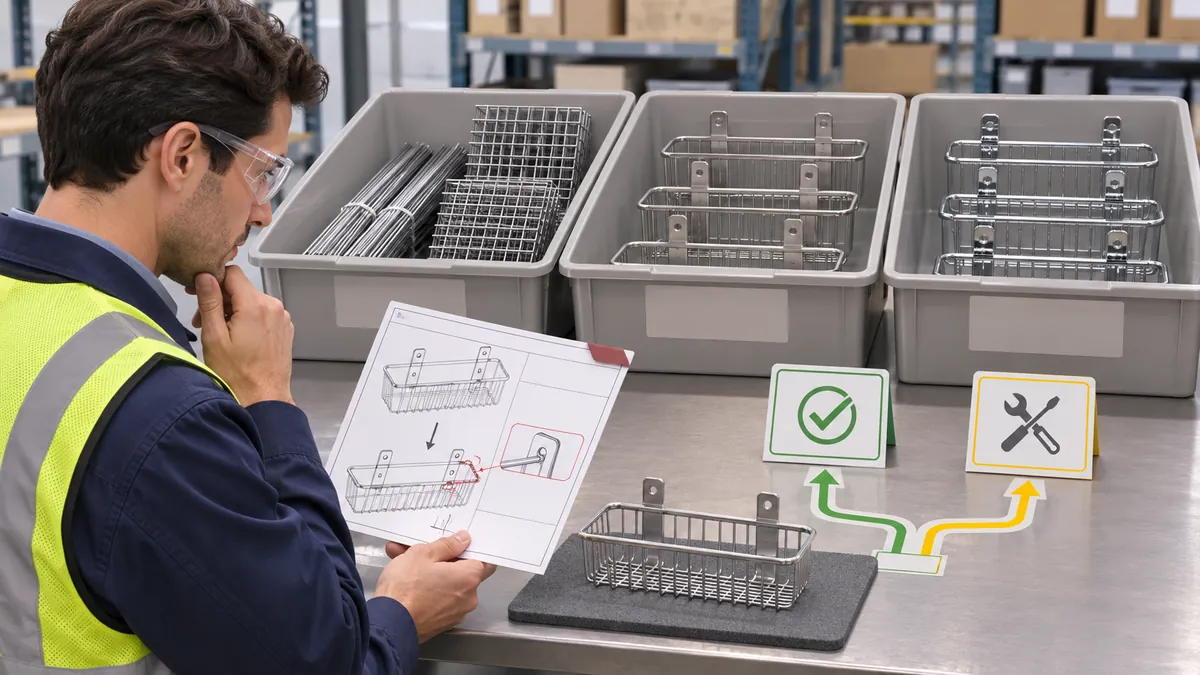
If the old and new revisions may appear in the same delivery, agree how they will be separated and documented. The buyer can set a temporary receiving hold until the correct identifiers are confirmed, if its process requires one. Store photos and inspection records with the batch or lot identity. If the revision changes again, close the previous transition record and open a new one.
Reorders should refer to the current released revision, not simply reuse an old PO line or product image. Confirm the buyer’s BOM, supplier’s accepted drawing and sample reference align. A product catalog may retain an older image after an engineering update; the order documents should control the delivered configuration.
A complete change record contains:
- Change request and initiating party.
- Affected SKU, PO lines, drawing, BOM and sample revisions.
- Technical approval and scope of changed features.
- Dated inventory snapshot by material and production state.
- Effectivity boundary and the exact identifier used to recognize it.
- Disposition and owner for each stock category.
- Commercial treatment recorded separately from technical status.
- PO, packaging, inspection and receiving documents updated.
- First changed lot evidence and reapproval trigger.
FAQs for hardware buyers
Is the newest drawing automatically effective for an open purchase order?
Not necessarily. The buyer and supplier need to establish which revision applies to which PO, line, lot, date or quantity through the approved change process and written order documents. A file upload alone may not establish a shared cutover.
What should happen to work in process after a design change?
First identify its status, revision and completed operations. Then have the relevant technical owner and buyer decide whether it can be completed, reworked, held or otherwise dispositioned. The decision depends on the actual product and order; no single option is universally correct.
Can old finished goods be used after a revision?
Only if the responsible buyer/customer accepts that revision for the intended order and any applicable requirements. Record the acceptance, quantity and traceability. If the revision is no longer acceptable, hold the stock until the owner decides its disposition.
Who pays for obsolete inventory?
That depends on the parties’ purchase terms and written change agreement. A supplier procedure or industry article does not establish liability for another order. Review the actual contract and document the agreed treatment.
Should the buyer use a date or a lot as the cutover?
Choose a boundary both parties can identify and verify. A named PO, lot, date or quantity can work when it aligns with the supplier’s production and the buyer’s receiving process. The boundary should specify what happens to items already in WIP or transit.
Does a buyer-requested change work the same way as a supplier change notice?
They are related but distinct. A supplier notice asks the buyer to evaluate a proposed supplier change. A buyer-requested revision requires the parties to approve the new design and decide how existing stock and released orders transition. Both need controlled documents.
Can a supplier rework all old stock to the new design?
That must be assessed for the actual part, process, finish, cost and inspection evidence. Some changes can be revised; others may not be technically or economically suitable. The buyer should approve the method and acceptance criteria before rework.
When a revision affects a custom metal part, send the current drawing, approved sample reference, affected PO and buyer’s proposed boundary for a scoped manufacturing discussion. Use the Koitor contact page to discuss the metal change. Order terms, inventory ownership and customer acceptance remain project-specific decisions.
Review a Metal Hardware Revision
Share the old and new drawings, approved sample, affected PO and requested cutover. Koitor can discuss metal-part manufacturing inputs within its confirmed scope.
OEM / PRIVATE LABEL
Turn this sourcing guide into a product brief
Share your target product, size, finish, order quantity and packaging requirements. Your team receives a practical manufacturability review before quotation.


 English
 Español
 Português
 Français
 Deutsch
 العربية