
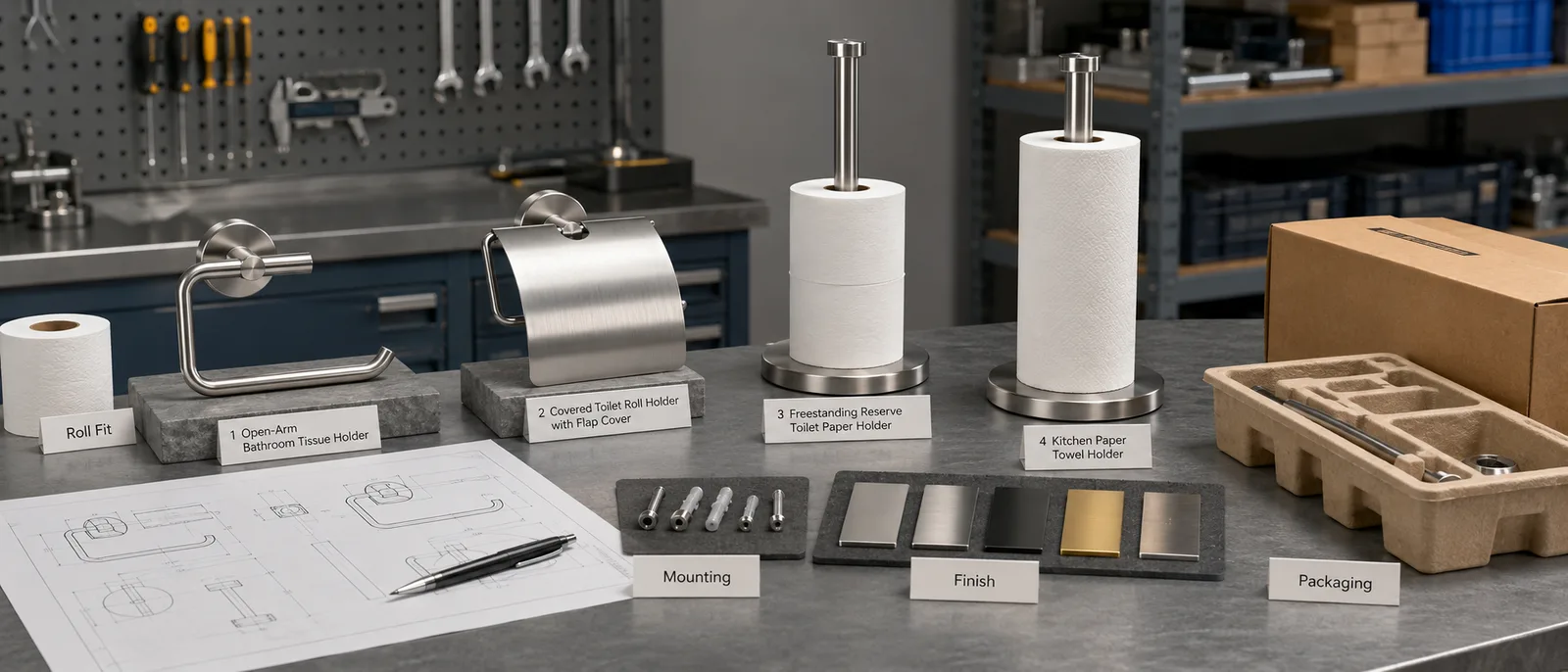
A tissue holder manufacturer China sourcing team should be evaluated by product-format knowledge, mounting control, material and finish capability, sample accuracy, packaging protection and practical OEM terms. Buyers should define the target roll, installation method, dimensions, accessories and retail pack before comparing final quotations. A low unit price cannot compensate for poor roll clearance, weak mounting geometry or incomplete pack contents.
Tissue holders include more than one simple bathroom accessory. Open-arm toilet roll holders, covered holders, spare-roll stands, wall-mounted dispensers and kitchen paper towel holders create different structural and packaging requirements. A controlled sourcing process turns the buyer’s use case into an approved drawing, complete sample and repeatable inspection plan.
Which Tissue Holder Products Can Buyers Source and Customize?
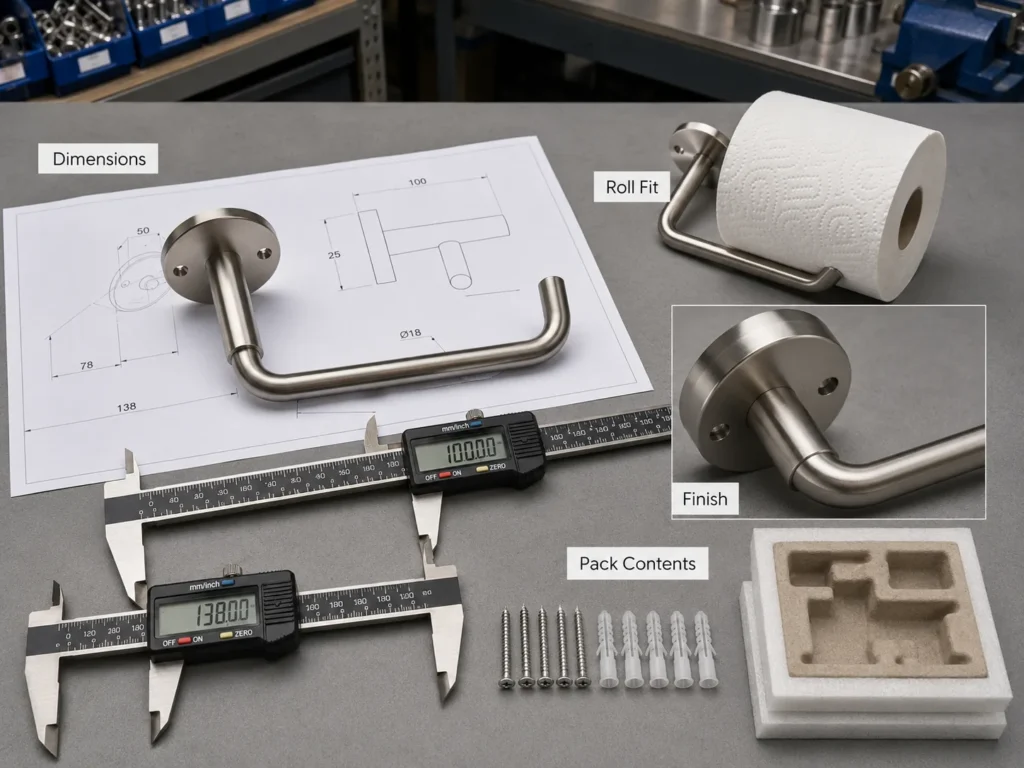
Buyers can source wall-mounted bathroom tissue holders, covered roll holders, freestanding reserve-roll stands, kitchen paper towel holders and integrated holder-and-shelf products. The right format depends on roll size, installation space, user access, moisture exposure, target price and the surrounding product range.
An open-arm holder offers simple roll replacement but needs a suitable arm direction, stop detail and wall clearance. A covered holder adds a lid or shelf interface that affects hinge movement, roll access and assembly. A freestanding model needs a stable base and efficient packed size. Kitchen paper towel holders may be wall-mounted, under-cabinet or freestanding, each with a different installation or stability risk.
Customization can include overall dimensions, arm length, tube or wire size, bracket shape, cover or shelf geometry, finish, mounting hardware, logo packaging and retail presentation. Each change should solve a customer or range requirement. Decorative variation without a clear brief can add tooling, inspection and packing complexity without improving the product.
| Product format | Primary use | Main customization points | Key buyer check |
|---|---|---|---|
| Open-arm roll holder | Easy bathroom roll replacement | Arm direction, stop, bracket, finish | Roll retention, clearance and mounting alignment |
| Covered tissue holder | Roll protection and coordinated appearance | Cover size, hinge, shelf, edge profile | Movement, noise, access and visible finish |
| Freestanding reserve holder | Store one or more spare rolls | Base, height, capacity, handle | Stability, floor contact and packed volume |
| Wall-mounted paper towel holder | Kitchen roll dispensing | Orientation, bracket spacing, arm length | Roll fit, cabinet clearance and mounting parts |
| Freestanding paper towel holder | Flexible countertop placement | Base weight, center post, top stop | Wobble, one-hand use and surface protection |
| Holder with shelf or hooks | Combined storage function | Shelf depth, guard, hooks, mounting layout | Interference, usability and packaging protection |
Buyers can review Koitor’s custom tissue holder manufacturing scope when comparing bathroom and kitchen formats, drawing-based customization and small-batch OEM options.
How Do Roll Size, Structure and Mounting Affect the Design?
Roll size, structure and mounting define whether the product works in the target market. Buyers should test the holder with representative tissue or paper towel rolls rather than approving dimensions from appearance alone.
Confirm roll width, outside diameter and core size where relevant. An open-arm holder needs enough usable length and wall clearance, while a covered design must allow the roll to rotate without contacting the lid or bracket. A kitchen paper towel holder should accommodate the intended roll size without interfering with a cabinet, wall or countertop.
Mounting geometry should be controlled in the drawing. Record bracket spacing, hole centers, wall offset, orientation and supplied hardware. If the holder can be installed in more than one direction, confirm whether both orientations retain the roll and preserve access.
No-drill or adhesive mounting requires a complete system review. The metal holder, adhesive component, mounting plate, target surface, installation instruction and curing conditions work together. Performance should be checked for the project-specific mounting method and stated surface rather than assumed across all walls.
Freestanding holders need a stable relationship between base size, product height and roll position. A heavy-looking base does not automatically provide stable use if the center post is misaligned or the floor-contact surface is uneven. Check wobble on a flat reference surface and protect counters or floors with suitable contact details where specified.
Edges and moving components deserve attention. Covers, shelves, roll stops and detachable arms should not create sharp contact points or pinch areas. Any load or durability requirement should be defined and confirmed through project-specific testing after the structure and complete assembly are approved.
Which Materials and Surface Finishes Should Importers Compare?
Importers should compare materials and finishes by target appearance, structure, price position, moisture exposure, range coordination and manufacturing method. Powder-coated steel and stainless steel are common, while mixed-material designs may also include plastic caps, rubber pads, adhesive parts or separate mounting hardware.
Powder-coated steel allows a broad range of colors, gloss levels and textures. Buyers should approve a physical finish reference where appearance matters. Surface preparation, edge geometry, weld cleanup, coating coverage and packing contact all influence the finished product.
Stainless steel supports a metallic visual direction, but grade, construction, welding, polishing and environment remain relevant. Mark customer-facing surfaces and approve polishing direction or other visible criteria. Stainless steel should not be described as universally rust-proof because product design, exposure, handling and care affect performance.
Mixed materials need color and interface control. A plastic cap may not visually match a powder-coated tube without a reference. Adhesive pads, anchors or screws may come from separate processes and need their own revision and pack-content controls.
When tissue holders belong to a bathroom accessory range, inspect them beside towel racks, hooks and shower caddies under consistent lighting. A shared color name does not guarantee an identical appearance across different materials or finishing processes.
A tissue holder manufacturer China buyer considers should explain which finish variables need a physical sample and which can be defined in a drawing or specification. Koitor Hardware can review forming, welding, grinding, polishing and powder-coating requirements according to the selected product structure.
How Should Samples, Customization and MOQ Be Managed?
Samples, customization and MOQ should be managed through one controlled development record. The buyer should separate fixed functional requirements from features where the factory can suggest a more practical manufacturing solution.
Send a drawing or physical reference, target roll dimensions, installation method, overall size, material and finish preference, expected quantity and packaging idea. State whether the product is for a bathroom, kitchen, retail shelf, e-commerce parcel or coordinated product range.
The sample should include the intended bracket, screws, anchors, adhesive components, caps, instructions and packaging concept. Install or assemble it using the supplied parts. Test representative rolls for fit, rotation, replacement, retention and user access.
Record critical dimensions, finish approval, pack contents and accepted deviations. Update the drawing after sample review and add a revision code. The purchase order, inspection plan, artwork and packaging layout should use the same revision.
MOQ can start from around 100 pieces for some Koitor projects, depending on structure, material, finish and packaging. Printed retail boxes, custom colors or specialized components may have separate minimum quantities, so buyers should compare the complete project rather than only the metal-product MOQ.
Samples usually take about 5-7 working days after details and materials are confirmed. Bulk production often takes about 4-6 weeks depending on quantity, complexity, material availability, finish and packaging. These are planning references and should be reconfirmed for each project.
For broader bathroom programs, custom bathroom hardware development can coordinate tissue holders with towel racks, baskets and hooks. Kitchen-focused buyers can also review custom kitchen storage rack manufacturing when building a related storage range.
How Should Quality and Packaging Be Checked Before Shipment?
Quality and packaging should be checked against the approved drawing, sample, finish reference and pack-content list. Inspection should cover installation dimensions, roll function, workmanship, appearance, accessories and the complete packed product.
Verify item code and revision first. Measure arm length, bracket spacing, hole centers, wall clearance, base dimensions and other critical interfaces. Check alignment, wobble, joint position, visible grinding, sharp edges and moving covers or shelves.
Use representative rolls during inspection. Confirm fit, rotation, replacement and retention. For freestanding paper towel holders, review stability and floor or countertop contact. For wall-mounted items, assemble representative units with the actual supplied mounting components.
Compare finish on several units under consistent lighting. Review color, gloss, polishing direction, visible coverage, handling marks and contact damage. Separate functional issues from minor cosmetic observations using buyer-defined criteria.
Tissue holders can have projecting arms, brackets, covers and separate hardware that move or rub during transport. Protect customer-facing surfaces, prevent metal-to-metal contact and seal loose accessories in an identified bag. Do not allow screws or anchors to move freely against the finish.
Check the retail box and master carton for orientation, separators, instruction placement, barcode and artwork revision, pack count and outer markings. Packaging should limit movement without placing damaging pressure on the arm, bracket, cover or shelf.
Recommended Final Inspection Sequence
- Confirm item code, drawing revision, finish and production quantity.
- Measure critical roll, mounting and overall dimensions.
- Check alignment, joints, edges, covers and assembly interfaces.
- Test representative rolls for fit, rotation and replacement.
- Compare finish appearance on multiple units.
- Count brackets, screws, anchors, caps and instructions.
- Inspect inner protection, retail packaging and master cartons.
- Record issue type, affected quantity, evidence and disposition.
What Should Be on a Tissue Holder Sourcing Checklist?
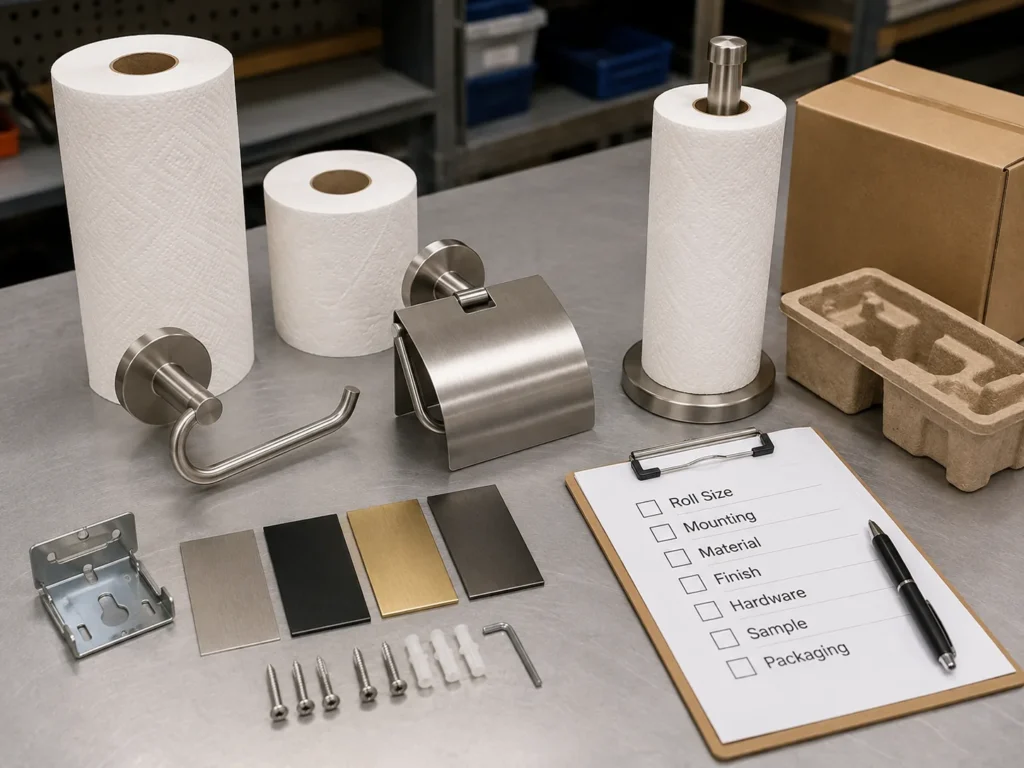
A tissue holder sourcing checklist should connect intended use, roll dimensions, mounting, structure, finish, sample approval, packaging and commercial terms. Buyers can use the same checklist to compare suppliers on evidence rather than catalogs or general claims.
- Bathroom or kitchen application and target sales channel
- Open-arm, covered, freestanding, wall-mounted or integrated format
- Target roll width, diameter, core and replacement method
- Overall dimensions, clearance and installation orientation
- Bracket spacing, hole centers and mounting method
- Material, tube, wire, sheet or component dimensions
- Joint placement, alignment and customer-facing surfaces
- Finish color, gloss, texture or polishing reference
- Cover, shelf, stop, cap, pad and removable components
- Screws, anchors, adhesive parts and installation instructions
- Complete assembled sample and roll-fit approval
- Drawing, finish, artwork and packaging revision control
- Trial quantity, MOQ, tooling and sample charges
- Inspection criteria and issue-classification method
- Inner protection, retail box and carton layout
- Production timing and buyer-approval dependencies
Mandatory functional issues should not be hidden by a general supplier score. Incorrect mounting centers, sharp edges, missing parts or failure to fit the approved roll require a clear disposition before shipment.
A tissue holder manufacturer China sourcing team approves should also have a defined scope. Success with a powder-coated open-arm bathroom holder does not automatically approve a freestanding stainless kitchen model or an adhesive mounting system. Expand the relationship product by product.
Frequently Asked Questions
What information is needed for a custom tissue holder quotation?
Send a drawing or physical sample, target roll dimensions, installation method, material and finish preference, expected quantity, accessories, packaging idea, target market and desired timing. Clearly identify open details that need factory review.
Can a factory make both bathroom and kitchen paper holders?
Yes, if the structure and processes fit the factory’s capabilities. Bathroom tissue holders and kitchen paper towel holders may share forming, welding and finishing methods, but roll size, mounting, stability and packaging should be reviewed separately.
How should buyers approve an OEM tissue holder sample?
Install or assemble the complete sample, measure critical dimensions, test it with representative rolls, inspect the finish, count accessories and review the initial packaging concept. Record the approved revision and any accepted deviation.
Is a low MOQ available for custom tissue holders?
Some projects can start from around 100 pieces depending on structure, material, finish and packaging. Custom colors, printed boxes or specialized components may have different minimum quantities.
What packaging problems are common with tissue holders?
Common risks include projecting arms rubbing or bending, covers being scratched, loose screws damaging the finish and movement inside the retail box. Protective separation and a physical pack review help reduce these risks.
Work With Koitor Hardware
Developing a Custom Tissue or Paper Towel Holder?
Send Koitor your drawing, physical sample, roll dimensions, mounting idea, finish target, packaging concept and expected quantity. Our team can review manufacturability, samples and small-batch production options before quotation.
OEM / PRIVATE LABEL
Turn this sourcing guide into a product brief
Share your target product, size, finish, order quantity and packaging requirements. Your team receives a practical manufacturability review before quotation.
 English
  Español