

Bathroom hardware warranty claim photo evidence is a packet question, not a promise to credit, replace, or answer a claim on a set clock. Importers and distributors should tell their aftersales teams which photos, lot marks, and install-context shots are required so a finish, mount, or transit complaint is not argued from one blurry phone image.
A single beauty shot of a hook on a wall cannot prove when the mark appeared, which lot was installed, whether the wall or the anchor failed, or whether the carton was already crushed. The following packet is a minimum evidence menu. It does not write legal warranty terms, and it does not map Amazon reason codes; those belong in their own files.
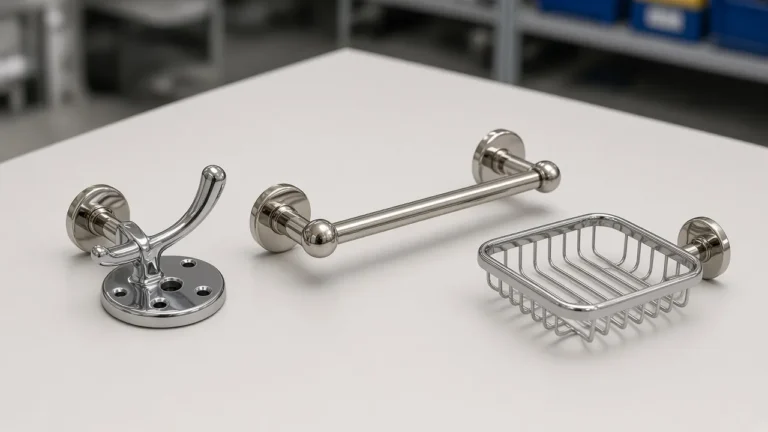
This page uses screw-mounted metal bathroom accessories such as towel bars and robe hooks as the working examples. Neighbor pages already cover returns investigation method and cargo-damage evidence. Use them with this menu, and do not treat this file as a substitute for either one.
What a single photo cannot prove, and what the packet must add
A close-up without a room shot cannot show scale or context. A room shot without a close-up cannot show the defect. A product photo without a lot mark cannot tie the piece to a shipment. An install photo that hides the wall type cannot separate a product issue from a substrate issue.
Date and identity belong in the packet as well as images. Ask for the order or invoice number, the SKU, any lot or date code on the part or the bag, and the install date if it is known. If the user no longer has the bag, say so in the form rather than leaving a blank that looks like a missing fact.
Investigating customer returns on metal storage hardware remains the method for sorting return causes when goods come back to a warehouse. This page is about the photos that should arrive with a field warranty claim, including claims that never become a physical return.
Cargo-damage evidence for metal hardware importers already lists what to photograph when the carton is the issue. For a warranty form that might actually be transit damage, require that cargo packet or an honest statement that the carton is gone, and still photograph the product, the inner wrap if any remains, and the lot mark.
How should the photo menu change by failure type?
Finish claims need a room-light photo, a close-up of the affected face, a photo of a nearby un-affected face on the same part, and a readable lot or bag mark. If a cleaner or a tool was used, ask for the cleaner name or a photo of the bottle. Do not invent a chemical cause from the photo alone, and do not write a rust-proof defense in this file.
Mount claims need the plate or post in place, the same interface after the plate is off if it is safe to remove, the wall or tile around the holes, the screw and the anchor, and a wide shot of the substrate. A hook hanging crooked may be a wall failure, a short screw, or a product issue. One tight crop of the hook neck will not decide that.
Transit or arrival claims should follow the cargo-evidence neighbor when cartons still exist, and should still include product identity. A “scratched on arrival” story without carton photos is a weaker packet. This page does not rewrite scratched-arrival triage; it only requires enough photos to keep that triage possible.
| Claim type | Photos to require | Identity and context to require | What a single beauty shot cannot show |
|---|---|---|---|
| Finish mark, peel, or discoloration | Room-light view, close-up, a clean face on the same part, lot or bag mark | SKU, lot or date code, install date if known, cleaner or tool if used | When the mark appeared, which lot it is, or what was used on the surface |
| Mount loose, pulled, or plate bent | Installed view, interface after safe removal, wall or tile, screw and anchor, wide substrate shot | Wall type, anchor type, who installed it if known, install date | Whether the wall, the anchor, or the product gave way |
| Transit or arrival damage | Carton, inner pack, product, labels, and the same identity shots as a finish claim | Shipment or invoice number, and a note if the carton was discarded | Whether the hit happened in the carton, in store handling, or later in the room |
| Missing or wrong kit part | Open-box layout, the remaining kit, the bag or card, and the product lot mark | Packing-list photo if available, SKU, and whether the box was already opened at retail | Whether the part was never packed or was lost after opening |
| Fit or function in the room | The part in use, a scale or a known object, and the adjacent product in the same set if relevant | The stated size or drawing revision if the user has it, plus the lot mark | Whether the unit matches the current drawing or an older revision |
| Identity only, no defect yet | Lot mark, SKU pack, and a full part photo | Order number and channel | Anything about the failure; this row is only to stop a claim with no trace |
What should a claim form and a retained file include?
The form should list the photo menu by claim type so a customer-service agent is not inventing a shorter list under time pressure. It should also say that more photos may be requested, without promising that a complete packet will be approved, paid, or turned around in a stated number of days.
Store the images with the lot code, the SKU, and the claim number in a way a later investigator can find. A chat thread with six untitled images is a poor archive. If the part will be returned, keep the packet anyway; the physical unit and the original room photos answer different questions.
Do not coach the user to hide the wall or the cleaner bottle. Context that seems inconvenient is often the fact that separates a product issue from a use or substrate issue. A complete packet protects honest claims as well as the factory.

What the factory can do with a complete packet, and what it cannot promise
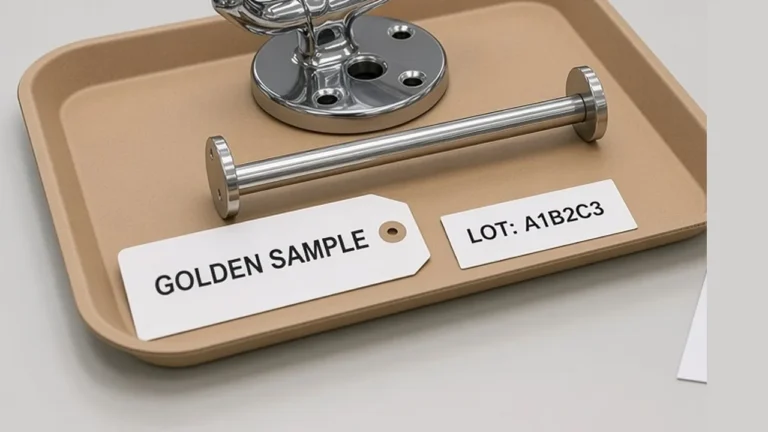
A factory can review a complete packet, compare it with the sealed sample and the lot record, and say what the photos appear to show. Custom bathroom hardware manufacturing can also say when the packet is incomplete and which views are still needed.
The factory cannot honestly promise a credit, a free replacement, or a response time from this article, and this page does not create those terms. Koitor can review evidence completeness as a family-owned China OEM manufacturer of bathroom and home-storage metal hardware; any commercial decision stays a project agreement.
If the photos show a likely transit issue, point the team to the cargo-evidence checklist rather than stretching a finish warranty. If they show a returns pattern, point to the returns-investigation method. This file stays on the photo and identity menu that makes those next steps possible.
For a running program, send a sample claim form and, when a real case exists, the photo set, lot mark, and install context for a completeness review. Do not treat that review as an approval of the claim.
Buyer checklist for bathroom hardware warranty claim photo evidence
Use this list when you write the aftersales form and when you audit a live claim.
- Require room-light and close-up photos, not only one of the two.
- Require a lot mark, bag mark, or an explicit statement that the mark is gone.
- Require SKU, order or invoice number, and install date if known.
- For finish claims, ask for a clean face on the same part and any cleaner or tool in use.
- For mount claims, ask for wall or tile context, screws, anchors, and a wide substrate shot.
- For arrival damage, require the cargo-evidence packet or a note that the carton was discarded, plus product identity.
- For kit claims, require an open-box layout and the remaining parts.
- Store images with the claim number and the lot code, not only in a chat thread.
- Keep the original room photos even if the physical part is later returned.
- Do not promise credit, replacement, or a clock in this evidence file.
- Do not use this menu as an Amazon reason-code map or as a legal warranty-term draft.
- Compare a complete packet with the sealed sample and the lot record before arguing cause.
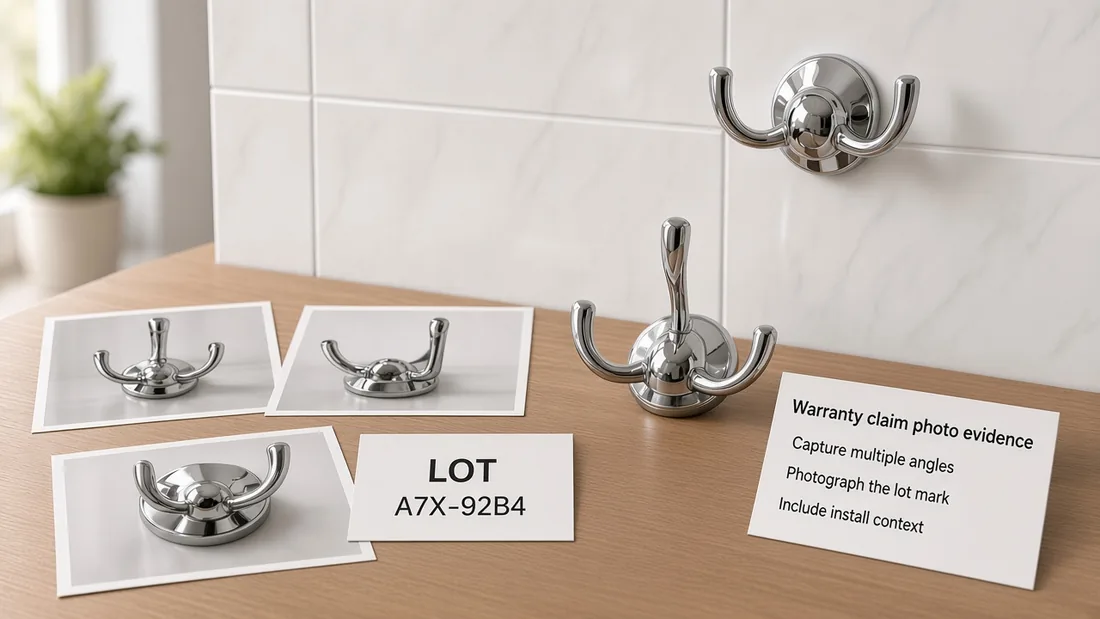
Lighting in bathrooms is often mixed and yellow. Ask for one photo with the room lights as they normally are, and if a second photo is taken with a flash, label it as a flash shot. Unlabelled flash close-ups make ordinary chrome look uneven and can start a false finish debate.
A coin, a tape, or a ruler in one close-up helps later reviewers judge size. Do not require a laboratory scale. A familiar object in the frame is enough, and it is better than a cropped smear with no reference.
Video can help a mount claim if the hook rocks, but it should sit beside stills, not replace the lot-mark still. A ten-second clip without identity is as weak as a single beauty still.
Installer photos taken on the day of fitting are gold when they still exist. If a trade installer shot the finished wall, ask for those images. They often show the substrate and the kit better than a claim photo taken months later after paint touch-up.
A set sold as a family should include a photo of the other pieces in the same room when the claim is a shade or finish match issue. One hook cannot prove a set mismatch. Photograph the bar and the hook in the same light.
Do not let a marketplace message thread stand in for a form. Portals drop images, strip metadata, and lose the order of shots. Pull the images into the claim record the same day.
If a user sends a screenshot of a previous email instead of the product, ask again for the live photos. A screenshot of a mark is not the mark, and it often hides the lot code at the edge of the original frame.
Privacy can be a reason to crop a mirror or a child from a room shot. Cropping is fine; cropping away the wall around a failed plate is not. Tell the user which area must stay in the frame.
Language on the form should be calm and specific: “Please photograph the lot mark on the bag or the part.” It should not say that a complete packet guarantees a yes. Clear instructions raise the quality of honest claims and reduce empty files.
Internal teams should use the same menu for distributor claims and for direct consumer claims, then add channel-specific fields if a marketplace requires them. Two informal lists will produce two qualities of evidence and two arguments about the same hook.
When the photo menu, the identity fields, the storage rule, and the boundary with cargo and returns files are written, bathroom hardware warranty claim photo evidence can run as a program habit. If the form only says “please send a photo,” the argument will start from a single blurry image.
Lot codes worn off in cleaning are a fact, not a reason to stop the rest of the packet. Collect the remaining shots and record that the code is unreadable. A later investigator can still use install date, invoice, and the room context.
If several claims share a lot, do not merge their photos into one folder without claim numbers. Each room is a different install. A combined album will mix substrates and make a pattern harder, not easier, to see.
Aftersales scripts should ask for the packet before any commercial sentence is spoken. The evidence file is there to slow down guesses, including guesses that favor the factory and guesses that favor a quick courtesy gesture.
Worked example: a robe hook with a dull patch on the ball. The user sends a flash close-up only. Ask for a room-light photo of the installed hook, a close-up without flash if possible, a photo of the back plate and any lot bag, and a shot of the cleaner if one sits in the same niche. Until those arrive, do not debate “bad chrome” from the flash still alone.
Worked example: a towel bar that pulled from the wall. The user sends a photo of the bar on the floor. Ask for the wall holes, the anchors, the screws, a wide shot of the tile or drywall, and a photo of the remaining plate if it is still on the wall. The floor shot proves the product is down; it does not prove why.
Worked example: a set in which the hook looks darker than the bar. Require both pieces in the same room-light frame, plus each piece close up, plus both lot marks. Without the shared-light frame, shade claims become two unrelated close-ups taken days apart.
Worked example: a “missing screw” kit claim with a photo of the hook only. Ask for the open-box layout, the bag, and the remaining screws on a contrasting sheet of paper. A product-only photo cannot show a missing kit part.
Distributors who refill claims from retailers should keep the retailer’s original images and add their own identity shots if the lot bag was opened at the warehouse. Copying a cropped retail photo into a new email, without the lot mark, resets the packet to zero.
Time stamps help when they are honest, but edited phone images can lose them. The form can ask for the date the issue was first seen, in words, and for the original files rather than a compressed social-media export when that is practical.
A second claim on the same lot should still get a full packet, not a note that says “same as last week.” Rooms and installers differ. The pattern appears only after complete files sit side by side.
If the user is uncomfortable on a video call, do not require one. A still-photo menu should be enough to start. Live video is optional when a mount is rocking and the user offers it; it is not a gate that blocks a written claim.
Translation matters on multilingual forms. A field labelled only “photo” will collect a selfie. Label fields with the view you need: “room view of the installed product,” “close-up of the mark,” “lot mark on the bag or the part.”
When a claim is closed, keep the packet for the period the program file already sets for quality records. Deleting images after a short chat makes later pattern work impossible, whether the close was a yes, a no, or a request for the physical part.
Do not use severity labels from a factory inspection sheet as the only title on a consumer photo. Call the file what the user photographed: “hook ball mark, room light,” not an internal grade. The buyer-facing archive should stay readable to aftersales, not only to a QC office.
A physical return does not cancel the need for the original room photos. Once the hook is in a warehouse, the wall context is gone. Keep both, and label which images were taken in the room and which were taken after return.
If a distributor offers a courtesy unit while photos are still missing, record that commercial choice in a separate note. This evidence file should still request the packet, or the next claim on the same SKU will have no pattern left to read later on file.
Frequently asked questions
Does a complete photo packet mean the claim will be approved?
No. Completeness only makes a review possible. Approval, credit, replacement, and timing are separate commercial decisions and are not promised here.
What if the user already threw the carton away?
Record that fact and still collect product, kit, and identity photos. Transit causes are harder to prove without the carton, which is why the cargo-evidence neighbor asks for carton shots early.
Can one close-up replace a room shot to save the user time?
No. The close-up shows the mark; the room shot shows scale, install, and sometimes the cleaner or the substrate. You need both.
Should this form be used as an Amazon reason-code process?
No. Keep marketplace reason mapping in its own file. This page only lists photos and identity fields for a bathroom-hardware warranty claim.
What if there is no lot mark on the part?
Ask for the bag, the carton label, or the invoice, and record which of those is missing. The rest of the packet is still worth collecting.
The user already sent a flash close-up. Is that enough to start a finish debate?
No. Ask for a room-light view, identity, and context first. A flash still can wait in the file, labelled as a flash shot, until the rest of the packet arrives.
Should a pulled towel bar be judged from a floor photo?
No. The wall, anchors, screws, and substrate shots are what separate a product issue from a wall issue.
How should a first program file be set up?
Write the menu by claim type, add the identity fields, show two example packets (a complete one and an incomplete one), and train the aftersales team before the next busy season, not after.
Work With Koitor Hardware
Need a warranty photo menu reviewed for completeness, not as a claim decision?
Send Koitor the claim photo set, lot mark, and install context for a review of evidence completeness. Our team can also discuss the hardware construction and small-batch OEM options on a running program.
OEM / PRIVATE LABEL
Turn this sourcing guide into a product brief
Share your target product, size, finish, order quantity and packaging requirements. Your team receives a practical manufacturability review before quotation.
 English
 Español
 Português
 Français
 Deutsch
 العربية