
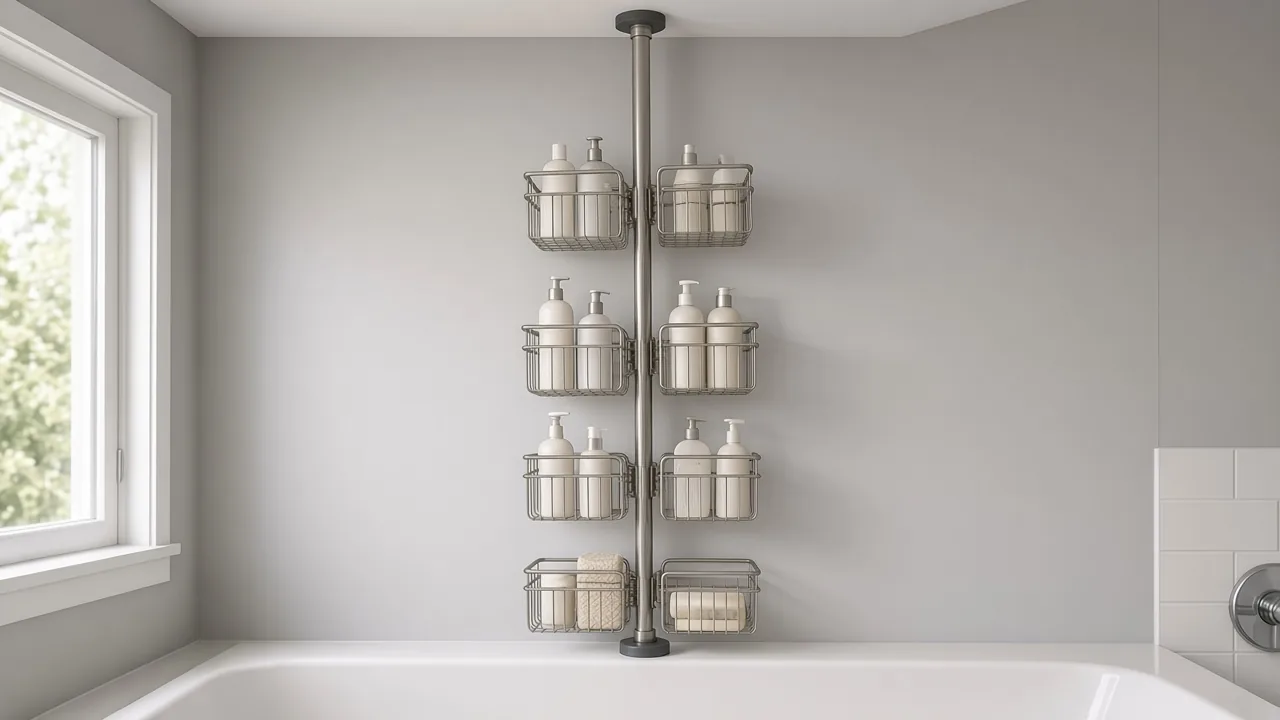
A pad that does not slip does not settle tension pole shower caddy wobble. A loaded pole can still sway at mid-span, and a basket that does not spin can still travel sideways with the pole. Freeze a lateral sway and recovery check under a named basket load, and keep a spring rate or an unbounded sturdy slogan off the listing until that check is written.
This guide is for importers and private-label teams writing tension-pole shower-caddy artwork, first-article checks, and after-sales answers. It is not a foot-pad slip file, not a joint-rust file, not a pole height-range file, and not a basket-clocking file. The decision is whether a loaded tension-pole caddy stays within an agreed lateral sway and recovery.
Koitor is a family-owned custom metal hardware factory. We can review pole and basket geometry, the named load map, and the wording you want to print. We do not invent a spring rate, a kilogram safe load, or a “will not wobble” promise for a setup we have not agreed how to observe.
Why pads and height do not close a sway file
Foot pads answer whether the pole marks the tub or slips at the contact. rubber compression set for mounting pads is useful when the question is the pad compound itself. A pad can stay put while the mid-span still moves. Do not treat a no-slip note, or a pad-hardness note, as a stiffness pass.
tension-pole shower caddy height-range specification answers whether the pole covers the intended ceiling-to-tub or ceiling-to-tray range. A pole can reach the ceiling and still feel loose under a side load. Height fit and lateral sway are separate observations, even though both use the same installed length.
Joint rust is a corrosion path at telescoping joints or locking collars. It can eventually change feel, but it is not the first-article sway check. A clean, dry joint can still have play. Keep rust on the rust file, and keep today’s lateral movement on this page.
Basket clocking or spin is a rotation question: does a basket stay facing the user, or is a 360° turn an advertised feature. A basket that stays clocked can still sway with the pole. A spinning basket is not the same motion as a mid-span lean. Do not merge those complaints because a user said the caddy felt loose.
Hanging-caddy sag is also a neighbor, not this product. Mid-span basket deflection on a hook-over caddy is a different architecture. Floor-standing storage racks that wobble on feet are a third family. This page stays on a tension pole that is compressed between two surfaces and loaded through its baskets.
Shopping language such as sturdy, solid, or wobble-free does not close the file. Those words are listing impulses. They become claims only after a named load, a named datum, and an agreed recovery are on the page. Until then, they should stay off the artwork.
How should the basket map and the sway datum be named?
Name the installed length and the surfaces before you name a result. Record the ceiling and tub or tray condition used on the sample, the installed pole length, and how the locking collar or tension mechanism was set. “Fully tightened” is not a setting unless you also record what that means on the actual sample.
Name the basket map. Record how many baskets are fitted, which heights they occupy, and which side of the pole they sit on. A four-basket load on one side is not the same moment as a balanced map. If the listing photograph shows a particular map, that map should be the observation map, or the artwork should not lean on that photograph.
Name the load. Use the bottles or weights the project will merchandize, or a named substitute the brief describes. Empty baskets are not a loaded sway check. Do not invent a Koitor kilogram figure. If the buyer wants a stated mass, that mass has to be written into the project and used on the sample, not borrowed from another caddy.
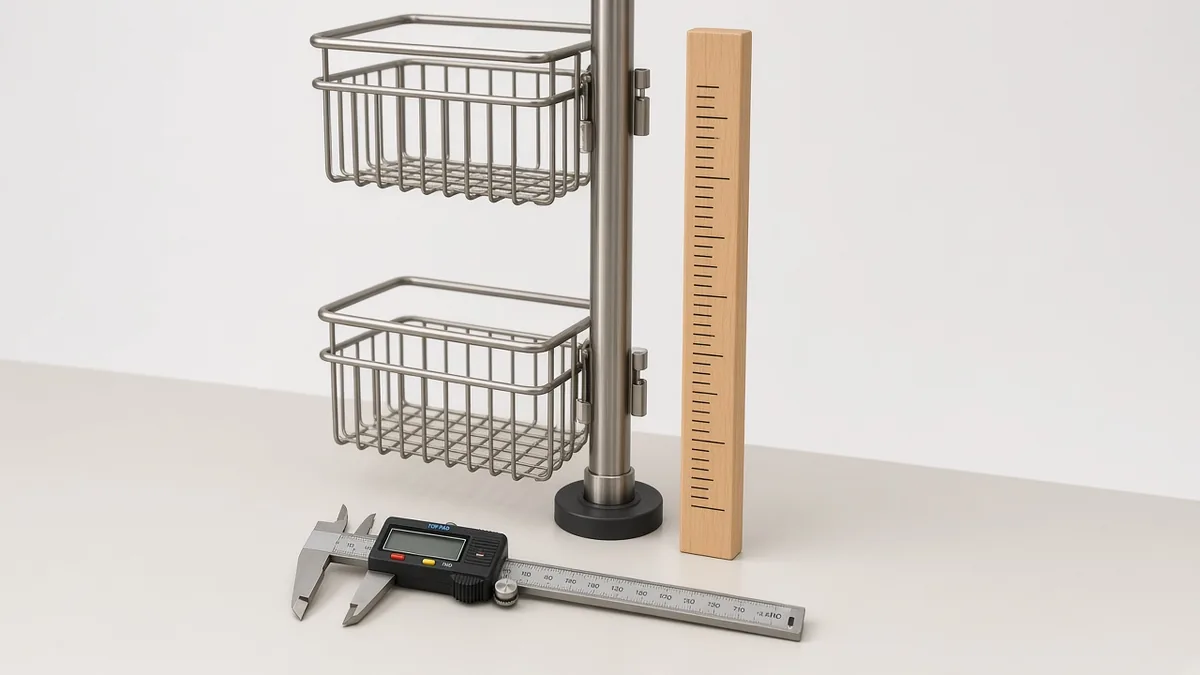
Agree a lateral datum at mid-span or at an agreed basket height. Typical project choices are a displacement from a vertical reference, a lean against a nearby wall or curtain, and whether the pole returns when the side load is removed. Pick the marks on the actual sample and photograph them before the side force or the dwell begins.
Record the direction of the check. A pole may move differently toward the open side of the baskets than toward the wall. If the merchandising implies the caddy sits in a corner, include that corner in the setup, or write an exclusion for open placements.
Collar type, telescoping overlap, and basket-arm stiffness all change the feel. The brief should name those parts as they will be shipped. A later lot that shortens the overlap, changes the collar, or lengthens the basket arms is not automatically covered by a prior sway photograph.
How should temporary sway be separated from lingering play?
Agree what happens when a side load is applied, and what happens when it is removed. Temporary sway that stays inside an agreed limit and then recovers is one outcome. Lingering lean, a collar that walks, or a pole that no longer returns to the datum is a different outcome. Those two results should not share one casual “it wobbled a little” note.
The side load itself is a project choice. Some teams use a named horizontal pull at a basket, some use a dwell with the named bottles only, and some use both. Write the method you will defend. Do not invent a Koitor pull figure, and do not copy a load from a floor-rack wobble page or a hanging-caddy sag page.
Wait time matters. A pole that looks acceptable when the last bottle is placed can still walk after a longer hold, especially if someone bumps the baskets during the wait. The hold is a project choice. Do not invent a Koitor hour.
Recovery should be judged on the same marks as the outbound lean. A new camera angle can make a lean look smaller. The before, during, and after photographs should share a stand-off and a background edge so the file can be reviewed later without an argument about perspective.
If the caddy will be sold at more than one installed length, either observe the lengths you will claim or write an exclusion. A short install with a large telescoping overlap is not automatic evidence for a long, extended install. Height range coverage and sway coverage can be written in the same project, but they are still two records.
Do not let a “spring feels tight” comment replace the datum. Tightness at the collar is not the same measurement as mid-span lean under the named map. Record both if both matter, and do not print only the feeling.
What must not be printed as a spring rate or a safe load?
Do not print that the caddy will not wobble, is solid in any shower, or holds a stated mass as a universal safe load. Those lines turn a hardware SKU into a spring and load rating the factory did not issue. A family-owned OEM can help you describe the observation. It cannot invent a rate.
Do not borrow a kilogram, a pound, or a stiffness number from a competitor listing or from a prior project and drop it onto this artwork. If a later project wants a stated load, that load has to be written into the brief and used on the sample.
Safer listing language stays inside the observation: the named basket map, the installed length, the agreed datum, and the agreed recovery. If that evidence is not in the file yet, omit the sturdy slogan or print an exclusion, rather than inventing a confident number.
After-sales scripts should follow the same split. “It should not wobble” is not a defense. “The named load at the named length stayed within the agreed lean and recovered” is a sentence you can point back to. Train the script on the brief.
What belongs on the clocking, pad, or height page instead?
Basket facing, rotation, and any claimed swivel belong on the clocking page. Foot-pad slip, marks, and pad compound belong on the pad files. Installed length coverage belongs on the height-range page. Joint corrosion belongs on the rust file. Hanging-caddy mid-span basket deflection belongs on that sag page, not here.
If a user complaint mixes several of those feelings, split the file. Check whether the pad slipped, whether a basket rotated, whether a joint is corroded, and whether the pole leaned under load. One photograph of a messy shower will not tell you which of those happened.
What should the importer freeze before artwork is approved?
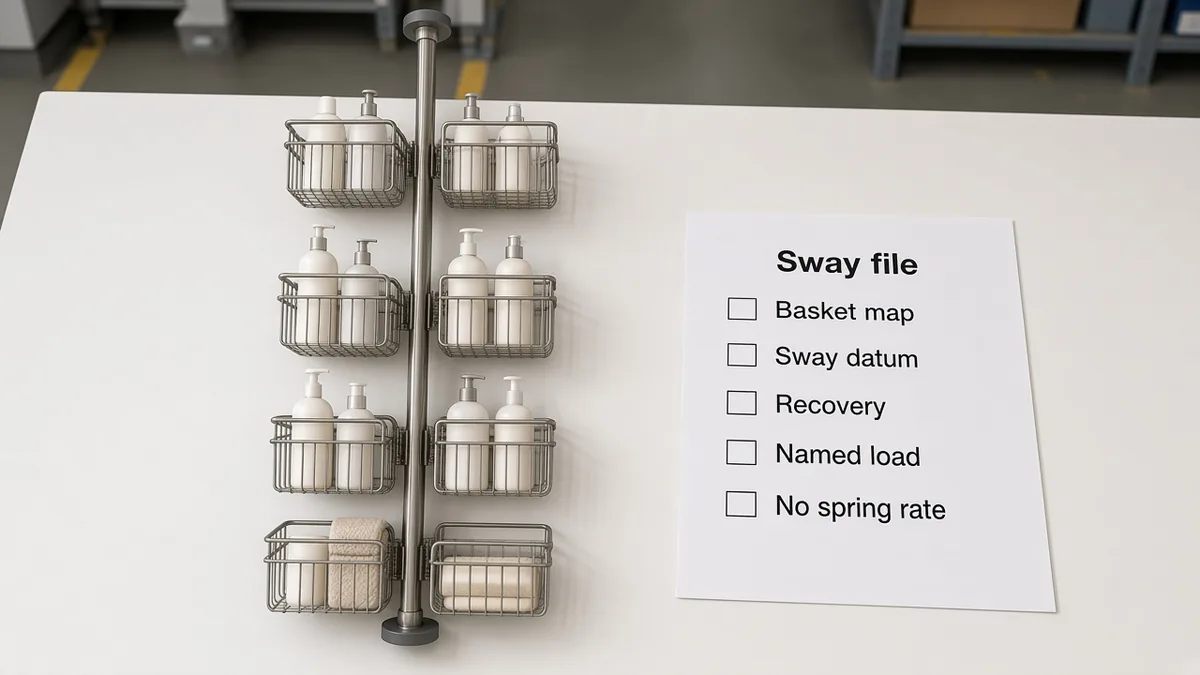
Use a written sway file. The checklist and the matrix remind you which decisions to freeze. They do not replace the photographs, the basket map, or the installed length in the project folder.
Do not approve a tension pole shower caddy wobble line until the named load and the datum exist. A tight-looking studio photograph of empty baskets is not a loaded sway check.
If production later changes the collar, the telescoping overlap, the basket arms, the pad, or the recommended bottle map, the file needs a new observation. A copied sturdy sentence from a pilot lot is not evidence for a changed pole.
A first-article pack should include the installed length, the surface conditions, the basket map, the named load, the datum photographs, and the recovery result. If the buyer will also sell a corner version and an open-wall version, say which setup was run.
Installer tightness is part of the file when the instruction sheet tells the user how to set the pole. If the observation used a shop setting that a household cannot repeat, write that limitation, or change the instruction so the setting can be repeated. A factory-only tightness is a weak basis for a retail sturdy claim.
A telescoping rattle is not automatically the same finding as mid-span lean. A joint can make a noise while the datum still holds, or a quiet pole can lean past the agreed mark. Record the sound only if the project cares about it, and do not let a rattle note stand in for the lean photograph.
One-sided merchandising is a common way sway files go wrong. If the listing shows every heavy bottle on one side of the pole, that is the map you should load. A balanced sample cannot support a one-sided photograph, and a one-sided sample should not be silently called typical of a balanced household fill unless that fill was also run.
Ceiling and tub geometry deserve an exclusion when they differ from the sample. A sloped ceiling, a curved tub rim, or a narrow ledge can change how the pads sit and how the pole leans. If those conditions will appear in the market and were not on the bench, say so, rather than printing a universal shower-corner promise.
Incidental bumps happen in real stalls. If the project wants a recovery after a side bump, write that bump as a method, without turning it into a child-proof or abuse-proof slogan. If you did not include a bump, do not imply the pole will shrug one off.
Shower curtains and glass doors can hide or restrain a lean in a photograph and then surprise a user in a more open stall. Record whether a curtain, a door, or an open side was present during the check. A restrained corner shot is a weak basis for an open-stall sturdy line.
When the map, the length, and the recovery agree, the listing can stay modest and still be useful. It can name the loaded check you ran and avoid an unbounded wobble-free badge. That modest sentence is stronger than a borrowed kilogram or a copied sturdy headline with no datum behind it.
After-sales videos should be read with the same split. A phone video of a pole moving in a shower does not, by itself, tell you whether the pad slipped, a basket spun, a collar walked, or the mid-span simply leaned under an unnamed load. Ask for the installed length, the basket map, and a still frame of the starting datum before you treat the video as a sway failure.
If a later production change is only cosmetic — a finish, a hook color, or a pad color — the sway file can often stay with the prior geometry record, so long as the collar, overlap, arms, and map did not change. If those functional parts changed, do not assume the previous lean still holds. Re-run the datum, then decide whether the sentence can stay.
| Claim impulse | What to freeze | What the sample should show | What to keep off artwork until then |
|---|---|---|---|
| Will not wobble in the shower | Installed length, basket map, named load, lean datum, and recovery | Any mid-span lean stays inside the agreed limit and recovers as agreed | An unbounded sturdy or wobble-free slogan |
| Stays solid at full height | The longest install you will claim, or an exclusion | The extended length was the length you observed | A short-install photo used as proof of a long install |
| Pads are strong, so it is stable | A split between pad slip and lateral pole sway | The pads stayed put, and the mid-span was judged separately | A no-slip note treated as a sway pass |
| Baskets do not spin, so it is firm | A split between clocking and pole lean | The baskets stayed facing, and the pole was judged separately | A clocking pass treated as a stiffness pass |
| Holds a stated mass safely | The mass as a project load used on the sample, if you use one at all | The named load was the load in the check | A borrowed kilogram or an invented spring rate |
- Write the product as a tension-pole shower caddy compressed between two surfaces, not as a hanging caddy or a floor rack.
- Record the installed length, the ceiling and tub or tray conditions, and how the collar was set.
- Name the basket map, including count, heights, and which side of the pole is loaded.
- Name the load as the merchandised bottles or a described substitute; do not invent a factory mass.
- Photograph a mid-span or agreed-height datum before, during, and after the check.
- Separate temporary lean that recovers from lingering play or a collar that walks.
- Keep pad slip, joint rust, height range, and basket clocking on their own files.
- If only one installed length or one placement was observed, write an exclusion for the others.
- Keep spring rates, universal safe loads, and unbounded wobble-free language off the listing.
- Send the drawing, the load map, and the intended sentence before the artwork is locked.
How can a family-owned OEM review the stiffness brief?
Koitor can review the pole and basket geometry, the collar and overlap, the named load map, and the wording you want to use. That is a construction and acceptance discussion, not a spring certification. custom shower caddy manufacturing is the usual starting point when the caddy family itself still needs development.
If you already have an installed-length and load outline, attach it. If you only have an empty-basket studio photograph, say that. We can help you tighten the datum and the sentence, but we will not invent a rate to fill a blank. For a sway-file review, send the loaded-sway brief to Koitor with the drawing and the intended claim.
MOQ, sample timing, and bulk lead time stay on the quotation path and depend on the product, the finish, and the order. They are not a substitute for the loaded sway observation.
Frequently asked questions
Can tension pole shower caddy wobble be cleared by a no-slip pad photo?
No. A pad that stays in place does not tell you whether the mid-span leaned or recovered. Take the pad record if you need it, then take the sway record on the loaded pole.
Do we need a spring rate or a safe-load kilogram to sell the caddy?
Not from this article, and not as an invented Koitor figure. You need a named map, a named length, and an agreed observation. If a later project wants a stated load, write that load into the brief and use it on the sample.
How is this different from basket clocking or hanging-caddy sag?
Clocking is rotation of a basket around the pole. Hanging-caddy sag is mid-span deflection of a hook-over basket. This page is lateral sway of a compressed tension pole under a named basket load. Use the neighbor pages for their decisions.
What if we sell the same pole at several heights?
Observe the lengths you will claim, especially the most extended install, or write an exclusion. A short, overlapping install is not automatic evidence for the longest listing height.
Can a corner photograph support an open-wall sturdy line?
Only if the open-wall setup was also observed. A corner can hide or restrain a lean that would be visible in an open placement. Write the placement you ran.
Can Koitor write the wobble listing sentence for us?
Koitor can review a sway sentence against the basket map, the load, and the datum photographs, as a construction and acceptance discussion. The buyer still owns what is printed. If the loaded sway file is missing, the safer path is to narrow or drop the line.
Work With Koitor Hardware
Need a loaded-sway brief reviewed?
Send Koitor your tension-pole caddy drawing or sample, the basket map and named load, and the sway sentence you want to print. Our team can review pole geometry and claim wording as a construction and acceptance brief before quotation. MOQ can start from about 100 pcs depending on the product; samples usually take 5–7 working days after details are confirmed; bulk production usually takes 4–6 weeks depending on the project.
OEM / PRIVATE LABEL
Turn this sourcing guide into a product brief
Share your target product, size, finish, order quantity and packaging requirements. Your team receives a practical manufacturability review before quotation.
 English
 Español
 Português
 Français
 Deutsch
 العربية