

How to clean brushed nickel safely starts by identifying the exact product and follow its finish-specific care instructions. For ordinary surface soil, the manufacturer’s approved gentle method may involve a soft damp cloth, a compatible mild cleaner, rinsing when directed and drying with a soft cloth. Do not assume that vinegar, polish, steel wool or a general nickel-cleaning recipe is safe for every brushed-nickel finish. Stronger treatment should be used only when the product supplier explicitly approves it.
Why should the exact finish come before the cleaner?
“Brushed nickel” describes an appearance or finish name used across products; it does not tell the user exactly how the surface was produced or which care rules apply. A brushed appearance may be associated with different finish systems, products and suppliers. The care instructions for one brand or faucet cannot automatically be transferred to a different bathroom accessory.
Manufacturer instructions illustrate why product identity matters. Moen’s current care page organizes instructions by finish type and includes different finish groups, including brushed-nickel names; its treatment guidance differs between groups. Moen also says its instructions apply to its products and that failure to follow them may affect its warranty. This is evidence for checking the exact manufacturer’s guidance, not permission to apply Moen-specific treatments to an unrelated towel bar or storage accessory. See Moen’s Faucet Finish Care and Cleaning page.
Before cleaning, locate the product model, packaging, installation guide or supplier care card. Confirm that the document refers to the actual SKU and finish. If a private-label product has no care instructions, contact the brand or supplier before escalating beyond a gentle routine. A generic web page may be useful background, but it should not override the product owner’s written guidance.
The cleaner itself should also be considered as a named product. Formulations and labels can change, and the word “mild” is not a complete chemical specification. If the manufacturer gives an approved cleaner by product type or class, use that description and follow the cleaner label. Do not assume that a cleaning method that worked on an older purchase is approved for a revised finish, a different supplier or a replacement part with a similar color.
This matters because “nickel” can describe different surfaces, and brushed texture changes how residue and light appear. A spot may be mineral deposit, soap residue, surface soil, a scratch or a coating change. A cleaning method that removes one deposit could alter another surface. Do not diagnose an unknown finish from a photograph alone.
How to clean brushed nickel for ordinary surface soil?
Use the exact product instructions first. If those instructions permit a gentle routine, work with clean hands and a soft, nonabrasive cloth. Apply the approved cleaner to the cloth or surface only as instructed, remove routine soil without aggressive pressure, rinse if the manufacturer directs, and dry with a clean soft cloth. Do not leave cleaner sitting on the finish unless the product instructions specifically allow it.
Keep the cloth clean and avoid transferring grit from another surface. A soft cloth can still scratch if it contains particles. Do not use an abrasive pad simply because the finish has a directional brushed pattern. Avoid scrubbing across the grain unless the finish owner explicitly instructs a particular method. When the care sheet does not state a grain direction or wiping method, ask the supplier rather than treating a decorative texture like unfinished metal.
| Situation | Safe next step | What not to assume |
|---|---|---|
| Routine fingerprints or light soil | Follow the product’s approved gentle method | That every household cleaner is compatible |
| Water spots or mineral residue | Check whether the finish owner permits a specific treatment | That vinegar is safe on all nickel finishes |
| Grease or residue from a product | Identify the contaminant and consult the care instructions | That stronger solvent or polish is automatically better |
| Scratch, peeling, color change or exposed substrate | Stop routine cleaning and request product-specific advice | That abrasion can restore the original finish |
| No model-specific care information | Contact the brand or supplier for the applicable instruction | That advice for a similar-looking faucet applies |
These steps are general decision guidance, not a universal chemical formula. A gentle cleaner that is appropriate for one finish may still be excluded by another supplier. The product’s own instruction governs. The Delta guidance referenced in the research pack similarly emphasizes soft cleaning and avoiding certain harsh or abrasive treatment for its named products; it should not be treated as an instruction for an unrelated SKU. When a brand-specific guide conflicts with generic advice, follow the brand’s applicable product instruction.
How should you handle water spots and stubborn deposits?
First determine whether the mark is a removable deposit or a change to the finish. A dried droplet, soap film, corrosion stain, scratch and coating failure can look similar in a quick photo. Start with the approved routine cleaning. If the mark remains, check the exact product document for an authorized deposit treatment. If none is specified, stop and contact the product supplier.
Do not assume household vinegar or another acid is appropriate. Some product-specific faucet instructions permit a limited vinegar-and-water treatment for certain finish groups, but the same page distinguishes other finishes and warns against other treatments. That instruction belongs to the listed Moen product finishes; it is not a universal brushed-nickel formula. The same limitation applies to steel wool, metal polish, wax and household descalers.
If the surface changes sheen, darkens, flakes or reveals a different-colored layer, do not continue rubbing to make the area match. More abrasion may remove additional finish and make the mark larger. Photograph the condition under ordinary lighting, record the product model, cleaner used and contact time if known, and ask the supplier for the next step. Do not promise restoration unless the manufacturer provides an approved repair method.

For a branded product, warranty terms may depend on the applicable instructions. Keep the manual, packaging or link used for the product and follow the named supplier’s conditions. The warranty statement on one manufacturer’s page does not set the policy for a different brand. If you are an importer or retailer, do not copy a branded care paragraph into your own product manual without confirming that it matches your finish supplier and SKU.
When a user has already applied an unapproved cleaner, ask them to stop further treatment and preserve the condition for review. Record the name of the cleaner, whether it was diluted, approximate contact time, rinsing and drying steps, and when the appearance changed. Share those facts with the brand or supplier. Avoid assigning blame or promising that a surface can be repaired from a photo. A clear incident record helps the supplier distinguish product-care questions from a possible finish or handling issue.
Which tools and chemicals should you avoid unless approved?
Avoid selecting a treatment based on a generic “nickel cleaner” label. Check both the surface manufacturer and cleaner label, and use only a method allowed for the exact product. Unless specifically approved, do not use steel wool, abrasive pads, scouring powders, harsh descalers, strong acids, solvents, bleach or aggressive polishing compounds on a brushed finish. A green fibrous pad can contain abrasive mineral particles even when it feels soft, and repeated rubbing can change the brushed appearance.
Do not mix cleaning chemicals. Do not soak the complete accessory or allow cleaner to pool around joints, seams, fasteners or concealed mounting parts unless product instructions allow that exposure. A finish-care question can become a water-ingress or assembly issue if liquid remains trapped in a hidden area. The cleaning label should address the product construction as well as the visible face.
Never assume a “natural” cleaner is automatically safe. Vinegar, lemon-based products and other acids may be recommended for some surfaces but excluded for others. Likewise, wax may be permitted for one named product and inappropriate for another. Always use the product-specific guide and follow its dilution, application, rinse and contact instructions. If the guide does not address the intended cleaner, ask before experimenting.
If the user cannot identify the finish or product, use a nonabrasive dry dusting or gentle wipe only if it is consistent with the available instructions; do not escalate to an unverified chemical. When there is no care documentation at all, the safer action is to seek the brand or supplier’s written direction. A hidden-area trial does not override a manufacturer’s exclusion and does not prove long-term compatibility.
How can a buyer distinguish dirt from finish damage?
There is no dependable diagnosis from appearance alone. Start with the product model and the history of the mark: where it appeared, what contacted it, which cleaner was used, and whether the surface changed before or after cleaning. A removable residue may respond to an approved routine method; a scratch, coating change or exposed substrate will not necessarily do so. Do not repeatedly test stronger chemicals just to identify the problem.
Record the affected area in a clear photograph and include a reference for scale. Note the lighting, cleaning material and whether the area was dry. Avoid editing contrast or color in a way that changes the apparent finish. Keep an unaltered image for supplier review. If the product is under warranty, retain purchase details and the applicable care document.
The supplier may ask for a sample, batch code, product number or description of the exposure. Share only the information needed to identify the item and condition. Do not scrape the finish or use an abrasive test unless the supplier specifically directs it. A consumer’s improvised test may complicate later assessment and could change the condition being evaluated.
What should private-label care instructions say?
An importer should not copy cleaning advice across products solely because each is called brushed nickel. The care instruction should be approved for the exact finish system and complete SKU. It should explain the routine method, any approved treatment for deposits, excluded tools or chemicals and when the user should stop and contact support.
Use a version-controlled care card with these fields:
- Product name, SKU, finish name and instruction revision.
- Supplier or finish owner who approved the cleaning method.
- Routine cloth and cleaner description, if the supplier permits one.
- Application, contact, rinse and drying directions.
- Explicit restrictions on abrasives, acids, solvents or other chemicals.
- A separate deposit-removal method only when confirmed for the finish.
- Stop conditions such as peeling, color change, scratches or exposed substrate.
- Customer-support path for unresolved marks or damaged surfaces.
- Date and approver for the text used on packaging, website and retailer materials.
Review all customer-facing versions together. A carton insert, online listing and customer-service script should not give conflicting advice. If the finish supplier updates the instruction, the brand should identify which product revisions use the new care rules. Do not imply a particular coating technology, lifetime or test performance unless current evidence supports that claim for the actual SKU.
Care language should be short enough to follow without losing a necessary restriction. Avoid vague commands such as “clean normally” or “use a suitable product” when the supplier has a specific method. If a method requires prompt rinsing, include that sequence near the cleaner instruction. If the finish owner does not permit a chemical, state the exclusion in plain language rather than burying it in a general disclaimer.
What cleaning mistakes can damage a finish?
Using a recipe from a different brand. Instructions for one faucet or finish system may not apply to a towel bar or shelf. Confirm the exact product.
Using abrasive pads to follow the brushed grain. A pad can contain particles that scratch or alter the sheen. Use only an approved cloth and method.
Applying vinegar to every mineral mark. Some product instructions allow it for a named finish; that does not make it universal. Check the exact care guide.
Leaving cleaner on the surface. A product may require prompt rinsing and drying. Follow its stated contact and rinse sequence.
Polishing until the mark disappears. Abrasion may change the finish permanently. Stop if the surface changes and request supplier advice.
Cleaning before identifying the product. Model and finish labels help locate the correct instruction. Find them before trying an aggressive treatment.
Copying generic care text onto private-label packaging. The wording should match the actual finish supplier’s approved directions and SKU revision.
Claiming a surface is maintenance-free. Brushed appearance does not guarantee that water spots, fingerprints or cleaner exposure are irrelevant. Use accurate instructions.
How can Koitor support product-care planning?
Koitor Hardware is a family-owned custom metal hardware factory focused on bathroom and home-storage products. For a confirmed OEM project, Koitor can discuss the metal product construction, finish reference, sample review and how care information is handed off. The exact cleaning chemistry and compatibility must be confirmed by the supplier responsible for the finish and the specific product. This article does not claim Koitor manufactures branded faucets, tests household cleaners or guarantees a finish result.
An importer can share the drawing or sample, finish designation, supplier care document and proposed private-label text. The project team can then identify open questions: Does the instruction match this SKU? Does it apply to all visible and concealed faces? Are the rinse and drying steps clear? Which products or tools are excluded? Who will approve a revision if the coating or supplier changes?
The goal is a traceable care handoff, not an unverified promise that marks will never appear. A sample review may confirm appearance and construction. Cleaner compatibility, warranty terms and finish performance require evidence from the responsible supplier. Keep those responsibilities separate in the project record.
Learn about the confirmed manufacturing scope on the Koitor OEM home-storage hardware page, or contact Koitor with the product and finish references. Any product-specific care advice should be checked with the actual finish supplier before it is printed or published.
What is a brushed-nickel care checklist?
The checklist below helps a buyer or product owner identify the right instruction before cleaning. It is a document-control tool, not a replacement for the supplier’s care procedure. Before applying a method, confirm how to clean brushed nickel for this exact SKU in its current product care document. This makes how to clean brushed nickel a product-specific instruction instead of a generic finish promise.
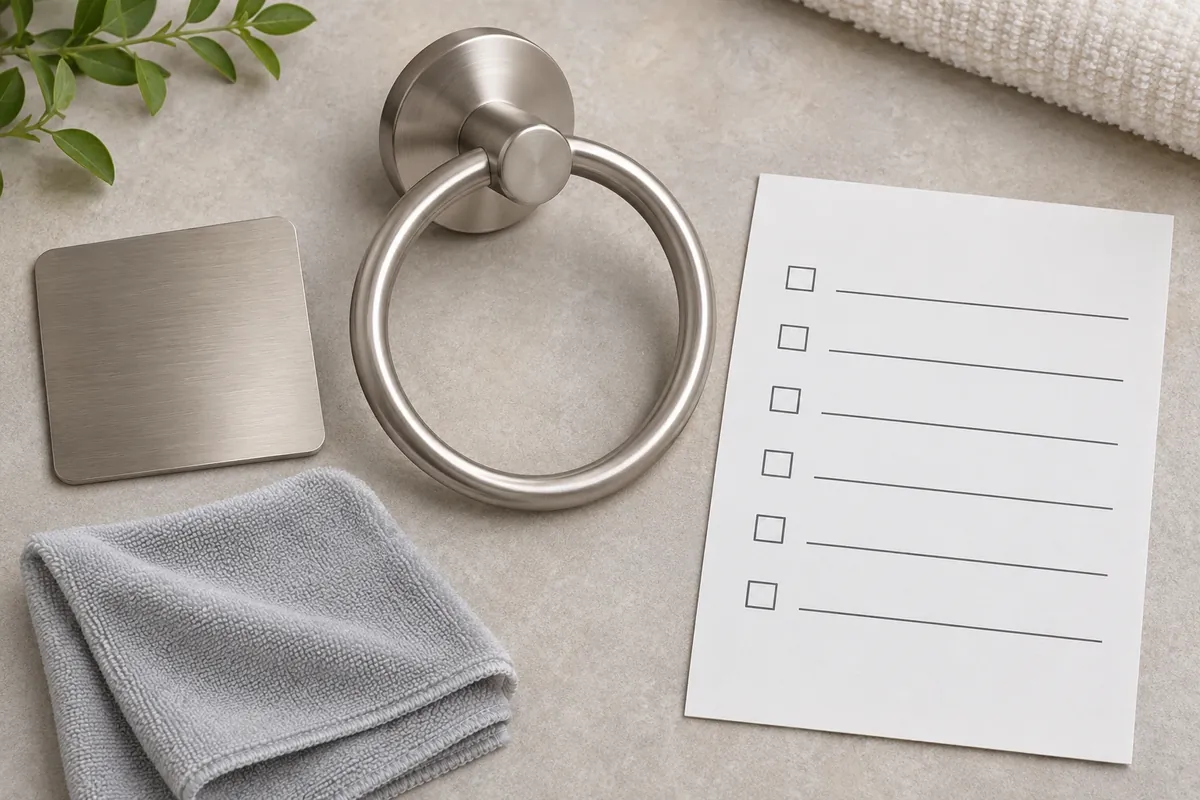
Before cleaning or approving a care card, confirm:
- Exact product model, SKU, supplier and finish designation.
- The current manufacturer care page or manual for that product.
- Whether the instruction specifically covers the brushed-nickel finish.
- Approved cloth, cleaner, application and rinse/dry sequence.
- Whether a water-spot or mineral-deposit treatment is expressly allowed.
- Prohibited pads, abrasives, solvents, acids or other chemicals.
- What to do when the surface is scratched, discolored or peeling.
- Which support contact handles unresolved surface changes.
- That website, carton and customer-service wording match the approved revision.
- Who approved the instruction and when it was last checked.
If any answer is missing, do not fill the gap with a generic cleaning blog. Ask the product or finish supplier for written clarification. Keep the care instruction alongside the finish specification and sample record so a later buyer can confirm that it still matches the supplied item.
How should a hotel or importer manage care across multiple SKUs?
Do not assume that every product in a bathroom assortment uses the same finish system because the color name is similar. Build a SKU-to-care-document matrix for each supplier and family. Record the product code, finish name, supplier instruction link, document revision, permitted routine method and any separate restriction for water spots or stronger treatment. If the supplier groups several SKUs under one instruction, confirm that the grouping applies to the exact parts being sold.
For hotels, distributors and retailers, assign responsibility for keeping the care information current. A product revision, finish-source change, replacement part or new private-label supplier may make an old card inaccurate. When purchasing updates the BOM, route the care-card reference through the same document-control review. Customer service should be able to identify the model from the packaging or invoice before advising a customer to use a stronger cleaner.
Cleaning teams also need instructions that match their actual products and procedures. Do not rely on a general housekeeping chemical list if the product supplier excludes one of those chemicals for a specific finish. If a facility needs a standard cleaner across multiple fixtures, obtain compatibility confirmation for each relevant finish and SKU. Keep any confirmed exclusions visible in the cleaning plan rather than hidden in a supplier PDF that staff cannot find.
This coordination does not require a claim that the finish will never spot or wear. It reduces ambiguity about which approved method applies. When an instruction is uncertain, ask the product supplier and record the answer before distributing a revised manual or service script.
Frequently asked questions
Can I use vinegar on brushed nickel?
Only if the exact product’s manufacturer permits that treatment for its finish. Some supplier instructions distinguish finish types and limit where vinegar may be used. Do not transfer one brand’s directions to another product.
Is steel wool safe for water spots?
Do not use it unless the manufacturer explicitly approves it for the exact finish. A treatment listed for one product may damage another brushed-nickel surface.
Can I use metal polish to restore the brushed appearance?
Not without product-specific approval. Polishing may change the sheen or remove finish. If the surface appears damaged, stop and ask the supplier for advice.
How often should brushed nickel be cleaned?
Follow the product’s care instructions and clean when needed. This article does not prescribe a schedule for every product or environment.
What if gentle cleaning does not remove the spot?
Check the exact care guide for an approved deposit treatment. If none is stated, record the product and condition and contact the supplier instead of escalating to an unapproved chemical.
Can a private-label brand reuse faucet-care instructions for a towel bar?
Only after the responsible finish supplier confirms that the instruction applies to the exact finish and product. Similar appearance is not enough.
Sources and further reading
- Moen: Faucet finish care and cleaning
- Delta product care and maintenance
- Cleaner compatibility for powder-coated bathroom hardware
Work with Koitor Hardware
Align the care card with the actual finish
Share the product sample, supplier finish record and proposed care text so an OEM project discussion can identify which details need finish-supplier confirmation.
OEM / PRIVATE LABEL
Turn this sourcing guide into a product brief
Share your target product, size, finish, order quantity and packaging requirements. Your team receives a practical manufacturability review before quotation.


 English
 Español
 Português
 Français
 Deutsch
 العربية