

Screw vs bolt is a comparison about more than a head shape: the useful distinction is how a fastener is named, specified and assembled with its mating part. In common purchasing practice, a bolt often passes through joined parts and engages a separate nut, while a screw may engage a nut, an internally threaded hole or, in some designs, form or cut threads in the receiving material. Those patterns are helpful, but they are not universal definitions for every catalog or industry. Buyers should identify the actual fastener, its mating thread, access for installation and the drawing that controls the assembly before approving a substitution.
What does screw vs bolt mean in practice?
The practical difference is the fastener’s intended installation and mating configuration, not a single visual feature. A hexagonal head does not automatically make an item a bolt, and a fastener called a screw does not always cut its own thread. A machine screw, for example, can pass through a clearance hole and tighten into a separate nut, or it can engage a tapped hole or threaded insert. A hex bolt commonly passes through parts and tightens with a nut, but supplier naming conventions and product standards vary.
For an importer, this means that the word on a quotation is a starting point rather than a complete approval record. Two suppliers may use different everyday labels for products that look similar. Conversely, two fasteners both described as screws can have different thread systems, points, head geometry, materials or intended mating parts. A project should therefore be approved against a part number, drawing, sample and assembly configuration.
The reliable question is: what does this fastener engage, and how is the joint assembled? If the answer is “a matching nut,” record the nut. If the fastener engages a tapped plate, record that internal thread and the plate material. If it enters wood or another substrate, identify the substrate and the specified fastener family. This simple shift from label to joint reduces ambiguity without pretending that the terminology is identical across all markets.
The Bolt Depot fastener type chart distinguishes categories such as machine screws and hex bolts and describes machine screws as fasteners used with a nut or tapped hole. The Portland Bolt explanation of hex bolts and hex cap screws discusses a narrower naming distinction and illustrates why product conventions matter. Neither source makes every buyer’s drawing or supplier designation interchangeable.
Why do ordinary definitions sometimes conflict?
Different references answer different questions. A catalog may organize products by intended use, a drawing may use a controlled standard designation, and an assembler may use a familiar shop term. A supplier article can simplify a broad topic for a general reader. These sources can all use the words “screw” and “bolt” while focusing on different details.
Some guides describe a bolt as requiring a nut, while other suppliers list fasteners called bolts that can engage a tapped hole. Some explain screws as creating their own threads, even though machine screws commonly engage an existing internal thread. These differences show why a broad rule should not replace the actual product description. They do not prove that every reference is wrong; they show that the scope and vocabulary of each source need to be understood.
The Accu screw buying guide includes a machine screw used with a matching nut. That example is sufficient to disprove the shortcut that every screw must cut a new thread in its mating material. It does not establish that a particular screw will fit a buyer’s nut or perform under a specified load. The interface still has to match.
A practical supplier conversation should resolve three distinct fields:
- Product family and designation: the supplier’s controlled name, product number and drawing reference.
- Mating configuration: nut, tapped hole, threaded insert, wood, sheet material or another defined receiver.
- Assembly method: which side is accessible, what tool reaches the drive, and how the parts are held during installation.
These fields are more useful than arguing over a universal dictionary definition. If buyer and supplier use the same words differently, the drawing and sample should settle what is being supplied.
The approval owner should also be explicit. A buyer can verify that the quotation names the requested item and that the sample matches the visible callout. The product engineer or responsible design owner should confirm that the chosen joint meets the product’s fit and functional requirements. A component supplier can provide its own designation and available technical documents, but it cannot decide an undocumented requirement on the buyer’s behalf. If the product is already in production, route a proposed fastener change through the same engineering-change process used for other controlled components. This keeps the commercial record, assembly drawing and received sample aligned.
What features should a buyer compare?
Compare the fastener as a complete component. A visual resemblance can hide a mismatch in thread, length, head form, material or finish. The choice affects not only whether a part can be assembled, but also whether it fits the space, can be installed with available access and remains compatible with the mating part selected by the responsible engineer.
| Buyer field | What to record | Why it matters |
|---|---|---|
| Product identity | Supplier name, catalog number and revision | Prevents a generic label from standing in for a defined part |
| Mating part | Nut, tapped hole, insert or substrate and its drawing | Confirms that the thread or engagement is intended to work together |
| Thread description | Diameter, pitch or supplier-controlled thread designation | Helps distinguish visually similar but incompatible threads |
| Length datum | Under-head, overall or countersunk measurement as shown on the drawing | Fastener length can be measured from different reference points |
| Head and drive | Head profile, drive recess and tool access | A head may interfere with a mating face or leave inadequate tool clearance |
| Material and finish | Exact supplier specification and finish description | Appearance alone does not identify the substrate or coating |
| Assembly access | Which side can be reached during assembly or service | Determines whether a nut can be held or a tool can reach the drive |
| Approval basis | Drawing revision, sample ID and agreed acceptance record | Links the reviewed item to later production and change control |
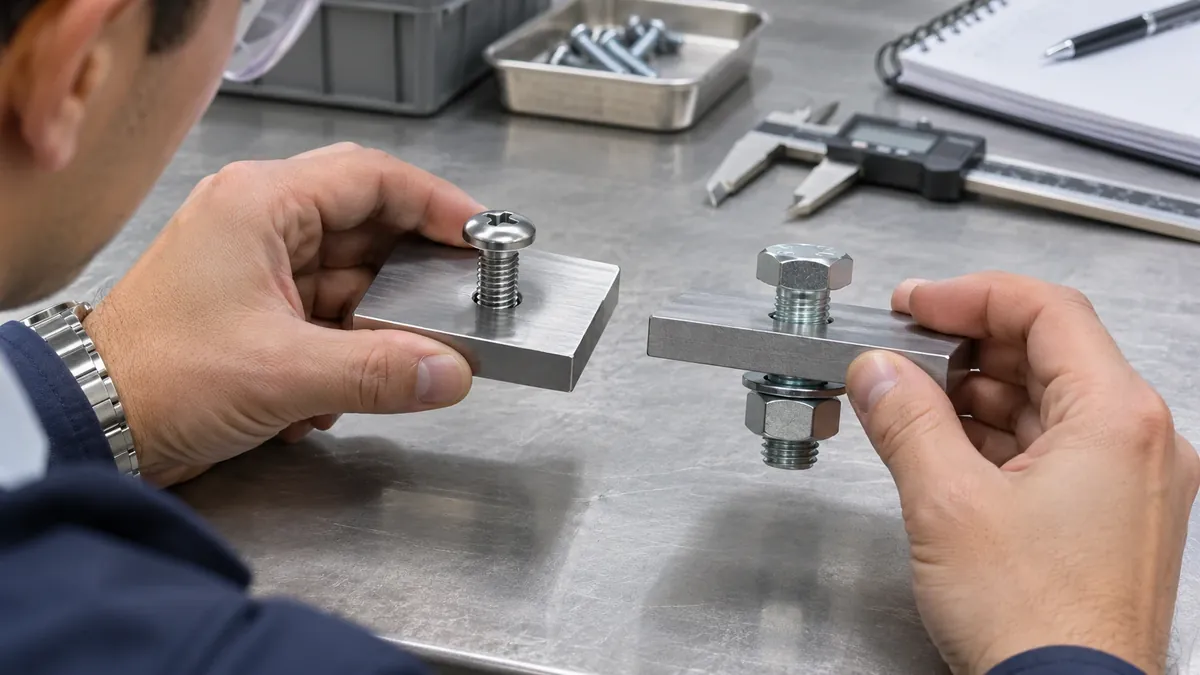
For a sample review, lay the proposed fastener beside the actual mating component. Check that the intended parts can be brought together without forcing them. Confirm that the tool can approach the drive in the assembled geometry. Verify that a nut, insert or tapped feature is the one identified in the drawing. Record any difference between the approved sample and the quote.
Do not infer a thread standard from apparent diameter alone. A caliper can help compare dimensions, but it does not identify every thread parameter or prove compatibility. If a thread gauge or controlled technical document is needed, the buyer should use the specified method and qualified person. The purpose of a visual or sample check is to catch obvious identity and fit questions, not to replace engineering approval.
Does head shape tell you whether a fastener is a screw or bolt?
No. Head shape by itself is not a dependable naming rule. Hex, pan, flat, round, socket and other heads appear across different fastener families. The drive recess is a separate feature from the head profile. A buyer can use those features to identify the part, but should not use them as the only basis for classifying it.
This distinction matters in compact metal storage products. A low-profile head may be chosen to reduce projection, but the assembly still needs enough clearance for the selected driver. A countersunk form needs a compatible seat if the design calls for a flush surface. A wider head may distribute contact differently in a particular design, but it does not prove a stronger joint without the relevant design and evidence.
Record both the head style and drive type. “Phillips screw” identifies one drive family but does not specify whether the head is pan, flat or another form. “Hex bolt” may imply a head or product family in a particular catalog, but still does not describe the mating thread, length datum, grade or finish. The drawing should separate these details so that the supplier and buyer can compare like with like.
If the fastener will be visible, appearance may also matter. Specify the exposed head finish, color or surface expectation as a separate requirement. Do not treat a head that looks similar in a catalog photo as proof that the underlying material or coating is the same. A photograph is a screening aid; a controlled sample and written designation establish the intended item.
How should importers verify a proposed substitution?
Treat a substitution as a change to an assembly, not a synonym swap. The proposed part should be compared with the approved fastener and mating components using the same drawing revision and acceptance questions. If the supplier proposes a screw in place of a bolt, or a different screw family in place of the specified part, ask what else changes: nut, hole, insert, assembly access, visible projection, tool and instructions.
A useful substitution record includes:
- The original fastener part number, supplier and drawing revision.
- The proposed part number and a supplier drawing or specification.
- A side-by-side comparison of head, drive, thread, point, length and finish.
- The intended mating component and its thread or receiving material.
- The assembled sample or representative fit check used for review.
- Any assembly sequence, tool-access or service-access difference.
- Written approval and the date or revision at which the substitution takes effect.
Keep unknowns visible. If the supplier cannot yet confirm the thread, write “not confirmed” and resolve it before production approval. Do not fill a missing field with a guess based on a familiar product title. If a fastener is supplied by a separate component vendor, identify that vendor’s responsibility for material and product documentation. Koitor’s role as a custom metal hardware manufacturer does not make every purchased screw or nut a Koitor-made part.
A short sample check may confirm that a part can be assembled in one reviewed configuration. It does not prove fatigue life, load capacity, corrosion life or consistency across a production lot. Those conclusions require specified requirements and appropriate evidence. The source guides used here do not authorize numeric torque values, strength ratings or current compliance claims for an unexamined fastener.
What mistakes cause avoidable sourcing problems?
Ordering only by a familiar label. If the quote says “bolt” but omits its designation, mating nut and drawing, the buyer may be comparing unlike products. Ask for the supplier part number and the joint it is designed to form.
Assuming every screw cuts its own thread. Machine screws may engage a nut or tapped feature. If a buyer expects a self-tapping action but receives a machine screw, the assembly may not match the receiver. State the actual receiver.
Assuming every bolt uses a separate nut. Some product names and standards may not follow a simplified everyday rule. Check the specific item and drawing rather than rejecting or approving it from its title.
Treating head style as a performance rating. A hex head, a larger head or a countersunk profile does not alone establish the strength of a finished joint. The application, materials, thread engagement and design matter.
Approving a sample without tying it to a revision. A loose sample can be useful, but it should be recorded against a drawing or part number. Otherwise a later quotation or production lot may not match the item the buyer reviewed.
Ignoring the access side. A joint that works on a bench may be difficult to assemble inside a narrow rack frame or cabinet. Check where the installer can reach the nut and drive.
Mixing thread, finish and material. A fastener may have the right head but the wrong thread or a different exposed finish. Keep the fields separate in the RFQ and inspect them separately on the sample.
Using visual inspection as proof of hidden properties. Appearance may reveal obvious differences, but it cannot prove alloy, internal thread class or measured strength. Request the evidence appropriate to the requirement.
How does fastener selection affect a metal storage assembly?
A screw or bolt is often a purchased interface within a larger product. For a towel holder, basket, cabinet organizer or metal rack, the fastener may connect a bracket to a frame, join two subassemblies or let a user remove a component. It is only one part of the design. Hole location, bracket thickness, bend clearance, weld access, finish masking and packaging all influence the completed product.
A product team can make the specification easier to quote by showing the fastener and mating interface on the assembly drawing. Include dimensions that control fit, the intended hardware kit, and which faces are cosmetic or hidden. If a buyer wants the fastener packed separately, define the bag or compartment and its relationship to the assembly instructions. Packaging notes should be confirmed with the responsible supplier rather than assumed from a product photo.
When the design is still flexible, review whether the fastener can be installed with a commercially available tool and whether replacement is expected. These are design questions for the product owner; they are not automatic recommendations to change the joint. A detachable screw may aid service access in one product, while a different permanent joint may be appropriate in another. The buyer’s use case and approved design control the decision.
For private-label products, a hardware kit can also influence the customer’s first assembly experience. A clear parts list should identify each item by quantity and drawing number, not just by a generic word such as “screw.” If two fasteners look similar but are not interchangeable, separate them in the packaging and in the instruction diagram. That step reduces selection confusion without claiming a quantified reduction in returns.
What can Koitor contribute during OEM development?
Koitor Hardware is a family-owned custom metal hardware factory focused on bathroom and home storage hardware. In a project involving a purchased fastener, Koitor can review the metal-product drawing, the sample assembly and the interface that connects the fastener to a bracket or frame. That review helps clarify dimensions, access, finish and packaging questions around the product being developed.
Koitor should not be presented as a fastener manufacturer, certified fastener laboratory or supplier of an unverified screw brand. The buyer or responsible component supplier must confirm the actual fastener material, thread designation and technical evidence. A drawing or physical sample gives the project team a better basis for discussing fit than a broad phrase such as “standard bolt.”
For a new or customized rack, holder or basket, early review can identify whether the fastener head has clearance, whether the mating parts can be held during assembly, and whether a visible interface matches the appearance reference. It can also help align the sample and final packaging with the agreed parts list. These are project-specific design and manufacturing discussions, not guarantees that any named fastener meets an unstated performance target.
If a buyer is developing a custom storage product, the OEM home storage hardware page describes the relevant manufacturing context. Send the actual fastener drawing, mating component and assembly sample through the Koitor contact page if you want a scope review. Include a target quantity and which details are already approved. A supplier can only answer the requirements that are made clear.
What should an importer include in an RFQ?
An RFQ should make the fastener and receiving component traceable. Attach the assembly drawing and point to the exact fastener callout. State whether the quote includes the mating nut, washer, insert or another component. If the fastener is sourced separately, identify who supplies it and who approves any substitute. The screw vs bolt label belongs beside the actual receiver and part reference in that RFQ.
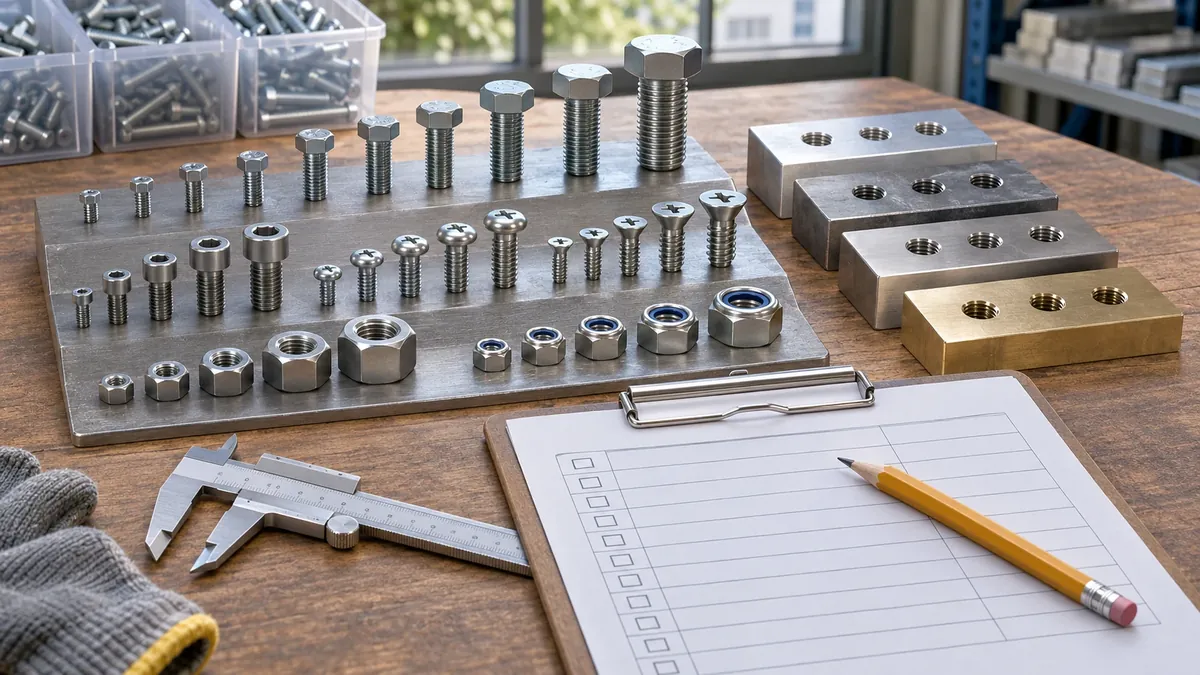
Before sending a request, check that the package contains:
- Product drawing, revision and key interface dimensions.
- Fastener family, supplier designation or approved sample reference.
- Mating nut, tapped feature, insert or receiving substrate.
- Head style, drive, thread details and length measurement datum.
- Material and finish requirements where applicable.
- Assembly direction and tool-access constraints.
- Sample quantity, sample approval record and change-control expectation.
- Hardware kit packaging and instruction requirements.
- Destination market and any buyer-specific documentation requirements.
- Open questions clearly marked as open rather than silently assumed.
The RFQ should distinguish the requested information from a desired outcome. “Easy to assemble” is not a complete measurable specification until the team defines the assembly context and acceptance method. “Rustproof” or “stronger” is too broad without a relevant environment or design requirement. Ask the responsible engineering or quality owner to establish acceptance criteria before using a rating in a purchase decision.
For repeat orders, preserve the approved fastener reference and notify the buyer if a supplier or product change is proposed. A matching name in an updated quote is not enough to show that the same part is being supplied. The buyer should compare part numbers, revisions, samples and the mating joint.
Frequently asked questions
Is a hex-head fastener always a bolt?
No. A hexagonal head is a visible feature, not a complete definition. Product naming depends on the family, standard and supplier catalog. Check the specific designation and mating configuration.
Does every screw create its own thread?
No. A machine screw can engage a nut or a tapped hole. Other screw families are designed for different receiving materials and functions. Identify the part and its intended receiver before ordering.
Can a screw be used with a nut?
Yes. A machine screw commonly can be used with a matching nut or with an internally threaded feature. The thread and mating part must be compatible and specified.
Are bolts stronger than screws?
The name alone does not answer that. A strength comparison depends on the actual fastener material, dimensions, thread, joint design and specified evidence. Do not approve a substitution using a general ranking.
What should a buyer check first?
Start with the part number or drawing, then identify the mating nut, tapped hole or substrate. Confirm head, drive, thread, length datum, tool access and sample fit.
Does a sample fit check approve mass production?
A sample check documents the reviewed sample and configuration. It does not by itself prove lot consistency or a performance value. Tie approval to the drawing, change process and required production evidence.
Sources and further reading
- Bolt Depot fastener type chart
- Portland Bolt: Hex bolts vs. hex cap screws
- Accu: Ultimate screw buying guide
Work with Koitor Hardware
Review the fastener interface before your next sample
Share the assembly drawing, fastener reference and mating part so the product team can review the metal hardware interface, access and packaging scope.
OEM / PRIVATE LABEL
Turn this sourcing guide into a product brief
Share your target product, size, finish, order quantity and packaging requirements. Your team receives a practical manufacturability review before quotation.


 English
 Español
 Português
 Français
 Deutsch
 العربية