

Brass vs aluminum is a useful material comparison only when the buyer also defines the part and the basis of comparison. Brass is a family of copper-zinc alloys; aluminum hardware is specified by alloy, product form and condition. Aluminum generally has lower density than brass, but equal-volume mass is not the same as the mass of two functionally equivalent parts. Geometry, manufacturing route, finish, interfaces and use determine whether either proposal suits the component. Compare the actual alternatives instead of treating “lighter” as a complete performance verdict.
What is the difference in brass vs aluminum?
Brass is a family of copper-zinc alloys with different grades and product forms. Aluminum products also include many alloys, tempers and forms. A material name alone does not identify the exact mechanical properties, processing limits, finish or suitability of a finished hardware part. The buyer should obtain the supplier’s designation and the drawing for the actual component.
Hydro’s producer information for 6061 aluminum describes one alloy and notes that tempering affects its condition; it also cautions that welding can change strength in the heat-affected area. This is a useful example of why “aluminum” is too broad. The page describes Hydro’s own alloy and product scope, not every aluminum part or a Koitor capability.
The Copper Development Association’s brass datasheets list multiple brass grades and compositions. That supports the same principle: brass is not a single fixed material. Some brass and aluminum grades may be available in different product forms or production routes, and the exact part supplier must identify what is being offered.
For a buyer, “which is better?” should become “which defined material and finished construction meet this component’s requirement?” A decorative cap may be selected for appearance and fit. A formed bracket may depend on a particular geometry and condition. A purchased fitting may rely on threads or a mating surface. These use cases are not identical and cannot be resolved by one generic strength ranking or property table.
How should a buyer compare weight fairly?
There are two common comparison bases, and they answer different questions. Equal-volume mass compares how much two materials weigh when the volume is held constant. Functionally equivalent part mass compares two designs that perform the same intended task, which may require different dimensions, shapes or local reinforcement. Aluminum typically has lower density than brass, but a lighter starting material does not prove that a finished aluminum part will be lighter after its geometry changes.
If a buyer is comparing raw material in a fixed shape, the volume basis may be useful. If the buyer is selecting a replacement component, the more relevant question is whether the alternative meets the same fit, stiffness, strength, finish and assembly requirements. The candidate may need a thicker section or a different design. Only an engineering comparison of the actual components can establish that result.
| Comparison basis | What is held constant? | What it can answer | What it does not prove |
|---|---|---|---|
| Equal volume | The volume or dimensions of the material sample | Relative mass for that defined volume and material condition | Equal stiffness, strength, load or finished-part function |
| Equal external envelope | Outer dimensions of the compared parts | A rough shape-controlled mass comparison | Equal internal geometry or equivalent performance |
| Functionally equivalent component | The product requirement and interfaces | Whether redesigned alternatives meet the same defined task | A universal winner for other part sizes or environments |
| Complete assembly | Product configuration, mating components and stated use | Total assembly mass and interface implications | Hidden material identity or long-term behavior without evidence |
Keep the calculation, if one is made, attached to named materials, units and dimensions. Do not apply a density value for one alloy to every brass or aluminum product. Do not compare a solid brass sample with a hollow aluminum component as though material alone caused the weight difference. The drawing and measured part determine the relevant volume and mass basis.
If product weight affects freight or a retailer’s listing, record where the measurement is taken. A supplier may report a component net weight; the buyer may need the assembled product, accessories and retail packaging. These are different measures. Define the tolerance, scale or record method through the project’s normal quality process if the weight is an acceptance point. A one-off sample value should not be copied into a product data sheet as a guaranteed production weight unless the production requirement and evidence support it.
Weight may matter for a moving cover, a handheld accessory, shipping, or a buyer’s product specification. In each case, say which mass is being discussed: raw stock, individual component, packaged item or full assembly. A carton-weight target does not equal a material selection rule. If a product must stay under a defined mass, measure the assembled proposal and maintain the design revision that was weighed.
Does lower density mean aluminum is weaker?
No such conclusion follows from density alone. Density is a measure related to mass and volume; it is not by itself a finished-part strength, stiffness or load rating. Those properties depend on the selected alloy and condition, part geometry, manufacturing process, joints, supports and actual test or design requirement.
Hydro’s information for 6061 notes the difference between temper conditions and states that welding affects the strength of the welded product. That example shows why a raw-material table cannot automatically rate a finished welded assembly. It should not be generalized to every aluminum alloy, every joining process or every product. A supplier’s data must match the actual grade, form, condition and manufacturing sequence.
Brass also covers a broad alloy family with varying properties and forms. A buyer should not infer a strength comparison from the word brass, its color or its heft. If the component has a defined load, flex, impact or deflection requirement, the product’s technical owner should define the test or calculation basis and evaluate the exact geometry. A general material-comparison article does not establish a safe load or approve a substitution.
Separate four questions in the design review:
- What material designation and condition is supplied?
- What geometry and process produce the component?
- Which part interfaces and loads are relevant to the product?
- What evidence demonstrates that the finished proposal meets the requirement?
If one of those answers is missing, the buyer should not fill it with a family-level assumption. A lighter part may be appropriate, may need redesign or may not meet an application-specific constraint. The decision belongs to the complete product design and its evidence.
How do alloy, product form and process change the selection?
The available form and production route affect what can be made and how a part is finished. A brass component could be machined, formed or produced by another route depending on its grade and design. An aluminum component could be extruded, formed, machined, cast or assembled from other parts. A specific manufacturer and product drawing determine the available route; the material family by itself does not.
Ask the supplier to identify which process is proposed and whether it changes the shape, tolerances, tooling, secondary operations or supplier responsibility. An extruded profile has different design considerations from a machined part. A welded heat-treated alloy may have local condition changes that the responsible supplier needs to address. A brass-colored surface on aluminum is not the same as an uncoated brass substrate. These are material and route distinctions to record, not blanket process rankings.
The route also changes how a buyer should compare supplier quotations. A proposal that includes a new die, machining fixture or finishing operation may have a different one-time and recurring cost profile from an existing component. Ask the supplier to separate tooling, unit price assumptions, secondary processing and minimum quantity where commercially appropriate. A lower raw-material line can be offset by other steps, while a tooling investment may make sense only at a particular volume. No universal break-even quantity follows from a material family comparison.
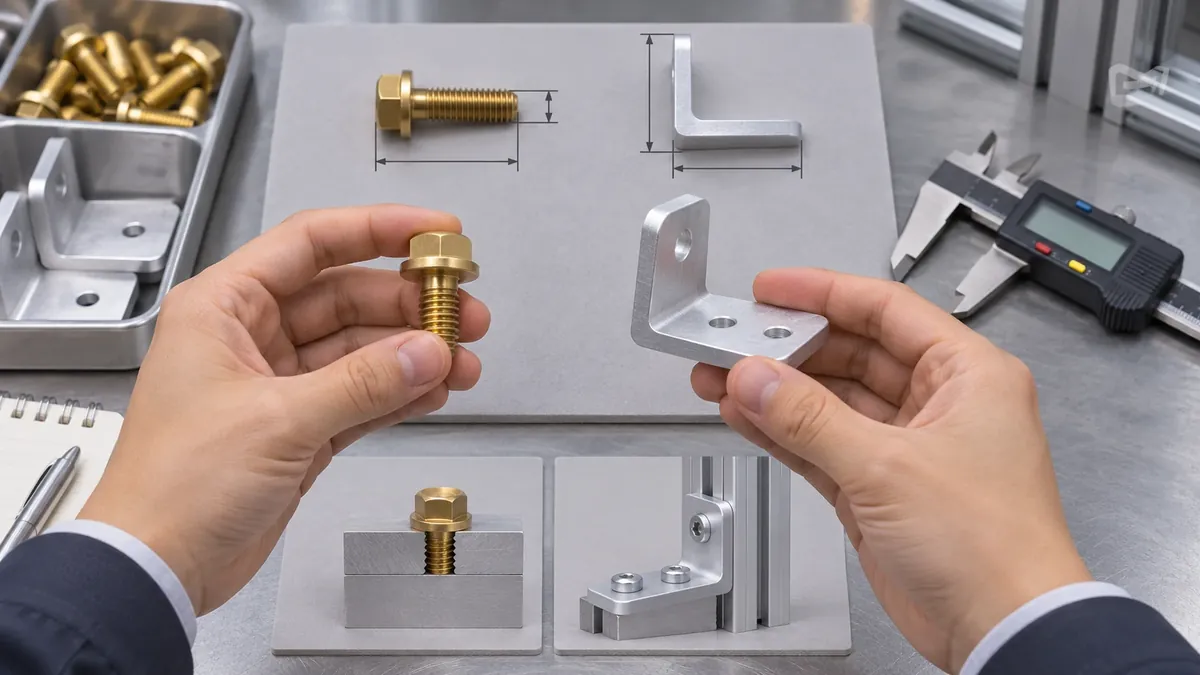
Finish is a separate decision. An anodized aluminum surface, a plated brass surface and an uncoated metal surface should not be treated as equivalent because their colors look close. The substrate, finish process, visible faces and maintenance expectations should be recorded separately. If appearance is important, use a representative sample and state the review conditions. If a performance property is important, request evidence for the precise finished product and environment.
Do not promise a universal cost result. Material price is only one part of a quote. Tooling, machining, forming, joining, finishing, scrap, assembly, inspection, packaging and order quantity affect the total. A supplier may quote different process routes for the two materials. Ask for an itemized scope and compare quotes on the same quantity and finish basis. The adjective “cheaper” is not justified until the actual quote conditions are known.
What should be checked in a finished component?
Start with the drawing revision and a clear component role. Identify all mating parts, exposed faces, holes, threads, mounting details and dimensional datums. Then compare the proposed material and route against those features. If the candidate has been redesigned, document what changed and which acceptance checks are needed for the new geometry.
The assembly can matter more than a sample strip. A material coupon may help a supplier discuss a grade or finish, but it does not prove that a complete bracket, post or fitting will assemble correctly. Review the actual fasteners, joints, edge conditions and surface references. If a part mates with a different metal, ask the technical owner to assess the specific material pair and environment. Do not rely on a broad label to settle a corrosion or compatibility question.
Record the supplier and part number for each candidate, the named grade, product form, temper or condition if supplied, manufacturing route, surface treatment and drawing revision. Check that the sample corresponds to those records. If a document is generic, ask whether it applies to the actual item. A sample can establish appearance and fit for the reviewed revision; it does not automatically establish hidden composition or long-term performance.
How should an importer approve a material substitution?
Treat a brass-to-aluminum or aluminum-to-brass proposal as a design and sourcing change. The substituted part may require different dimensions, manufacturing steps, finish, supplier or assembly detail. The buyer should involve the product engineer or other responsible design owner before approving a production change.
- Identify the currently approved component by supplier, part number and drawing revision.
- Record its exact material designation and product form.
- Request the proposed alternative’s alloy, condition, route and supplier documentation.
- Compare geometry, dimensions, interfaces and the complete product envelope.
- Define whether mass means raw stock, component, package or finished assembly.
- Review the finish system, appearance reference and exposed faces separately.
- Identify the actual function and any performance or environmental requirement.
- Agree which sample, test or supplier records will support approval.
- Record open issues and the engineering owner responsible for resolving them.
- Update the BOM, drawing, listing and incoming inspection reference before reordering.
Keep the approved sample tied to the record. If the supplier changes alloy, temper, source, process or finish after approval, review whether the change affects the requirement. A product title or unchanged photograph does not prove that the construction stayed the same. Explicit change notification helps maintain a traceable comparison over repeat orders.
What mistakes create misleading brass and aluminum comparisons?
Comparing density as if it were finished-part performance. Density relates mass to volume. It does not establish strength, stiffness or suitability.
Assuming every alloy in a family behaves alike. Brass grades and aluminum alloys differ. Request the actual designation and condition.
Comparing unequal part designs. Different geometry, thickness or hollow sections can dominate the weight comparison. State the basis clearly.
Equating color with substrate. A brass-tone aluminum finish is not a solid brass part. Material and surface require separate evidence.
Assuming a raw-material datasheet covers a welded assembly. Processing and joining can change the finished product. Match the evidence to the actual route.
Choosing a material by price alone. Total cost includes process, finish, tooling, quantity and downstream work. Compare equal scopes.
Approving from a coupon or photo only. A coupon may not prove full-part fit, geometry or function. Inspect an identified component and drawing.
Using a general material guide as a design approval. The final part and its requirement need project-specific review and acceptance evidence.
What can Koitor contribute to an OEM material discussion?
Koitor Hardware is a family-owned custom metal hardware factory specializing in bathroom and home-storage hardware. In a confirmed OEM project, the factory can discuss the metal part drawing, manufacturing route, assembly interfaces, finish sample and packaging scope. This does not mean Koitor operates an aluminum extrusion mill or brass foundry, nor that it supplies every material grade named in a comparison. Specific purchased components and external processes must be confirmed in the project’s scope.
Share the drawing or physical sample, material designation, intended function, mating parts and desired finish. State whether the priority is mass, appearance, manufacturability, a defined fit or another buyer requirement. If a supplier is responsible for material certification or test data, name that responsibility. Koitor can coordinate the metal hardware discussion within the confirmed project scope; the buyer’s design owner remains responsible for product requirements and technical approval.
Small-batch OEM work may help a buyer evaluate a custom product or trial configuration when the project fits the factory’s confirmed capability. Keep the approved material and process tied to the sample and drawing revision. Do not make a repeat order from a vague color or family name if the original decision depended on an exact alloy or finish. A new supplier or route should be reviewed before being treated as identical.
See the Koitor OEM home-storage hardware page for confirmed product scope. For a project-specific drawing discussion, use the contact page. Any production timing, MOQ and capability should be confirmed in the actual quotation.
What should a buyer put in the RFQ?
The RFQ should specify the actual comparison basis and prevent suppliers from quoting different constructions under the same words. Attach the drawing, define function and interfaces, identify current and proposed materials, and state what evidence is needed. If a requirement is undecided, label it as an open item rather than implying that a supplier may choose freely. For a brass vs aluminum proposal, list the actual component, the weight basis and the alloy records requested from each supplier.

Use this buyer checklist:
- Component name, function, drawing revision and assembly context.
- Current and proposed supplier part numbers and sources.
- Exact brass or aluminum designation, form and condition.
- Manufacturing route, tooling and secondary-operation assumptions.
- Dimensions, mating parts, threads, attachment and interface requirements.
- Finish name, substrate, exposed faces and appearance sample.
- Weight basis: material volume, individual part or complete assembly.
- Intended environment and relevant performance requirements.
- Supplier documents, tests or declarations required for approval.
- Representative sample, acceptance owner and approval record.
- Cost basis, quantity, tooling, finishing, inspection and packaging scope.
- Supplier change notification and reapproval triggers.
The RFQ should distinguish a desired result from a measurable acceptance rule. “Lightweight,” “strong,” “premium” or “corrosion resistant” describes a goal but does not specify how a part will be evaluated. Ask the responsible product owner to define the relevant unit, condition and method. Keep the supplier’s response tied to that exact requirement.
How should the buyer control a weight or finish claim?
If the product page will advertise a specific weight, define whether the number covers the bare component, assembled product or packaged retail unit. Ask how it was measured and which drawing revision or configuration it represents. Accessories, screws, inserts, protective caps and packaging can change the delivered weight. A sample value should not be reused across a different finish, size or kit without checking that the configuration is the same.
If the listing describes aluminum as a lightweight alternative to brass, make sure the statement refers to the actual product and not just the raw-material family. A redesigned aluminum component may use a different cross-section or include added hardware. Compare the finished assembly in the relevant size and record the test or weighing basis. Avoid saying “same strength at lower weight” unless the exact design has evidence that supports both parts of that sentence.
Finish claims need their own evidence. “Brushed brass look,” “anodized aluminum” and “uncoated metal” refer to different things. Check the supplier’s finish code, appearance sample and covered surfaces. If a photograph is used in a listing, confirm that lighting and image editing do not imply a substrate or color the product does not have. The buyer should approve the production sample and the copy together when a material or finish phrase is prominent.
When a product line offers several sizes, treat each size as its own configuration where mass, geometry or finish changes. Keep the approved data linked to the SKU. This avoids extending a measurement or appearance sample from one size to every item in a range without review.
Frequently asked questions
Is aluminum lighter than brass?
Aluminum generally has lower density than brass, but finished-part mass depends on the alloy, volume and geometry. Compare the actual component and state whether the basis is equal volume or equivalent function.
Is brass stronger than aluminum?
There is no universal answer from the family names alone. Grade, temper, geometry, manufacturing route, joints and application determine the relevant comparison. Use evidence for the actual part.
Can aluminum replace brass in a hardware product?
Only after the proposed material, geometry, finish, interfaces and product requirement have been reviewed. A substitution can require a redesigned component and should be approved by the responsible product owner.
Does a brass-colored finish mean the part is brass?
No. Color and finish do not prove the substrate. Ask for the supplier’s material designation and record finish separately.
Does an aluminum datasheet prove a welded part’s properties?
Not automatically. Data must match the alloy, condition and processing route. The responsible supplier or engineer should assess the finished construction and the requirement.
Which material costs less?
The broad family names do not establish total cost. Compare actual quotes with the same quantity, geometry, route, finish, inspection and packaging scope.
Sources and further reading
Work with Koitor Hardware
Compare the actual component before changing material
Share the assembly drawing or sample, current and proposed material references, mating parts and finish target so the OEM discussion can stay tied to the real product requirement.
OEM / PRIVATE LABEL
Turn this sourcing guide into a product brief
Share your target product, size, finish, order quantity and packaging requirements. Your team receives a practical manufacturability review before quotation.


 English
 Español
 Português
 Français
 Deutsch
 العربية