
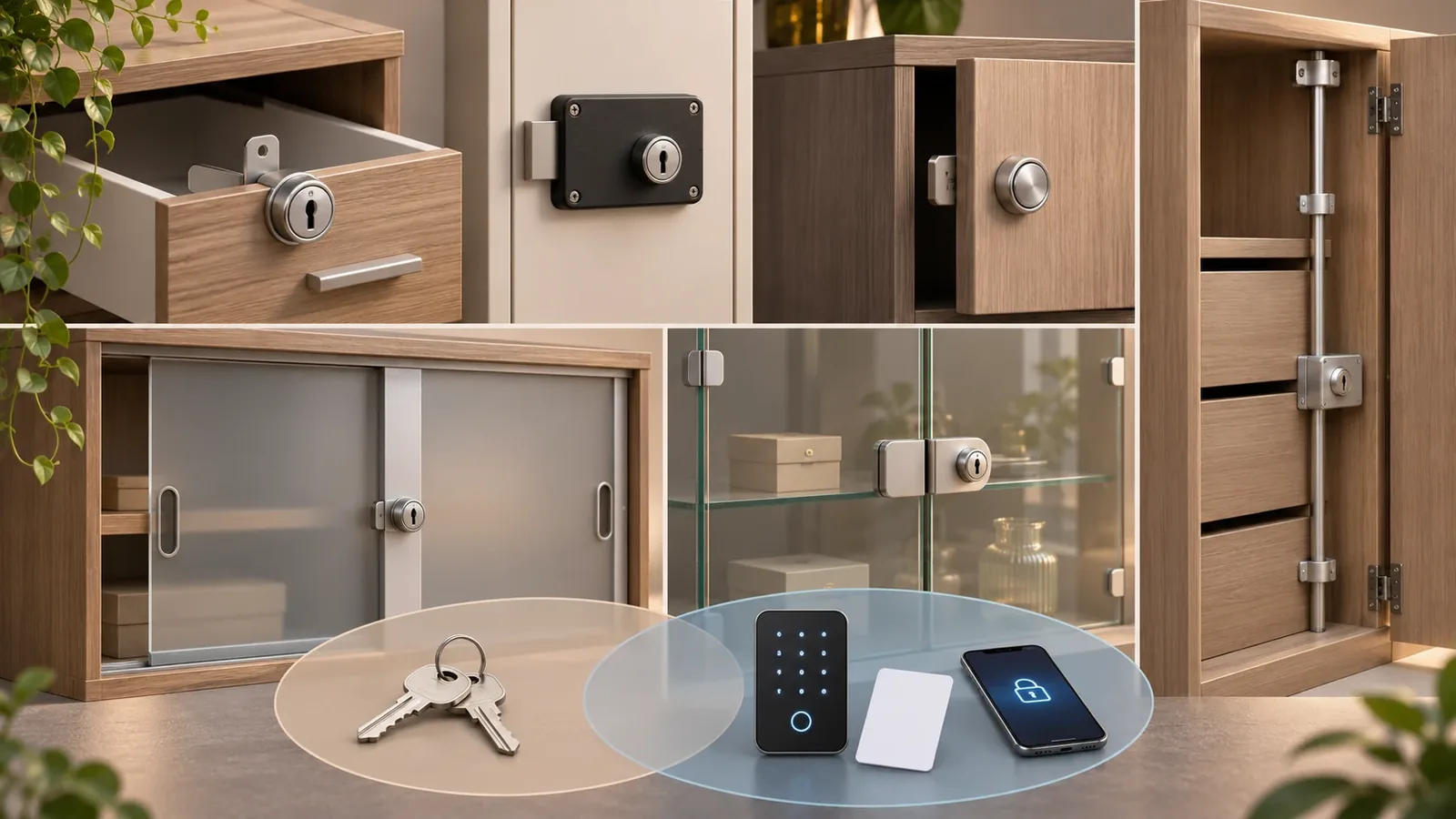
The types of cabinet locks are easier to compare when buyers separate three different things: the physical mechanism, the way access is authorized and the furniture or panel arrangement the lock must fit. A cam lock describes a mechanism; keyed, combination, RFID or fingerprint describe access methods; and rim, central, sliding-door or glass-door labels may describe mounting or application. These labels can overlap. Before sourcing, identify the exact lock supplier, door or drawer construction, panel thickness, cutout, cam or bolt, receiver and access-management requirements. A family name alone does not establish security performance, child resistance, emergency access or compatibility.
What do cabinet lock type names actually describe?
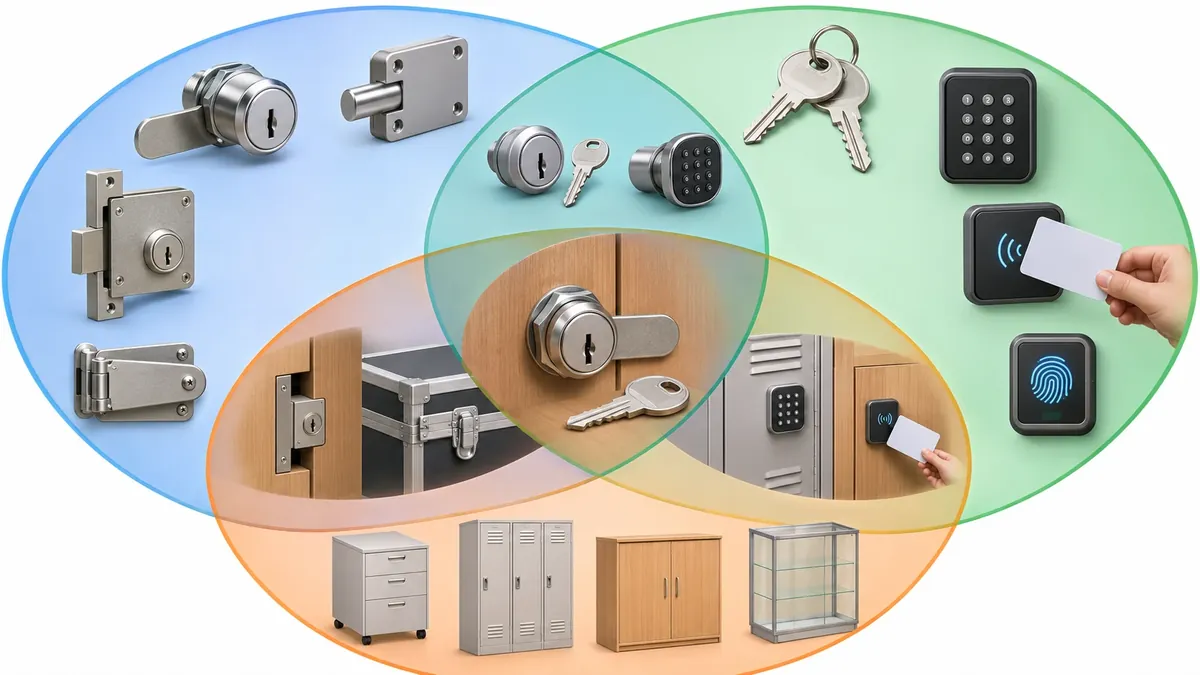
Cabinet lock names do not all describe the same feature. Some names refer to the part that moves to retain a door or drawer; others refer to the credential or action a user employs; still others describe where or how the lock attaches to furniture. A useful sourcing comparison sorts the labels into these categories before choosing a part.
When a product team searches for types of cabinet locks, it should translate the broad category into the attributes needed for the specific furniture. For example, a cam lock uses a rotating arm or cam to engage a receiving feature. A keyed cam lock and an electronically released cam arrangement may share a basic mechanism concept while using different access methods. A cabinet catalog can also describe a lock as a rim, push, central, espagnolette, sliding-door or glass-door arrangement. Those terms point to different mounting positions, closure geometry or application. The labels are not a single list of competing technologies.
| Classification axis | Examples of labels | What the label may tell a buyer | What still needs confirmation |
|---|---|---|---|
| Mechanism or retaining movement | Cam, bolt, hook, latch, central rod | How a component may engage a keeper or another part | Exact travel, geometry, installation and intended application |
| Access method | Keyed, combination, RFID, electronic credential, fingerprint | How a user is authorized to operate a product | Credential management, power, backup, compatibility and approval |
| Furniture arrangement | Rim, push, central, sliding-door, glass-door, espagnolette | Where a product is mounted or what closure arrangement it serves | Panel material, thickness, cutout, handing, clearance and receiver |
| Product purpose | Storage cabinet, wardrobe, drawer, display case, locker | The furniture context used by a supplier or catalog | Whether the exact item fits the buyer’s panel and operating requirements |
| Closure action | Latch, catch or lock terminology used by a seller | Whether a component retains, closes or restricts access in the seller’s usage | Whether the component actually controls access and what the project requires |
The terminology can vary between manufacturers and catalogs. A catalog category may group products for browsing rather than define a formal engineering classification. When comparing proposals, ask the supplier to identify the exact part number, drawings, mounting method and intended use. The buyer should not infer that two products are equivalent because they share a word, or that two different labels cannot describe one product.
Can a cam lock also be keyed or electronic?
Yes, the physical mechanism and access method are different classification questions. A cam arrangement may be operated by a key or by another design. Buyers should confirm the actual product architecture and approved access method instead of treating “cam” and “keyed” as mutually exclusive types.
Which cabinet lock families might appear in a furniture catalog?
Furniture hardware suppliers may list multiple arrangements, including cam locks, rim locks, push locks, central locking systems, espagnolette arrangements, combination or electronic models and products for sliding or glass furniture. A SISO furniture-fittings catalog shows that catalogs group products using several arrangement and access labels, while a lock-maker overview of wardrobe products illustrates overlapping keyed, cam and electronic terminology. These sources describe their own catalogs and do not establish security performance or an exhaustive classification. The exact catalog name and construction vary by manufacturer. A family list is a way to organize potential options, not an exhaustive taxonomy or a ranking by security.
Cam arrangements. A cam turns to engage a keeper, panel or frame feature. A buyer needs to confirm the cam’s shape and movement, the available space behind the panel, the mounting hole, door or drawer thickness and the receiver’s location. The term “cam lock” does not describe the access method, security level or suitability for a particular furniture design on its own.
Rim or surface-mounted arrangements. A rim lock is generally mounted on a surface rather than inserted in the same way as a through-panel cylinder or cam. The furniture geometry and visible appearance may therefore differ. Buyers should confirm the mounting footprint, fastener locations, door swing, stop position and how the counterpart is installed. The supplier drawing should show the assembled relationship rather than only the loose part.
Push-operated products. “Push lock” can be used for products that engage or release through a push action, but the exact mechanism and application must be identified. Do not assume that every product with this label offers the same access control, retention or installation sequence. Ask what is locked, what is released and what panel or frame parts are included.
Central or multi-point arrangements. A central system may operate more than one point or connect to rods or other linkage, depending on its design. The cabinet size, movement, alignment, connection parts and supplier scope should be confirmed. A buyer should not treat a central system as a simple single cam without checking the controlled product drawing and full bill of materials.
Espagnolette and sliding or glass-door arrangements. These names often refer to a closure architecture or a specific furniture configuration. A sliding door may have different overlap, travel and keeper requirements from a hinged door. A glass-door product may have a clamp, cutout or edge relationship that differs from a wood or metal panel. Identify the complete application and panel construction before selecting a nominally similar component.
Combination and electronic access products. These describe access methods or operating systems, not necessarily a single body shape. Depending on the product, a user interface, credential, power source, programming or backup behavior may be relevant. Confirm exactly what the supplier includes and which party supports configuration, replacement or servicing. Do not infer compatibility with a building access system, emergency procedure or security standard from the category name.
Keyed products. A keyed arrangement may appear in cam, rim or other furniture forms. Buyers may need to specify key control, quantity, supplied keys, replacement policy and whether a particular keying plan is actually supported. A generic statement such as “keyed alike” should be defined in the purchase documentation and confirmed by the lock supplier. Do not assume different products share a cylinder or key system because their listing photos appear similar.
These categories can overlap and catalogs may place an item in more than one group. A procurement team should maintain a classification matrix that records mechanism, access, mounting/application and responsible supplier. That makes it easier to compare alternatives without turning marketing categories into a technical specification.
How should buyers check fit with a cabinet or wardrobe?
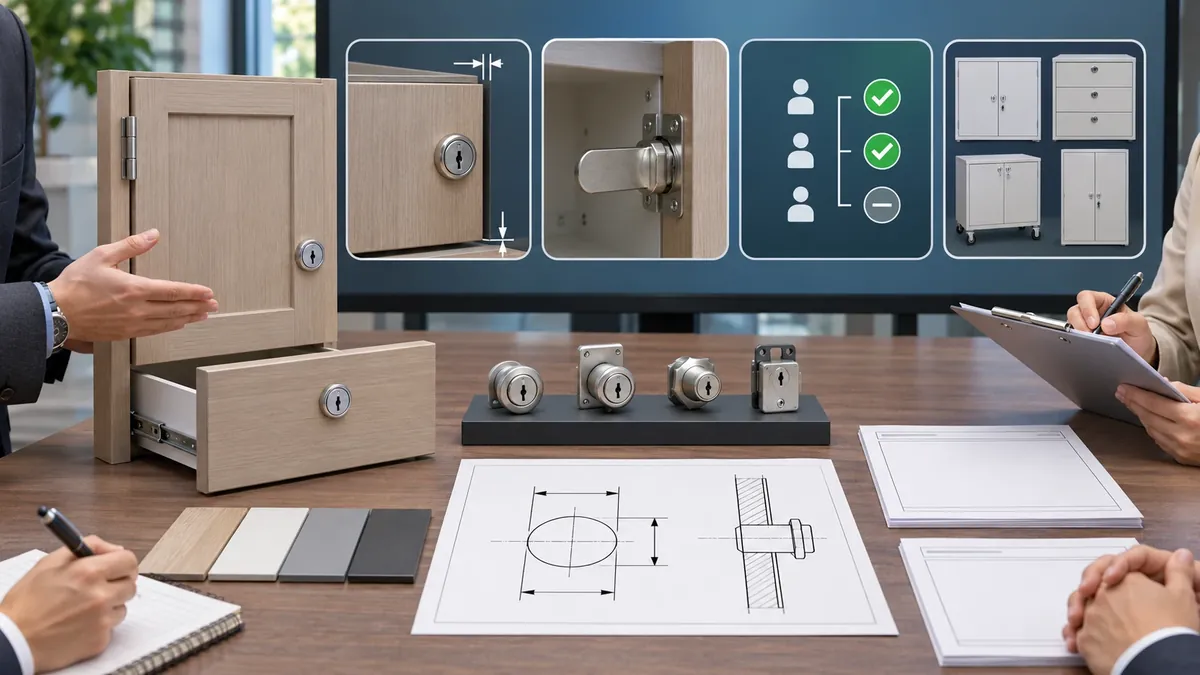
Start with the furniture geometry and the exact lock assembly. A lock that operates correctly in isolation may not fit the panel, door overlap, receiver, drawer front or internal clearance of the buyer’s product. Ask for an installation drawing or dimensioned outline and compare it with the controlled cabinet or furniture drawing.
The fit review should address at least:
- Door or drawer material and nominal thickness.
- Panel cutout diameter, shape, location and tolerance.
- Lock body envelope and clearance behind the panel.
- Cam, bolt or other retaining part shape and travel.
- Keeper, strike or receiving feature and its location.
- Door overlap, reveal, swing or sliding path.
- Mounting screws, nuts, spacers or plates included in the supply.
- Key access or user-interface clearance after installation.
- Whether the lock is replaceable without damaging the furniture finish.
- Who supplies and approves the cabinet-side receiving part.
For a wood panel, the lock supplier and furniture designer should confirm the cutout and fastener arrangement for the actual panel construction. For a metal panel, hole size, burr condition, coating thickness and access behind the panel may affect fit. For a glass or thin panel, a specialist product and mounting arrangement may be required. The buyer should not ask an unverified supplier to design a glass interface or assume that a generic lock fits every material.
The receiving geometry matters as much as the lock body. A cam needs a compatible surface or keeper to engage. A sliding cabinet can require the correct meeting point and travel. A rod-operated mechanism depends on linkage alignment. If the buyer changes panel thickness, door overlap or mounting orientation, it may also need a different cam length, spacer or receiver. These changes should be reviewed on a drawing and tested with a representative assembly before purchase approval.
An assembly sample can show if the parts align and if a user can operate the mechanism in the intended direction. It does not establish security resistance, durability or suitability for all users unless a defined test and acceptance criterion support that conclusion. The buyer should separate fit approval from performance approval and record which party owns each decision.
How should buyers distinguish a lock from a latch?
A latch retains or closes a moving part; a lock is intended to restrict access through some form of controlled release. The distinction can depend on the product and how a supplier uses the terms, so the buyer should ask what the part does in the actual assembly. A simple closure or catch does not automatically establish security or authorization.
This matters when comparing cabinet parts because some catalog categories sit near the boundary. A catch can hold a door closed, a latch can engage a keeper, and a lock can require a key or other access method. A secondary catch or padlock provision may add another feature without changing the underlying closure mechanism. The buyer should describe whether the product must merely stay shut, limit casual opening, restrict access or satisfy a separately defined security requirement. Those are different requirements and should not be collapsed into one term.
The site’s guides on snap-action draw latch adjustment and draw latch secondary catches and padlock provisions cover closure and secondary retention questions. They do not qualify a cabinet lock or establish a security rating. Use them to keep closure hardware terminology distinct while the actual lock supplier confirms its own product and access features.
For any requirement involving child access, privacy, controlled entry, emergency release, tamper resistance or security ratings, identify the responsible product and compliance authority. Verify current standards and test methods with the applicable specialist. This article does not provide bypass or opening instructions, and it does not infer a security level from the family name, price or appearance of a component.
What should buyers confirm with the lock supplier?
Ask the lock supplier to state the exact part and the scope of its proposal. Request the dimensioned drawing, material and finish information available for that product, supported panel ranges, supplied mounting parts and any instructions or evidence relevant to the project. If the supplier sells a family of parts, specify the exact model and options rather than leaving selection to an image or category label.
For an access-controlled product, establish what the supplier provides and what the buyer must provide. A key-operated lock may raise key quantity, keying and replacement questions. An electronic lock may require details about the access credential, power, software or configuration, but these must be confirmed for the actual product. Do not assume the component integrates with an existing access platform or has a particular backup behavior unless the supplier confirms it in documentation. Avoid putting sensitive key codes or credentials into general purchase records; use the buyer’s controlled process.
For product quality, agree how the buyer will verify identity and fit on receipt. Possible evidence can include the product label, purchase-order reference, incoming visual check, representative assembly sample and supplier documentation. Which evidence is appropriate depends on the requirement. An incoming appearance check cannot establish a security rating, and a supplier data sheet cannot show that a particular cabinet cutout is correct. Keep each verification linked to the question it answers.
If the lock is included in a kit with metal bathroom or home-storage hardware, define the supply boundary. Is the lock bought by the importer, sourced by the cabinet supplier, or included as a buyer-approved component in a larger assembly? Who supplies keys or credentials? Who validates the cutout and receiver? Who confirms the panel? Who handles a missing component? These questions prevent a metal hardware manufacturer from being assumed to make or approve a lock product outside its confirmed scope.
A product-team comparison can be organized in three passes. First, name the furniture use and panel arrangement, such as hinged door, drawer, sliding door or glass panel. Second, select the mechanism or closure behavior required by that arrangement. Third, define whether the user requires a key, combination, credential or another access method. This order helps avoid comparing an application label with an access label as though they were alternatives. The selected lock supplier can then confirm which exact model covers the combined requirement and which items must come from the cabinet or furniture manufacturer.
Use a controlled sample or first assembled unit to verify the component interface where required. Note the lock model, panel thickness, hole position, cam or receiver configuration, finish and assembly revision. If any of these changes, review whether the previous sample approval still applies. A sample made with a different lock or panel can be useful for concept evaluation but should not be presented as the approved production configuration.
What mistakes should importers avoid?
The most common sourcing mistake is treating labels from different classification axes as alternatives in one list. “Cam,” “keyed,” “electronic,” “sliding door” and “wardrobe” do not all answer the same question. A buyer who compares them without separating mechanism, access method and application may choose a lock that fits one part of the description but not the actual furniture.
Other mistakes include:
- Assuming a keyed product necessarily uses a cam mechanism, or that a cam cannot have another access method.
- Treating a latch or catch as a security lock without confirming intended function.
- Ordering by a catalog photo without a part number or dimensioned drawing.
- Omitting panel thickness, cutout, door overlap, handing or clearance behind the panel.
- Failing to identify the keeper, strike, receiver, rod or other mating component.
- Assuming keying, master-keying or credential management is available without supplier confirmation.
- Treating an electronic label as proof of a certain protocol, backup or system integration.
- Inferring child safety, privacy, tamper resistance or a security rating from a product family name.
- Approving a lock sample assembled on a different panel thickness from production.
- Failing to name who supplies the lock, keys, credentials and furniture-side mounting parts.
Avoid combining a product fit question with a claim about how difficult a component is to defeat. The former can be addressed by controlled geometry and assembly review; the latter requires an appropriate specialist, defined threat model and test or standard. If the project needs a security-related feature, the buyer should involve the responsible lock manufacturer and qualified reviewer and preserve their evidence with the product record.
Buyer checklist for cabinet lock selection
Before selecting or approving a cabinet lock, record:
- Product purpose and furniture type: cabinet, wardrobe, drawer, locker or display case.
- Exact lock supplier, model and part number.
- Mechanism type and access method as separate attributes.
- Panel material, thickness and approved cutout drawing.
- Lock body envelope and clearance behind the panel.
- Cam, bolt, latch or rod dimensions and intended engagement.
- Keeper, strike, receiver or furniture-side component and its supplier.
- Door swing, sliding path, overlap, handing and operating clearance.
- Finish, appearance and identification requirements.
- Keys, credentials, programming or power details that the supplier confirms.
- Required sample, assembly review and incoming evidence.
- Any separate safety, privacy or security requirement and its technical owner.
- Responsibility for replacements, exceptions and access administration.
- Packaging, kit quantity and labeling against the purchase order.
Frequently asked questions
What are the main types of cabinet locks?
Catalogs may list cam, rim, push, central, espagnolette, keyed, combination, electronic, sliding-door and glass-door products. These labels may describe different properties and can overlap. Buyers should classify mechanism, access method and application separately.
Is a cam lock the same thing as a keyed lock?
No. “Cam” describes a mechanism, while “keyed” describes an access method. A particular product may be both; the exact lock design should be confirmed with its supplier.
Is a cabinet latch a lock?
Not necessarily. A latch or catch may retain a door without restricting access through a controlled release. Confirm the function required and the exact product behavior instead of relying on a broad label.
How do I know whether a lock fits my cabinet door?
Compare the supplier’s dimensioned drawing with the controlled cabinet drawing. Confirm panel thickness, cutout, body clearance, cam or bolt geometry, receiver position, door movement and supplied mounting parts.
Does an electronic cabinet lock automatically work with an existing access system?
No. Compatibility, credentials, power, configuration and system integration must be confirmed for the exact product by the responsible supplier and system owner.
Does the lock type name tell me its security level?
No. A family name or access method does not establish a security rating. If a project needs a security claim, define the requirement with the qualified authority and verify it using applicable evidence.
Should a buyer approve a lock from a sample alone?
A sample can support appearance and fit review when the model, panel and assembly are representative. The buyer should separately review any access, safety or security performance requirement and record the evidence and technical approver.
Work With Koitor Hardware
Koitor Hardware is a family-owned custom metal bathroom and home-storage hardware factory. If a storage product combines metal hardware with a bought-in cabinet or furniture lock, share the controlled metal drawing or sample, the confirmed lock and panel details, and the unresolved interface question. Koitor can review the metal hardware portion within its current OEM scope; lock product selection, access administration and security approval remain with the responsible lock supplier and technical authority.
Review a Metal Hardware Interface
Share the metal drawing or sample, the confirmed lock and panel interface, and the unresolved production question. Koitor can review whether the metal hardware request fits its current OEM scope.
OEM / PRIVATE LABEL
Turn this sourcing guide into a product brief
Share your target product, size, finish, order quantity and packaging requirements. Your team receives a practical manufacturability review before quotation.



 English
 Español
 Português
 Français
 Deutsch
 العربية