
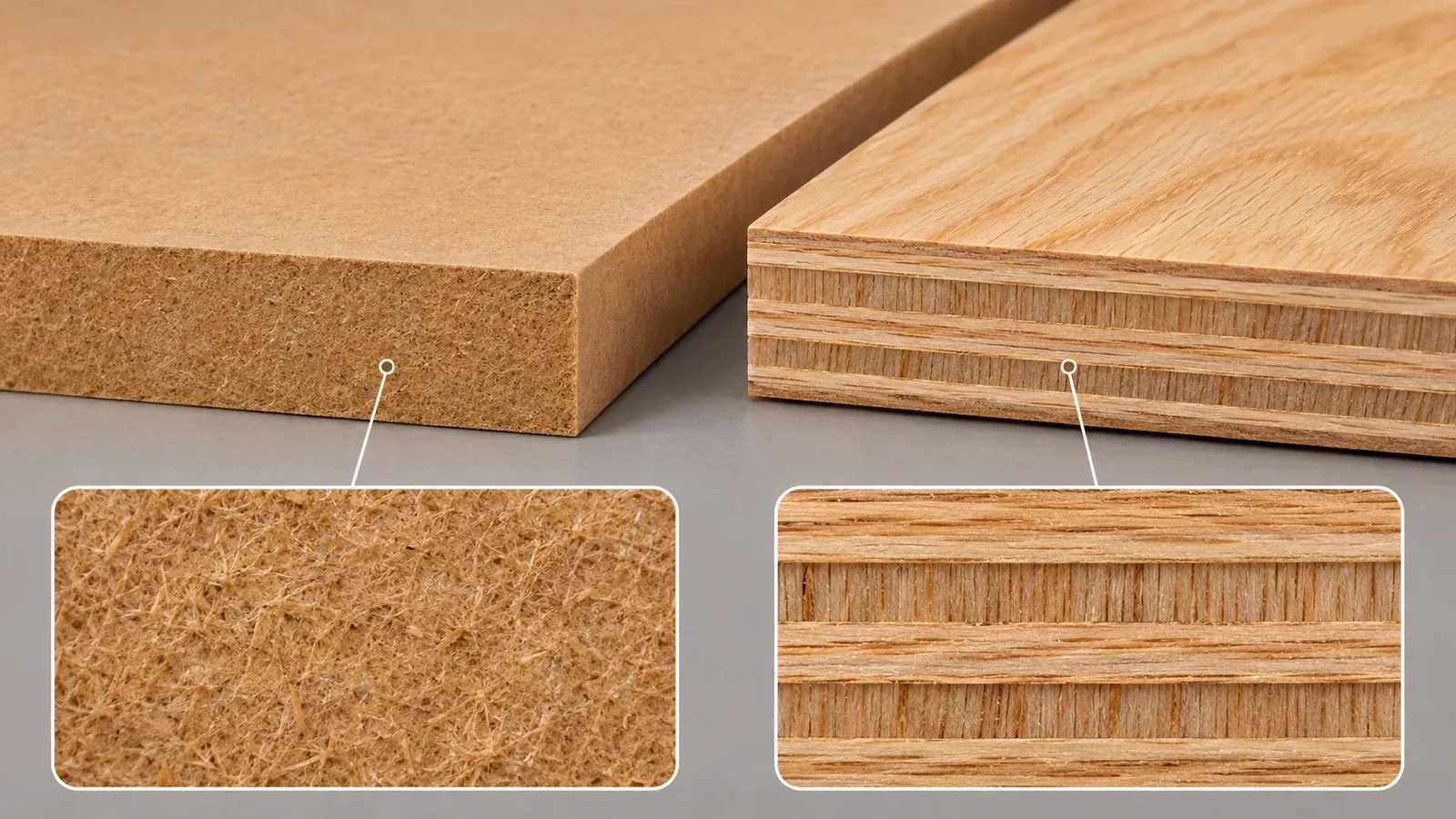
The plywood vs MDF decision is a comparison between panel constructions, not a universal ranking of strength, moisture resistance or price. MDF is a wood-fiber composite made with a binder and pressing process; veneer-core plywood is made from bonded thin wood layers arranged across the panel, though other products called plywood may use different core constructions. Columbia Forest Products’ comparison describes these broad constructions and furniture-panel context. Its general statements do not establish a grade or design value for a separately sourced panel. For a metal storage product, the buyer should specify the exact panel, face and core, thickness, edge treatment, machining, attachment and intended exposure. The material name alone does not establish grade, density, structural performance, emissions documentation or wet-area suitability.

What is the difference between plywood and MDF?
MDF is made from wood fibers combined with a binder and consolidated into a panel. Veneer-core plywood uses thin wood layers bonded with their grain directions arranged across adjacent plies. These descriptions explain how two common panel families are constructed, but they do not define every commercial grade or product sold under those names. A decorative plywood panel may use a different core construction, face veneer or backing, so a buyer should not assume every “plywood” panel has the same layers.
The comparison affects how a buyer describes a part and what evidence should be requested. MDF usually presents a uniform fiber-based core when machined, while veneer-core plywood shows alternating wood layers at a cut edge unless that edge is concealed or finished. Faces may be veneered, laminated, coated or otherwise surfaced on either family, depending on the product. Those visible and hidden details influence appearance, finishing, machining and how the panel joins a metal structure.
| Attribute | MDF panel | Veneer-core plywood | Buyer check |
|---|---|---|---|
| Basic construction | Pressed wood fibers with a binder | Bonded thin wood layers with grain arranged across adjacent layers | Identify exact panel product and core type |
| Face appearance | Can be surfaced or coated; the base panel face is not necessarily a finished decorative surface | May have one or more face veneers or other surfacing | Specify visible face, color, grain and finish sample |
| Exposed edge | Shows a fiber-based core unless treated or covered | Can reveal layered plies and veneer transitions | Define edge band, seal, profile or exposed-edge appearance |
| Machining | Depends on panel product, tool and process | Depends on core, veneer, grain, thickness and machining method | Approve actual holes, cutouts and edge quality on the drawing/sample |
| Fastening and support | Depends on screw type, location, pilot details, panel and load path | Depends on the specific panel, ply construction, location and load path | Obtain assembly-specific design review; do not assume a universal ranking |
| Moisture-related claim | Product-specific; a label alone does not mean unrestricted wet use | Product-specific; plywood construction alone is not a moisture guarantee | Request the exact product conditions and evidence |
| Appearance and cost | Varies with grade, thickness, face and finishing | Varies with veneer, core, grade, thickness and finishing | Compare like-for-like proposals and declared inclusions |
This table is a buyer orientation, not a design or performance chart. It does not rank panel weight, screw holding, rigidity, water resistance, emissions or cost. A buyer must define the product, dimensions, support, machining, environment and relevant acceptance criteria before drawing a conclusion.
Does plywood always mean veneer-core construction?
No. Veneer-core plywood is a common construction, but product families can use other cores or combinations. When the core affects machining, fastener placement, appearance or the panel’s role in an assembly, require the supplier to identify the actual construction rather than relying on the word “plywood.”
How should a buyer specify the actual panel?
Start with the product identity and dimensions, then describe faces, edges, machining and interfaces. A plywood vs MDF comparison should first align the products being quoted. A complete panel callout should name the panel family and supplier product, nominal thickness and tolerance, dimensions, visible face requirements, core construction where relevant, edge treatment, cutouts and holes, coating or veneer, and any specified exposure or documentation. The purpose is to help suppliers quote the same product and to preserve the approved sample during production.
For MDF, clarify whether the buyer is specifying a raw panel, surfaced panel, laminated board or another finished product. Record which face is visible, whether both faces are treated, what edge is exposed, and what treatment is expected at holes or cutouts. For veneer-core plywood, identify the face veneer expectations and whether the edge may show the layers. If the panel uses a different core construction, write it explicitly. A sample with a sealed edge should not be taken to represent a production panel with an unfinished edge unless that difference is documented and approved.
The drawing should also state the panel’s relationship to the metal frame. Identify the panel orientation, mounting points, fastener position, slot or hole locations, edge clearance, overlap and any pads or trim. Specify which supplier provides each item. If the wood panel is supplied by a separate vendor, the metal-product manufacturer needs controlled dimensions and interface requirements to make the metal assembly fit the approved panel.
Separate essential requirements from open design choices. A buyer might have a fixed overall size and visible face while still deciding between a metal screw, insert or bracket detail. Such a detail should be evaluated by the responsible product engineer based on actual geometry and intended use. Do not choose a fastener from a generic “MDF vs plywood” chart. Core construction, edge distance, thickness, pilot method, support, direction of force and installation process all matter.
| Specification field | Example of what to record | Why it matters |
|---|---|---|
| Panel identity | MDF panel or a named plywood construction and supplier product | Prevents a broad category name from hiding a different core |
| Size and tolerance | Length, width, thickness and drawing reference | Controls fit with brackets, frames and fasteners |
| Faces | Visible side, veneer or surface, color and finish sample | Aligns appearance and orientation expectations |
| Edges | Exposed, banded, sealed, profiled or concealed | Affects visual acceptance and interface conditions |
| Machining | Holes, slots, notches, cutouts and edge distances | Ensures the metal components align with the panel |
| Environment | Intended indoor or other specified exposure, with product evidence | Avoids inferring suitability from a material name |
| Attachments | Fastener, bracket, pad or trim supplier and controlled detail | Clarifies who owns fit and assembly review |
| Packaging | Face protection, corners, separation and carton identification | Reduces confusion and handling damage risk |
How do face, edge and machining choices affect the metal assembly?
The face and edge are not cosmetic afterthoughts when the panel is part of a finished storage product. The visible face may determine orientation; the edge can be hidden, exposed or intentionally used as a design feature; and the machining defines where the panel meets the frame, screws or brackets. Each dimension should be reviewed together with the metal parts that it touches.
An exposed fiber-based edge and a layered plywood edge look different. Either can be concealed or finished, but the finish must be specified and represented by the approved sample. If an edge band or seal is part of the design, clarify its width, material, color, corner treatment and termination. If the edge is intentionally exposed, state the appearance expected and the allowable variation from the approved sample. Do not assume a supplier will apply an edge treatment simply because it appears on a reference image.
Machining can reveal the panel construction. A routed recess, drilled hole or notched edge may expose fibers, plies, veneer or a core that differs from the face. The buyer should review the cutout drawing and the production sample to confirm that the selected finish resolves the visible area as intended. Dimensions should reference a clear datum. A hole position measured from an unfinished edge can change if an edge band is added, so the drawing should state whether the dimension references the panel core or final finished edge.
The metal hardware interface should be dimensionally controlled. A screw head may need clearance; a bracket may bear on a defined face; a metal lip may cover an edge; a removable panel may require access; and packaging may need to protect a protruding fastener. Small changes can affect assembly sequence or appearance. If the panel supplier changes thickness or core, the metal supplier should be notified to review clearances and approved fasteners before production proceeds.
The panel’s role should be clear: is it a shelf surface, a side panel, a decorative cover, a back panel or a load-carrying member? A label such as “shelf” is not a design calculation. The responsible engineer must define support spacing, expected loading and acceptance method for any structural use. A buyer article can help prepare the question but cannot determine a universal safe span or panel thickness without product-specific information.
What should buyers clarify about moisture exposure?
Buyers should describe the actual location and exposure, then obtain evidence for the specific panel product and finish. Descriptions such as “moisture resistant” may refer to a defined product or condition and do not mean unrestricted wet use. Bathroom and laundry environments can vary by splash, condensation, cleaning routine and ventilation, so a broad material name does not answer whether a particular panel is suitable.
Do not infer a waterproof construction from veneer layers, a sealed edge or a product description. A finish may protect a surface under certain conditions while cut edges, holes and assembly joints remain different. The relevant supplier should explain what the panel and finish are intended for and what conditions are outside that use. The buyer’s technical authority should approve the material for the actual application.
For a mixed-material product, the panel and metal frame can respond differently to the same environment. A metal coating, panel finish, adhesive, edge band, screw or gasket each has its own requirements. The project team should identify these components and avoid extending one material’s documented behavior to the complete assembly without evidence.
How should sample approval work?
A panel sample should be linked to an identifiable supplier product, purchase scope and drawing revision. Record whether the sample is a production-representative panel, a hand-finished prototype, a color chip or a cut section supplied only to show the core. Each sample answers a different question. A small edge cut may reveal layer structure but cannot show the full assembly fit; a finished surface coupon may help approve color but cannot show hole placement or the metal-frame interface.
When the product team signs off a sample, state exactly what has been approved: appearance, dimensions, edge finish, panel identity, component fit or packaging presentation. If a future production run uses a different supplier product, thickness or surface, the original approval may not cover that change. Keep the sample identifier with the order record and define how the supplier will retain or reproduce the reference. If the buyer sends a sample, agree how it will be stored, returned or used so the approval target stays clear.
The buyer should also identify the stages that require approval. A face-color sample may be approved before the final machining drawing is complete, but it does not release the hole pattern or attachment. A prototype assembled with a different bracket can show general concept but not final fit. Each checkpoint should name the reviewer, evidence and unresolved items so production does not proceed on an assumption that a partial approval was complete.
What should importers compare in supplier quotations?
Compare identical scopes rather than treating “MDF” and “plywood” as complete quotations. A quote should make clear the panel product, thickness, face material, edge treatment, machining, finish, hardware, packaging, labeling and supplier responsibility. If any of these items is omitted, ask for confirmation before comparing price or lead time.
For example, a lower quote may exclude edge banding, holes, coating, face protection or a metal mounting bracket. Another quote may include a finished face and the specified cutouts but use a different core. Without a scope comparison, the buyer may accept a different product rather than a lower cost for the same product. Use a line-by-line table and label missing information as pending; do not assume that two vendors understood the same reference image.
Sample review should cover the actual visible surfaces and interfaces. Confirm whether the sample uses the same panel product and finish proposed for the order. If the sample is a hand-finished prototype, note which dimensions or treatments are not representative of production. A sample can help assess appearance and assembly fit, but it does not establish a general performance value or erase the need to identify the production material.
When a supplier proposes a substitute, request a written deviation showing the original requirement, proposed product, reason for change, effect on fit and appearance, updated evidence and the approval owner. Review whether the change affects metal holes, brackets, fasteners, packaging, weight or assembly sequence. A small panel substitution can trigger several downstream updates, so the approved revision should be distributed to the parties that manufacture, assemble and pack the product.
Procurement records should keep material evidence with the order. Depending on the project, this may include the controlled panel designation, supplier identification, approved sample, purchase order revision, drawing, finish reference and packaging instruction. Do not claim a certification or compliance status from a generic panel description. If a market or customer requirement applies, identify the exact requirement and ask the relevant supplier for the documentation that addresses it; the technical and regulatory authority should determine applicability.
For a mixed-material product example, the site’s guide to slide-under metal side-table furniture clearance covers how surrounding furniture dimensions and a metal product interface can shape the fit question. It does not specify a wood panel grade. Use it as a product-fit reference while keeping the actual panel identity and acceptance criteria in the purchase documents.

What mistakes should buyers avoid?
A plywood vs MDF decision should stay tied to the exact product and application. Do not treat plywood as automatically stronger, more moisture resistant or more suitable for screws than MDF. Do not treat MDF as automatically cheaper, smoother or more stable than every plywood product. These comparisons depend on the exact panel, grade, thickness, manufacturing, support, fastener, environment and desired finish. A broad material label does not replace a supplier specification or assembly review.
Other common errors include:
- Comparing an MDF core with a plywood product that has an unreported different core.
- Approving a face but leaving the edge unfinished or unspecified.
- Assuming that the panel supplier will drill, seal or coat every exposed cutout.
- Drawing attachment points from a visible reference rather than the controlled dimensions.
- Assuming the same screw works the same way in every panel construction and edge location.
- Selecting a panel for a bathroom based only on the phrase “moisture resistant.”
- Approving a prototype with different thickness, finish or hardware from the production proposal.
- Treating a sample fit as proof of structural performance in every production condition.
- Allowing a material or finish substitution without updating the drawing and purchase record.
- Omitting protective packaging for visible faces, corners and edges.
When a defect or mismatch is observed, record the panel identifier, drawing revision, location, photo, condition and quantity affected. Avoid assigning the cause before comparing the delivered panel with the approved specification. A chipped edge, visible veneer variation, fastener pull-out or finish mark can arise from different stages; the investigation should involve the supplier responsible for the feature and the party that approves the acceptance criterion. Keep conclusions tied to the evidence available.
Buyer checklist for MDF and plywood panels
Before requesting a quotation or approving a mixed-material product, confirm:
- Exact panel family, supplier product and core construction.
- Nominal thickness, tolerance, length, width and approved drawing.
- Visible face, color, veneer or surface material and finish sample.
- Edge treatment, corner detail and appearance of holes or cutouts.
- Intended exposure and evidence for the exact panel and finish.
- Metal frame, bracket, fastener, pad or trim interface and supplier ownership.
- Assembly sequence, access and any required installation tooling.
- Sample identity and differences from the planned production item.
- Packaging protection for faces, edges, corners and projecting hardware.
- Documentation and change-approval process for substitutions.
- Technical owner for any structural, emissions, market or regulatory requirement.
- Receiving checks that compare supplied material and revision with the order.
Frequently asked questions
Is plywood always stronger than MDF?
No universal ranking follows from the panel names. Performance depends on the actual product, construction, thickness, support, loading direction, attachment and acceptance method. The responsible designer must assess the intended assembly.
Is MDF always smoother than plywood?
The surface depends on the panel product, face material, finishing and processing. Buyers should compare the specified visible faces and sample rather than assuming a universal finish based on the core name.
Is plywood waterproof?
The word “plywood” does not establish waterproof behavior. Identify the exact panel and finish, describe exposure and ask the supplier for applicable product conditions. A finished face does not automatically resolve cut edges or joints.
Does MDF have to arrive with finished edges?
No. Edge treatment should be specified. A raw panel edge, banded edge, sealed edge and concealed edge are different purchase conditions.
Can a buyer use the same fastener for MDF and plywood?
Do not assume so from the material name alone. The product engineer should consider the panel, fastener, location, thickness, edge distance, support and required use condition.
What should change when a supplier offers an alternative panel?
Record the proposed product and differences, review impacts on appearance, machining, fit, attachment, packaging and application requirements, and obtain approval from the named technical owner before changing the controlled order specification.
Work With Koitor Hardware
Koitor Hardware is a family-owned custom metal bathroom and home-storage hardware factory. If your product combines a metal frame with a bought-in panel, share the controlled frame drawing or sample, actual panel specification and unresolved interface question. Koitor can review whether the metal hardware scope fits its current OEM work; panel manufacture and specialist wood-panel design remain with their responsible suppliers and technical authorities.
Review a Metal and Panel Interface
Share the metal frame drawing or sample, the confirmed panel details and the open fit or packaging question. Koitor can review whether the hardware portion fits its current OEM scope.
OEM / PRIVATE LABEL
Turn this sourcing guide into a product brief
Share your target product, size, finish, order quantity and packaging requirements. Your team receives a practical manufacturability review before quotation.



 English
 Español
 Português
 Français
 Deutsch
 العربية