
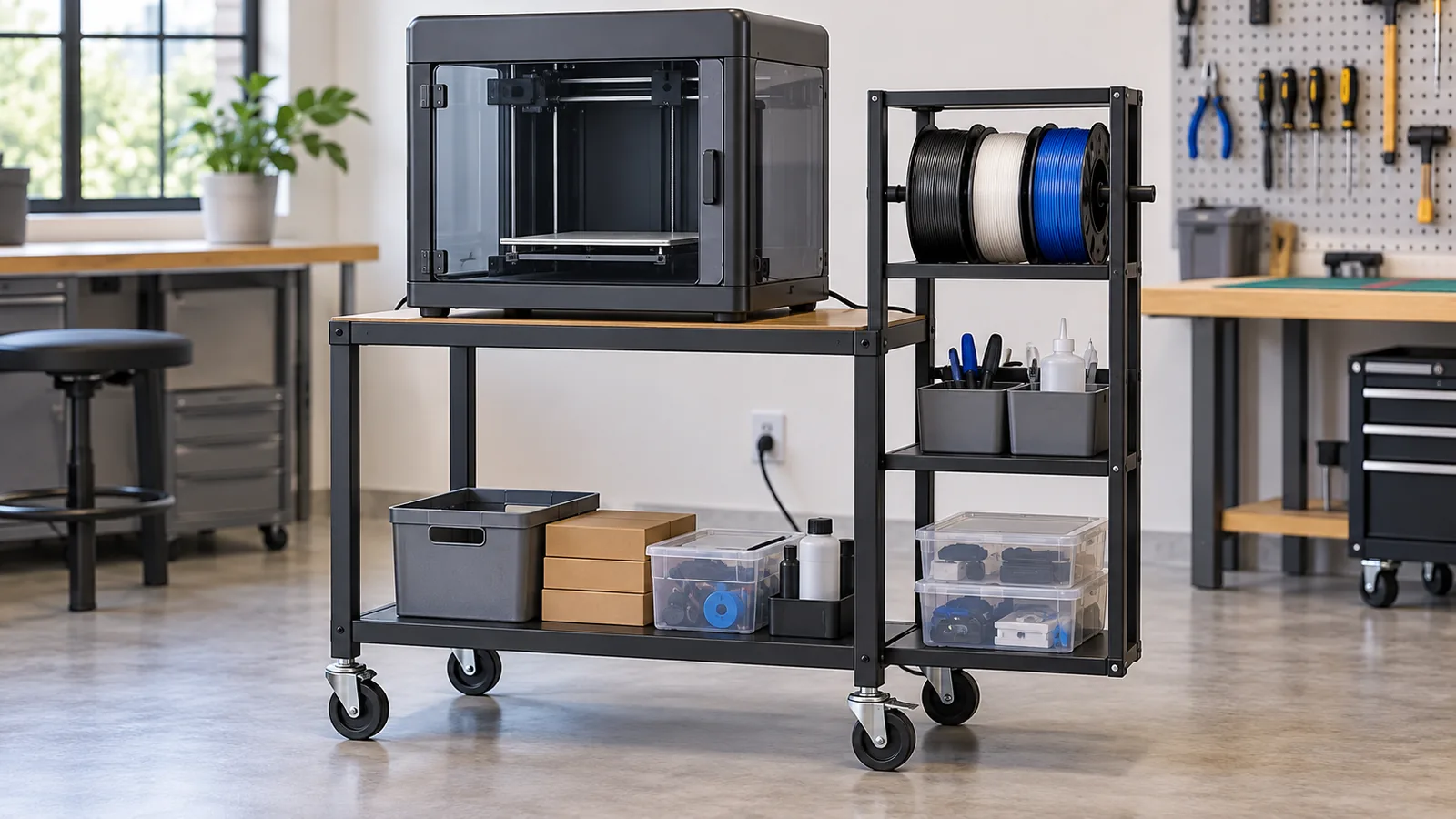
A 3D printer cart should be specified around a named printer and accessory configuration, not a broad claim that it fits “most printers.” Before approving a supplier sample, record the equipment footprint, required access, spool or material storage, cable route, stationary or mobile base, included options, assembly and packaging. A fit review confirms only the dimensions and configuration checked; it does not establish print quality, vibration performance, electrical suitability or a universal load rating.
What should an importer settle in the RFQ?
The RFQ should identify the exact cart configuration the buyer wants quoted and the evidence required to approve it. “Printer cart with storage” leaves suppliers free to propose different work surfaces, shelf counts, casters, glides, side racks and accessories. The resulting prices may describe different products and cannot be compared fairly until those differences are visible.
Start with the intended setting and user. An education distributor supplying a shared makerspace may prioritize material storage, supervised access and repeatable assembly. A retailer selling a compact home cart may prioritize footprint, flat-pack volume and a simple accessory kit. These are buyer-side design inputs; they do not prove that one layout or wheel type is suitable for every printer or room.
Assign a SKU and revision to each configuration. Record whether the base product includes the printer-supporting surface, lower shelf, spool rack, bins, handle, cabinet, side shelf, power-related parts, casters or glides. Identify any option that is quoted separately. If two models differ only in wheel selection or an upper rack, keep their component lists and pack data separate so the sample and quotation do not silently mix features.
A useful specification also distinguishes three types of requirement:
- Required: a dimension, interface, component or document that must be present for the buyer to approve the SKU.
- Preferred: a desired feature that can be quoted as an option or trade-off.
- Open for review: an unresolved issue assigned to the buyer, equipment maker, supplier or qualified technical reviewer.
For example, state the intended printer model and required spool configuration, then identify whether the cart needs to move during ordinary room setup or remain in one position. Avoid saying “stable,” “heavy-duty” or “anti-vibration” without a defined condition and evidence plan. These words do not tell a supplier how to design or a buyer how to inspect.
How should buyers define the printer and accessory envelope?
Measure the complete equipment envelope that must fit, including parts that extend beyond the printer body during use. Record the printer model or a controlled dimensional drawing, outside width and depth, height, door or lid swing, service panels, spool holder, filament path, screen access, removable build plate, ventilation clearance and the space needed to reach controls. If the product line includes several printers, create one fit row per model instead of relying on the largest outside dimension alone.
Separate the cart’s usable surface from its outside dimensions. A top may be wider than the support area, have corner radii, contain a raised edge or be interrupted by a cable grommet. Those details affect whether the printer feet sit where intended and whether a buyer can reach the controls. Show critical surfaces and reference points on the drawing. If the printer maker specifies clearances, ventilation or access requirements, use the current instructions for that named equipment; do not invent a generic gap and call it safe.
Accessories need their own interface map. A filament spool may need a horizontal axle or a rack with a specified orientation. Storage bins may need a known footprint and retrieval clearance. A laptop shelf, tool tray or spare-material cabinet can compete for the same space as a cable path or maintenance door. List each item included in the buyer’s proposed use and mark whether it is supplied with the cart, supplied separately or only used as a fit reference.
The interface drawing should distinguish inside clear dimensions from outside frame dimensions. For a lower shelf, measure clear width, depth and vertical opening after accounting for legs, braces and fasteners. For a top rack, note its height above the work surface and the path a spool or cable must follow. For a side shelf, define which side is used and whether nearby walls, benches or other equipment could obstruct it. This prevents an attractive rendering from being mistaken for a dimensioned fit guarantee.
Use representative items during the sample review. A paper footprint can check the plan-view envelope, while a physical printer or dimensionally controlled mock-up can reveal handle, lid and service-access conflicts. Record the item used, sample revision, measurement points and result. A fit check is specific to those references; it does not certify the cart for other printer brands or operating conditions.
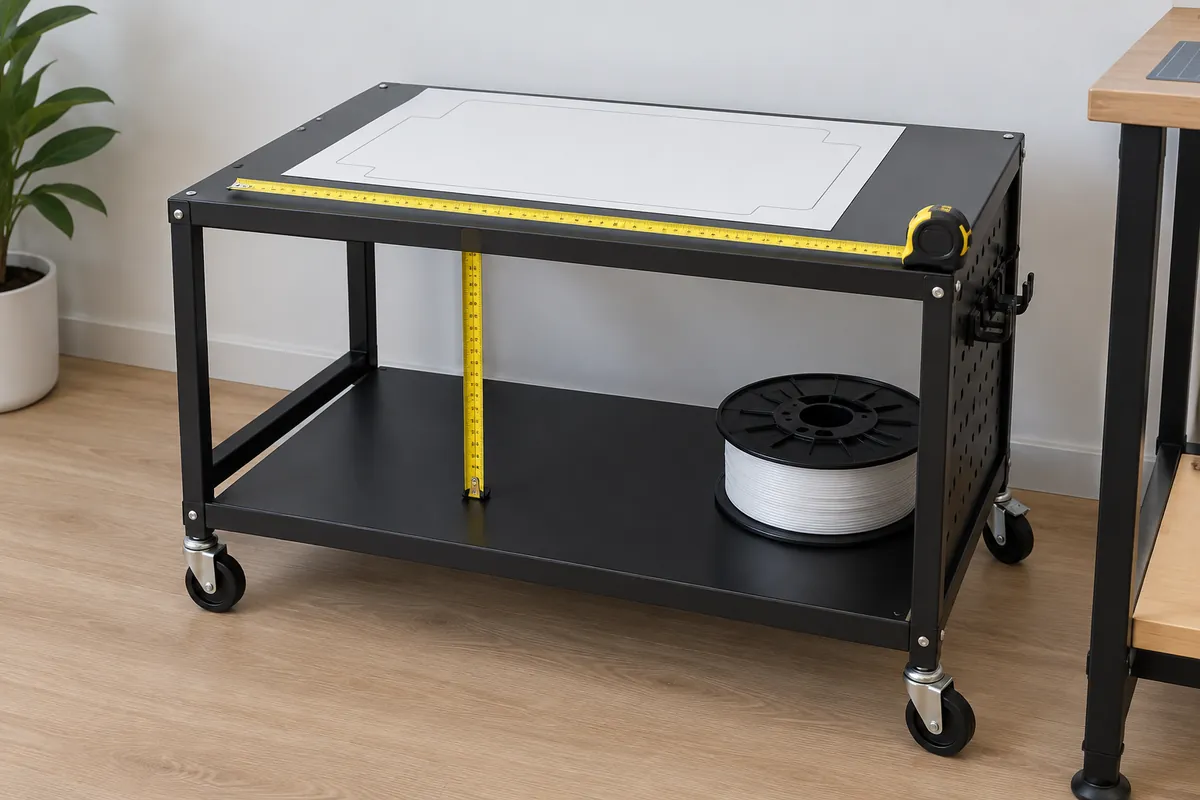
Should the cart use glides or casters?
The buyer should choose between a stationary base and a mobile base according to the intended workflow, floor and handling route. A fixed cart with glides and a mobile cart with casters are different configurations. Neither is universally better, and the mere presence of a brake does not prove that a cart will remain in a desired position under every floor, load or use condition.
If users move the cart between rooms, define where it travels, whether thresholds or floor transitions are present, how it is pushed, and which parts must remain accessible during movement. Name the caster arrangement, wheel material if specified, overall height change and any lock or brake function the buyer expects. Ask the supplier to identify the caster model and mounting interface in the component list. The sample should include the production-intent wheels and fasteners, not substitute wheels chosen only for a photo.
If the cart is normally stationary, describe how it is positioned and whether the buyer expects it to be moved for cleaning or maintenance. Record the selected glide type, foot-contact area and any leveling feature. Do not treat glides as a promise that the equipment is level on every floor; the room and floor condition remain part of the buyer’s use context.
A product-specific specification from Spectrum Furniture for its 3D2GO cart illustrates how a single product family can have separate stationary and mobile configurations, different wheel options and optional storage components. Its specifications also describe a particular work surface, assembly state and accessory choices. Those details belong to that named model and are not universal dimensions, acceptance criteria or recommendations for another supplier’s cart. See the Spectrum 3D2GO technical specification.
For a mobile configuration, agree on a buyer-defined sample check, such as confirming wheel orientation, lock operation where specified, turning clearance and whether the intended route can be traversed under controlled conditions. Do not turn a basic movement demonstration into an unverified vibration, equipment-safety or print-quality claim. If operational qualification is needed, ask the printer manufacturer and the responsible test party to define the method and acceptance criteria for the exact cart-and-printer combination.
What should a production-intent sample demonstrate?
The sample should represent the exact configuration the buyer expects to order. Confirm the frame geometry, surface material, shelf arrangement, finish, fasteners, casters or glides, accessory rack, handle, cabinet and side options. Compare it with the controlled drawing and quote line by line. If the supplier used a substitute part, record the difference and decide whether it is acceptable before treating the sample as approved.
Review access as well as fit. Open the printer’s intended service panels or lid, remove the build plate if relevant, reach controls, replace a spool and remove stored items using the specified layout. Check that a crossbar, upper rack or side shelf does not block the movements the buyer identified. This is a workflow demonstration for the selected equipment references, not a statement about the equipment’s technical operation.
Inspect the frame-to-shelf and frame-to-top interfaces. Confirm that mounting holes align, fasteners are accessible with the intended tool, and the cart can be assembled in the documented sequence without unapproved drilling or bending. Identify visible surfaces, edges and finish areas that matter to the buyer’s appearance standard. A visual inspection can find a mismatch; it cannot by itself prove a hidden material grade, weld strength, coating adhesion or long-term service life.
If a power strip or cord-management feature is included, separate that option from the metal-cart fit review. The buyer should identify the intended electrical component, target market, responsible supplier and required electrical documentation. Do not assume that adding a cable hole, switch or outlet makes a cart electrically compliant. When the cart is passive and no electrical parts are specified, keep the article and product brief focused on the support structure and storage interfaces.
Write sample findings in a short approval record: model and drawing revision, sample identifier, equipment references, dimensions checked, options present, deviations, open questions and authorized disposition. The approved record should name the person who accepted each deviation. A “looks good” message without a revision or reference equipment leaves the supplier uncertain about which product is authorized for production.
How should assembly and packaging be approved?
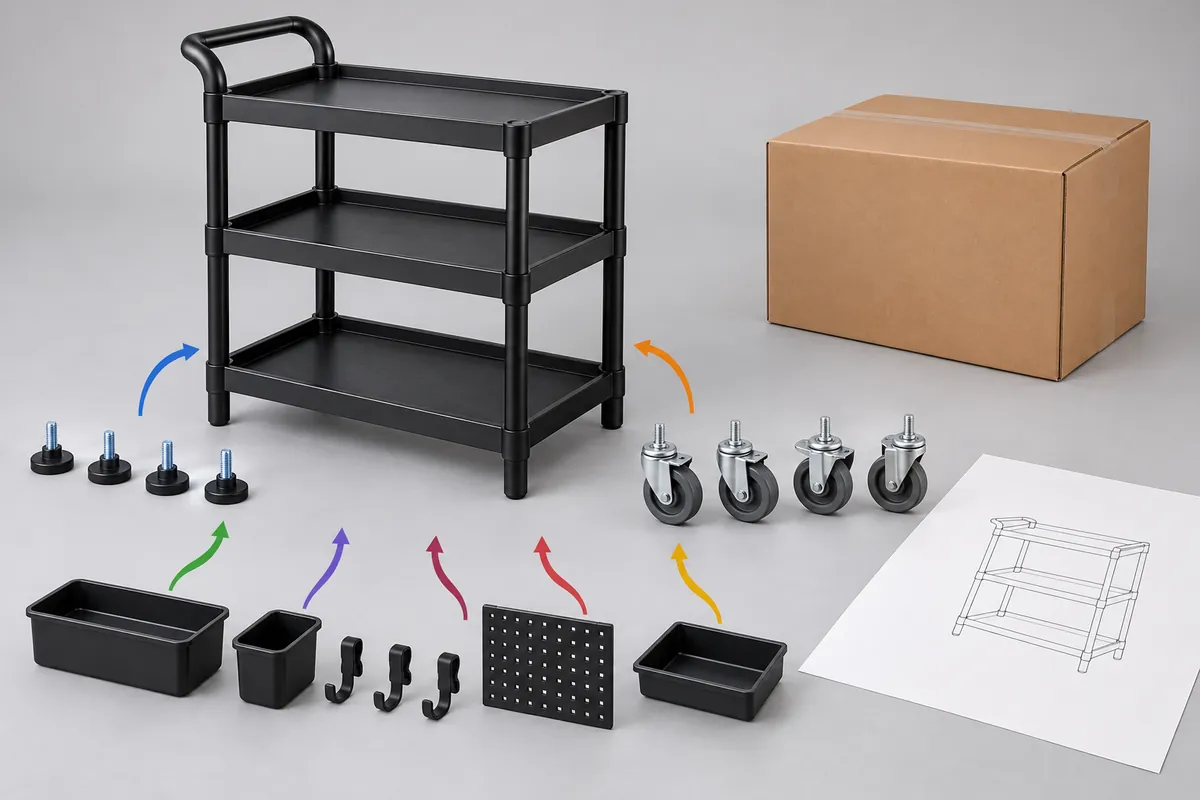
Approve the knock-down or assembled condition together with the parts list. Count the frame members, shelves, top, caster or glide set, fasteners, bins, handles, racks, instructions and optional components. Identify any left/right parts and any parts that change with the buyer’s configuration. The packaging artwork and assembly sheet should use the same SKU and revision as the approved sample.
Run the assembly sequence with the intended tools and instructions. Note where the frame must be squared, whether hardware is grouped by step, whether the top surface needs protection during assembly, and whether an option changes the sequence. A successful assembly of one sample does not guarantee every future unit will assemble identically; it gives the buyer a controlled reference for instructions and inspection.
Record whether the cart ships assembled, partially assembled or fully flat-packed. Request actual packed dimensions, carton quantity, gross and net weight, protection method, hardware-bag placement and external label positions for the production-intent configuration. Optional cabinets, side shelves, larger wheels or upper racks can change the package volume and component count. Do not use a preliminary render or another model’s carton data to calculate freight or retail storage.
If a transit test is required, agree the exact packaged configuration, handling method and acceptance criteria before testing. A test result applies to that sample and method; it is not a guarantee against damage on every carrier route. Open the tested package, inspect the top, frame corners and finish, and document whether the instructions and parts kit remain identifiable. Keep any test report with the packaging revision it actually covers.
What should an importer put on the approval checklist?
Before signing a sample approval, confirm that the cart, equipment references and pack-out are controlled as one SKU. A concise checklist can include:
- Printer model, dimensions, intended accessories and source of each reference measurement.
- Usable work-surface width and depth, edge details, access needs and cable route.
- Lower-shelf clear dimensions, upper-rack position and accessory storage configuration.
- Stationary or mobile base, exact glides or casters, mounting interface and expected movement route.
- Included and optional parts, with quote line items and a complete component list.
- Frame and surface materials, finish references, cosmetic faces and critical assembly interfaces.
- Any electrical or printer-specific requirement assigned to a qualified responsible party.
- Sample identifier, drawing revision, inspection points, deviations and authorized approval.
- Assembly instructions, tools, hardware grouping and intended shipment condition.
- Unit and master-carton dimensions, protection, packed quantity and label placement.
- Any transport or operational test method and acceptance criteria required for this project.
This buyer-side approach aligns with the broader planning principle in MIT’s makerspace guidance: plan a workspace around the intended users, activities, movement and storage needs before finalizing equipment placement. The guide is a layout resource, not a cart specification or product-safety standard. See MIT Edgerton Center’s makerspace setup guide.
Does one cart fit every desktop 3D printer?
No. Printer footprints, lids, service panels, spool paths and accessory arrangements vary. Approve fit against the named model or a controlled dimensional envelope and state which accessories were included in the review.
Do locking casters prove that the printer cart is stable?
No. A lock is one component feature. The buyer should define the intended floor, cart configuration and evidence needed for the project; a wheel-lock demonstration does not establish vibration performance, print quality or suitability for every operating condition.
Can an importer copy another cart’s load capacity?
No. A capacity statement belongs to the model, configuration and evidence source that published it. It is not a universal benchmark. If the project requires a capacity claim, the buyer should define the required evidence with a qualified party for the exact design.
Should the sample include every optional rack and shelf?
The buyer should approve the configuration it intends to order. If several options are offered, create separate SKU records and verify any interface or packaging changes that result from switching an option.
Keep 3D printer cart tied to the named product or order configuration, and record which revision and requirements the supplier actually reviewed.
When comparing 3D printer cart, state the open assumptions and approval owner in the project record rather than generalizing beyond the evidence.
اعمل مع شركة «كويتور» للأدوات
| Review point | What the buyer should define | What the sample can confirm |
|---|---|---|
| Equipment envelope | Named printer model or controlled dimensions | Clearance at the approved cart position |
| Storage layout | Which shelves or holders are included | Access to the items shown in the approved setup |
| Frame and finish | Drawing revision and visible finish reference | Fit, alignment and appearance for that revision |
| Pack-out | Assembled or knock-down configuration | Parts, instructions and carton arrangement |
Review a Custom Metal Storage Requirement
Share your drawing, sample, intended configuration, finish, packaging plan and target quantity. Koitor can discuss metal-storage requirements within its confirmed manufacturing scope and identify product-specific questions that need another technical reviewer.
OEM / العلامة التجارية الخاصة
حوّل دليل التوريد هذا إلى موجز منتج
يرجى إطلاعنا على المنتج المستهدف، والحجم، والتشطيب، وكمية الطلب، ومتطلبات التغليف. وسيتلقى فريقك تقييمًا عمليًّا لإمكانية التصنيع قبل تقديم عرض الأسعار.

 English
 Español
 Português
 Français
 Deutsch
 العربية