
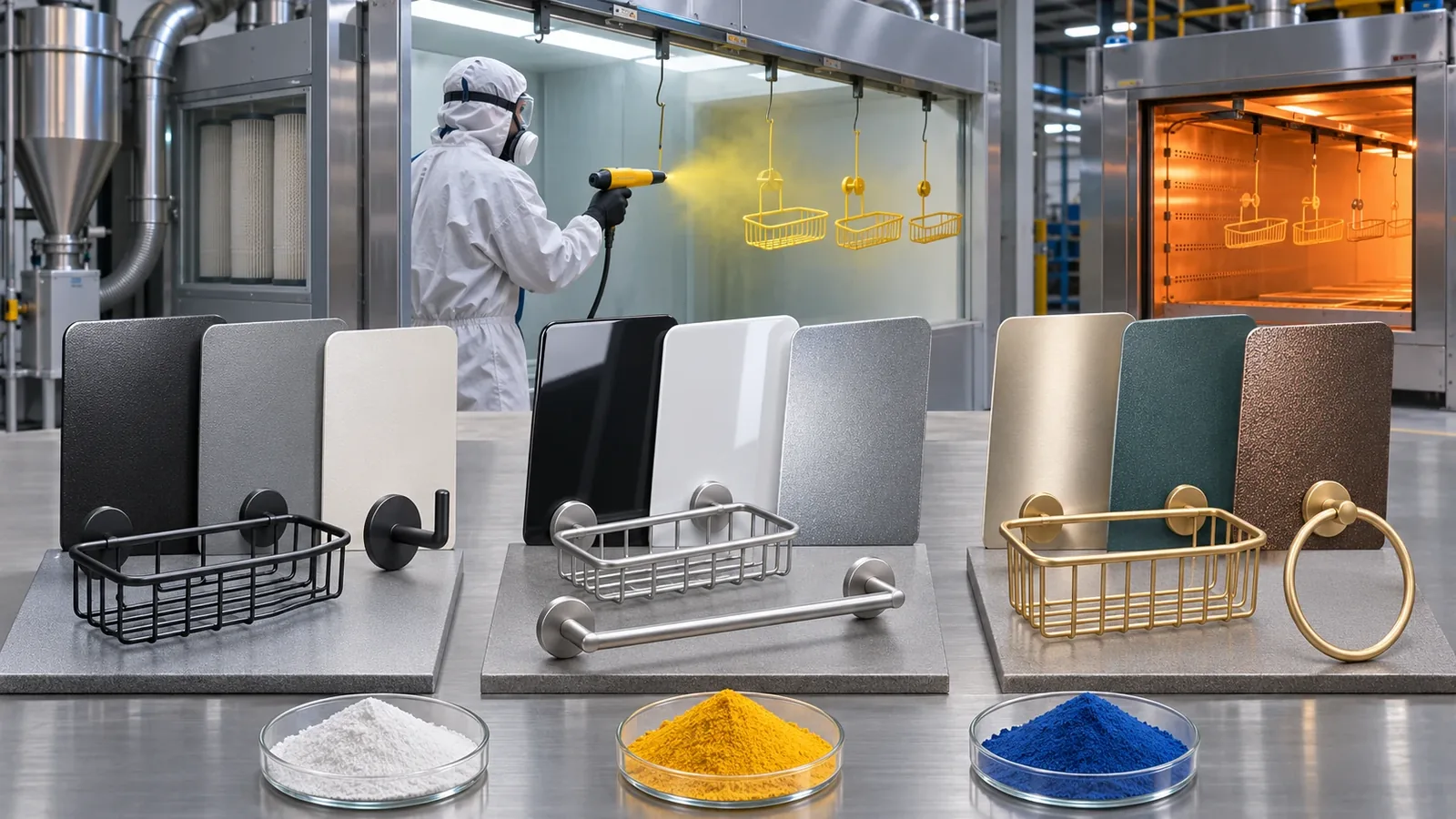
The types of powder coating are easier to compare when a buyer separates three classification questions: how the coating behaves during cure, which resin family is used, and how the powder is applied. These labels describe different axes, not one flat list of interchangeable choices. “Thermoset” and “thermoplastic” describe different material behavior categories; “epoxy,” “polyester” and “hybrid” identify resin families or formulations; electrostatic spray and fluidized-bed application describe process routes. A finish proposal should identify the relevant combination for the actual part.
For a metal bathroom or home-storage component, the buyer’s task is not to select a coating from a generic chart. It is to define the substrate, environment, appearance, fit constraints and acceptance criteria, then clarify the proposed coating system and sample. A type name alone does not guarantee corrosion resistance, durability, color consistency or suitability. Those depend on the product, formulation, preparation, application, cure and project evidence.
Types of powder coating: organize the labels by axis
Powder coating is applied as a dry powder and then processed to form a coating. A useful buyer overview begins with the material behavior category. Thermosetting powders cure through a chemical change that forms a crosslinked coating; a thermoplastic coating softens when heated and can be fused into a coating without the same thermoset cure behavior. These broad distinctions help explain why “powder” alone is not a full material specification.
Resin-family labels form another axis. Supplier literature commonly discusses epoxy, polyester, epoxy-polyester hybrid and other formulations, including polyurethane or fluoropolymer families. These categories can have different intended uses and properties, but no broad family name independently establishes suitability for a particular bathroom product or outdoor exposure. Product design, formulation, surface preparation and supplier recommendations remain relevant.
Application method is separate again. Electrostatic spray is a widely recognized powder application route. Fluidized-bed processes are another category in which a heated part may be brought into contact with suspended powder, depending on the process and product. An application label does not tell the buyer the resin family or prove that every recess, edge or internal surface receives the required result. Ask the coating supplier how the proposed route applies to the actual geometry.
| Classification axis | Example terms | What the buyer should clarify |
|---|---|---|
| Material behavior/cure | Thermoset, thermoplastic, and some UV-curable descriptions | Which behavior category does the supplier mean, and what cure or fusion approach is specified for this part? |
| Resin family/formulation | Epoxy, polyester, hybrid, polyurethane or fluoropolymer | What exact product or specification is proposed, and what project requirement is it intended to address? |
| Application route | Electrostatic spray, fluidized bed, or another declared route | How does the proposed method address the part’s geometry, edges, recesses and hanging points? |
| Appearance/result | Color, gloss, texture, coverage and visual sample | What sample and acceptance criteria will control approval? |
| Layer/system configuration | Single or multiple layers where specifically proposed | What is included in the approved system and which party validates the process? |
Some classifications overlap in commercial descriptions. For example, a supplier may name a resin family and separately state that it is thermoset. Another may describe an application process while leaving the formulation to a product code. Capture the actual product name or specification, the technical data sheet revision and the proposed route so the buyer can distinguish what is known from what still needs confirmation.
Thermoset and thermoplastic are not resin-family synonyms
Thermoset and thermoplastic describe material behavior categories, not a direct ranking of coating quality. A thermosetting powder undergoes a cure process that forms a network in the coating. The specific chemistry and cure requirements depend on the product supplier’s formulation. Do not copy cure temperatures or times from a generic webpage into a production specification; the supplier’s current technical documentation and the actual part/process validation should govern.
Thermoplastic powder coatings are described as a separate behavior category. They are associated with softening and fusion on heating rather than the same crosslinking cure mechanism. That broad distinction does not tell a buyer whether a given powder is available, suitable for a thin sheet bracket, compatible with a dimensional fit, or appropriate for a particular environment. Confirm the exact product, substrate and process with the coating provider.
Some coating literature also mentions UV-curable powder. That term should be treated as a bounded classification lead, not as proof that a particular system is suitable for a metal hardware application. The referenced industry document discusses UV-curable naming in a wood-finishing context, and it is not a process recipe for Koitor’s metal products. If a supplier proposes such a route for a specific part, request current product documentation and actual application evidence.
The buyer should avoid combining these terms as though they mean the same thing. “Polyester” says something about a resin family; “thermoset” describes a cure behavior category; “electrostatic spray” describes how material is deposited. A purchase specification that says only “thermoset powder coating” may still leave the formulation, color, texture, pretreatment and acceptance plan unresolved.
Compare resin-family terms carefully
Epoxy powders are one commonly discussed resin family. Polyester powders and hybrid epoxy-polyester powders are other familiar categories. Coating manufacturers also describe polyurethane and fluoropolymer systems. A supplier’s product sheet may identify intended applications and properties, but those statements apply to its own product and test scope. They should not be generalized to every formulation under a broad family name.
Do not assume that epoxy always provides the best answer, polyester always suits every exterior application, or a hybrid always combines the “best” properties of two materials. Such language erases product differences and actual application conditions. Instead, provide the part drawing, substrate, intended exposure, appearance target, functional requirements, quantity and process constraints. Ask the supplier to identify a specific formulation and support its recommendation with relevant documentation or a representative sample.
Likewise, avoid relying on broad claims such as “no VOC,” “never chips,” “perfect coverage,” “longest life” or “lower cost” unless the supplier’s actual product evidence and applicable test scope substantiate the statement. A resin-family label alone does not establish environmental compliance, service life, corrosion protection or warranty coverage. If a claim matters to a buyer’s legal or technical decision, verify the current documentation and jurisdiction separately.
The same caution applies to layer count. A proposal may include a primer, topcoat or other multi-step system, but more layers do not automatically mean better performance. The full system, substrate condition, preparation, application and cure have to be assessed together. Ask what each layer is intended to accomplish, whether it changes dimensions or fit, and which product data or project test supports the acceptance criteria.
Application method and part geometry
Electrostatic powder spray uses electrical charging and a grounded workpiece to support powder deposition. A fluidized-bed route uses a different powder contact arrangement and may be selected for some geometries or coating needs. These descriptions explain application categories, not a guarantee that a particular part will receive uniform coverage. Complex corners, narrow recesses, interior features, sharp edges, hanging points and contact areas can create process considerations that must be reviewed for the actual component.
Before approval, identify functional surfaces that must remain clear, including threads, mating holes, slots, bearing faces, assembly interfaces, drain openings or concealed fit features. The buyer should show these on the controlled drawing or finish specification. Ask the supplier how masking, racking and handling will affect the specified faces. Do not assume a color sample is enough to approve dimensions, coverage or adhesion.
The coating supplier may need to review the geometry and proposed hanging orientation. A flat color panel can confirm a color family or visual direction but does not demonstrate the result on a basket, tube assembly, bracket or welded frame. Request a representative part or appropriate sample panel and note what it does and does not establish. If a sample is made on a different substrate or preparation state, record the limitation and keep the production approval open for the relevant attributes.
Pretreatment is another independent part of the finish system. The coating maker may specify preparation conditions for its own product, while the part supplier or finishing provider controls the actual process. A buyer should request the applicable specification and confirm who owns the preparation, coating and inspection steps. This guide does not prescribe chemicals, pretreatment parameters or cure schedules.

What the coating label does not establish
The words “powder coated” or a named resin family do not independently demonstrate corrosion resistance, coating thickness, adhesion, chip resistance, color match, impact performance or service life. A particular manufacturer may test or warrant defined properties for its own product and conditions, but that evidence cannot be transferred to a different formulation or production part without confirmation. A buyer should ask for the actual standard, method, sample, acceptance limits and responsible party when a performance claim matters.
Salt-spray hours, if specified, also require careful interpretation. A test result pertains to the tested specimen, preparation, coating system, method and evaluation criteria. It does not equal a guaranteed number of years in a customer’s bathroom, hotel or coastal environment. Do not insert generic hours or convert them into a product life claim. Define the project’s requirement with qualified technical input and evaluate the actual test scope.
Color and gloss approval are distinct from performance validation. A physical panel or controlled reference can support appearance review under agreed viewing conditions. It may not show how the finish behaves around a weld, edge, recess, tube end or contact point. Conversely, a coating test coupon may provide technical evidence but not represent the final product’s visual layout. Use the right evidence for each decision.
Changes also matter. A revised substrate, pretreatment route, powder product, supplier, application method, cure setup, masking scheme or part geometry can affect a previously approved result. State which changes require notification and approval. Preserve the approved sample, drawing revision and finish code so later orders can be compared to a traceable baseline.
Write a buyer-ready coating specification
Start with the part and the condition it will face. Identify the substrate and its current finish, intended indoor/outdoor or wet-area exposure when known, cleaning expectations if established, functional interfaces, visible surfaces, color and texture target, and quantity. Do not claim that a broad environment label alone predicts performance. The project’s actual risk and applicable evidence should drive any technical requirement.
Ask the coating provider to identify the specific powder product or specification, resin family, cure category and application route to the extent relevant and available. Request the current technical data sheet and note its revision or product identifier. If the supplier’s terminology is unclear, ask it to explain whether a label describes chemistry, cure behavior, application method or finished appearance. Capture open questions rather than filling them with assumptions.
Define the approval sample. State whether it must use the production-intent substrate, preparation, geometry, color, texture and finish route. Specify which faces and interfaces will be reviewed. Agree on the visual acceptance conditions and any technical validation separately. Identify the buyer, supplier or qualified laboratory responsible for each decision, and keep the approved sample connected to the purchase order and drawing revision.
A useful approval sequence separates the product decision into manageable records. First, the buyer approves the visual target and identifies the sample revision. Second, the technical owner reviews the named coating product and any documented performance requirement. Third, the supplier confirms the route and which interfaces require masking or special attention. Finally, the purchase record identifies the approved drawing and any allowed substitutions. This does not guarantee a particular outcome; it helps the parties know which question each approval actually settled.
If the coating is applied by a subcontracted finisher, identify who owns the product code, process instructions, sample retention and change notification. The buyer does not necessarily need every proprietary process detail, but should know which organization is accountable for the specified result and where the controlled evidence resides. An undocumented handoff can leave the importer comparing a sample approved by one party with a production lot controlled by another.
For quote comparison, normalize included scope. Ask whether the price includes pretreatment, masking, coating, cure, color setup, sample development, inspection, packaging protection and rework expectations. Clarify minimum batch assumptions and any exclusions. A low quote without the same preparation, inspection or sample scope cannot be compared as though it supplies the same finish system.
| Specification item | Buyer record | دليل الموافقة |
|---|---|---|
| Part and substrate | Part number, material and relevant revision | Released drawing or material record |
| Proposed powder | Supplier, product code, family and current documentation | Current technical data sheet or supplier confirmation |
| Process axes | Cure category and application route when established | Written process description and responsible provider |
| Appearance | Color reference, gloss/texture expectation and viewed faces | Controlled color/finish sample under agreed conditions |
| Functional features | Threads, holes, mating faces, drains and masking needs | Marked drawing and representative assembly review |
| Validation | Specific property, method, sample and acceptance owner | Project-specific evidence tied to the tested system |
| Change control | Which substitutions need notice and approval | Revision record and approval log |
The purpose of this specification is to make the proposal understandable and reviewable. It does not require the importer to dictate chemistry beyond its competence. A qualified coating supplier can recommend a product, but the buyer still needs to confirm that the recommendation addresses the intended part and stated requirement.
Common selection mistakes
Treating every label as a separate competing powder type
Thermoset/thermoplastic, epoxy/polyester/hybrid, and spray/fluidized-bed terms belong to different classification axes. Ask what each word describes. A complete proposal can state the product family, cure behavior and application route separately.
Choosing by resin name alone
A broad family label does not establish that a particular formulation is right for a substrate or environment. Request the named product, documentation, sample and evidence relevant to the actual part.
Assuming thicker coating always performs better
The buyer should not infer better service from a generic thickness claim. Film build, fit, edges, cure, preparation and the specified test all matter. Use the project requirement and supplier documentation rather than a universal rule.
Treating an appearance panel as full qualification
A color panel can help approve visual direction. It does not necessarily represent the product geometry, preparation, coverage, fit or performance. State the scope of sample approval and keep other required evidence separate.
Comparing quotes with different process scope
One offer may include preparation, masking, inspection and a production-intent sample; another may cover only powder application. Normalize those items and ask each supplier to disclose exclusions before selecting on price.
Buyer checklist before approving a powder finish
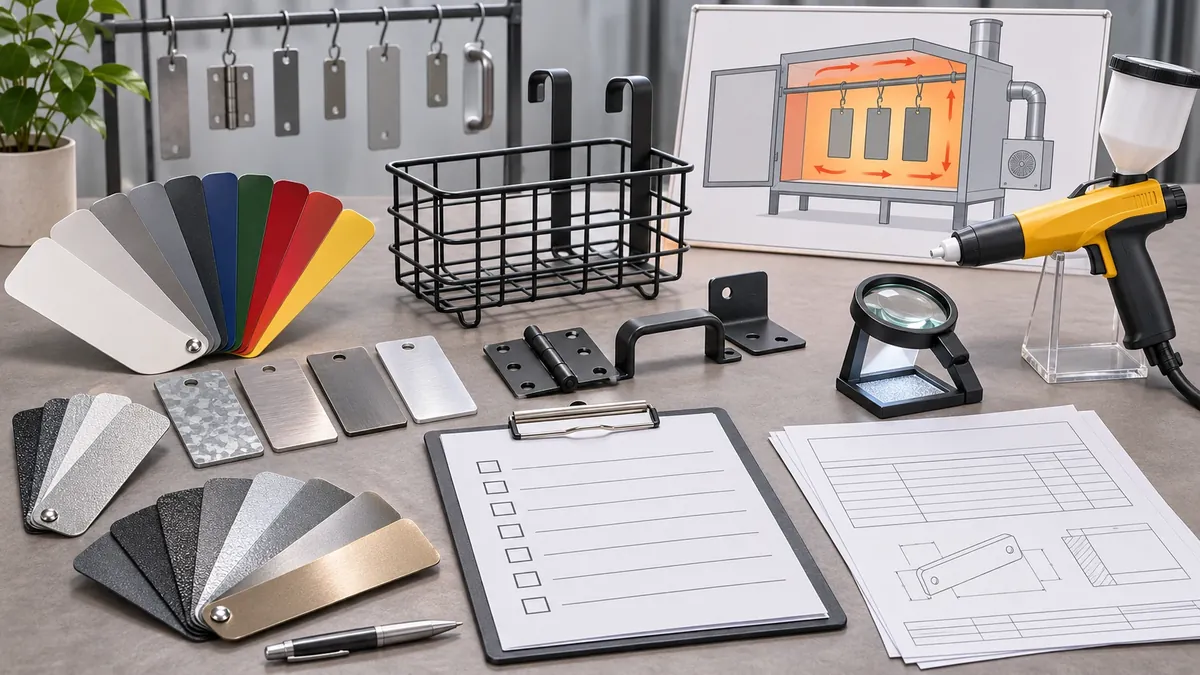
Before approving a coating proposal, confirm:
- The part number, substrate and drawing revision are current.
- The supplier has distinguished resin family, cure behavior and application method.
- The proposed powder product or specification is identifiable.
- The current product data sheet is available and tied to the proposal.
- Functional faces, threads, holes and masking requirements are marked.
- The sample represents the production-intent part or its limitations are recorded.
- Appearance acceptance and performance validation are separate decisions.
- Any durability or compliance claim has a defined evidence basis.
- The quote identifies pretreatment, masking, sample, inspection and exclusions.
- Substitution, process changes and finish revisions have an approval path.
الأسئلة الشائعة
What are common types of powder coating?
Commonly discussed categories include thermoset and thermoplastic behavior, resin families such as epoxy, polyester and hybrid formulations, and application methods such as electrostatic spray or fluidized bed. They describe different axes rather than one flat list.
Is epoxy powder coating always better than polyester?
No. A resin-family name alone does not establish suitability or performance. Ask the supplier to identify the exact product, intended use and evidence for the actual substrate and project requirement.
Is powder coating always applied by electrostatic spray?
No. Electrostatic spray is a common route, but other methods such as fluidized-bed application are also described. The supplier should confirm the proposed method for the actual geometry and coating product.
Does the powder type guarantee corrosion protection?
No. A type label does not establish performance. Substrate, preparation, formulation, application, cure and test conditions matter. Request evidence tied to the actual system and requirement.
Is a sample panel enough to approve the production part?
It may support appearance review, but a flat panel may not represent the production geometry, edges, recesses, masking, fit or preparation. Define which attributes the sample confirms and what additional evidence is needed.
Should a buyer specify a cure temperature from a generic guide?
No. Follow current supplier documentation and project validation. Generic values may not apply to the powder product, part, oven, measurement location or production setup being used.
Sources and scope
- PPG: Powder coating process specifics — supports the distinction between thermoplastic/thermoset categories and separate application routes; no generic cure schedule is adopted.
- IFS Coatings: Different types of powder coating — identifies several resin-family terms; product-specific performance statements are not generalized.
- Powder Coating Institute resource — supports the bounded existence of UV-curable naming in a wood-finishing context, not a metal hardware process recommendation.
- Scope note: This article focuses on classification axes. Verify any related Koitor page against the current live internal-link register before adding it to a published version.
This guide does not prescribe coating chemistry, pretreatment, cure settings, test values, durability, warranty or environmental performance. Confirm the actual powder product, supplier instructions, substrate and project evidence before making a finish decision.
اعمل مع شركة «كويتور» للأدوات
Clarify the finish brief before a custom quote
Share the current part drawing, substrate, finish target, functional faces, expected quantity, sample requirement and any established exposure or inspection criteria. Koitor Hardware is a family-owned custom metal hardware factory focused on bathroom and home-storage products. The specific powder product, process route and performance requirement must be confirmed for the project before they are represented in a quote.
Clarify a Powder Finish Requirement
Share the controlled drawing, substrate, finish target and sample expectations so the coating proposal can be reviewed against the actual part.
OEM / العلامة التجارية الخاصة
حوّل دليل التوريد هذا إلى موجز منتج
يرجى إطلاعنا على المنتج المستهدف، والحجم، والتشطيب، وكمية الطلب، ومتطلبات التغليف. وسيتلقى فريقك تقييمًا عمليًّا لإمكانية التصنيع قبل تقديم عرض الأسعار.



 English
 Español
 Português
 Français
 Deutsch
 العربية