
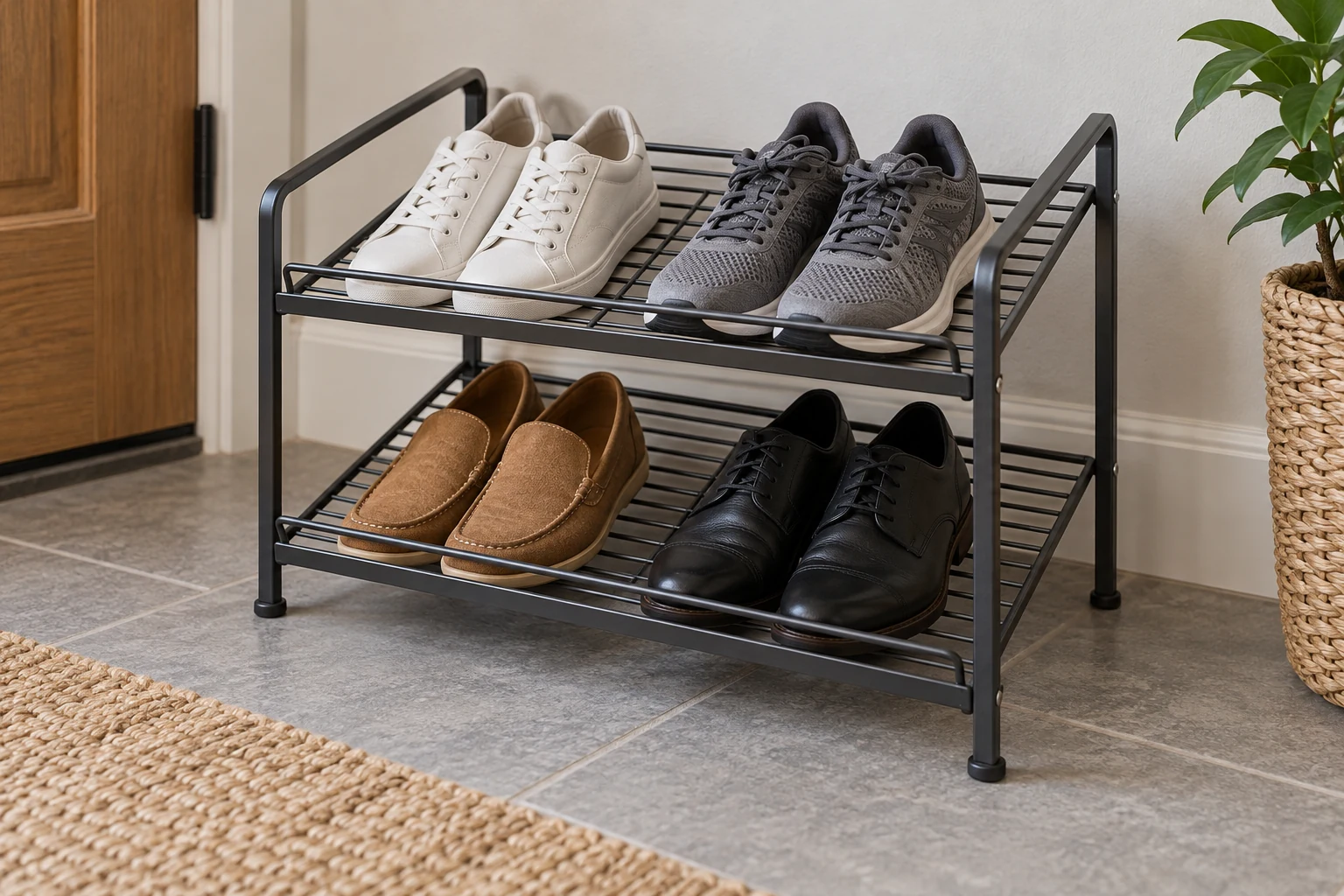
Buyer specification guide | Entryway and closet-storage hardware
When a slanted shoe shelf presents footwear toward the user, its front edge becomes a retention feature, not merely a decorative rail. A buyer facing angled shoe rack shoes sliding off should define the assembled shelf orientation, representative shoe profiles, front-lip interface and sample acceptance method together. A larger lip is not automatically better: it may obstruct a hand or catch the shoe during removal. The useful specification is the smallest appropriate geometry that satisfies the agreed use scenario on an identified sample, with no universal angle or lip dimension assumed.
Why do shoes slide on an angled metal rack?
A user described a metal rack angled toward the front on which shoes slipped even though the shelf had a gripping surface. This reported use problem demonstrates a question worth investigating; it is not a controlled failure-rate study. The rack’s actual angle, shoe materials and handling conditions were not established. A buyer should not copy a fix from that discussion directly into a production drawing.
On an inclined shelf, gravity has a component directed toward the low edge. Whether a particular shoe moves also depends on where its sole contacts the bars or sheet, sole texture, shelf finish, heel shape, shelf orientation and normal handling. Dust, moisture or a different shoe size could change the result. A front rail or lip can provide a physical stop, but only if its position intersects the part of the shoe likely to move and its structure remains suitable for the intended product.
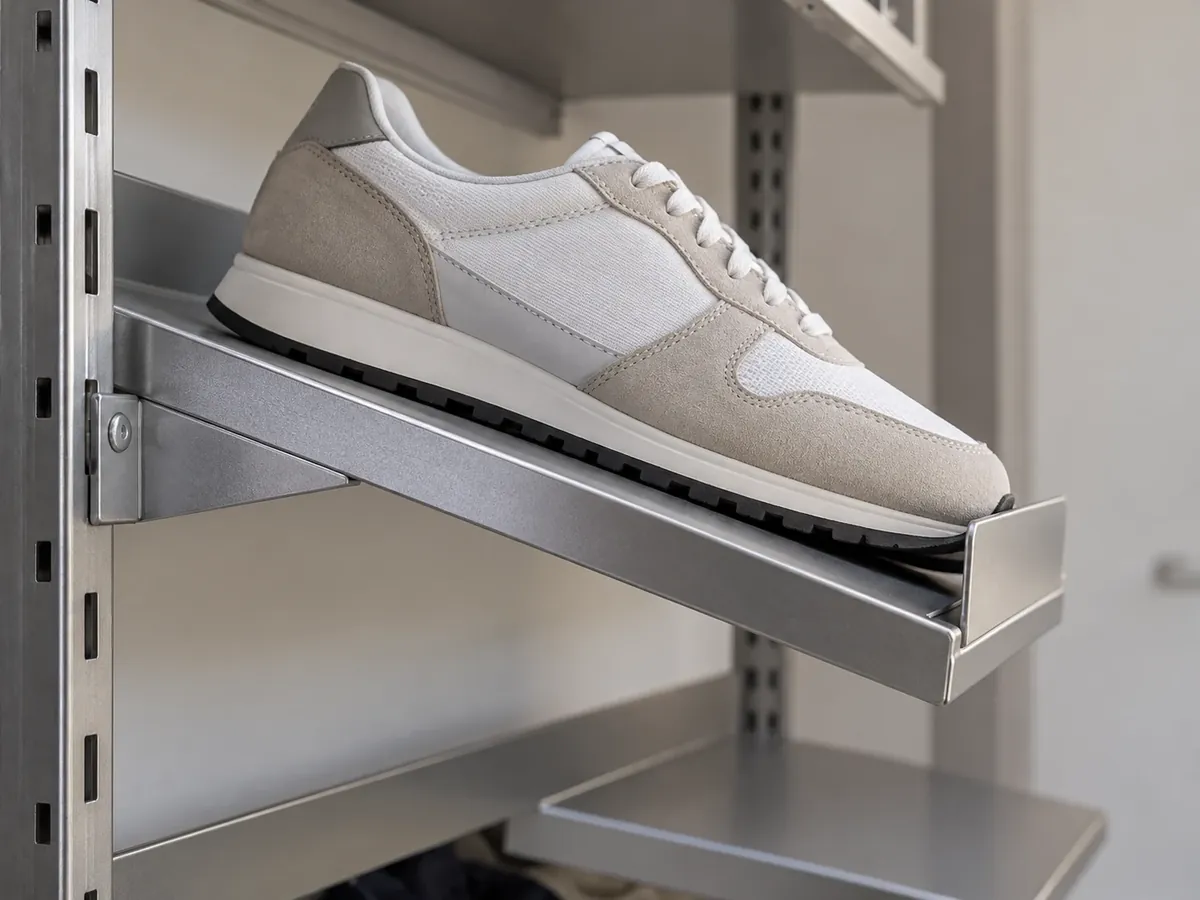
First-party products show why orientation and edge design deserve explicit attention. Elfa describes a slanted metal shelf with a front lip, while IKEA’s angled metal shoe rack specifies the raised-edge orientation. These are model-specific examples, not industry dimensions or proof that one design fits all footwear. They demonstrate that the edge must be understood as part of the assembled product.
For an importer, the immediate question is not “What angle stops slipping?” It is “Which approved shoe set must remain placed under the intended shelf orientation, and how will we check that without sacrificing retrieval?” This framing prevents a supplier from choosing a visually similar but functionally different lip.
Separate the shelf angle from the retention edge
An angled shelf can improve display and visibility, but the incline also changes the shoe’s contact and movement. A front lip is a separate design input. If a supplier changes the inclination while retaining the same lip drawing, the resulting contact point can shift. If the lip moves or changes shape while the inclination remains fixed, a different sole or toe may catch it differently. An approved design needs both dimensions on the same drawing revision.
Ask the supplier to state how the rack stands when assembled, which edge is the front, and whether any shelf or crossbar can be reversed during assembly. A sample photographed on a table in the wrong orientation cannot establish the installed use condition. Show the front and rear support heights or equivalent datum on the assembly drawing. If the product is adjustable, identify the allowed positions and decide which require separate checks.
The shelf’s metal form also matters. Open bars, wire, a perforated tray and a solid sheet do not contact the sole in the same way. Rail spacing and front-edge profile can allow a thin sole, heel or toe to pass differently. A buyer should request a section view of the front edge, not merely a front-facing product render.
Why a grippy surface may not be enough
A textured or coated shelf surface may alter friction, but a broad claim that it prevents movement requires evidence for the finished product and intended shoes. Contact with a tread block differs from contact with a smooth sole or narrow heel. Where the shoe bridges only two bars, much of the sole may not touch the shelf at all. Surface treatments can also wear, attract dirt or create cosmetic concerns, depending on the construction and use.
Do not substitute a rough finish for a clear retention specification. The buyer can request both a surface condition and a front stop, but each should have a defined purpose. For example, a surface may protect the shoe or reduce noise, while the lip is intended to prevent a particular shoe profile crossing the low edge in ordinary handling. The sample review should check the assembled combination, not evaluate each feature in isolation.
Which shoe profiles belong in a buyer’s acceptance set?
A shoe rack does not serve a single generic “shoe.” An importer may be selling into a market with trainers, formal shoes, children’s sizes or boots, but the exact assortment varies by SKU and customer. The buyer should select representative footwear from the target category and document it before sample approval. Neither a supplier nor this guide can infer the correct set from a rack photo.
A practical set spans the conditions likely to challenge retention or access: a relatively smooth sole, a thicker or highly patterned outsole, a small or short shoe, and a shoe with a raised heel or rigid toe, where relevant. If the rack is marketed for boots or bulky footwear, also review the vertical clearance to the tier above. If that is a different buyer question, keep the acceptance requirement separate rather than claiming the front lip solves it.
Record each shoe’s approximate external length, width and outsole shape, whether it is placed toe-forward or heel-forward, and the intended number of shoes per shelf. Photographs are useful when tied to measurements and a sample ID. A single adult trainer tested once cannot establish suitability for all sizes. Conversely, an unusual footwear type outside the target market should not silently dictate a bulky rail that harms access for the normal assortment.
| Buyer input | What to record | Why it affects the decision |
|---|---|---|
| Intended footwear | Named representative styles and size range | Different soles and heels contact bars and lips differently |
| Shelf orientation | Front/rear datum and permitted assembly positions | A reversed or adjusted shelf changes the direction of movement |
| Shelf form | Wire/bar spacing, sheet profile and support locations | Contact area and local gaps affect placement |
| Front edge | Lip height, shape, continuity, corner finish and location | Retention must work without snagging or sharp contact |
| Retrieval | Hand clearance and agreed removal motion | A tall stop can make everyday removal awkward |
| النهاية | Agreed appearance and contact-zone condition | Coating or burrs can affect shoe contact and perceived quality |
This table is a specification aid, not a set of universal tolerances. The agreed drawing and sample should carry the actual values for the buyer’s product.
Consider placement and removal as different motions
Retention is only half the task. A shoe may stay put when left alone but be difficult to remove if a tall lip blocks the toe or a close upper shelf limits hand access. The buyer should decide how a user is expected to place and remove footwear. Is the shoe lifted above the lip, tilted backward, or drawn forward over a rounded rail? Each motion calls for different clearance.
Review the lower tier as well as the top tier. A hand has less room beneath another shelf, and a shoe with a high upper may require a different angle of removal. The position of a full neighboring pair can also restrict reach. A sample display with only one shoe on the upper tier may hide this issue.
Specify an acceptable retrieval observation in plain language. For example: with the sample assembled as instructed and the representative shoes arranged as marked, a user can remove a shoe without forcing it against a sharp edge or displacing the adjacent pair. This is an example acceptance statement to adapt, not a claim that Koitor has tested a particular rack.
How should the front lip be drawn and inspected?
The drawing should make the front-lip interface unambiguous. Dimension the lip relative to the supporting shelf surface, locate it from a stable front datum, and show the edge radius or other safe contact treatment where appropriate. If the rack uses a separate welded or fastened rail, identify the joint and the revision of that component. For a formed sheet lip, show the bend and its relationship to the usable shelf depth.
Continuity matters. A rail that stops short near an end or is interrupted by a bracket can leave a different retention condition at the outer shoe position. That is not automatically a defect; it depends on where shoes are intended to sit. Mark the intended shoe positions and inspect the actual opening. If a lip is only at selected points, the buyer should understand which shoe profiles are expected to contact it.
Ask for a smooth contact edge and inspect burrs, weld residue, sharp corners and finish build-up at the points a shoe may touch. A visually acceptable rack can still snag fabric or mark a shoe if the contact zone is neglected. Equally, a perfectly smooth lip may be too low or too far forward for the approved footwear. Cosmetic and functional inspections therefore need separate lines in the acceptance sheet.
For a flat-pack product, include the lip in assembly instructions and packaging review. A reversible component installed backward may remove the intended stop. A long rail or formed front edge can also be vulnerable to transit bending if not protected in the carton. The packaging review should ensure the production-intent sample arrives with its front edge and assembly cues intact.
What should a sample acceptance sheet include?
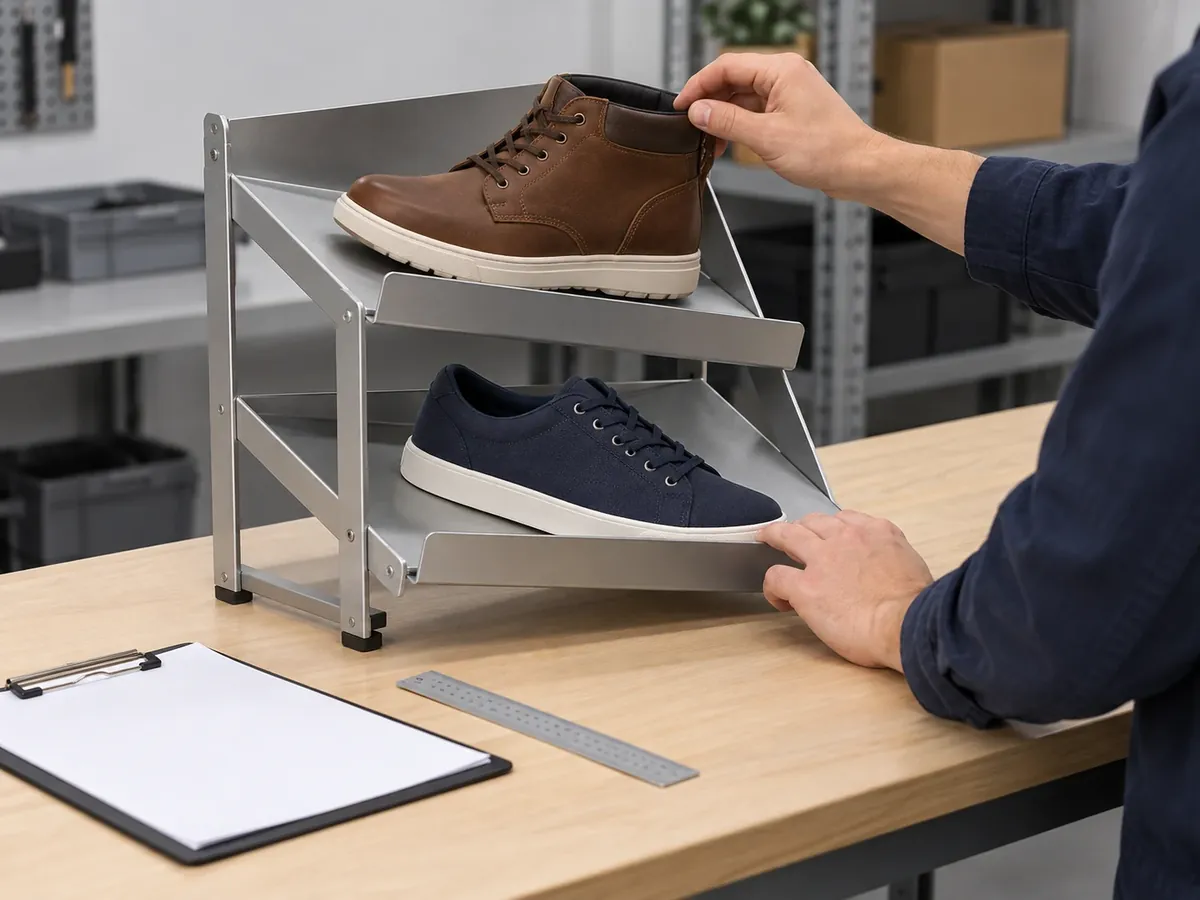
Make the trial repeatable enough for buyer and supplier to discuss the same product. Record the rack drawing number and revision, sample ID, shelf position, assembly orientation and footwear set. Note who performed the review, where each shoe was placed, whether the rack was empty or loaded on the other tier, and which ordinary handling motion was used. Keep the conditions modest and relevant; do not present an informal desk review as a certified safety or load test.
Use separate result columns for placement stability, ordinary retrieval, contact or scuff concern, assembly correctness and visible front-edge condition. Photograph both passing and failing positions. If a shoe slides, document whether it bypassed the lip, contacted it but tipped over, or was pushed by another shoe during removal. These are different design problems. A larger lip might help one and worsen another.
Before sign-off, have the supplier mark any deviation between the sample and production-intent construction. A handmade prototype may use a different bend, rail position or fastening method from the planned production part. If those differences influence the front edge, the earlier review may not transfer. Agree which change requires a new sample or at least a targeted recheck.
What belongs in the RFQ and change-control record?
The phrase angled shoe rack shoes sliding off describes a use problem, but a useful RFQ must convert it into defined geometry and an observable sample check.
An RFQ for an inclined metal shoe rack should do more than request dimensions, color and quantity. Provide the use scenario, intended footwear assortment, assembled shelf orientation, permitted shelf positions and expected front-edge behavior. Attach the relevant drawing or physical sample and identify what the supplier is being asked to quote: a rack only, assembly hardware, packaging, or a private-label retail pack.
The supplier can then review feasibility of the metal structure, forming or joining details, surface finish and packaging. Koitor’s custom metal storage rack و OEM home-storage hardware context is relevant to a discussion about metal geometry, samples and small-batch development. This does not assert that Koitor already makes the exact angled shoe rack shown in the examples or owns a particular test capability.
Ask the supplier to return a drawing that identifies the front lip, shelf angle and critical interface dimensions. Agree the sample revision and how proposed changes will be communicated. In a repeat order, a different rail cross-section, altered bar spacing or new packaging orientation can affect the same buyer question even if the product name and outside footprint are unchanged.
| Change proposed | Why it deserves review | Suggested buyer action |
|---|---|---|
| Shelf angle or bracket position | Changes downhill force and shoe contact | Recheck representative shoe set in assembled orientation |
| Lip height, profile or position | Changes both stop engagement and removal | Recheck retention, retrieval and contact condition |
| Wire spacing or tray profile | Changes sole support and gaps | Review all approved shoe positions |
| Finish or edge treatment | May change contact and cosmetic result | Inspect shoe-contact zones on new sample |
| Assembly or packaging | Could reverse, bend or conceal the front edge | Review instructions and unpacked sample |
The table identifies triggers, not mandatory universal test methods. The buyer should decide what inspection is proportionate to the specific SKU and claim. Keep earlier approvals traceable rather than assuming a small design change is harmless.
Avoid a false promise in marketing copy
Claims such as “no shoes ever slide” or “fits all shoes” go beyond what a limited sample review can show. If a product claim is needed, tie it to the particular size range, assembly orientation and conditions actually evaluated, and have the responsible team review the wording. The buyer may instead choose a narrower, more defensible description: the rack has an inclined shelf with a front retention edge. Even that description should match the delivered design.
Retail photographs should not accidentally show a rack assembled backward or a shoe balanced outside the intended support area. If a private-label package uses a lifestyle image, compare it with the approved drawing and instructions. Content accuracy is part of the product handoff, not an afterthought after tooling or packaging is complete.
Buyer checklist before approving production
Use this short checklist when angled shoe rack shoes sliding off is the concern:
- Identify the target buyer, use location and footwear types the SKU is meant to hold.
- Record representative shoe size, sole and heel profiles rather than testing one convenient pair.
- Mark the rack’s front and back and show its assembled orientation on the drawing.
- Dimension the shelf angle and front-lip location on the same revision.
- Inspect how the front edge contacts or clears each representative shoe.
- Check both shoe retention and ordinary hand retrieval on every marketed tier.
- Inspect bar spacing, contact edges, finish and visible joint quality at the lip.
- Confirm the sample reflects the intended production structure and assembly parts.
- Record results, photographs, sample ID and any approved limitations.
- Define which changes to lip, angle, shelf form or packaging trigger another review.
This is a buyer decision framework, not a substitute for project-specific engineering or applicable product-safety requirements. If the rack is wall-mounted or has a tip-over concern, those questions need their own documented assessment; shoe retention alone does not establish structural stability.
الأسئلة الشائعة
Is there one ideal angle for every shoe rack?
No. The useful angle depends on shelf construction, intended shoes, visibility, access and the front edge. Approve the specific assembled design with representative footwear rather than copying a number from a different product.
Will a taller front lip always stop shoes sliding?
Not necessarily. A lip may miss the part of a shoe that moves, and excessive height can make placement or removal awkward. Its profile, position and continuity matter as much as height. Test retention and retrieval together on a production-intent sample.
Can a non-slip coating replace the lip?
That depends on the finished shelf, footwear and claim. A gripping surface does not guarantee retention across all soles or handling conditions. Define the target performance and inspect the actual construction; do not treat a material adjective as evidence of the assembled rack’s behavior.
What should buyers send a supplier first?
Send the rack drawing or sample, assembly orientation, target shoe profiles, desired finish, packaging concept, order context and a concise acceptance sheet. If no drawing exists yet, identify the buyer question and ask the supplier to return a proposed geometry for sample review.
When does an approved sample need another check?
Recheck when a change could affect shoe contact, retention or retrieval: angle, front-lip profile, rail location, bar spacing, finish, assembly orientation or packaging that deforms the edge. Record the drawing revision and approval decision so a repeat order refers to the same design.
Developing a Custom Metal Storage Rack?
Send Koitor your rack drawing or sample, intended shoe profiles, front-edge concept, finish, packaging and order quantity. The factory team can discuss the metal structure and practical small-batch OEM development options. Any product-specific retention claim should be supported by your approved sample criteria.
OEM / العلامة التجارية الخاصة
حوّل دليل التوريد هذا إلى موجز منتج
يرجى إطلاعنا على المنتج المستهدف، والحجم، والتشطيب، وكمية الطلب، ومتطلبات التغليف. وسيتلقى فريقك تقييمًا عمليًّا لإمكانية التصنيع قبل تقديم عرض الأسعار.
 English
 Español
 Português
 Français
 Deutsch
 العربية