
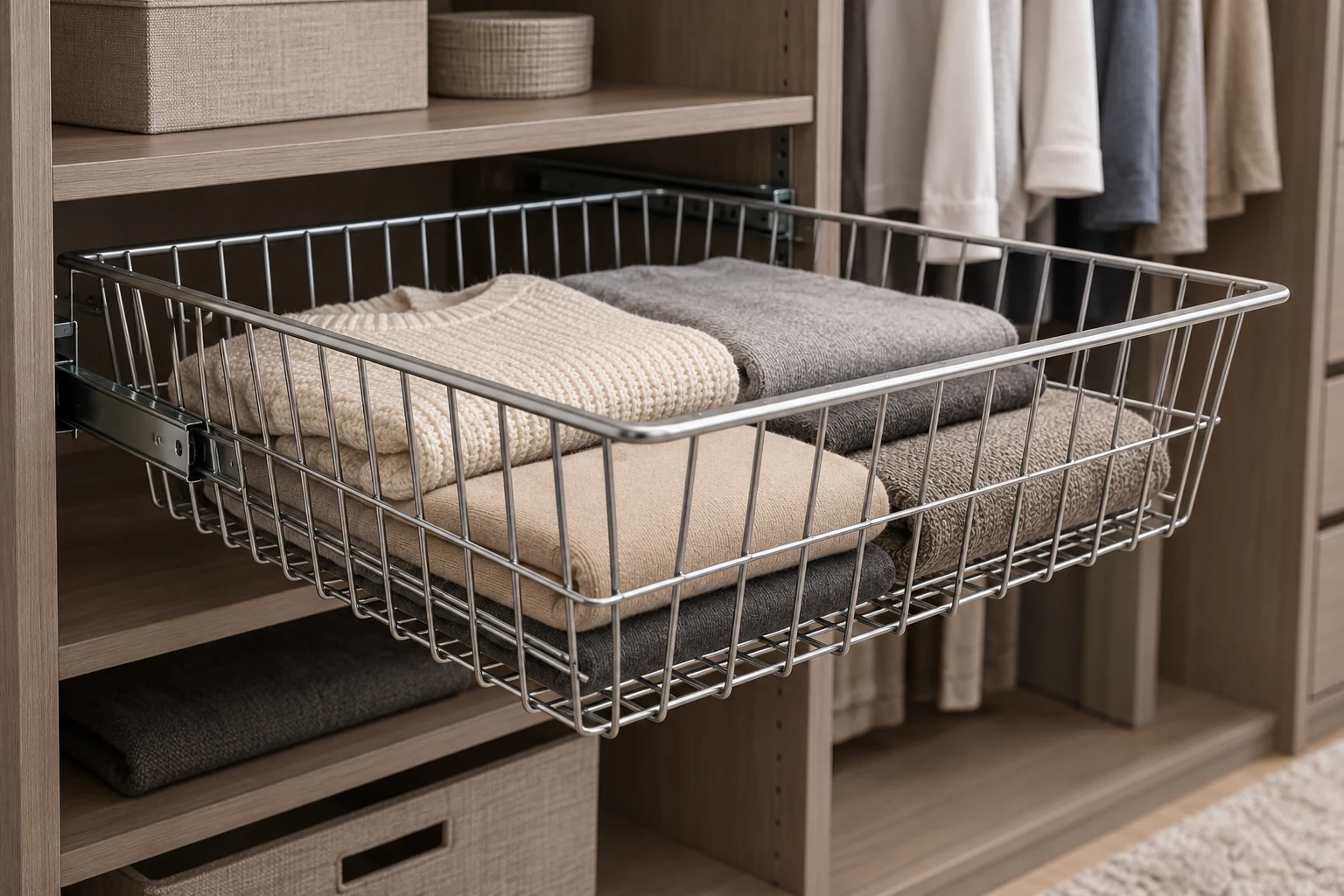
Buyer specification guide | Wire closet baskets
بالنسبة لـ wire basket inside dimensions tapered sides, an outside rim measurement rarely answers whether a liner, folded goods or rigid insert will fit. The buyer needs separate measurements for the closet frame, slide envelope, basket outside maximum and usable inside cavity at a stated height. If the basket narrows below its rim, identify the narrowest section and verify the intended object on an approved sample. “Fits a 24-inch frame” can describe a product family, but it is not the same as a verified inside width.
Why do outside basket dimensions hide usable capacity?
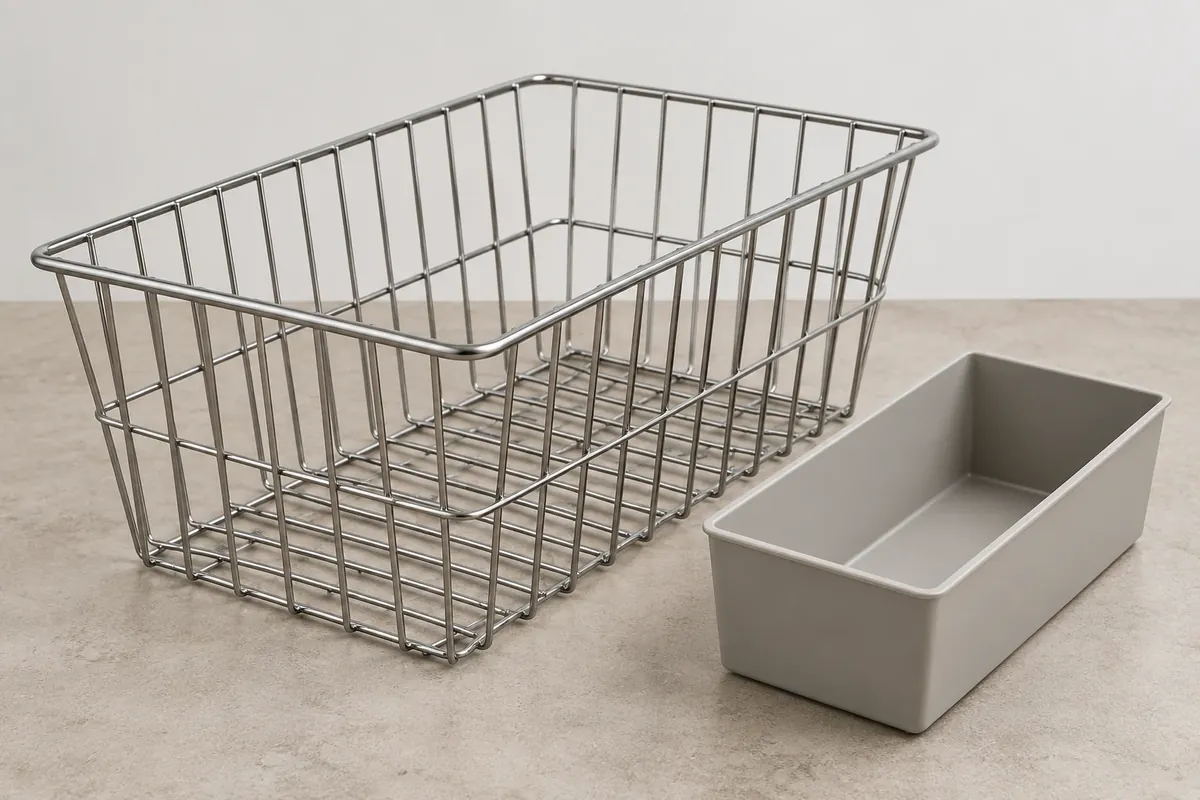
A wire basket’s top rim may be wider than its lower base. The side wires angle inward, or the basket may have a front slope that changes its clear space from front to back. The maximum outside width measured at the rim can therefore overstate the available room lower down. Wire diameter and any finish layer occupy some of the cavity too. A liner with a rigid wall may fit at the opening and bind before reaching its intended position.
A real user asked about the narrowest internal size of a KOMPLEMENT wire basket because its sides curve inward. This is one observed fit question, not a prevalence estimate. Product specifications also use different reference points: Häfele states a basket width measurement at the second horizontal wire from the top, while Organize-It describes its listed dimensions as outside maximum measurements. IKEA’s KOMPLEMENT product page provides model-specific frame context. These are not interchangeable methods; each applies to its own product.
For an importer or private-label buyer, the practical question is: “Which usable inside dimensions does the customer need, and where are they measured?” That question matters for a plastic liner, storage bin, folded clothing, footwear box or other rigid item. The answer should appear on the supplier drawing and sample worksheet, not only in a product title or cabinet compatibility statement.
Keep four dimension groups separate
The closet frame’s nominal size identifies a system or installation opening. The slide envelope describes the mounting or moving interface. The basket’s outside maximum size describes its external footprint. The usable interior describes the space available to contents. A supplier may use “basket width” for any one of these unless the buyer labels the reference plane. Put each on its own line.
The same applies to depth. A basket may taper side to side, front to back, or both. A sloped front edge can reduce the floor length available for a rigid box. Measure inside between the wire surfaces at the location relevant to the contents rather than measuring the basket diagonally or using a maximum rim dimension. If a liner has rounded corners, specify whether its outside radius must clear the basket’s inside corner structure.
How should a tapered basket be measured?
Start from a stable datum on the finished product, such as the top rim or basket floor. State the height above the floor or bottom wire where width is measured. If the width changes, provide at least the top opening, a named intermediate reference and the narrowest usable section. For a sloped front, state whether depth is measured at the rim, floor or a defined side-to-side plane. Include the actual usable clear span after wire and finish.
The drawing should show a front, side and top view. Mark the direction of pull-out, the basket front, the rim, the bottom perimeter and any slide hardware. If the sides curve rather than taper as straight lines, show the profile or enough reference points to communicate where the widest and narrowest sections occur. A single “inside width” without a height reference cannot be repeated consistently by buyer and supplier.
For incoming or sample inspection, use a measuring tool that fits the basket without forcing the wires apart. A rigid gauge can be useful if it represents the actual liner or object. Record whether the gauge is inserted vertically, tilted, or placed at the bottom. A flexible tape laid across the rim may follow a different path than a rigid box’s corners. Do not treat an estimate from a photograph as an acceptance measurement.
| Measurement | Reference to state | What it helps answer |
|---|---|---|
| Frame nominal width | Closet system or installation opening | Which frame or slide family is intended |
| Basket outside maximum | Widest outer point and measurement height | Whether the basket clears surrounding structure |
| Usable inside width | Clear distance between inner wire surfaces at a named height | Whether a liner or rigid contents fit |
| Usable inside depth | Clear front-to-back distance at a named plane | Whether items fit behind a sloped front |
| Bottom clear area | Usable floor width and depth inside the wire boundary | Whether a box or insert can sit flat |
| Slide envelope | Rail width and mounting condition | Whether the assembly fits the cabinet opening |
These entries form a reference framework, not standard dimensions. Buyers and suppliers should agree the actual values and tolerances for each design revision.
Include wire, coating and formed corners
Clearance is measured after the basket is formed and finished. Wire diameter reduces the internal opening compared with an outside-to-outside measurement. Corners, welds, folded ends and coating build can further affect a liner or rigid insert. If an insert is made to sit at the bottom, its corner radius and edge thickness may determine fit even when its nominal width appears smaller than the rim.
A useful drawing distinguishes nominal theoretical dimensions from the measured finished sample. If a coating or plating is specified, inspect whether it changes the contact points or leaves an unwanted sharp edge. Do not assign a universal coating allowance; the supplier should use actual material, process and drawing inputs to establish tolerances. The buyer’s acceptance method should describe the finished product rather than an unfinished wire frame.
Inspect whether the basket can be measured consistently. Flexible wire sides may deflect when pressed. If the basket is suspended on slides during use, support it as intended when measuring. If it is removed for loading, use the same state and rest position for every check. Record the tool, measurement plane and sample condition so another inspector can repeat it.
How should buyers check liner and contents fit?
First identify the object that must fit: a purchased liner, storage box, folded item or retail package. Obtain its actual outside dimensions, including rim, handle, corner radius or protruding edge. Then compare it with the basket’s clear inside profile at several relevant heights. The object should not be forced into the basket or rely on springing the wire outward unless that flexibility is an intended design feature and has been evaluated.
For a soft liner, consider how it rests against the wire and whether it can slip through openings or bunch at a taper. For a rigid insert, check that it can be lowered into the opening and removed without snagging. A liner that only fits when tilted may still be acceptable, but the operation and intended user should be explicit. If the basket is full extension on slides, check the loaded assembly and its access angle as well as a bench-top fit.
Use a production-intent sample and a representative insert. Mark the basket ID and insert version. Place the insert in the intended orientation and at the intended depth. Check that it seats without distorting the basket, that the front remains accessible, and that the basket still closes or retracts normally. A photo can document the setup but should accompany recorded dimensions rather than replace them.
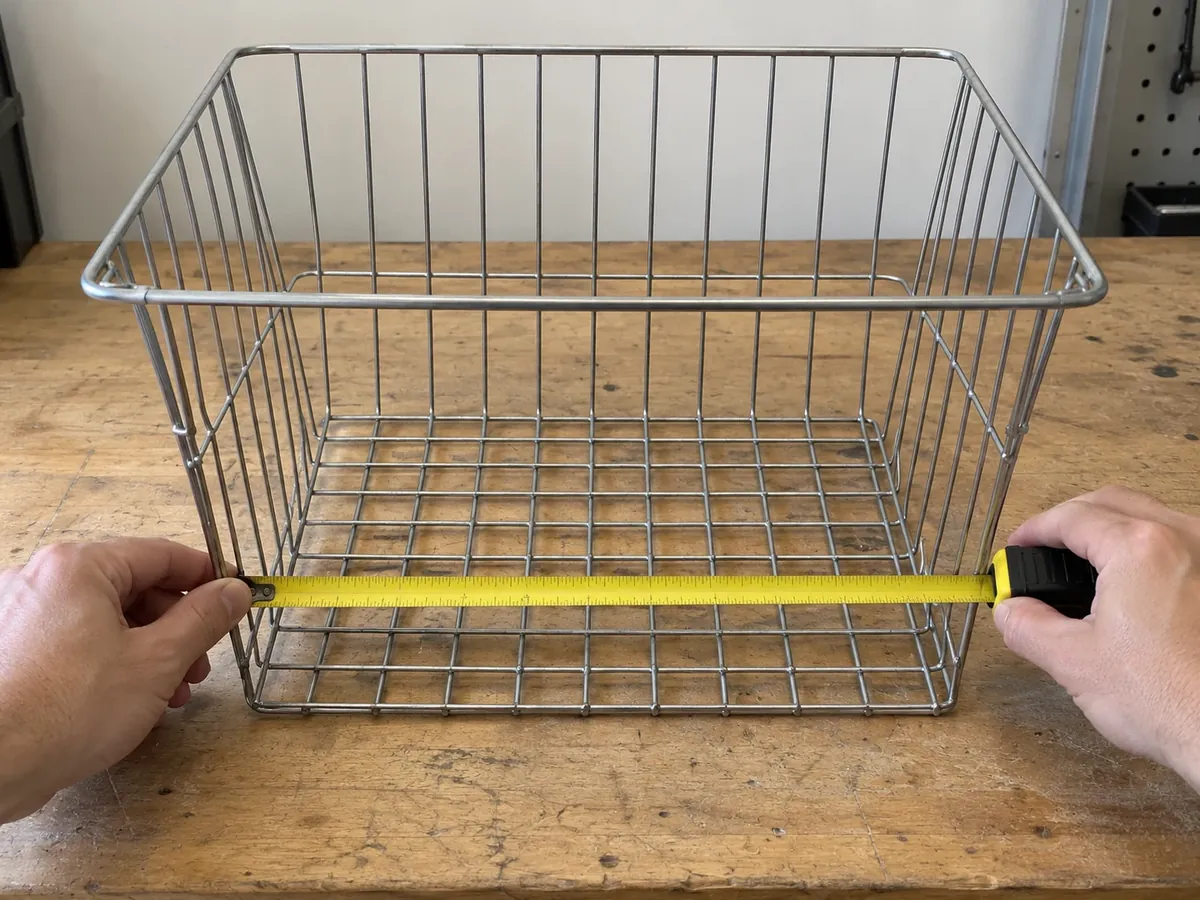
Watch the front slope and slide path
A basket with an angled or lowered front can improve access, but it may reduce usable depth near the opening. A rigid organizer might fit at the back but collide with the sloped edge when inserted. A liner may be cut to the rim outline while sitting lower on the basket floor. Define whether the buyer needs a liner covering the full floor or only a partial insert.
The slide system introduces a second fit interface. A basket can fit inside a closet opening but not mount to the specified slide, or it can mount but collide with a door, frame or adjacent drawer. This is separate from internal capacity. Published K209 content addresses pull-out basket rail width and cabinet installation tolerance; K923 is about the internal cavity of a tapered basket. Do not use the cabinet opening as a proxy for the usable width inside the basket.
If a particular wardrobe system is the target, provide the frame or slide information and verify compatibility on the actual mounting arrangement. The IKEA KOMPLEMENT page is an example of model-specific compatibility context, not a universal dimension reference for other frames. Keep system compatibility claims tied to an identified model and revision.
What belongs in the RFQ and drawing package?
بالنسبة لـ wire basket inside dimensions tapered sides, include the exact buyer use case and measurement datum. State whether the project needs a basket only, a basket with slides, or a basket plus liner. Provide the target cabinet opening, slide specification, required frame system if applicable, contents or liner sample, finish expectation, order context and private-label packaging requirements. If the buyer only knows the nominal frame size, ask the supplier to propose the basket envelope and return a drawing showing the internal clear dimensions.
Ask suppliers to label outside and inside measurements separately. Identify the narrowest internal point, the height at which it occurs, the usable bottom footprint and the front-to-back clear dimension. Show whether the front or sides taper. For an insert fit, include the object’s maximum outside dimensions and the insertion path. Avoid saying “fits basket” without specifying which basket revision and which insert.
كويتور custom metal storage rack manufacturing و OEM home-storage hardware context makes wire geometry, metal interfaces, drawings and sample review relevant discussion areas. This does not assert Koitor currently makes the cited Häfele, IKEA or Organize-It baskets, or that it supplies the same slide hardware. Confirm component responsibility and capability for the actual project.
| RFQ item | Example information to provide | Supplier response to request |
|---|---|---|
| Frame or cabinet | Opening and mounting references | Proposed basket and slide envelope |
| Basket profile | Target rim and bottom outline | Front, side and top drawing views |
| Contents or liner | Outside size, corner and edge detail | Clear inside dimensions at named heights |
| النهاية | Agreed appearance and project specification | Finished sample and controlled dimensions |
| Acceptance | Sample ID and measurement method | Recorded fit result and drawing revision |
Use buyer-specific values on the real drawing. This example simply identifies what the parties should exchange.
How should a sample be approved and changes controlled?
Record the sample number and drawing revision. Measure the rim opening, lower inside width, bottom clear area and depth at the named reference points. Compare those values with the actual liner or rigid item. Check that the insert can be placed and removed through the intended opening without forcing wires or damaging the finish. If the basket mounts to slides, repeat the check in its installed position and confirm normal movement.
Photograph the basket with the measuring tool at each reference plane. Retain the measurements, sample setup and result with the quote. If the product uses a tolerance, state how it is applied and who measures it; do not invent an allowable value from a product page. A sample that barely accepts an insert may require a design review, but the right correction could involve taper, wire spacing, liner outline or basket depth. Do not assume the rim must simply be made larger.
Changes that can affect usable capacity include basket taper, wire diameter, bottom frame, coating, front slope, slide position and corner construction. If any change could interfere with contents or liner fit, compare the new revision against the approved reference points. A new outside width can leave the lower cavity unchanged, and a small wire change can matter to a close-fitting rigid insert. Ask the supplier to identify changes rather than relying on the same product name.
Checklist before production release
Treat wire basket inside dimensions tapered sides as a measurement question with a named reference plane, not a catalog label alone.
- Separate frame opening, slide envelope, outside basket and usable inside dimensions.
- Mark measurement height and direction on a drawing with front, side and top views.
- Record the narrowest clear section and the bottom usable footprint.
- Include front slope, wire thickness, corner shape and finished surface.
- Identify the exact liner or rigid contents and their maximum outside dimensions.
- Check the insertion path and access in the installed basket position.
- Verify on a production-intent sample with the same finish and slide hardware.
- Retain sample ID, drawing revision, measurements, photos and approval decision.
- Define what changes trigger another fit review.
- Keep compatibility claims tied to the specific closet or slide system verified.
This process gives buyers a repeatable capacity discussion and helps suppliers quote the actual product. It does not create a universal taper allowance or prove a basket fits every wardrobe system.
الأسئلة الشائعة
Is a basket’s listed width the same as usable inside width?
Not necessarily. A listing may use an outside maximum dimension or a particular wire reference. Ask for the measurement method and clear inside width at the height your contents require.
Why measure the basket below the top rim?
Tapered sides can make the lower cavity narrower than the opening. The rim measurement may not predict whether a rigid insert fits at its final resting position.
Should the supplier measure before or after coating?
The buyer’s fit acceptance should apply to the finished product. The drawing and inspection plan may include process-stage controls, but the final liner or contents fit must be checked on the finished sample.
Can a cabinet frame size confirm liner fit?
No. Frame and slide dimensions concern installation, while liner fit depends on the basket’s internal shape and measurement height. Verify both interfaces separately.
What should a buyer send with a basket RFQ?
Provide the cabinet opening or frame system, slide requirement, intended liner or contents, target usable inside dimensions, finish, sample method and packaging context. If measurements are not yet defined, ask for a supplier drawing proposal first.
Developing a Custom Metal Wire Basket?
Send Koitor your basket drawing or sample, cabinet or slide context, liner or contents dimensions, finish, packaging needs and order quantity. The factory team can discuss metal structure and practical small-batch OEM development options. Final internal fit should be confirmed on your approved finished sample.
OEM / العلامة التجارية الخاصة
حوّل دليل التوريد هذا إلى موجز منتج
يرجى إطلاعنا على المنتج المستهدف، والحجم، والتشطيب، وكمية الطلب، ومتطلبات التغليف. وسيتلقى فريقك تقييمًا عمليًّا لإمكانية التصنيع قبل تقديم عرض الأسعار.
 English
 Español
 Português
 Français
 Deutsch
 العربية